HomeBlogSmart Health Kiosk: Transforming Preventive Healthcare with Digital Health Screening
Deep Dive24 September 202611 min read
Smart Health Kiosk: Transforming Preventive Healthcare with Digital Health Screening
A smart health kiosk brings multiple screening capabilities into one connected station, moving preventive care into the places people already are.
CCClinics On Cloud TeamPublished from Pune, India
Health ATM
Healthcare is changing rapidly. As healthcare providers, organizations, pharmacies, workplaces, and communities look for ways to make preventive care more accessible, technology is helping move basic health screening beyond traditional clinical settings.
One of the technologies supporting this shift is the smart health kiosk.
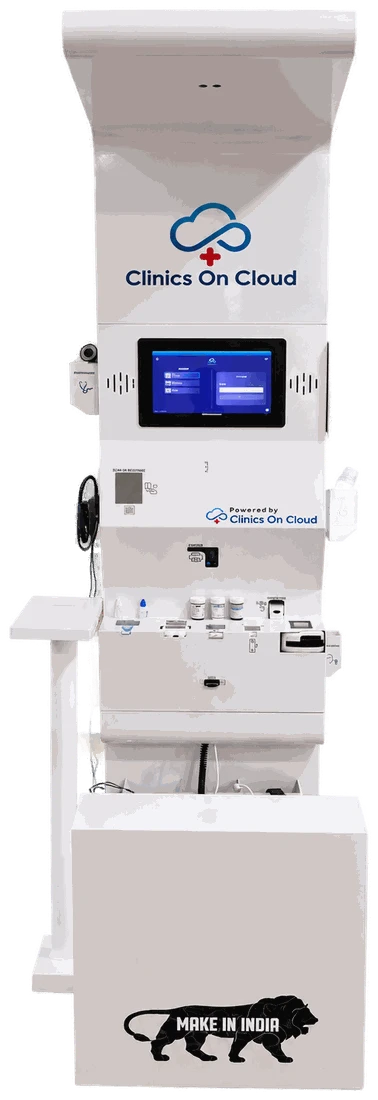
A smart health kiosk is a technology-enabled healthcare station that can bring multiple health screening capabilities into a single, accessible setup. Depending on its configuration, a health kiosk can capture vital health parameters, perform screening tests, collect patient information, and generate digital health reports.
For organizations looking to expand access to preventive healthcare, smart health kiosks can provide a practical way to introduce health screening into locations such as hospitals, clinics, pharmacies, workplaces, residential communities, educational institutions, public facilities, and underserved areas.
Clinics On Cloud develops digital healthcare solutions designed to bring technology-enabled screening and healthcare access closer to people.
What Is a Smart Health Kiosk?
A smart health kiosk is a digitally enabled healthcare station that combines multiple health screening and patient-assessment technologies in one system.
Unlike a conventional health-check station that may measure only one or two parameters, a multifunctional smart health kiosk can integrate several screening capabilities into a single workflow.
Depending on the model and configuration, a health kiosk may support assessments such as:
The key idea is simple: multiple healthcare screening functions can be brought together through one digitally connected platform.
How Does a Smart Health Kiosk Work?
A smart health kiosk typically combines medical or screening devices, software, connectivity, and digital reporting.
A typical workflow can look like this:
1. Patient registration. The user enters or verifies basic information through the kiosk interface. This creates a digital profile for the screening session.
2. Health screening. The user follows on-screen instructions to complete the available tests. Depending on the kiosk configuration, this may include measurements such as blood pressure, SpO₂, blood glucose, body composition, vision, pulmonary function, or other screening parameters.
3. Data collection. The kiosk captures the measurements digitally rather than relying entirely on handwritten records.
4. Digital analysis. The collected information can be processed through the kiosk's healthcare software to organize the screening results. Where supported, AI-enabled software can assist with data interpretation and risk-oriented insights.
5. Digital health report. The results can be compiled into a digital health report that can be reviewed by the user, healthcare professional, or authorized organization.
6. Follow-up. The screening result can help determine whether the individual should seek further medical evaluation.
A smart health kiosk is therefore not simply a machine that measures health parameters. It is a connected digital workflow for health screening and preventive care. Where a live consultation is needed, the same workflow can extend into a telemedicine kiosk setup.
What Can a Smart Health Kiosk Measure?
The capabilities of a health kiosk depend on the specific configuration.
A comprehensive smart health kiosk can integrate multiple screening categories, including:
Screening Category
Examples
Vital Signs
Blood pressure, pulse, SpO₂, temperature
Diabetes Screening
Blood glucose and related measurements
Body Composition
BMI, body fat and other composition parameters
Vision
Basic vision screening
Pulmonary Function
Respiratory and lung-function assessment
Cardiac Screening
Selected cardiovascular screening parameters
Hearing & Voice
Hearing and voice-related assessments
Dermatology
Skin-related assessment
Lipid Profile
Selected lipid measurements
Renal & Kidney
Selected kidney-related screening
Oral Health
Oral health and screening assessments
Mental Health
Digital mental-health questionnaires or assessments
The purpose of these screenings is generally early identification of potential health risks, not replacement of a complete clinical diagnosis.
Traditional healthcare remains essential, particularly when a person requires diagnosis, treatment, specialist consultation, or emergency care.
The role of a smart health kiosk is different. It can help create an additional layer of accessible preventive screening.
For example, instead of waiting until a person visits a hospital because of symptoms, organizations can introduce regular screening at locations where people already spend time. This can include:
Corporate offices
Pharmacies
Hospitals
Clinics
Housing societies
Schools and colleges
Factories
Airports and transport hubs
Community centers
Rural healthcare facilities
Public health programs
This model can make basic screening more convenient and can support a more proactive approach to healthcare. Our use cases page sets out how these deployment settings differ in practice.
Why Are Smart Health Kiosks Important for Preventive Healthcare?
Healthcare systems around the world are increasingly focused not only on treating disease but also on prevention and early identification of health risks.
A major challenge is accessibility. People may postpone health checkups because of:
Lack of time
Distance from healthcare facilities
Cost concerns
Limited availability of screening services
Lack of awareness
Inconvenience associated with traditional appointments
A health kiosk can help address some of these access barriers by bringing selected screening capabilities into more convenient locations.
Easier access to screening. People can access basic health screening without necessarily beginning their healthcare journey inside a hospital.
Faster data collection. Digital measurements can reduce dependence on manual data entry.
Centralized screening. Multiple screening capabilities can be brought together within one healthcare station.
Digital records. Health information can be captured and organized digitally, depending on the system configuration.
Preventive healthcare. Regular screening can help individuals become more aware of potential health risks and encourage appropriate follow-up.
Pharmacies are increasingly becoming important touchpoints within the healthcare ecosystem.
A smart health kiosk in a pharmacy can transform the pharmacy from a medicine-access point into an additional location for preventive health screening. We have explored this shift in more detail in from pharmacy to micro-clinic.
For example, a person visiting a pharmacy could potentially use a health kiosk to check selected health parameters and receive a digital screening report.
This creates a broader healthcare journey:
“
Screen → Understand → Consult → Follow Up
For pharmacies, this can also create opportunities to offer additional health services while improving the overall customer experience.
Smart Health Kiosks for Corporate Wellness
Workplaces are another important application for smart health kiosks.
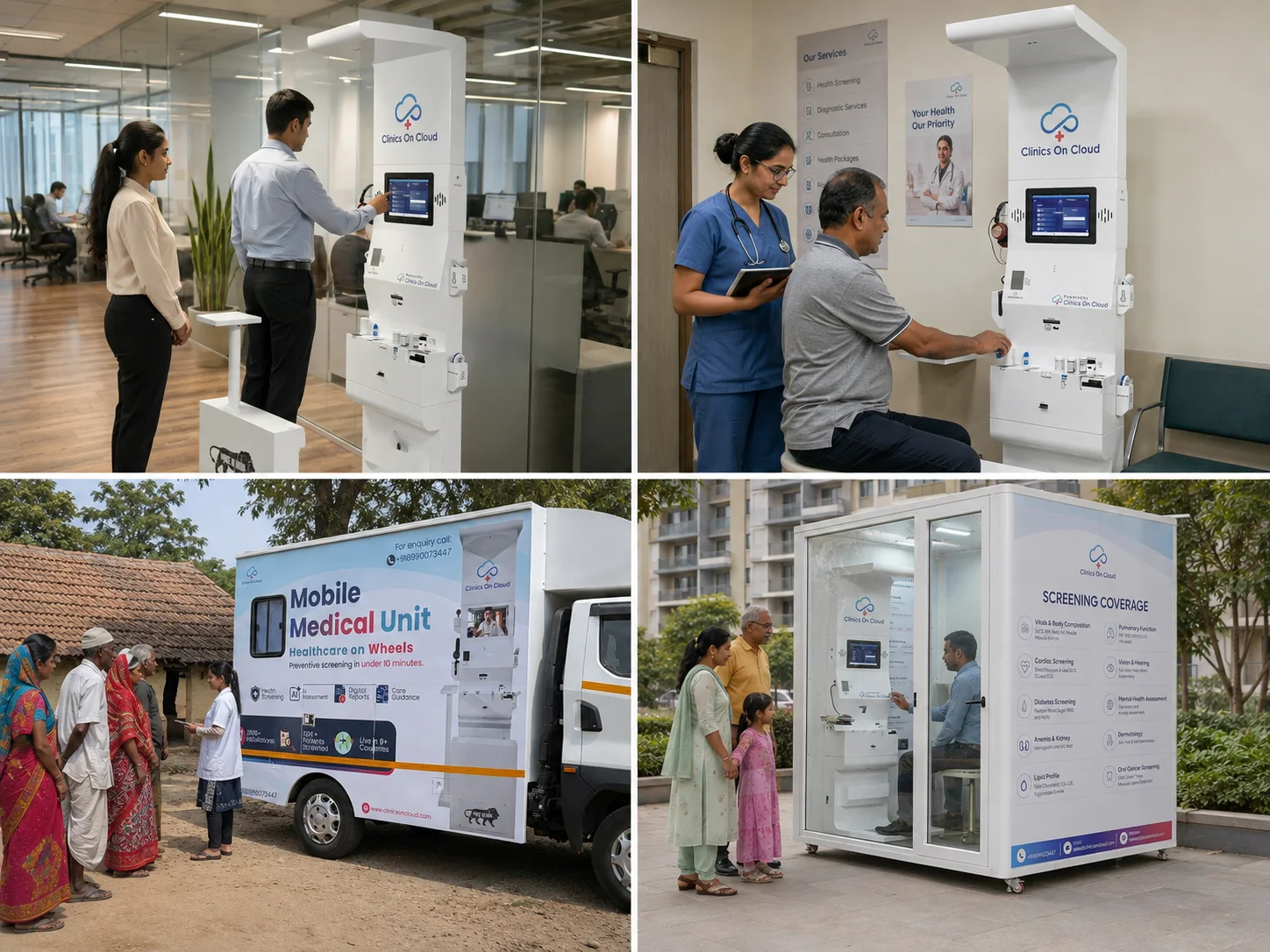
Organizations can deploy health kiosks within offices, factories, campuses, or employee wellness centers to make routine screening more accessible to employees. Where the setting calls for something more considered than a walk-up unit, a Health Lounge provides a self-contained wellness zone.
A workplace health kiosk can support programs around:
Smart Health Kiosks for Rural and Community Healthcare
Access to healthcare can be challenging in locations where hospitals, diagnostic centers, and specialists are limited.
A digitally connected health kiosk can become one component of a broader community healthcare infrastructure. Depending on the deployment model, a kiosk can enable basic screening at locations closer to communities. Where a fixed installation is not practical, a portable Box Clinic or a Mobile Medical Unit can carry the same screening to the doorstep.
This can be particularly relevant for:
Rural communities
Remote areas
Community health centers
Village-level healthcare initiatives
Public health programs
NGO-led healthcare initiatives
Industrial and semi-urban communities
However, kiosks should complement, not replace, qualified healthcare professionals and appropriate referral pathways. Our field notes on improving rural healthcare look at how this works on the ground.
AI and Smart Healthcare Kiosks
The next evolution of health kiosks is increasingly connected with AI and digital health software.
AI can potentially help organize health information, identify patterns, generate risk-oriented insights, and support healthcare workflows. We have written separately about AI-powered healthcare pods and care pods.
However, it is important to distinguish between screening and diagnosis.
A smart health kiosk can help identify parameters or patterns that may warrant further medical attention, but clinical diagnosis and treatment decisions should remain within appropriate professional and regulatory frameworks.
This distinction is particularly important when deploying AI-enabled healthcare technologies.
What Is the Difference Between a Health Kiosk and a Health ATM?
The terms health kiosk, health ATM, digital health kiosk, and smart health kiosk are sometimes used interchangeably. However, their capabilities can vary significantly.
A basic health kiosk may provide a limited number of measurements. A more advanced smart health kiosk can integrate multiple screening devices, digital reporting, connectivity, software workflows, and potentially AI-enabled capabilities. The distinction is unpacked further in our piece on the smart eHealth kiosk and eHealth ATM, and in the health kiosk and Health ATM FAQ hub.
Therefore, when evaluating a health kiosk, organizations should look beyond the name and examine:
What parameters can it measure?
What screening technologies are integrated?
How accurate are the measurements?
How is patient data stored?
Is the system connected to a healthcare platform?
Can reports be generated digitally?
Can healthcare professionals access the results?
What support and maintenance are provided?
What compliance and data-security measures are implemented?
How to Choose a Smart Health Kiosk
Organizations considering a smart health kiosk should evaluate the technology based on their specific healthcare use case.
Screening capabilities. Understand exactly which health parameters and tests the kiosk supports.
Accuracy and validation. Healthcare screening devices should be evaluated for appropriate accuracy, validation, calibration, and regulatory requirements.
Software integration. The kiosk should work as part of a broader digital healthcare ecosystem rather than operating as an isolated machine.
Digital reporting. Look for clear, understandable digital reports that can support appropriate follow-up.
Data security. Patient health information is sensitive. Organizations should evaluate how data is collected, stored, transmitted, accessed, and protected.
Scalability. A suitable kiosk solution should be capable of supporting the organization's current requirements while allowing future expansion.
Service and maintenance. Healthcare technology requires reliable installation, maintenance, calibration, technical support, and service infrastructure.
The future of healthcare is increasingly moving toward connected, preventive, accessible, and data-driven care.
Smart health kiosks can become part of this transformation by bringing selected healthcare screening capabilities closer to people.
The opportunity is not simply about installing a machine. It is about building a connected healthcare ecosystem where:
People can screen earlier.
Healthcare providers can access better data.
Organizations can support preventive wellness.
Communities can access healthcare closer to where they live and work.
As digital healthcare continues to evolve, smart health kiosks can become an important bridge between technology and accessible preventive care, a direction we explore further in the future of full-body health checkups.
Smart Health Kiosk by Clinics On Cloud
Clinics On Cloud is a health technology company focused on making healthcare more accessible through digital healthcare solutions.
Its smart health kiosk ecosystem is designed to bring multiple health screening capabilities into a connected healthcare platform. The full specification is on the Health Kiosk product page.
The solution can support screening across areas such as vision and body composition, pulmonary function, cardiac screening, voice and hearing, diabetes, mental health, renal and kidney health, dermatology, lipid profile, and oral health, depending on the configuration and deployment.
The broader objective is to make healthcare screening more accessible across different environments, including hospitals, pharmacies, workplaces, communities, institutions, and other high-footfall locations. You can see where our deployments are today.
A smart health kiosk can be more than a standalone device. With the right technology, infrastructure, and healthcare ecosystem behind it, it can become a connected point of care for preventive health screening.
Quick answer: In rural India, women are usually the last in the family to get a health check-up and the first to notice when someone else is unwell. Health ATMs change that equation by bringing 60+ diagnostic tests, an instant AI health report and a doctor teleconsultation into the village itself — in under 10 minutes, in the local language, without a day's travel or wage loss. At the first Clinics on Cloud roadshow in Satara, over 1,000 people turned up, and women led the queue, the questions and the follow-up.
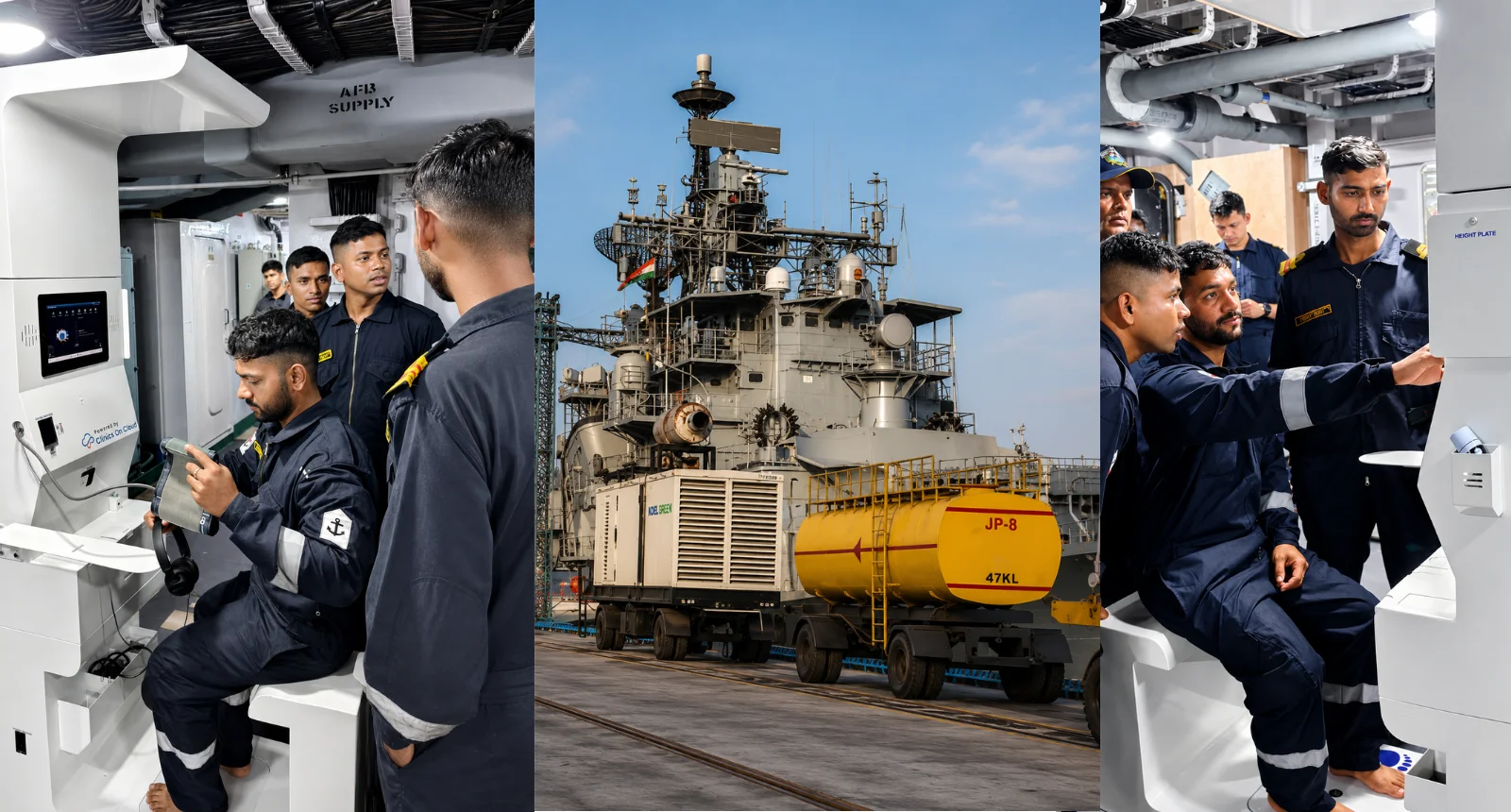
Discover how Clinics On Cloud Health Kiosks are enabling preventive screening, digital health records, telemedicine and connected healthcare for Indian Navy personnel serving at sea.
Looking for the best Health ATM in India? Discover how to choose the best Health ATM manufacturer in India and explore Health ATM, health kiosk, telemedicine and preventive healthcare solutions from Clinics On Cloud.
A smart health kiosk is a digitally enabled healthcare station that combines several health screening and patient-assessment technologies in one system. Depending on its configuration it can capture vital parameters, run screening tests, collect patient information and generate a digital health report.
What is the difference between a health kiosk and a health ATM?
The terms are often used interchangeably, but capability varies. A basic health kiosk may offer a limited number of measurements, while a more advanced smart health kiosk can integrate multiple screening devices, digital reporting, connectivity, software workflows and AI-enabled capabilities. Evaluate the specification rather than the name.
What can a smart health kiosk measure?
It depends on the configuration. Categories can include vital signs, diabetes screening, body composition, vision, pulmonary function, cardiac screening, hearing and voice, dermatology, lipid profile, renal screening, oral health and mental health assessment.
Can a smart health kiosk diagnose illness?
No. A smart health kiosk is a screening tool. It can help identify parameters or patterns that may warrant further medical attention, but clinical diagnosis and treatment decisions should remain with qualified healthcare professionals within the appropriate regulatory framework.
Where can a smart health kiosk be installed?
Common settings include hospitals, clinics, pharmacies, corporate offices, factories, housing societies, schools and colleges, airports and transport hubs, community centres, rural healthcare facilities and public health programmes.
What should organizations check before buying a smart health kiosk?
Screening capabilities, accuracy and validation, software integration, digital reporting, data security, scalability, and the service and maintenance arrangements behind the machine.
Get In Touch
Healthcare is a right. Not a privilege.
We started Clinics on Cloud with a simple belief - that the quality of your healthcare should not depend on your postcode. Whether you're a government, corporate, NGO or entrepreneur - we built this for you.
Call us
+91 8999 073 447
Mon - Sat · 9 AM to 6 PM IST
Write to us
sales@clinicsoncloud.com
Partnerships · Deployments · Support
Visit us online
www.clinicsoncloud.com
Products · Case Studies · News
Find us
Nighoje, Chakan MIDC
Pune, Maharashtra - 410501, India
Built for every kind of health partner.
Government Body Corporate / HR Team NGO / CSR Partner Hospital or Clinic Defence Organisation International Partner Investor / Distributor Rural Entrepreneur
 Entry · HA-83Health ATM