 Entry · PC-31Preventive Care
Full Body Health Checkup Machine
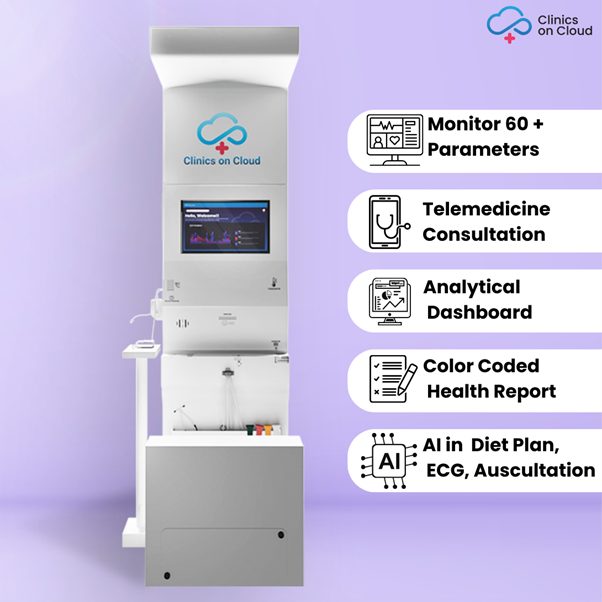
This in-depth guide explores everything you need to know about full body checkup machines, spotlighting why Clinics On Cloud deserves
Read story 10 min
Introduction
An ECG records the heart’s electrical activity, a blood pressure reading measures the force of blood against the artery walls, and a lipid profile measures the fats circulating in the blood. The Clinics On Cloud Health Kiosk screens all three as part of a 9-parameter cardiac module inside a 10-minute, 65+ parameter checkup.
Each test looks at a different thing, and none substitutes for the others. An ECG looks at the heart’s electrical conduction. Blood pressure looks at the mechanical load the circulation works against. A lipid profile looks at the biochemical risk carried in the blood over time. A person can have a clean ECG, a normal blood pressure reading and a lipid profile that warrants attention, or any other combination. Cardiovascular risk is usually silent until it is not, and screening exists to shorten that silence.
Clinics On Cloud is India’s first CDSCO-licensed Health ATM and Health Kiosk manufacturer, operating from Nighoje, Chakan MIDC, Pune, under SehatPro Technologies Pvt Ltd. The cardiac module sits inside the complete 65+ clinical parameter map.
| Parameter | What it measures | How it is captured |
|---|---|---|
| ECG (6-lead or 12-lead) | Electrical activity of the heart, as a waveform | Electrodes on the limbs and, for 12-lead, the chest |
| Blood pressure | Systolic and diastolic pressure in the arteries | Oscillometric cuff on the upper arm |
| Total cholesterol | All cholesterol carried in the blood | Finger-prick blood, point-of-care analyser |
| Triglycerides | Fats circulating in the blood | Finger-prick blood, point-of-care analyser |
| HDL cholesterol | High-density lipoprotein fraction | Finger-prick blood, point-of-care analyser |
| LDL cholesterol | Low-density lipoprotein fraction | Calculated or measured from the panel |
| TC:HDL ratio | Total cholesterol relative to HDL | Calculated |
| Non-HDL cholesterol | Total cholesterol minus the HDL fraction | Calculated |
The Clinics On Cloud specification counts the cardiac specialty as 9 parameters, with the lipid panel contributing six of them. This is worth knowing when you compare vendor parameter counts, because a single finger-prick lipid panel is sometimes quoted as one parameter and sometimes as six.
An ECG, or electrocardiogram, records the electrical signals that make the heart contract. Every heartbeat begins as an electrical impulse, and electrodes on the skin pick it up as it travels through the heart muscle. The output is a waveform trace rather than a number, and clinicians read its shape, timing and regularity to assess rhythm and conduction. On the Clinics On Cloud Health Kiosk the trace is printed on the report and stored in the digital health record.
An ECG at a kiosk is a screening tool. It captures the heart’s electrical behaviour only during the seconds it is running, so intermittent rhythm problems will not appear and a normal kiosk ECG is not a clearance. Where a trace is flagged, the kiosk offers a live teleconsultation so a doctor can look at it immediately.
A “lead” in ECG terminology is not a wire. It is a view of the heart’s electrical activity from a particular angle, derived from the electrodes on the body.
| 6-lead ECG | 12-lead ECG | |
|---|---|---|
| Views of the heart | 6 | 12 |
| Electrode placement | Limb electrodes only | Limb electrodes plus six chest electrodes |
| What it is generally used for | Rhythm and rate level screening | The standard clinical recording used in hospitals |
| Time to record | Shorter, simpler placement | Longer, requires correct chest electrode positioning |
| Typical screening context | High-throughput walk-in screening | Clinical settings and screening where full views are required |
| Operator requirement | Minimal | Correct chest lead placement matters |
The trade-off is coverage against throughput. A 12-lead recording provides more views and is the format clinicians expect; a 6-lead recording is faster and easier to place correctly in a self-service setting, which matters when several hundred people cross a plant gate in a day. Clinics On Cloud supplies either configuration, chosen at order time. The deployment side of that decision is covered in how organisations run cardiac screening programmes at scale.
Blood pressure is the force circulating blood exerts against the artery walls, reported as two numbers: systolic, the peak during a heartbeat, and diastolic, the pressure between beats. The Health Kiosk measures it with an oscillometric cuff on the upper arm, and the reading appears on the report alongside pulse.
What it tells you. What the pressure was, in that arm, at that moment, in those conditions. That is genuinely useful, because most people with raised blood pressure have no symptoms and would otherwise never find out.
What it does not tell you. Whether you have hypertension. That is a clinical diagnosis based on repeated readings under controlled conditions, sometimes supported by home or ambulatory monitoring, interpreted alongside your history. A single kiosk reading cannot do it, and ordinary things move one reading: rushing to the kiosk, a full bladder, caffeine, talking during the measurement, cuff size, arm position, cold and simple anxiety. The correct response to one high screening reading is to repeat it and speak to a doctor.
The categories used to describe blood pressure readings are defined by standard clinical guidance from bodies including WHO, with Indian practice drawing on ICMR and National Health Mission non-communicable disease guidance. Those definitions differ between guidelines and have changed over time. Clinics On Cloud does not set them, and this page deliberately does not print them, because a number read against a chart without clinical context misleads more often than it helps. Take the report to a qualified physician.
A lipid profile is a blood test measuring the fats circulating in your blood. It is the standard screening panel for cardiovascular risk, and on the Clinics On Cloud Health Kiosk it runs from the same finger-prick sample used for the diabetes and anaemia modules. Here is what each fraction is.
Fasting. Kiosk lipid panels are normally run without fasting, which is what makes walk-in screening possible; non-fasting samples affect triglycerides most. If your physician has asked for a fasting laboratory lipid profile, follow that instruction.
What the numbers mean for you depends on age, sex, family history, blood pressure, glycaemic status, smoking and existing conditions. Cardiovascular risk is assessed as a combination, not one fraction at a time, and that assessment belongs to a qualified physician.
Screening is not for emergencies. Chest pain, pain radiating to the arm or jaw, sudden breathlessness, fainting or palpitations with dizziness require emergency care immediately.
A Clinics On Cloud report is colour-coded into three bands: within standard reference ranges, borderline, and outside range. Read the colour as a routing instruction, not a conclusion.
Reference ranges and risk thresholds for these parameters follow standard clinical guidance from bodies including WHO and ICMR, vary with age, sex, pregnancy, medication and existing conditions, and are not set by Clinics On Cloud. Interpretation belongs with a qualified physician.
Device accuracy is 90–95%, depending on the specific test and device, under correct usage, calibration and patient preparation. That is screening grade: it identifies who needs a doctor, and it does not replace an accredited laboratory lipid panel, a clinical ECG interpretation or a formal hypertension assessment. Across the Clinics On Cloud network, 2 lakh+ abnormalities have been identified and routed for early intervention from 12M+ patients screened at 3,500+ installations in 200+ cities.
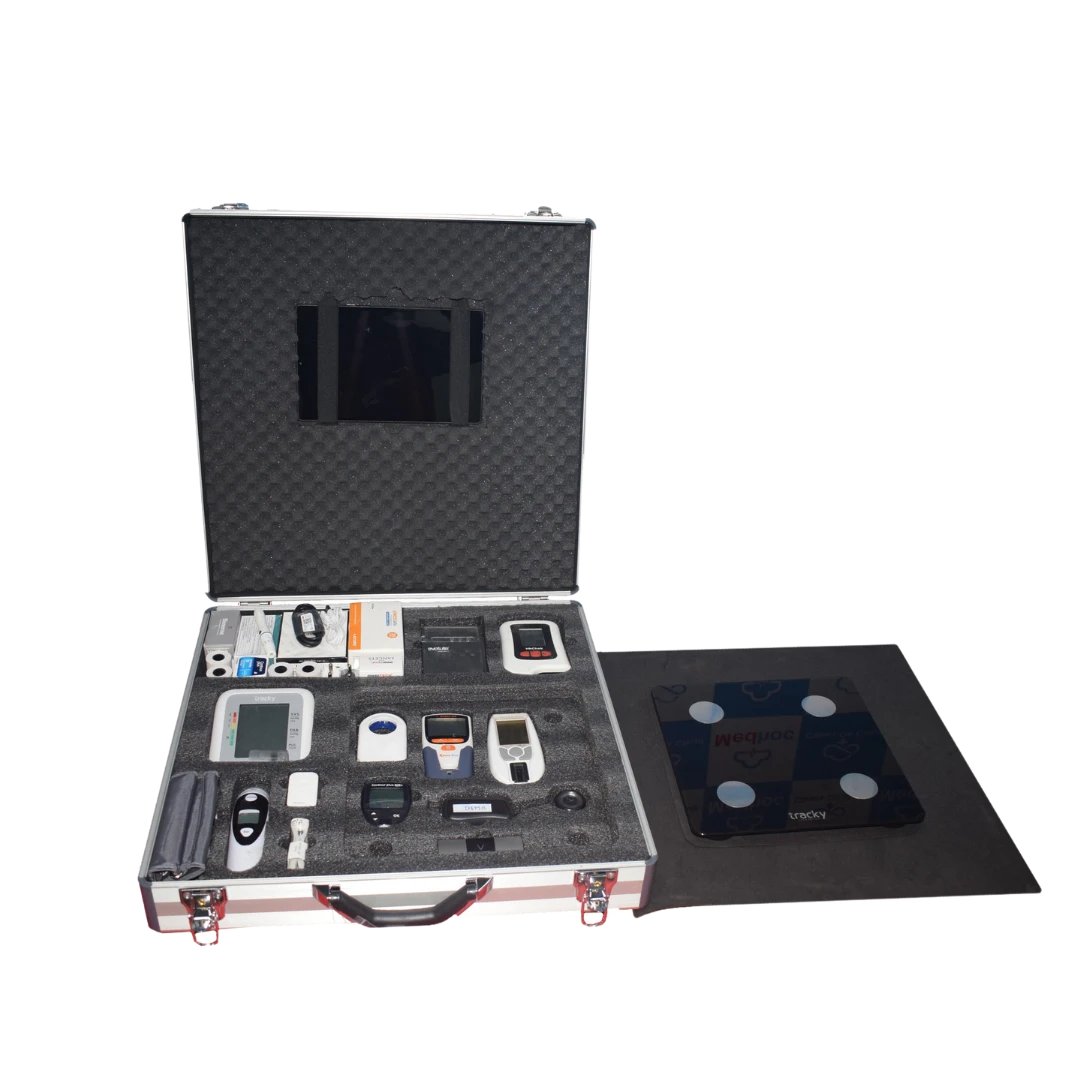
The cardiac block runs inside a 10-minute full checkup, and a colour-coded report with the ECG trace prints and is sent by SMS, email and WhatsApp. For fixed sites use the Clinics On Cloud Health Kiosk; for community and worksite screening, the Mobile Medical Unit for doorstep screening carries the same module.
If you are specifying a cardiac screening module for a hospital OPD, a plant gate, a corporate campus or a CSR camp cycle, talk to our team about lead count, analyser choice and consumable planning. Call +91 8999 073 447, Monday to Saturday, 9:00 to 18:00 IST, or email sales@clinicsoncloud.com. Background reading: what a Health ATM is.
Clinics On Cloud provides preventive health screening and is not a diagnostic laboratory. Screening results are indicative and are not a diagnosis. Always consult a qualified physician before acting on any health information.
Your email is never published. Comments appear after a quick review.
Entry · PC-31Preventive CareThis in-depth guide explores everything you need to know about full body checkup machines, spotlighting why Clinics On Cloud deserves
 Entry · PC-04Preventive Care
How to Make Your CSR Initiative Stand Out and Deliver Real Impact In today’s socially aware and hyper-connected world, CSR
 Entry · PC-72Preventive Care
Clinics on Cloud – Your Trusted Full Body Checkup Machine Provider Looking for a reliable and accurate full body checkup
An ECG, or electrocardiogram, records the electrical activity driving each heartbeat and displays it as a waveform trace, used to assess rhythm and conduction. On a Clinics On Cloud Health Kiosk the recording takes a couple of minutes and the trace is printed on the report and stored in the digital health record for a clinician to review.
A lead is a view of the heart’s electrical activity, not a wire. A 6-lead ECG produces six views using limb electrodes only. A 12-lead ECG adds six chest electrodes for twelve views and is the standard clinical recording used in hospitals. Clinics On Cloud supplies either configuration, chosen at order time.
No. A kiosk ECG is a screening recording, not an emergency diagnostic. It captures electrical activity only during the seconds it is running and is read as a flag for clinical review. Anyone with chest pain, breathlessness or pain radiating to the arm or jaw needs emergency care immediately.
A lipid profile measures the fats circulating in the blood: total cholesterol, triglycerides, HDL, LDL, the TC:HDL ratio and non-HDL cholesterol. On a Clinics On Cloud Health Kiosk it runs from a single finger-prick sample using a point-of-care analyser, with results included in the printed screening report.
Point-of-care lipid screening is normally run without fasting, which is what makes walk-in screening practical. Non-fasting samples affect the triglyceride fraction most. If a physician has asked for a fasting laboratory lipid profile, follow that instruction, because a screening result does not replace an accredited laboratory panel.
HDL, high-density lipoprotein, carries cholesterol away from the tissues back to the liver and is described as the protective fraction. LDL carries cholesterol to the tissues and in excess contributes over time to arterial narrowing. What the balance means for you is a question for a qualified physician.
Indicative pricing for a Clinics On Cloud Health ATM starts from ₹6,00,000. The cardiac module affects the figure through the ECG lead count and the analyser fitted, and lipid strips are a recurring consumable quoted separately. Request a configured quote with your expected monthly screening volume.
A Clinics On Cloud screening report and ECG trace are intended to raise awareness and prompt appropriate medical follow-up, and are supplied in printed and digital form to carry to a consultation. They are indicative screening outputs, not a diagnosis, and a clinician will confirm findings with their own assessment.
We started Clinics on Cloud with a simple belief - that the quality of your healthcare should not depend on your postcode. Whether you're a government, corporate, NGO or entrepreneur - we built this for you.
+91 8999 073 447
Mon - Sat · 9 AM to 6 PM IST
sales@clinicsoncloud.com
Partnerships · Deployments · Support
www.clinicsoncloud.com
Products · Case Studies · News
Nighoje, Chakan MIDC
Pune, Maharashtra - 410501, India