What Is Health Kiosk and How It Works | Smart Healthcare 2025
In today’s fast-paced world, healthcare is evolving rapidly — becoming smarter, more digital, and more accessible. One of the most
Read story 4 min
Introduction
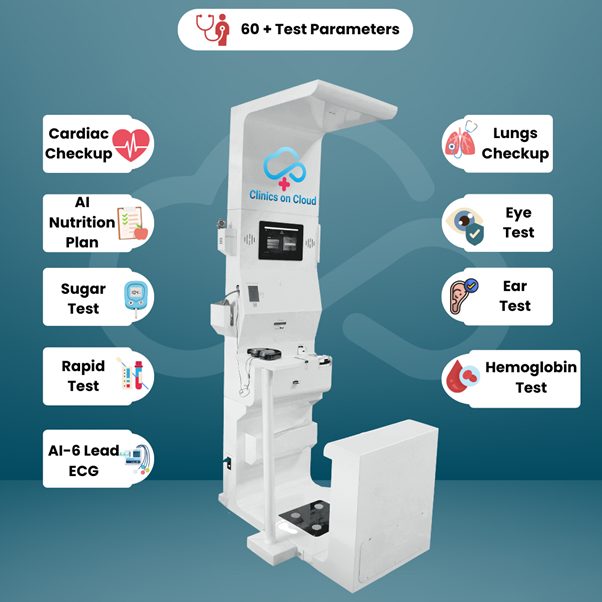
General health tests are the non-invasive baseline measurements a screening kiosk takes without a blood sample: oxygen saturation, pulse, temperature, height, weight and a full body composition profile. The Clinics On Cloud Health Kiosk records 19 general health parameters as part of a 65+ parameter screening completed in 10 minutes.
General health tests are the baseline measurements describing how a body is functioning right now, taken without a needle and without a laboratory. They open any screening session because they are quick, painless and universally applicable.
On the Clinics On Cloud Health Kiosk, general health is one of 14 clinical specialties and contains 19 individual parameters. It is the widest single specialty in the menu and the one with the highest completion rate in workplace and residential deployments, precisely because nothing is invasive. Clinics On Cloud manufactures the Health ATM and Health Kiosk in India and is India’s first CDSCO-licensed Health ATM and Health Kiosk manufacturer, operating from Nighoje, Chakan MIDC, Pune. The block sits inside the complete 65+ clinical parameter map.
Height and weight are things people already know about themselves. The other readings are things almost nobody knows without measurement, and that gap is the point of the specialty.
| # | Parameter | What it measures | Method |
|---|---|---|---|
| 1 | SpO2 | Oxygen saturation of the blood | Fingertip pulse oximetry |
| 2 | Pulse | Heart rate in beats per minute | Pulse oximeter sensor |
| 3 | Body temperature | Core body temperature | Contact or infrared sensor |
| 4 | Height | Standing height | Ultrasonic sensor |
| 5 | Weight | Body weight | Calibrated platform scale |
| 6 | BMI | Weight relative to height squared | Calculated |
| 7 | BMR | Energy the body uses at complete rest | Calculated from composition |
| 8 | Body water | Total body water as a share of weight | Bioelectrical impedance |
| 9 | Skeletal mass | Mass of the skeletal system | Bioelectrical impedance |
| 10 | Muscle mass | Total muscle tissue mass | Bioelectrical impedance |
| 11 | Bone mass | Estimated bone mineral mass | Bioelectrical impedance |
| 12 | Protein | Protein as a share of body composition | Bioelectrical impedance |
| 13 | Metabolic age | Metabolic profile expressed as an age | Calculated |
| 14 | Fat-free weight | Body weight excluding fat mass | Calculated |
| 15 | Body fat | Total body fat percentage | Bioelectrical impedance |
| 16 | Subcutaneous fat | Fat stored directly under the skin | Bioelectrical impedance |
| 17 | Visceral fat | Fat stored around the abdominal organs | Bioelectrical impedance |
| 18 | Physique rating | Composite build classification from fat and muscle | Calculated |
The Clinics On Cloud specification counts this specialty as 19 parameters. The named readings above are the ones printed on a standard report; the exact line items on your report depend on the module configuration at your site, so confirm the list with the team when you specify a unit.
Blood pressure is often assumed to be a general health test. On the Clinics On Cloud parameter map it belongs to the cardiac specialty and is covered in ECG, blood pressure and lipid profile explained. It is measured in the same seated cycle, so a user experiences it as part of the same block.
Vital signs describe the body’s immediate operating state. They change hour to hour, which makes them useful for spotting something acute and less useful as a long-term trend.
SpO2 is the percentage of haemoglobin carrying oxygen, read optically at the fingertip by shining light through the tissue and measuring absorption. It is one of the fastest indicators of respiratory compromise. Pulse is heart rate in beats per minute from the same sensor; resting pulse varies with fitness, anxiety, caffeine, fever and medication, so a pattern says more than one reading. Body temperature identifies fever, and at factory gates and hospital lobbies it doubles as an entry screen.
One caution covers all three. Cold fingers, nail polish, movement and poor sensor contact distort pulse oximetry, and temperature shifts with ambient conditions. A single abnormal vital sign in someone who feels well is more often a measurement artefact than a medical event.
Height is measured by ultrasonic sensor while the user stands on the platform, removing the manual error of a wall-mounted tape. Weight comes from a calibrated platform scale and varies through the day with food, fluid and clothing, so programmes compare readings taken at a similar time of day.
BMI, body mass index, is weight in kilograms divided by height in metres squared. It is a population-level screening index, not a measure of body composition. A muscular person and a person carrying substantial fat can share a BMI, which is why a screening kiosk measures body fat and visceral fat separately rather than stopping at BMI.
BMI categories follow standard clinical guidance from the World Health Organization (WHO), with separate Asian-specific thresholds recommended by WHO and reflected in Indian Council of Medical Research (ICMR) guidance, because cardiometabolic risk appears at a lower BMI in South Asian populations. Which set applies to you is a question for a qualified physician, not for a chart.
Body composition analysis answers the question BMI cannot: what is the body actually made of?
The Health Kiosk uses bioelectrical impedance analysis (BIA). A very small, imperceptible current passes through the body via the hand grips and foot plates. Fat, muscle and water conduct it differently, and the measured resistance is used to estimate each compartment.
Here is what each output describes.
Body composition is a trend instrument. A single reading sets a baseline; the value arrives at the second and third screening, which is why kiosks placed where people already are outperform one-off camps. For the device side, see how a body fat composition machine works.
General health screening suits almost any adult, which is unusual in a screening menu. These groups get the most out of it.
Anyone with an implanted cardiac device should not use bioelectrical impedance measurement without their clinician’s approval, and pregnant women should confirm with their clinician, as impedance estimates are not validated for pregnancy. The remaining non-invasive parameters can still be recorded.
The Clinics On Cloud report is colour-coded across three bands: within standard reference ranges, borderline, and outside range. Treat the colour as a routing instruction.
Reference ranges for these parameters vary by age, sex, pregnancy, ethnicity, medication and existing conditions, and follow standard clinical guidance from bodies such as WHO and ICMR rather than being set by Clinics On Cloud. Do not compare your numbers with a general chart and reach a conclusion. Take the report to a qualified physician for interpretation.
Device accuracy is 90–95%, depending on the specific test and device, under correct usage, calibration and patient preparation. These are screening-grade measurements intended to identify who needs clinical attention, not to replace laboratory or clinical assessment.
Readings are also sensitive to how the test is taken. Screen at a similar time of day, avoid measuring straight after exercise or a large meal, stand with bare feet in full contact with the foot plates, stay still, and reuse the same mobile number or ABHA number each time so readings build into one longitudinal record.
Clinics On Cloud builds connected preventive-healthcare infrastructure, not a single checkup machine. For a non-invasive screening point in an office, a residential society, a plant or a hospital lobby, talk to our team about the Clinics On Cloud Health Kiosk and the Health Lounge for offices and communities. Call +91 8999 073 447, Monday to Saturday, 9:00 to 18:00 IST, or email sales@clinicsoncloud.com.
Background reading: what a Health ATM is and random blood sugar and HbA1c screening.
Clinics On Cloud provides preventive health screening and is not a diagnostic laboratory. Screening results are indicative and are not a diagnosis. Always consult a qualified physician before acting on any health information.
Your email is never published. Comments appear after a quick review.
In today’s fast-paced world, healthcare is evolving rapidly — becoming smarter, more digital, and more accessible. One of the most
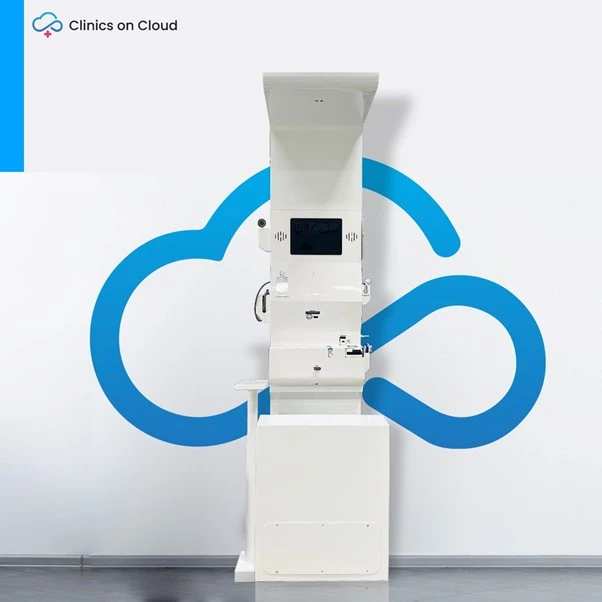 Entry · HA-46Health ATM
Smart eHealth Kiosk – Your Digital Doorway to Instant Healthcare Clinics on Cloud – India’s Leading Provider of AI-Powered eHealth
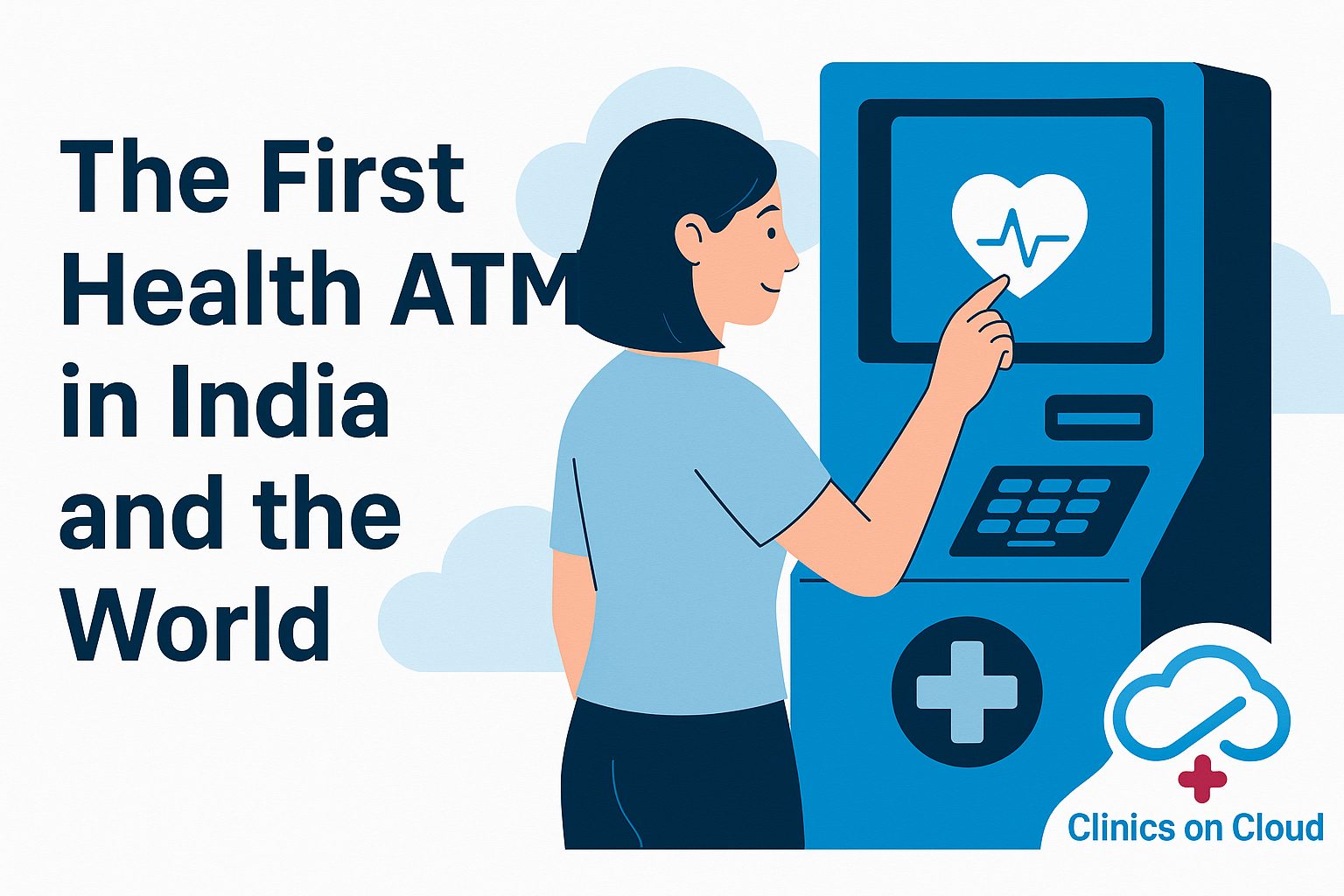 Entry · HA-22Health ATM
Pioneering the Future of Preventive Healthcare: The First Health ATM in India and the World In the digital age, healthcare
A Clinics On Cloud Health Kiosk records 19 general health parameters, including SpO2, pulse, body temperature, height, weight, BMI, BMR, body water, muscle mass, bone mass, metabolic age, body fat, subcutaneous fat, visceral fat and physique rating. All are non-invasive and take a few minutes inside a 10-minute full screening.
No. Every general health parameter is non-invasive, using sensors, a calibrated scale and bioelectrical impedance through the hand grips and foot plates. Blood is needed only for the separate diabetes, cardiac lipid, anaemia and rapid infectious disease modules, which all run from one finger-prick sample.
BMI is calculated from height and weight only, so it cannot tell muscle from fat. Body fat percentage is measured directly by bioelectrical impedance and tells you what share of body weight is fat tissue. Two people with the same BMI can have very different body fat percentages, which is why a kiosk measures both.
Visceral fat is fat stored deep in the abdomen around the internal organs, distinct from subcutaneous fat under the skin. It is measured by bioelectrical impedance and reported as a rating. Someone can appear slim and still carry a high rating, and interpretation belongs with a qualified physician.
Clinics On Cloud states device accuracy of 90–95%, depending on the test and device, under correct usage, calibration and patient preparation. Impedance estimates are also affected by hydration, recent food and exercise. Screen under consistent conditions and read the trend across sessions rather than treating one figure as exact.
The right interval depends on your age, history and risk factors, so it is a decision for your physician rather than a fixed rule. In practice, workplace and residential programmes commonly run monthly or quarterly cycles for the non-invasive block, because body composition is only informative as a trend.
Indicative pricing for a Clinics On Cloud Health ATM starts from ₹6,00,000, and the general health specialty is included in every configuration because it needs no consumables. The final price depends on which other specialties you enable, the enclosure and the integration scope. Request a configured quote.
Clinics On Cloud operates under ISO 27001 for information security, is HIPAA and GDPR compliant, and its platform is VAPT tested. Records are stored as digital health records and can be linked to an ABHA number under the Ayushman Bharat Digital Mission. Employers receive aggregate dashboards; individual reports go to the individual.
We started Clinics on Cloud with a simple belief - that the quality of your healthcare should not depend on your postcode. Whether you're a government, corporate, NGO or entrepreneur - we built this for you.
+91 8999 073 447
Mon - Sat · 9 AM to 6 PM IST
sales@clinicsoncloud.com
Partnerships · Deployments · Support
www.clinicsoncloud.com
Products · Case Studies · News
Nighoje, Chakan MIDC
Pune, Maharashtra - 410501, India