HomeBlogClinical Parameters and Tests Offered by Health Kiosk
Article16 August 20253 minUpdated
Clinical Parameters and Tests Offered by Health Kiosk
In the era of preventive health, early detection and comprehensive screening are paramount. Clinics On Cloud Health Kiosk revolutionizes full body health checkups by offering over 60 clinically validated parameters through a single, streamlined session. This advanced, AI-powered kiosk combines high-grade medical devices and telemedicine, providing users detailed health insights in under 15 minutes
CCClinics On Cloud TeamPublished from Pune, India
“
A health kiosk clinical parameter is a single measurable health indicator that a self-service screening station records, such as blood pressure, HbA1c or visceral fat. The Clinics On Cloud Health Kiosk screens 65+ clinical parameters across 14 specialties in a 10-minute session, and has screened 12M+ patients across 3,500+ installations in 200+ cities.
What is a clinical parameter on a health kiosk?
A clinical parameter is one measurable indicator of health, recorded as a number, a waveform or a graded observation. Blood pressure is a parameter. So is oxygen saturation, so is HbA1c, and so is a colour vision result.
A health kiosk is a self-service screening station that measures a bundle of clinical parameters in one sitting and issues an instant report. It sits between doing nothing and booking a full pathology panel, and its job is early identification rather than diagnosis.
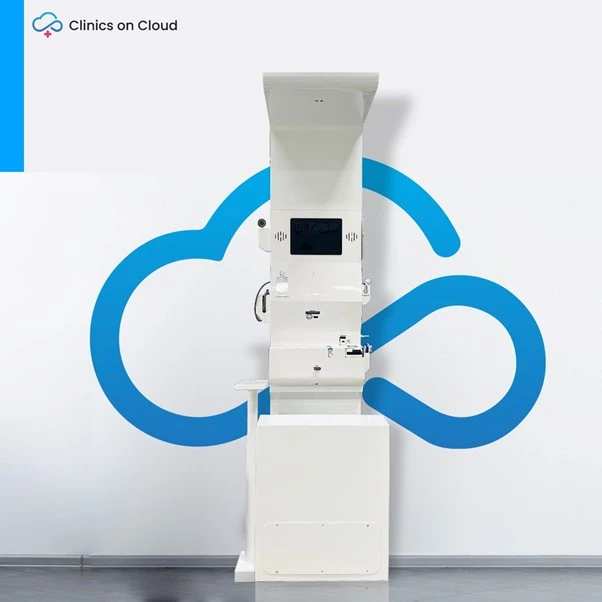
Clinics On Cloud manufactures this class of device in India as the Health ATM, also sold as the Health Kiosk. Clinics On Cloud is India’s first CDSCO-licensed Health ATM and Health Kiosk manufacturer, operating from Nighoje, Chakan MIDC, Pune, under the legal entity SehatPro Technologies Pvt Ltd.
Parameter counts are the most misread number in this category. Some vendors count a single lipid panel as one parameter and some count it as six. This page lists every parameter individually so you can compare like for like, whether you are writing a tender specification or simply deciding what a screening session will tell you.
What clinical parameters does a health kiosk test?
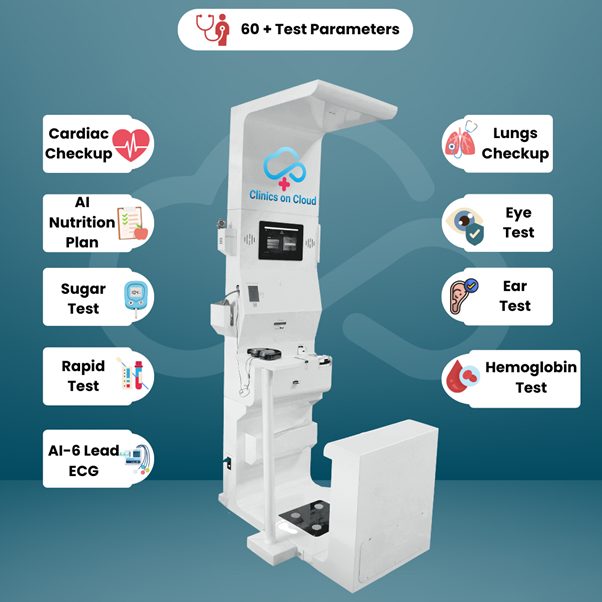
The Clinics On Cloud Health Kiosk screens 65+ clinical parameters across 14 specialties. The table below is the master map. Each specialty is then broken out in full in the next section.
Two qualifications matter before you read further. Not every unit ships with all 14 specialties; the configuration is selected at order time and drives both the price and the consumable cost. And every parameter below is screened, not diagnosed. The kiosk flags readings that fall outside standard reference ranges and routes the person to a clinician.
The 14 specialties, parameter by parameter
1. General health and body composition (19 parameters)
This is the widest specialty and the one most people complete. It is entirely non-invasive and needs no consumables, which is why it drives repeat use in workplaces and residential deployments.
Parameter
What it measures
SpO2
Oxygen saturation of the blood, read optically at the fingertip
Pulse
Heart rate in beats per minute
Body temperature
Core body temperature
Height
Standing height, measured by ultrasonic sensor
Weight
Body weight on a calibrated platform
BMI
Body mass index, weight relative to height
BMR
Basal metabolic rate, energy used at complete rest
Body water
Total body water as a share of weight
Skeletal mass
Mass of the skeletal system
Muscle mass
Total muscle tissue mass
Bone mass
Estimated bone mineral mass
Protein
Protein as a share of body composition
Metabolic age
Estimated metabolic age against chronological age
Fat-free weight
Body weight excluding fat mass
Body fat
Total body fat percentage
Subcutaneous fat
Fat stored directly under the skin
Visceral fat
Fat stored around the abdominal organs
Physique rating
Composite classification of build from fat and muscle values
The specialty is counted as 19 parameters in the Clinics On Cloud specification. The readings above are the ones printed on a standard report; exact line items depend on the module configuration ordered.
The cardiac module combines an electrical recording, a pressure measurement and a blood lipid panel. Together they cover three separate aspects of cardiovascular risk that no single test captures alone.
Parameter
What it measures
ECG (6-lead or 12-lead)
Electrical activity of the heart as a waveform trace
Blood pressure
Systolic and diastolic pressure against the artery walls
Total cholesterol
All cholesterol carried in the blood
Triglycerides
Circulating blood fats
HDL cholesterol
High-density lipoprotein fraction
LDL cholesterol
Low-density lipoprotein fraction
TC:HDL ratio
Total cholesterol relative to HDL
Non-HDL cholesterol
Total cholesterol minus the HDL fraction
The specialty is counted as 9 parameters in the Clinics On Cloud specification, with the lipid panel contributing six of them.
Lead count is a configuration choice. A 6-lead ECG records fewer views of the heart than a 12-lead ECG and is generally used for rhythm-level screening, while 12-lead is the standard used in clinical settings. For the full explanation, see ECG, blood pressure and lipid profile explained.
3. Urine analysis (10 parameters)
Urine strip testing is fast, inexpensive per test and covers kidney, liver and urinary tract indicators in a single dip.
Parameter
What it measures
Urobilinogen
A bile breakdown product, relevant to liver function screening
Microalbumin
Small amounts of albumin protein in urine, an early kidney indicator
Glucose
Sugar present in urine
Blood pH
Acidity or alkalinity of the urine
Bilirubin
Bilirubin in urine, a liver-related marker
Protein
Protein leakage into urine
Ketones
Ketone bodies, produced when the body burns fat for fuel
Nitrite
Nitrite, associated with certain urinary bacteria
Specific gravity
Urine concentration, an indicator of hydration
Leukocytes
White blood cells in urine
4. Rapid infectious disease (10 parameters)
Rapid immunoassay tests give a result within minutes from a finger-prick sample. They are used for screening and triage, particularly during outbreak seasons and in camp settings.
Parameter
What it screens for
Dengue
Dengue infection markers
Malaria
Malaria parasite antigens
COVID-19 antigen
SARS-CoV-2 antigen
HIV I and II
HIV antibodies, screening level
Typhoid
Typhoid infection markers
Chikungunya
Chikungunya infection markers
Hepatitis B
Hepatitis B surface antigen
Hepatitis C
Hepatitis C antibodies
Syphilis
Syphilis antibodies
Blood grouping
ABO and Rh blood group
Rapid tests are screening tests. A reactive result requires confirmatory laboratory testing and clinical counselling, and for HIV in particular this must follow the confirmatory and counselling pathway defined by national programme guidance.
5. Ayurvedic assessment (7 parameters)
A guided on-screen assessment covering constitution and lifestyle factors, scored as an indicative profile. It is a wellness assessment module rather than a laboratory test, and the exact assessment set is confirmed at configuration.
6. Pulmonary function (4 parameters)
Spirometry measures how much air a person can move and how fast. It is the specialty that matters most in dusty industrial environments and among smokers.
Parameter
What it measures
PEF
Peak expiratory flow, the fastest speed of a forced breath out
FVC
Forced vital capacity, total air forcibly exhaled after a full breath in
FEV
Forced expiratory volume in a given time
FEV1/FVC
The ratio of one-second volume to total forced capacity
7. Dental and oral cancer screening (4 parameters)
An intra-oral camera captures magnified images of the teeth, gums and soft tissue for visual screening, including screening for oral lesions. In India this specialty carries weight because tobacco and areca nut use is common in many workforces. Visual screening flags what a dentist or oncologist then examines properly.
8. Dermatology (3 parameters)
Parameter
What it captures
Skin
Magnified imaging of skin surface and lesions
Hair
Scalp and hair shaft visualisation
Nail
Nail bed and plate visualisation
9. Vision (3 parameters)
Parameter
What it measures
Far vision
Distance visual acuity
Near vision
Close-range visual acuity
Colour blindness
Colour discrimination using standard plates
10. Hearing and ENT (2 parameters)
Parameter
What it measures
Audiometry
Hearing threshold across test frequencies
Otoscope visualisation
Camera view of the ear canal and eardrum
Audiometry is the parameter that matters most in manufacturing. Noise-induced hearing loss develops slowly and silently, and periodic screening at the plant gate catches drift that an annual medical often misses.
Haemoglobin screening for anaemia, and a kidney function screening marker. Anaemia screening is heavily used in school, adolescent and women’s health programmes, where it is often the single most productive parameter in the entire menu.
13. Mental health (2 parameters)
Parameter
Instrument
What it produces
Depression screening
PHQ-9
A severity score across nine items
Anxiety screening
GAD-7
A severity score across seven items
PHQ-9 and GAD-7 are standard, widely used screening questionnaires. A score is a prompt to speak to a clinician. It is not a psychiatric diagnosis, and no screening score should be treated as one.
14. Maternal health (1 parameter)
A fetal monitor records fetal heart activity. In maternal health deployments this is paired with the general health and anaemia parameters, since those are the readings antenatal programmes track most closely.
Who should get screened at a health kiosk?
Screening is most useful for people who currently have no symptoms and no routine contact with a doctor. That is the group in which early identification changes the outcome.
Adults over 30 with no annual health check. The largest untested group in most Indian workplaces and residential communities.
Anyone with a family history of diabetes, hypertension or heart disease. Family history raises baseline risk and makes periodic screening more valuable.
Shift workers and factory workforces. Rotating shifts, noise exposure and dust exposure make general health, audiometry and pulmonary parameters directly relevant.
People carrying excess weight around the abdomen. Visceral fat is measured directly rather than inferred from BMI alone.
Smokers and tobacco or areca nut users. Pulmonary function and oral screening are the relevant specialties.
People already living with a diagnosed condition. Periodic screening supports the follow-up their physician has already prescribed. It does not replace it.
Rural and last-mile populations. Where the nearest laboratory is hours away, a kiosk or a Box Clinic camp is often the only realistic screening contact point.
Corporate, CSR and government programme cohorts. Screening at scale identifies the small share of a population that needs immediate clinical attention.
Two groups should be routed differently. Anyone with active symptoms such as chest pain, breathlessness, fainting or a sudden change in vision needs a doctor now, not a screening kiosk. And children, pregnant women and people with implanted cardiac devices should follow the specific guidance of their treating clinician on which modules are appropriate.
What your health kiosk results indicate, and what they do not
A Clinics On Cloud report is colour-coded. Readings that sit inside standard reference ranges are shown in one band, borderline readings in another, and readings outside the range in a third. The colour is a signal about what to do next, not a verdict.
Here is how to read the three outcomes.
All parameters within range. The screening found nothing outside standard reference ranges on the day of the test. It does not rule out any condition. Screening tests have limits, and a normal result is a snapshot rather than a clearance.
One or more borderline readings. The reading sits near the boundary of the standard range. Borderline readings are most useful as a trend: repeat the screening at the interval your physician suggests and see which direction the number moves.
One or more readings outside the range. This is a prompt for a clinical consultation and, usually, a confirmatory laboratory test. The Clinics On Cloud kiosk offers a live teleconsultation at the machine when a reading is flagged, so the conversation happens immediately rather than weeks later.
The numeric cut-offs that define these bands are not set by Clinics On Cloud. They follow standard clinical guidance published by bodies including the World Health Organization (WHO), the Indian Council of Medical Research (ICMR) and, for glycaemic parameters, the International Diabetes Federation (IDF). Those cut-offs also vary with age, sex, pregnancy, medication and existing conditions. Do not interpret your own numbers against a general range. Take the report to a qualified physician and let them interpret it in the context of your history.
Device accuracy is 90–95%, depending on the specific test and device, under correct usage, calibration and patient preparation. That is a screening-grade standard. It is good enough to identify who needs a doctor and not a substitute for accredited laboratory pathology.
Across the Clinics On Cloud network, 2 lakh+ abnormalities have been identified and routed for early intervention. That figure is the actual output of a screening programme: not tests performed, but people moved into care.
How a 10-minute health kiosk screening runs
A full checkup on the Clinics On Cloud Health ATM takes 10 minutes from first touch to printed report. The interface is voice-guided and multilingual, so no skilled operator is required at the kiosk.
Identify. The user enters a mobile number, scans an ID, or links an ABHA (Ayushman Bharat Health Account) number under the Ayushman Bharat Digital Mission. Returning users have their history pulled up automatically.
Select the package. The screen offers the packages enabled at that site, from a short vitals check to the full 65+ parameter screening.
Non-invasive block. Height, weight, all body composition parameters, blood pressure, pulse, SpO2 and temperature are captured in one seated and one standing cycle.
ECG. A 6-lead or 12-lead trace is recorded, depending on the configured module.
Point-of-care blood tests. One finger-prick sample runs the enabled strip tests: random blood sugar, HbA1c, lipid profile, haemoglobin and the rapid infectious disease panel.
Sensory and questionnaire modules. Vision, audiometry, spirometry, dermatology and otoscope imaging, plus PHQ-9 and GAD-7, run on-screen.
Report. A colour-coded report prints and is simultaneously sent by SMS, email and WhatsApp.
Teleconsultation on flags. Abnormal readings trigger the offer of a live doctor consultation at the machine, with eSanjeevani integration available for public-health deployments.
Record. The encounter is stored as a longitudinal digital health record and appears on the centralised dashboard your administrators use.
Step 8 is the step that separates a screening programme from a data-collection exercise. A report with no follow-up pathway changes nothing.
Where these parameters are screened in practice
The parameter menu you enable should follow the population, not the brochure. The same 65+ parameter device is configured very differently across settings.
Setting
Parameters that earn their place
Why
Factory and plant gate
Audiometry, spirometry, general health, cardiac, diabetes
Noise, dust and shift work are the dominant exposures
Corporate office and Health Lounge
General health, cardiac, diabetes, mental health
Sedentary risk profile and high uptake of PHQ-9 and GAD-7
Being explicit here protects both the reader and the programme.
It does not diagnose. Every parameter above is a screening measurement. Diagnosis is a clinical act performed by a qualified physician, usually with confirmatory testing.
It does not treat, cure or prevent disease. The kiosk produces information and a referral pathway.
It does not replace a pathology laboratory. Confirmatory pathology, imaging and specialist assessment stay with accredited labs and clinicians.
It does not handle emergencies. Anyone with acute symptoms needs emergency care immediately.
It does not guarantee a doctor will act on the report. The report is designed to raise awareness and prompt appropriate medical follow-up, and the teleconsultation module exists to make that follow-up happen at the point of screening.
Clinics On Cloud operates under CDSCO licensing in India, ISO 13485 for medical device quality management, US FDA and CE marks, ISO 27001 for information security, HIPAA and GDPR compliance, and VAPT testing of the platform. For the category background, read what a Health ATM is.
Talk to the team
Clinics On Cloud builds connected preventive-healthcare infrastructure, not a single checkup machine. If you are specifying a parameter menu for a hospital lobby, a plant gate, a district programme or a CSR camp cycle, talk to our team for a configuration and a reference site near you. Call +91 8999 073 447, Monday to Saturday, 9:00 to 18:00 IST, or email sales@clinicsoncloud.com.
“
Clinics On Cloud provides preventive health screening and is not a diagnostic laboratory. Screening results are indicative and are not a diagnosis. Always consult a qualified physician before acting on any health information.
What clinical parameters does a health kiosk test?
A Clinics On Cloud Health Kiosk screens 65+ clinical parameters across 14 specialties: general health and body composition, cardiac, urine analysis, rapid infectious disease, Ayurvedic assessment, pulmonary function, dental and oral cancer screening, dermatology, vision, hearing and ENT, diabetes, anaemia and kidney, mental health and maternal health. The exact list depends on the configuration ordered.
How long does a full health kiosk screening take?
A full 65+ parameter checkup takes 10 minutes on the Clinics On Cloud Health ATM, from the first screen touch to a printed report. Shorter packages, such as vitals and blood sugar only, take considerably less. Sites with high footfall usually enable a short package for walk-ins and reserve the full screening for scheduled camp days.
Do I need to fast before a health kiosk screening?
No fasting is required for the standard screening. Random blood sugar and HbA1c are both designed to be run without fasting, which is why they are the diabetes parameters used at kiosks. If your physician has asked for a fasting laboratory test for a specific reason, follow their instruction, because a screening result does not replace it.
How accurate are health kiosk test results?
Clinics On Cloud states device accuracy of 90–95%, depending on the specific test and device, under correct usage, calibration and patient preparation. Results are indicative and are not a diagnosis. Any flagged reading should be confirmed by a qualified physician through appropriate laboratory or clinical assessment before any decision is taken.
Can a health kiosk replace a pathology lab or a doctor?
No. A health kiosk is a preventive screening device, not a diagnostic laboratory and not a clinician. It identifies readings outside standard reference ranges and routes people towards care earlier than they would otherwise reach it. Confirmatory diagnosis, imaging and treatment remain with accredited laboratories and qualified physicians.
What happens if my health kiosk report flags an abnormal result?
The Clinics On Cloud kiosk offers a live doctor teleconsultation at the machine when a reading is flagged, so you can discuss the report immediately. The physician advises on the confirmatory testing or clinical follow-up appropriate to your history. Take the printed or digital report with you to any subsequent consultation.
How much does a health kiosk with all 65+ parameters cost?
Indicative pricing for a Clinics On Cloud Health ATM starts from ₹6,00,000, and the final figure depends on how many of the 14 specialties are enabled, the ECG lead count, the point-of-care analyser modules fitted, the enclosure and the integration scope. Consumables and annual maintenance are quoted separately. Request a configured quote for your site.
Is health kiosk screening data private?
Clinics On Cloud operates under ISO 27001 for information security, is HIPAA and GDPR compliant, and the platform is VAPT tested. Records are stored as digital health records with longitudinal tracking and can be linked to an ABHA number under the Ayushman Bharat Digital Mission. Ask any vendor for its ISO 27001 scope and data residency position in writing before deployment.
Get In Touch
Healthcare is a right. Not a privilege.
We started Clinics on Cloud with a simple belief - that the quality of your healthcare should not depend on your postcode. Whether you're a government, corporate, NGO or entrepreneur - we built this for you.
Call us
+91 8999 073 447
Mon - Sat · 9 AM to 6 PM IST
Write to us
sales@clinicsoncloud.com
Partnerships · Deployments · Support
Visit us online
www.clinicsoncloud.com
Products · Case Studies · News
Find us
Nighoje, Chakan MIDC
Pune, Maharashtra - 410501, India
Built for every kind of health partner.
Government Body Corporate / HR Team NGO / CSR Partner Hospital or Clinic Defence Organisation International Partner Investor / Distributor Rural Entrepreneur
 Entry · HA-11Health ATM