 Entry · HA-22Health ATM
The First Health ATM in India and the World
Pioneering the Future of Preventive Healthcare: The First Health ATM in India and the World In the digital age, healthcare
Read story 4 min
In the age of digital transformation, access to healthcare must be as easy as withdrawing money from an ATM. That’s the power of the eHealth Kiosk by Clinics on Cloud —a revolutionary health-tech innovation designed to bring diagnostics, teleconsultation, and health records to your fingertips.
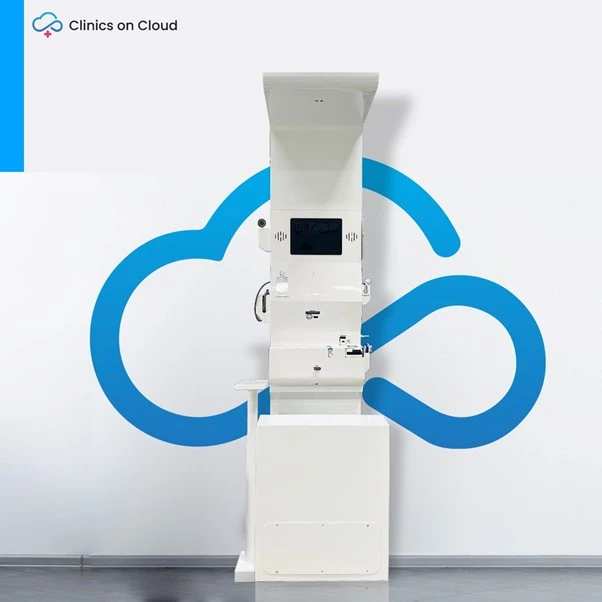
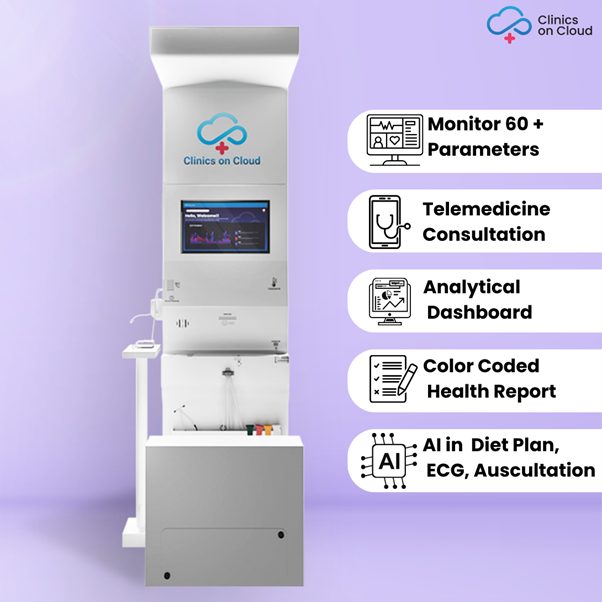
An eHealth kiosk, or eHealth ATM, is a self-service screening station whose output is a structured electronic health record rather than a printed slip, linkable to a person’s ABHA number. Clinics On Cloud eHealth kiosks screen 65+ clinical parameters across 14 specialties and write each result to a longitudinal record with telemedicine attached.
An eHealth kiosk, also written eHealth ATM or smart health kiosk, is a self-service preventive screening station in which the connected software layer, rather than the instrument set, is the product. The physical measurement is the input. The structured, identity-linked, longitudinal health record is the output.
That distinction is what separates a screening machine from health infrastructure. A machine produces a number on a printout. Infrastructure produces a record that survives the visit, follows the person, and aggregates into something a programme owner can act on.
Clinics On Cloud, the brand of SehatPro Technologies Pvt Ltd, is India’s first CDSCO-licensed Health ATM and Health Kiosk manufacturer. As of 2026 the network covers 3,500+ installations across 200+ cities and 8+ countries, with 12M+ patients screened and 2 lakh+ abnormalities detected and flagged for early intervention.
An eHealth kiosk screens and flags. It does not diagnose, treat, cure or prevent any disease.
There is no hardware distinction. The terms map to buyer vocabulary, and knowing which term a buyer uses tells you what they care about.
| Term | Typical buyer | What the buyer is really asking about |
|---|---|---|
| Health ATM | Government, CSR, public health | Reach, unattended operation, cost per screening |
| Health kiosk | Hospitals, corporates, international | The physical station and its parameter list |
| eHealth kiosk / eHealth ATM | Digital health, NHM programme teams, IT departments | Records, ABHA linkage, interoperability, data governance |
| Smart health kiosk | Smart city and facility management | AI risk flagging, dashboards, connectivity |
| Telemedicine kiosk | Teleconsultation programme owners | The doctor pathway after an abnormal result |
If you are drafting a tender, name at least two of these terms so that both hardware-led and platform-led vendors respond. For the physical mechanism, read how a health kiosk works, step by step; for the category definition, read what a Health ATM is.
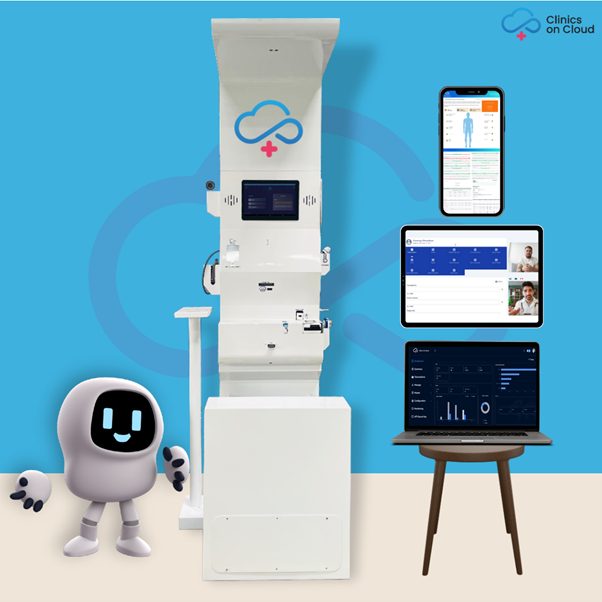
The Clinics On Cloud digital layer has five components: identity and record linkage, the screening record itself, AI-assisted risk flagging, the teleconsultation pathway, and the analytics dashboard. Each is a separate procurement question, and buyers who evaluate only the first two end up with data they cannot use.
| Layer | What it does | Why a digital-health buyer should care |
|---|---|---|
| Identity and linkage | Links the screening to a mobile number or an ABHA (Ayushman Bharat Health Account) number | Without identity, every screening is an orphan reading and longitudinal tracking is impossible |
| Screening record | Structured record of 65+ parameters across 14 specialties, colour-coded against standard reference ranges | Structured beats scanned; a structured record can be queried, exported and trended |
| AI-assisted risk flagging | Flags readings outside standard ranges and generates diet and lifestyle guidance | Turns a data point into a triage decision at the point of screening |
| Teleconsultation | Live doctor consultation with the report on screen, initiated from the kiosk | Closes the loop; a flag with no follow-up pathway is a wasted screening |
| Analytics dashboard | Centralised multi-location view of screening volume and flagged conditions | This is what a programme owner uses weekly, and it is the most under-specified item in most tenders |
Report delivery runs across print, SMS, email and WhatsApp, so the record reaches the individual on the channel they actually use.
Clinics On Cloud eHealth kiosks support ABHA (Ayushman Bharat Health Account) integration, so a screening record can be linked to a person’s digital health identity under the Ayushman Bharat Digital Mission where the deployment is configured for it.
Why this matters to a government or digital-health buyer:
Two honest procurement points. First, ABHA linkage is enabled per deployment; it is not automatic simply because a vendor lists it on a brochure. Ask for it explicitly in scope and in the acceptance criteria. Second, ABHA linkage should be consented, and the consent flow should be visible on the kiosk before the screening begins.
Clinics On Cloud describes integration capability with ABHA and the Ayushman Bharat Digital Mission. It does not claim endorsement, empanelment or sponsorship by any government programme, and no vendor should.
Clinics On Cloud eHealth kiosks support eSanjeevani integration alongside the platform’s own integrated telemedicine.
The design principle is that a flag must have a destination. When AI-assisted risk flagging marks a reading as outside standard ranges, the user can be moved into a live consultation with a doctor who has the same screening report on screen. The consultation outcome is written back to the record.
Three configuration decisions a buyer must make:
The teleconsultation layer is what makes a screening programme clinically meaningful. A programme that screens 10,000 people and refers none of them has measured a population, not helped it.
Each Clinics On Cloud screening produces a digital health record with longitudinal tracking. The value compounds: a single blood pressure reading is a data point; the same reading taken quarterly for two years is a trend, and a trend is what prompts action.
What the record set enables:
Export deserves emphasis. Ask, in writing, for the export format, the export frequency and what happens to your historical records if you change vendor. A platform you cannot leave is a platform you did not really buy.
Clinics On Cloud provides a centralised multi-location analytics dashboard, built for CSR, corporate and government programme owners who run screening across many sites.
Typical views a programme owner needs:
For CSR reporting, this is the difference between a report that says “we ran a health camp” and one that says how many people were screened, how many abnormalities were flagged, and what happened next. Across the Clinics On Cloud network, 12M+ patients have been screened and 2 lakh+ abnormalities detected for early intervention as of 2026.
Ask for a live dashboard walkthrough during evaluation. It is the component you will touch every week and the one most likely to disappoint after purchase.
Clinics On Cloud kiosks can push data to third-party systems, which matters when the screening programme is one part of a larger stack.
| Integration target | Typical buyer | What flows across |
|---|---|---|
| Hospital HMIS or EMR | Hospitals, district hospitals | Screening record and vitals ahead of an OPD consultation |
| Government health information systems | NHM and state programme teams | Aggregate screening and flagged-condition data |
| ABHA / ABDM | Government and digital-health buyers | Identity linkage and record portability |
| Corporate HRMS or wellness platform | Corporate HR and CSR teams | Anonymised participation and aggregate risk trends |
| Insurer platforms | Insurance and TPA buyers | Consented screening participation records |
| Client-owned server | Buyers with a data-residency requirement | The full dataset, hosted under the client’s control |
Where data is deployed on a client-controlled server, the server cost and the server-side security posture become the client’s responsibility. Agree that boundary in the contract, not in a kickoff meeting.
Clinics On Cloud operates against the following compliance set, listed in the order a procurement team should verify it:
Four questions to put to any vendor, including this one:
Clinics On Cloud health kiosk pricing starts from ₹6,00,000 and varies by configuration. For a digital-health buyer, the capital cost is only one line, and usually not the decisive one.
| Cost line | Driver | Question to ask before budgeting |
|---|---|---|
| Kiosk capital cost | Device set, enclosure, language pack | From ₹6,00,000, configuration-dependent |
| Software licence | Included initially; renewal terms vary | What does the licence cost from year two? |
| ABHA / ABDM integration | Scope of identity linkage required | Is it in scope, and who certifies acceptance? |
| Third-party integration | HMIS, HRMS, insurer or state system | Is integration effort quoted, or time-and-materials? |
| Consumables | Test menu enabled and screening volume | Priced per test or per box? Minimum order quantity? |
| Connectivity and power | Site conditions | Broadband or 4G; standard single-phase power |
| Annual maintenance contract | Device set | Quoted per configuration; agree scope before warranty ends |
| Data hosting | Vendor cloud or client server | If client-hosted, whose budget carries the server cost? |
How digital-health buyers justify the spend. The comparison is rarely kiosk price against machine price. It is usually one of three framings: cost per screening against the fully loaded cost of an off-site camp including travel, technician time and logistics; the value of earlier risk identification in a population with a known NCD burden; or the cost of a programme that produces no usable data at all, which is the outcome when screening is run without a records and analytics layer.
Build the model on your own footfall, your own population and your own alternative costs. Any figure a vendor gives you for your ROI is a guess about your operation.
If you are specifying a digital screening programme, Clinics On Cloud will map the parameter list, the ABHA and eSanjeevani scope and the analytics requirement to your deployment. See the Health Kiosk product page, the Mobile Medical Unit and portable Box Clinic formats for dispersed populations, the health kiosk and Health ATM FAQ hub for procurement detail, or talk to the Clinics On Cloud team.
Clinics On Cloud provides preventive health screening and is not a diagnostic laboratory. Screening results are indicative and are not a diagnosis. Always consult a qualified physician before acting on any health information.
Your email is never published. Comments appear after a quick review.
Entry · HA-22Health ATMPioneering the Future of Preventive Healthcare: The First Health ATM in India and the World In the digital age, healthcare
 Entry · HA-97Health ATM
Health Kiosk ATMs Plays a vital Role in Creating Health Awareness In today’s fast-paced world, taking care of our health
 Entry · HA-78Health ATM
A Health ATM is an innovative healthcare kiosk designed to provide basic health check-ups and medical services in a convenient
An eHealth kiosk is a self-service health screening station whose output is a structured electronic health record linked to a person’s digital health identity, rather than a standalone printout. Clinics On Cloud eHealth kiosks screen 65+ clinical parameters across 14 specialties in about 10 minutes, flag values outside standard ranges, and support ABHA linkage under the Ayushman Bharat Digital Mission.
There is no hardware difference. “eHealth kiosk” is the term digital-health and IT buyers use, and it emphasises the records, identity linkage and interoperability layer. “Health kiosk” and “Health ATM” emphasise the physical screening station. A tender should name at least two of these terms so that both hardware-led and platform-led vendors respond.
Clinics On Cloud eHealth kiosks support ABHA (Ayushman Bharat Health Account) and eSanjeevani integration, so screening records can be linked to a person’s digital health identity under the Ayushman Bharat Digital Mission where the deployment is configured for it. Integration is enabled per deployment, so put it in scope explicitly with acceptance criteria rather than assuming it.
Yes. Clinics On Cloud kiosks can push screening data to third-party systems including hospital HMIS and EMR platforms, corporate HRMS and wellness platforms, insurer systems and client-controlled servers. Where the data is hosted on a client server, server cost and server-side security are the client’s responsibility. Quote integration effort separately during procurement.
Clinics On Cloud health kiosk pricing starts from ₹6,00,000 and varies by configuration. For a digital-health buyer the recurring lines matter as much: software licence renewal, integration effort, consumables, connectivity, data hosting and the annual maintenance contract. Fix the parameter list and the integration scope before comparing quotations, because both drive the number.
Contact Clinics On Cloud with the site type, the population size, the parameter list and the integration requirements, including whether ABHA and eSanjeevani linkage is in scope. Sales confirms a configuration and quotes capital cost, integration, warranty and AMC. Reach the team on +91 8999 073 447 or sales@clinicsoncloud.com, Monday to Saturday, 9:00 to 18:00 IST.
Screening records are held on the Clinics On Cloud platform, with client-server deployment available where data residency is required. Ownership must be stated in the contract: for institutional buyers the usual position is that the buyer owns the records, the individual retains rights over personal health data, and the vendor processes it. Agree the export path before signing.
The Clinics On Cloud platform is operated against ISO 27001 for information security, with HIPAA and GDPR compliance and VAPT penetration testing, alongside CDSCO licensing and ISO 13485 for the device side. Ask for the VAPT report date, the encryption position for data at rest and in transit, and the breach-notification commitment written into the agreement.
Yes. Clinics On Cloud kiosks are offline-capable and carry 3–4 days of battery backup, so screening continues through connectivity gaps and power cuts. Reports print at the kiosk, and records, ABHA linkage and SMS, email or WhatsApp delivery sync automatically once the connection returns. This is what makes last-mile deployment viable across 200+ cities.
An eHealth kiosk report is a screening record, not a diagnostic report, and it is intended to raise awareness and prompt appropriate medical follow-up. Clinicians treat it as a reason to order confirmatory testing. The teleconsultation pathway exists precisely so that a flagged reading reaches a qualified physician rather than sitting on a printout.
We started Clinics on Cloud with a simple belief - that the quality of your healthcare should not depend on your postcode. Whether you're a government, corporate, NGO or entrepreneur - we built this for you.
+91 8999 073 447
Mon - Sat · 9 AM to 6 PM IST
sales@clinicsoncloud.com
Partnerships · Deployments · Support
www.clinicsoncloud.com
Products · Case Studies · News
Nighoje, Chakan MIDC
Pune, Maharashtra - 410501, India