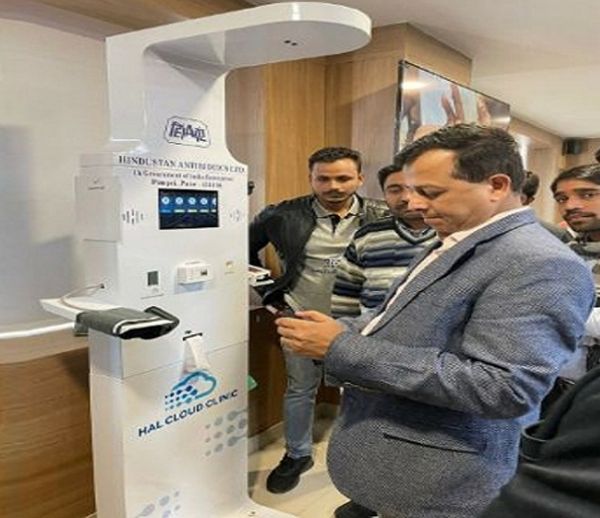
 Entry · HA-70Health ATM
NHM Uttar Pradesh sets up 200+ Health ATMs, facilitates training of healthcare personnel
NHM Uttar Pradesh sets up 200+ Health ATMs, facilitates training of healthcare personnel In a bid to bolster the health
Read story 2 min
Learn what a Health ATM is, how it works, what tests it can perform, its benefits, use cases, price factors and how Health ATMs support preventive healthcare.
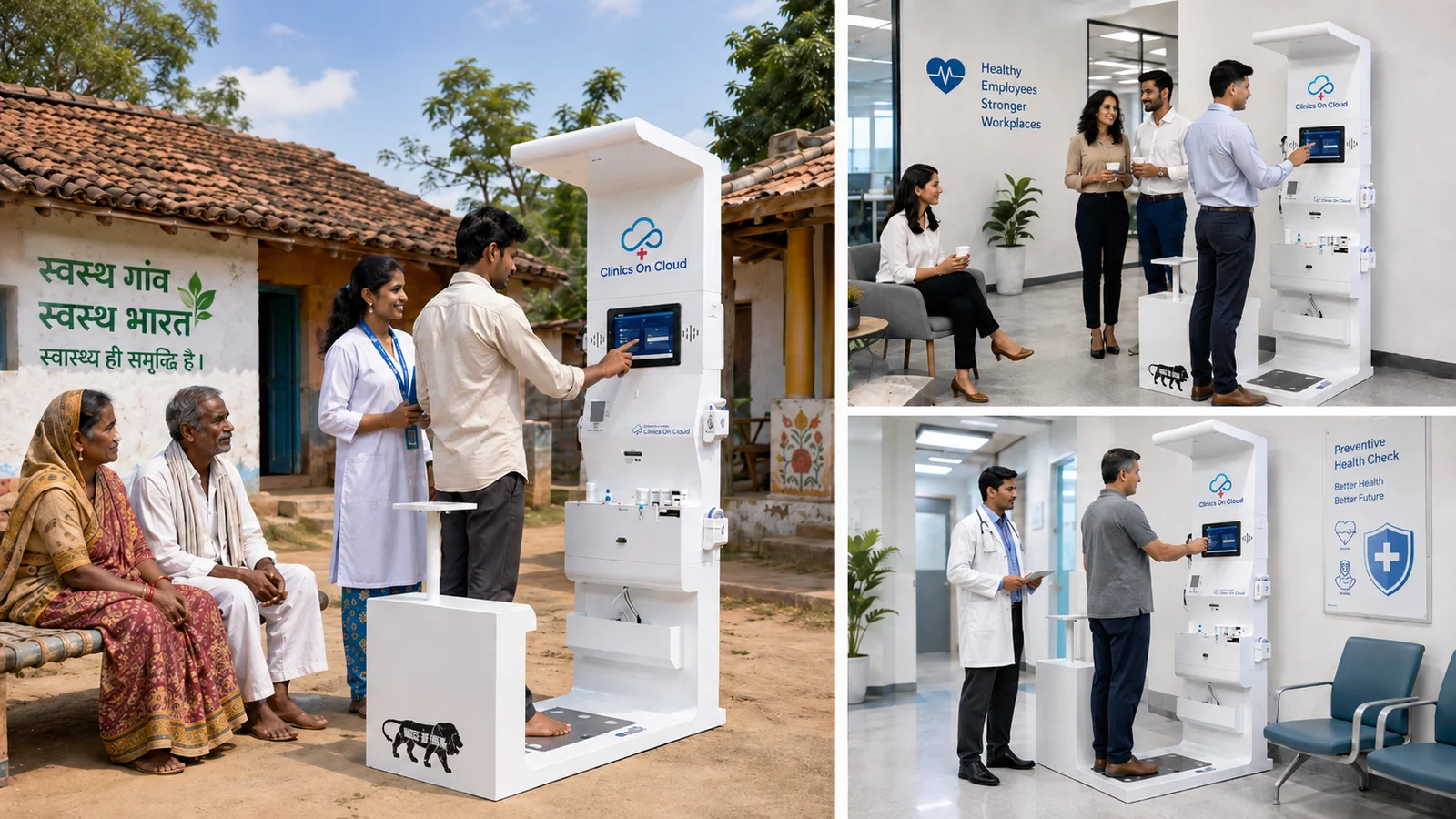
A Health ATM is a self-service screening station that measures a person’s clinical parameters in one guided session and returns an instant report. A Clinics On Cloud Health ATM screens 65+ clinical parameters across 14 specialties, sends a colour-coded report by print, SMS, email or WhatsApp, and connects the user to a doctor when a result is flagged.
A Health ATM screens and flags. It does not diagnose, treat, cure or prevent disease. Everything below is written on that basis.
A Health ATM is a compact, connected screening station that lets a person complete a multi-parameter preventive health checkup in a single short session and receive an instant report, without a laboratory visit.
The category is also called a health kiosk, healthcare kiosk, medical kiosk, telemedicine kiosk or wellness kiosk. In India the terms are used interchangeably, and capability varies far more between manufacturers than between labels. See health kiosk company terminology.
A modern Health ATM has four layers:
A unit missing the last two layers is a measuring device, not a Health ATM.
The name is an analogy with banking. A bank ATM moved routine transactions out of the branch and put them where people already were, without an appointment. A Health ATM applies the same idea to routine health screening.
The analogy has one limit. A bank ATM is always self-service. A Health ATM runs self-service and also in assisted mode, where a health worker, ANM, nurse or technician guides the user, which is the norm at Primary Health Centres, rural camps and school programmes.
A Health ATM session follows a fixed sequence, and a full Clinics On Cloud checkup completes in 10 minutes.
Steps 8, 9 and 10 separate a screening programme from a health check event. A screening that produces no follow-up produces no health outcome.
A Clinics On Cloud Health ATM screens 65+ clinical parameters across 14 specialties. The specialty view is more useful than a single number, because it tells you which health questions the unit can actually answer.
| Specialty | Parameters | Examples |
|---|---|---|
| General health | 19 | SpO2, pulse, temperature, height, weight, BMI, BMR, body fat, visceral fat, muscle and bone mass |
| Cardiac | 9 | 6-lead / 12-lead ECG, blood pressure, lipid profile |
| Urine analysis | 10 | Glucose, protein, ketones, bilirubin, nitrite, leukocytes, pH |
| Rapid infectious disease | 10 | Dengue, malaria, typhoid, chikungunya, hepatitis B and C, HIV I & II, syphilis, blood grouping |
| Ayurvedic assessment | 7 | Constitution-based assessment |
| Pulmonary function | 4 | PEF, FVC, FEV, FEV1/FVC |
| Dental and oral cancer screening | 4 | Intraoral visualisation |
| Dermatology | 3 | Skin, hair, nail visualisation |
| Vision | 3 | Far vision, near vision, colour blindness |
| Hearing and ENT | 2 | Audiometry, otoscope visualisation |
| Diabetes | 2 | Random blood sugar, HbA1c |
| Anaemia and kidney | 2 | Haemoglobin, renal indicators |
| Mental health | 2 | PHQ-9 depression, GAD-7 anxiety |
| Maternal health | 1 | Fetal monitor |
Device accuracy is 90–95% depending on the test and the device, under correct usage, calibration and patient preparation. Results are screening-grade and indicative. Reference ranges and their interpretation belong to standard clinical guidance and to a qualified physician, not to the kiosk. The parameter-level detail sits in clinical parameters and tests offered by a health kiosk.
Health ATMs go where the population already is, rather than where healthcare infrastructure already is.
As of 2026, Clinics On Cloud reports 3,500+ installations across 200+ cities and 8+ countries, 12M+ patients screened and 2 lakh+ abnormalities flagged for early intervention.
| Dimension | Health ATM | Hospital checkup | Diagnostic lab | Home test kit |
|---|---|---|---|---|
| Time per person | 10 minutes | Half a day or more | Collection plus wait | Minutes, one parameter |
| Breadth per session | 65+ parameters, 14 specialties | Broad, package dependent | Broad, order dependent | Narrow |
| Location | Where people already are | At the facility | Facility or home collection | At home |
| Report speed | Instant | Same day to days | Hours to days | Instant |
| Result status | Screening, indicative | Clinical assessment | Diagnostic-grade | Screening, indicative |
| Doctor involvement | Teleconsultation on flags | In person | Referring physician | None |
| Record continuity | Digital record, ABHA linkable | Hospital record | Lab record | None |
| Best used for | First-line screening at scale | Full assessment | Confirming a finding | Single-parameter monitoring |
These options complement each other. A Health ATM sits at the top of the funnel. Its job is to identify the people who need the other three.
Health ATM price starts from ₹6,00,000 for a Clinics On Cloud unit in India, with the final figure set by configuration rather than a list price. Two units of the same size can differ substantially once you compare the devices inside them.
Six variables drive the number: the parameter set (ECG, lipid profile, HbA1c, spirometry, audiometry and rapid infectious disease panels each add device cost to the vitals base); the form factor (Health Kiosk, Health Lounge, Box Clinic or Mobile Medical Unit); telemedicine (whether live consultation is bundled, and whose doctor panel is used); software and integration (ABHA and eSanjeevani linkage, hospital or HR system integration, dashboards, white-labelling); consumables (strips, cartridges, electrodes and printer rolls, which scale with screenings and are the real running cost); and service level (warranty length, AMC or CMC scope, guaranteed response times).
Model cost per screening completed, not cost per unit installed. Take five-year total cost of ownership, capex plus consumables plus AMC plus connectivity, and divide by realistic screening volume.
An employer compares that against an external annual checkup vendor plus the production hours lost to a half-day camp. A CSR or government programme compares cost per person reached against any other channel serving the same population. A pharmacy compares revenue per session against footfall.
The outcome that justifies the spend is early detection: across the Clinics On Cloud network, 2 lakh+ abnormalities have been flagged for early intervention out of 12M+ patients screened. Pricing varies by configuration, so ask for a written quote.
Access. Screening happens where people already are, removing the travel, appointment and return-visit costs that stop most preventive checkups happening at all.
Speed and breadth. A 10-minute session covering 65+ parameters across 14 specialties replaces a half-day and several separate visits for ECG, vision, hearing and blood work.
Instant, portable results. A colour-coded report printed at the kiosk and sent by SMS, email or WhatsApp, stored as a digital record the next visit builds on.
A path to a doctor. Teleconsultation on flagged results, which matters most where no physician is present.
Programme visibility. Anonymised population trends across sites, which is what CSR, HR and public health funders need at review time.
Early detection. The World Health Organization and the Indian Council of Medical Research both treat early detection as the most effective intervention for non-communicable diseases, which develop silently for years.
Stating the limits is part of using the category responsibly.
It screens, it does not diagnose. A Health ATM does not diagnose, treat, cure or prevent disease. Clinics On Cloud is not a diagnostic laboratory and does not replace one. Abnormal findings need physician review and, where required, laboratory confirmation.
It does not replace a physician. Whether a treating doctor uses a screening report depends on the doctor and the clinical situation. The report’s purpose is to prompt an earlier consultation, not to substitute for one.
Accuracy is conditional. 90–95% accuracy depends on correct usage, calibration, environmental conditions and patient preparation. A unit not calibrated on schedule will not perform to specification.
Utilisation decides value. A kiosk in an unused corridor with no awareness campaign runs a fraction of the volume of the same kiosk placed well.
The follow-up pathway must be designed. If nobody owns what happens after a flag, the screening produces data and no outcome.
Not every test belongs in a kiosk. Imaging, histopathology and most specialised laboratory work sit outside the category.
The category grew out of three converging shifts rather than a single invention. First, medical devices got smaller, cheaper and connectable, so instruments that once needed a bench became modules that fit in a cabinet and report over a data link. Second, telemedicine became accepted practice, giving a screening station a purpose beyond printing numbers: it could hand the user to a doctor.
Third, digital health infrastructure arrived. In India, the Ayushman Bharat Digital Mission and the ABHA health account gave a screening result somewhere durable to live, and eSanjeevani gave it somewhere to escalate. That is what turned a kiosk from an event into a record.
Clinics On Cloud, the brand of SehatPro Technologies Pvt Ltd, became India’s first CDSCO-licensed Health ATM and Health Kiosk manufacturer and manufactures at Nighoje, Chakan MIDC, Pune, holding CDSCO licensing, ISO 13485, US FDA, CE, ISO 27001, HIPAA, GDPR and VAPT testing.
Three directions are visible as of 2026.
From machine to network. The unit of value is shifting from a single kiosk to a connected network of screening points reporting into one dashboard. Clinics On Cloud describes this as building the infrastructure layer for the global microclinic economy.
From measurement to guidance. AI-assisted risk flagging and diet and lifestyle guidance already sit in the platform, pointing towards better triage of who needs a doctor now rather than more parameters for their own sake.
From standalone to integrated. Linkage with ABHA, eSanjeevani, hospital information systems and insurer workflows is becoming the default expectation rather than a custom project.
The measure of the category will not be how many parameters a kiosk lists. It will be how many people got in front of a doctor earlier than they otherwise would have.
For a fuller version of this evaluation, see best Health ATM in India and how to pick a manufacturer.
For market context, read the Indian Health ATM market and ABDM adoption. For supplier selection, read best Health ATM in India and how to pick a manufacturer. For overseas buyers, see international and distributor enquiries. For specifications, see the Health Kiosk product page.
To discuss a deployment, call +91 8999 073 447 (Mon–Sat, 9:00–18:00 IST) or email sales@clinicsoncloud.com. Clinics On Cloud is a brand of SehatPro Technologies Pvt Ltd, Nighoje, Chakan MIDC, Pune, Maharashtra 410501, India.
Healthcare is a right. Not a privilege.
Clinics On Cloud provides preventive health screening and is not a diagnostic laboratory. Screening results are indicative and are not a diagnosis. Always consult a qualified physician before acting on any health information.
Your email is never published. Comments appear after a quick review.
Entry · HA-70Health ATMNHM Uttar Pradesh sets up 200+ Health ATMs, facilitates training of healthcare personnel In a bid to bolster the health
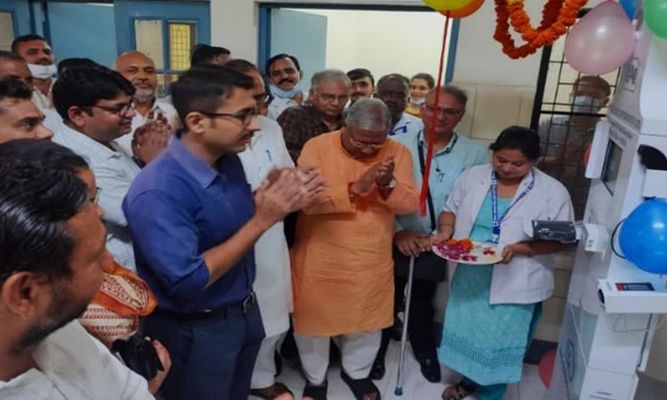 Entry · HA-35Health ATM
How can a Health ATM benefit rural India? MP Rajendra Agarwal inaugurated Health ATM in UP Meerut’s Kharkhauda Community Health
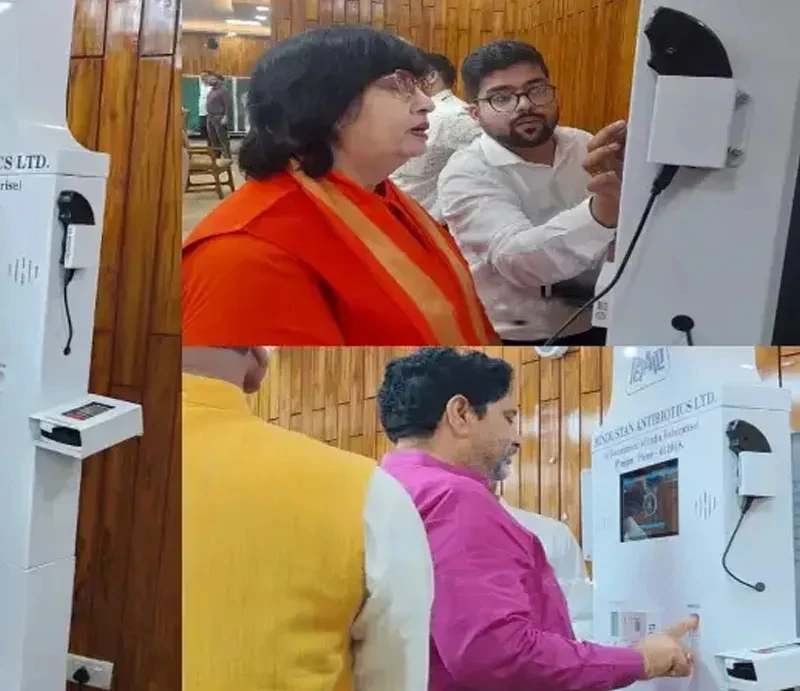 Entry · HA-72Health ATM
Clinics on Cloud Health ATM bringing revolution in the Preventive Health Care Industry. The machine was installed at Vidhan Sabha
A Health ATM is a self-service or assisted screening station that measures a person’s clinical parameters in one guided session and returns an instant report. A Clinics On Cloud Health ATM screens 65+ clinical parameters across 14 specialties in 10 minutes, prints and sends a colour-coded report, stores it as a digital health record, and offers a doctor consultation when a result is flagged.
The user is identified by mobile number, ID or an ABHA health account, then follows voice-guided multilingual instructions through non-invasive measurements, specialised modules such as ECG and vision, and point-of-care blood and urine tests where configured. Results are consolidated, colour-coded and risk-flagged, delivered instantly, stored as a record, and escalated to a doctor when needed.
A full Clinics On Cloud Health ATM checkup takes 10 minutes and covers 65+ clinical parameters across 14 specialties. Shorter configurations covering only vitals and body composition take less. Session time depends on which modules are included, since point-of-care blood tests and spirometry add steps that a vitals-only configuration does not have.
Device accuracy is 90–95% depending on the test and the device, under correct usage, calibration and patient preparation. Devices come from manufacturers holding US FDA, CE or CDSCO registration. Results are indicative and intended for screening, not confirmatory diagnosis. Any abnormal finding should be reviewed by a qualified physician and confirmed by laboratory testing where required.
No, a Health ATM does not replace a physician: it screens and flags, and does not diagnose, treat, cure or prevent disease. It can perform point-of-care blood tests where configured, including random blood sugar, HbA1c, haemoglobin, lipid profile and rapid infectious disease panels from a fingerstick sample. These are screening-grade results, not a laboratory substitute.
Health ATM price starts from ₹6,00,000 for a Clinics On Cloud unit in India, with the final figure set by configuration. Parameter set, form factor, telemedicine, integrations, consumables and service level all move it. Compare suppliers on five-year total cost of ownership rather than sticker price, and request a written quote for your specific sites.
Prepare a requirement note covering site count, expected daily screenings, required parameters and integrations, then request a demo and a written configuration quote. Contact Clinics On Cloud on +91 8999 073 447 or sales@clinicsoncloud.com. For tenders, ask for the CDSCO licence, ISO 13485 certificate and technical datasheet as compliance annexures.
Installation covers site survey, placement, power and connectivity checks, device calibration, a test screening run and operator orientation, and is usually completed within a day of the unit reaching site. An annual maintenance contract covers preventive visits, calibration, software updates and defined response times, with a comprehensive variant covering parts. Consumables are billed separately.
Clinics On Cloud Health ATMs operate offline and sync when a connection returns, with 3–4 days of battery backup, though teleconsultation itself requires connectivity. No skilled operator is required: the interface is voice-guided and multilingual for self-service, and also runs in assisted mode where a health worker guides the user at Primary Health Centres, camps and schools.
We started Clinics on Cloud with a simple belief - that the quality of your healthcare should not depend on your postcode. Whether you're a government, corporate, NGO or entrepreneur - we built this for you.
+91 8999 073 447
Mon - Sat · 9 AM to 6 PM IST
sales@clinicsoncloud.com
Partnerships · Deployments · Support
www.clinicsoncloud.com
Products · Case Studies · News
Nighoje, Chakan MIDC
Pune, Maharashtra - 410501, India