Health kiosk in Ramanagara
Health ATM in Ramanagara | Clinics On Cloud Smart Health Kiosk for Preventive Healthcare Ramanagara is a growing district near
Read story 2 min
Access to a doctor should not depend on how far you live from a hospital.
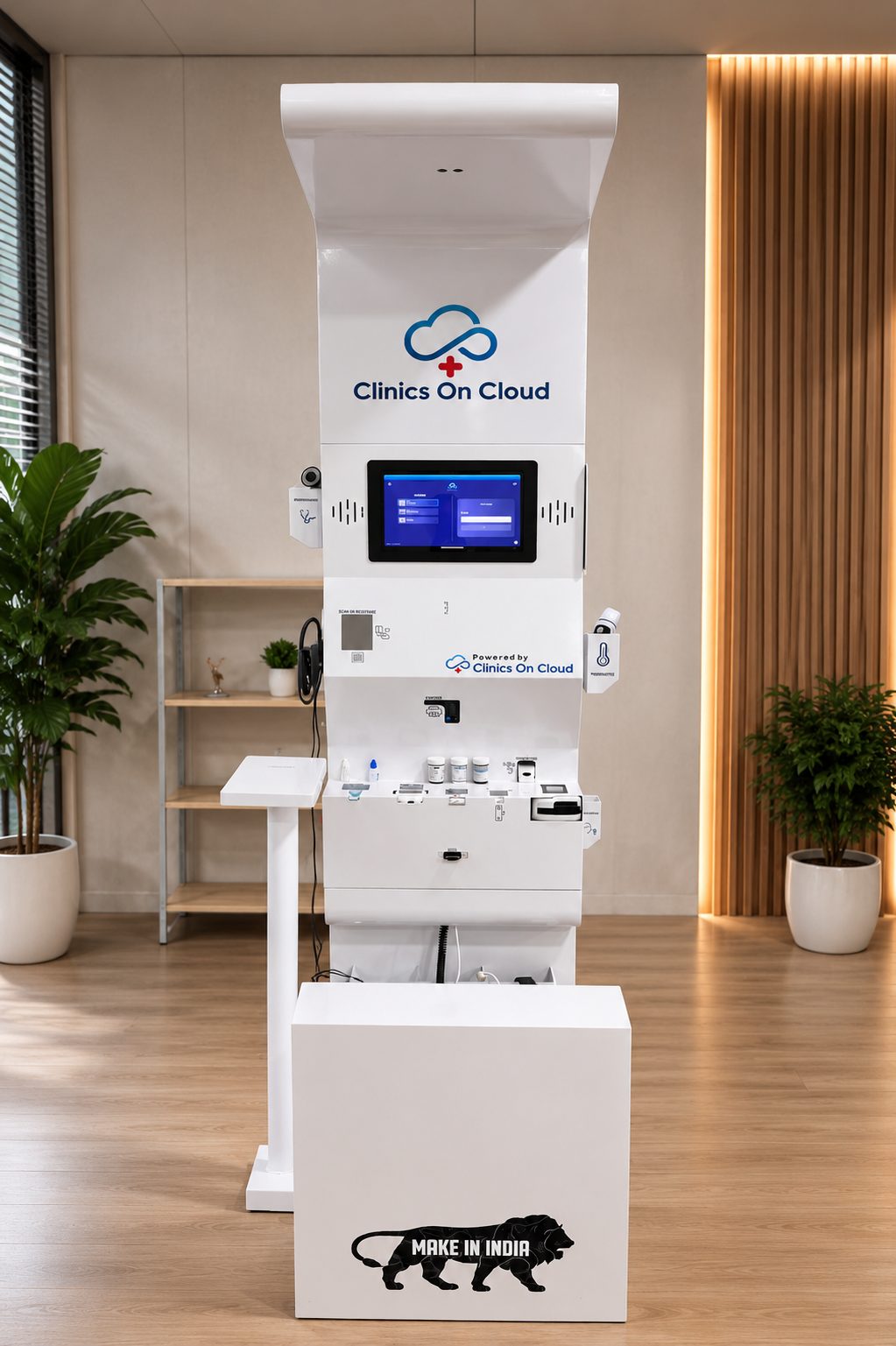
Health ATMs in India are self-service screening stations that check 65+ clinical parameters across 14 specialties in a 10-minute session and link the record to a person’s ABHA health account. Clinics On Cloud has 3,500+ Health ATM installations across 200+ cities in India and abroad, with 12M+ patients screened across the network as of 2026.
India does not have a shortage of clinical skill. It has a distribution problem. A preventive checkup that takes ten minutes of machine time can take a working day of travel, queueing and a return trip for reports, which is why so much screening in India never happens until symptoms force it.
Health ATMs in India exist to close that gap. This page covers where they are being deployed, how they connect to the Ayushman Bharat Digital Mission, what a health ATM machine costs, and what still limits adoption. If you are choosing between suppliers, read the best Health ATM in India and how to pick a manufacturer guide instead.
A Health ATM is a compact screening station that measures a person’s clinical parameters in one guided session and returns an instant, colour-coded report. It is also called a health kiosk, healthcare kiosk or medical kiosk, and in India the terms are used interchangeably.
The adoption logic in India is simple arithmetic. Non-communicable diseases such as diabetes, hypertension and cardiovascular disease develop silently for years. The World Health Organization and the Indian Council of Medical Research both treat early detection as the most effective intervention for this class of condition. Detection requires screening. Screening requires access.
A Health ATM moves the access point. Instead of asking a person to reach a hospital, it puts a 10-minute screening at the factory gate, the panchayat building, the pharmacy counter, the college campus or the railway concourse.
The second driver is data. A paper report from a camp is a one-time event. A Health ATM screening linked to a digital health record is a data point in a series, which is what makes trend detection and population reporting possible.
Health ATM India deployments cluster around six settings, each with a different reason for buying.
| Setting | Who funds it | Primary purpose | Typical form factor |
|---|---|---|---|
| PHCs, CHCs and panchayats | State health departments, NHM | Population screening, teleconsultation referral | Fixed Health Kiosk with telemedicine |
| Factories and industrial plants | Employer, occupational health budget | Statutory and occupational screening | Fixed Health Kiosk at the gate |
| Corporate campuses and IT parks | HR and wellness budget | Annual wellness, insurance-linked checks | Health Lounge or Health Kiosk |
| Hospitals and diagnostic chains | Provider | OPD triage, preventive packages, outreach | Fixed Health Kiosk |
| Schools and colleges | Institution or CSR partner | Vision, hearing, growth, mental health | Fixed Health Kiosk |
| Rural camps and last-mile outreach | CSR, NGO, government | Reach where no infrastructure exists | Box Clinic or Mobile Medical Unit |
Clinics On Cloud has installations in 200+ cities across India and abroad, including last-mile locations, and 8+ countries in total. Named Indian deployments include the Indian Army, the Indian Navy with a shipboard deployment in August 2026, the BSF, the National Health Mission in Uttar Pradesh, the UP Vidhan Sabha, Vidhan Bhavan, Mathura District Hospital, AIIMS Rishikesh and the Government of West Bengal for employee screening.
Where no building, mains power or connectivity exists, a fixed kiosk is the wrong answer. The portable Box Clinic packs the screening set into a transportable case, and the Mobile Medical Unit takes diagnostics and consultations to the doorstep.
A Health ATM in India becomes materially more useful when its output is written to a person’s ABHA (Ayushman Bharat Health Account) rather than printed and forgotten. Clinics On Cloud Health ATMs integrate with ABHA under the Ayushman Bharat Digital Mission and with eSanjeevani, the national teleconsultation service.
Three things change when that link exists:
For any public-health-adjacent buyer in India, ABHA and eSanjeevani integration should be a written requirement in the specification, not an assumed feature.
Public health programmes are the largest single driver of Health ATM adoption in India, because the problem they solve is exactly the problem the government is trying to solve: screening large populations that do not present themselves at facilities.
The National Health Mission in Uttar Pradesh has set up 200 Health ATMs supplied by Clinics On Cloud, with training provided for the healthcare personnel who operate them. Health ATMs have also been installed at the UP Vidhan Sabha and Vidhan Bhavan, and at Mathura District Hospital.
Government deployment imposes constraints that commercial deployment does not:
Health ATM price in India starts from ₹6,00,000 for a Clinics On Cloud unit, with the final figure decided by configuration rather than a list price. There is no single sticker price for the category because two units of the same size can carry very different device sets.
Six factors move the number:
Model on cost per screening completed, not cost per unit installed. Take the five-year total cost of ownership, capex plus consumables plus AMC plus connectivity, and divide by realistic annual throughput.
For an employer, the comparison is against the cost of an external annual checkup vendor plus the production hours lost to a half-day camp. For a CSR or government programme, the comparison is cost per person reached against any other channel that reaches the same population. For a pharmacy or clinic, it is revenue per session against footfall.
The outcome metric that justifies the spend is early detection. Across the Clinics On Cloud network, 2 lakh+ abnormalities have been flagged for early intervention from 12M+ patients screened. Pricing varies by configuration, so ask the team for a written quote against your site list.
| Dimension | Health ATM | Hospital preventive checkup | Diagnostic laboratory |
|---|---|---|---|
| Time per person | 10 minutes | Half a day or more | Sample collection plus report wait |
| Location | Where people already are | At the facility | At the facility or home collection |
| Report delivery | Instant, print, SMS, email, WhatsApp | Same day to several days | Hours to days |
| Output status | Screening, indicative | Clinical assessment | Diagnostic-grade result |
| Doctor involvement | Teleconsultation on abnormal flags | In person | Referring physician interprets |
| Best used for | First-line screening at scale | Comprehensive assessment | Confirming an abnormal finding |
| Cost per person at scale | Lowest | Highest | Middle |
The three are complementary, not competing. A Health ATM is the top of the funnel. Its job is to find the people who need the other two.
A Clinics On Cloud Health ATM screens 65+ clinical parameters across 14 specialties: general health (19 parameters including SpO2, pulse, temperature, BMI, BMR and body composition), cardiac (9, including 6-lead and 12-lead ECG, blood pressure and lipid profile), urine analysis (10), rapid infectious disease (10, including dengue, malaria, typhoid, hepatitis B and C, HIV I & II and blood grouping), Ayurvedic assessment (7), pulmonary function (4), dental and oral cancer screening (4), dermatology (3), vision (3), hearing and ENT (2), diabetes (random blood sugar and HbA1c), anaemia and kidney (2), mental health (PHQ-9 and GAD-7) and maternal health (fetal monitor).
Device accuracy is 90–95% depending on the test and the device, under correct usage, calibration and patient preparation. The full breakdown sits in clinical parameters and tests offered by a health kiosk.
Three constraints are real and worth naming.
Utilisation, not capability. A Health ATM in a badly chosen corner with no awareness campaign does four screenings a day. The same unit at a factory gate with a shift-linked schedule does forty. Placement and communication decide the return.
The follow-up gap. Screening creates a flag. If nobody owns what happens next, the flag produces no health outcome. This is a programme design problem, not a hardware problem.
Expectation setting. A Health ATM screens and flags. It does not diagnose, treat, cure or prevent disease, and Clinics On Cloud is not a diagnostic laboratory. Programmes that promise diagnosis lose trust the first time a screening result needs laboratory confirmation.
To scope a Health ATM deployment in India, call +91 8999 073 447 (Mon–Sat, 9:00–18:00 IST) or email sales@clinicsoncloud.com. Start with the Health Kiosk product page for fixed sites, or read what a Health ATM is and how it works and health kiosk company terminology for background.
Clinics On Cloud is a brand of SehatPro Technologies Pvt Ltd, Nighoje, Chakan MIDC, Pune, Maharashtra 410501, India.
Healthcare is a right. Not a privilege.
Clinics On Cloud provides preventive health screening and is not a diagnostic laboratory. Screening results are indicative and are not a diagnosis. Always consult a qualified physician before acting on any health information.
Your email is never published. Comments appear after a quick review.
Health ATM in Ramanagara | Clinics On Cloud Smart Health Kiosk for Preventive Healthcare Ramanagara is a growing district near
Health ATM in Kalaburagi (Gulbarga) | Clinics On Cloud Smart Health Kiosk for Preventive Healthcare Kalaburagi, also known as Gulbarga,
Health ATM in Vadodara | Clinics On Cloud Smart Health Kiosk for Preventive Healthcare Vadodara is an important industrial and
A Health ATM in India is a self-service or assisted screening station that measures a person’s clinical parameters in a single guided session and returns an instant report. A Clinics On Cloud Health ATM covers 65+ clinical parameters across 14 specialties in 10 minutes, links the record to an ABHA health account, and routes abnormal results to a doctor by teleconsultation.
Health ATM price in India starts from ₹6,00,000 for a Clinics On Cloud unit, with the final figure set by configuration. Parameter set, form factor, telemedicine, integrations, consumables and service level all move it. Compare vendors on five-year total cost of ownership rather than sticker price, and request a written quote for your specific sites.
Prepare a requirement note covering site count, expected daily screenings, required parameters and integration needs, then request a demo and a written configuration quote. Contact Clinics On Cloud on +91 8999 073 447 or sales@clinicsoncloud.com. For government tenders, ask for the CDSCO licence, ISO 13485 certificate and technical datasheet as compliance annexures.
A fixed Health ATM installation is usually completed within a day of the unit reaching site, covering placement, calibration, a test screening run and operator orientation. Site readiness causes most delays, so confirm a level floor area, single-phase power and connectivity in advance. Units also run offline with 3–4 days of battery backup.
An annual maintenance contract covers preventive maintenance visits, device calibration, software updates and a defined response time, with a comprehensive variant that also covers parts. Consumables such as test strips, rapid test cartridges, ECG electrodes and printer rolls are billed separately because they scale with screening volume. Confirm response times for remote sites.
Yes. Clinics On Cloud Health ATMs integrate with ABHA under the Ayushman Bharat Digital Mission and with eSanjeevani, so a screening can be written to a person’s health account and escalated to a teleconsultation. This turns a one-off checkup into a longitudinal record, which is what makes trend detection and population reporting possible.
Yes. Primary Health Centres and Community Health Centres are among the most common Health ATM sites in India, and the National Health Mission in Uttar Pradesh has set up 200 Health ATMs supplied by Clinics On Cloud. Units run in assisted mode with an ASHA worker or ANM, operate offline, and sync when connectivity returns.
Yes. Clinics On Cloud Health ATMs operate offline and synchronise records once a connection is available, with 3–4 days of battery backup for sites with unreliable power. Teleconsultation requires connectivity, so plan a SIM-based or broadband link where doctor escalation is part of the programme design.
Device accuracy is 90–95% depending on the test and the device, under correct usage, calibration and patient preparation. Devices come from manufacturers holding US FDA, CE or CDSCO registration. Results are screening-grade and indicative rather than confirmatory. Any abnormal finding should be reviewed by a qualified physician and confirmed by laboratory testing where required.
State health departments and National Health Mission programmes, hospitals and diagnostic chains, factories and corporate campuses, schools and colleges, pharmacies and clinics, CSR programmes and NGOs, and defence organisations including the Indian Army, Indian Navy and BSF. The right form factor differs by buyer, which is why configuration is quoted per use case.
We started Clinics on Cloud with a simple belief - that the quality of your healthcare should not depend on your postcode. Whether you're a government, corporate, NGO or entrepreneur - we built this for you.
+91 8999 073 447
Mon - Sat · 9 AM to 6 PM IST
sales@clinicsoncloud.com
Partnerships · Deployments · Support
www.clinicsoncloud.com
Products · Case Studies · News
Nighoje, Chakan MIDC
Pune, Maharashtra - 410501, India