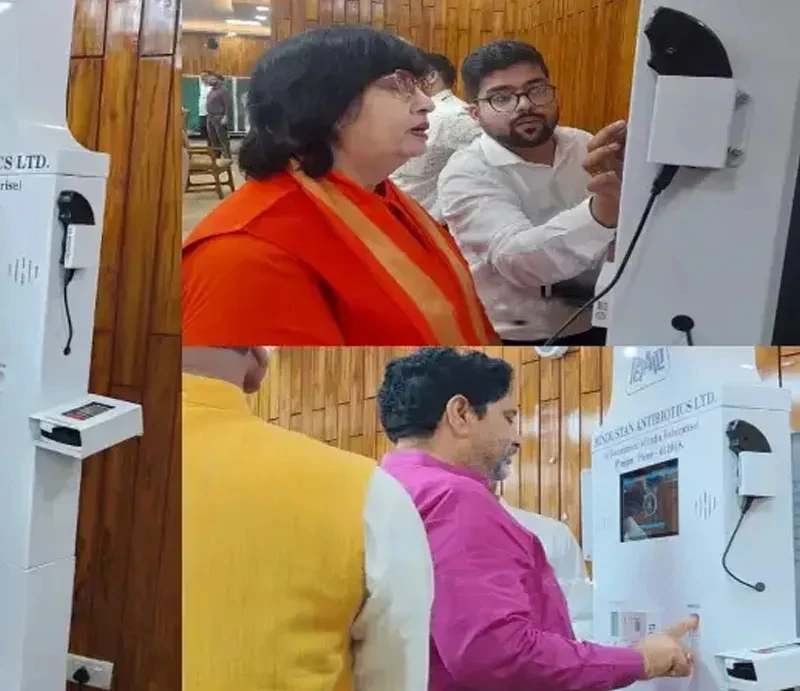
HomeBlogNHM Uttar Pradesh sets up 200+ Health ATMs, facilitates training of healthcare personnel
Article20 March 20232 minUpdated
NHM Uttar Pradesh sets up 200+ Health ATMs, facilitates training of healthcare personnel
NHM Uttar Pradesh sets up 200+ Health ATMs, facilitates training of healthcare personnel.elementor-widget-container p a:link,.elementor-widget-container p a:visited{color:#0066cc}
CCClinics On Cloud TeamPublished from Pune, India
Health ATM
“
The National Health Mission in Uttar Pradesh set up 200 Health ATMs supplied by Clinics On Cloud, and paired the rollout with operator training for health facility staff. Each Clinics On Cloud Health ATM screens 65+ clinical parameters across 14 specialties in a 10-minute checkup and works offline. Clinics On Cloud is India’s first CDSCO-licensed Health ATM manufacturer.
What NHM Uttar Pradesh deployed
The National Health Mission in Uttar Pradesh set up 200 Health ATMs manufactured by Clinics On Cloud, installed across state health facilities, and facilitated training of healthcare personnel to run them.
A Health ATM is a self-service preventive screening station that captures clinical parameters, prints a report on the spot, and stores the record for comparison at the next visit. The Clinics On Cloud unit covers 65+ clinical parameters across 14 specialties, completes a full checkup in 10 minutes, requires no skilled operator, and works offline.
This is the largest public-sector programme on the Clinics On Cloud reference list, and the one most useful to other state health departments, because it addresses the two things a public buyer worries about: whether units can be installed at scale across a large, largely rural state, and whether existing facility staff can be brought up to running them.
No individual official is named in this article. Participation by an office-holder in a state programme is not an endorsement of any manufacturer’s product.
Why operator training decides whether a programme works
The failure mode of government screening equipment is not procurement. It is the unit that sits unused in a corner of a facility because nobody was made responsible for it.
The Clinics On Cloud Health ATM is self-service, with a voice-guided multilingual touchscreen, so a patient completes a session unaided and no clinical qualification is needed to supervise one. That lowers the training burden from clinical instruction to operational orientation. What facility staff are trained on:
Starting a session and identifying the patient, including linking a record to an ABHA identifier under the Ayushman Bharat Digital Mission.
Correct patient preparation and positioning, which is what device accuracy of 90-95% depends on.
Consumable handling and stock, the commonest cause of a unit going idle.
Routing an abnormal flag to the medical officer, without interpreting it.
Escalating a fault, so a service call is raised in days rather than months.
Calibration and cleaning routine, on a stated schedule.
None of that requires a clinician. All of it requires an owner. A programme that assigns a named operator per facility gets utilisation; one that does not gets assets.
What a Health ATM does at a PHC, CHC or district hospital
At a primary health centre, a community health centre or a district hospital, the Health ATM sits ahead of the consultation rather than replacing it.
A patient completes a 10-minute screening before seeing the medical officer. The 65+ clinical parameters across 14 specialties include general health and body composition, blood pressure, ECG and lipid profile, random blood sugar and HbA1c, urine analysis, pulmonary function, vision, audiometry, dental and oral screening, and validated depression and anxiety screeners.
The medical officer then opens the consultation with a data sheet in hand. That changes the economics of a crowded OPD: the same clinical minute goes on decision-making rather than measurement.
Two platform features matter in public facilities. Offline operation with 3-4 days of battery backup keeps units running through power and network interruptions at block-level sites. And ABHA and eSanjeevani integration means a screening record joins the patient’s national digital health record rather than staying trapped inside one machine. Screening is indicative and does not diagnose; the report flags risk and prompts clinical follow-up.
Managing 200 units as a programme, not 200 purchases
Two hundred installations across a state the size of Uttar Pradesh is a logistics and governance problem before it is a clinical one. The elements that hold it together:
Programme element
What it prevents
Named operator per facility, trained
Idle units, unowned faults
Centralised multi-location analytics dashboard
No visibility into which sites are actually screening
Standard consumable supply chain
The commonest cause of a unit stopping
Defined AMC and service response terms
Long dead time after a single component failure
Offline-capable units with 3-4 day battery backup
Downtime at facilities with unreliable power or network
Digital records with longitudinal tracking
Screening that produces reports but no follow-up
ABHA and eSanjeevani linkage
Data that cannot travel with the patient
The dashboard is the item public buyers most often leave out of a specification and most often need. Without site-level utilisation reporting, a department cannot tell an under-used facility from a broken unit. For state and city context, see health kiosk deployment across Uttar Pradesh and health kiosk in Lucknow.
Why government health ATM programmes matter as a category
Public screening programmes exist to find disease in people who have not presented with a complaint. That is exactly the population a facility-based system, which waits for arrivals, cannot see.
India’s non-communicable disease burden is concentrated in conditions that stay silent until they are severe: raised blood pressure, disordered blood sugar, adverse lipid patterns, reduced lung function, uncorrected vision and hearing loss. Each is measurable in minutes and expensive to miss for years.
A Health ATM inside a facility converts every OPD visit into a screening opportunity, whatever the patient came in for. At a block headquarters it extends the screening frontier past the district town. On a camp footing with a Box Clinic portable screening unit, it reaches populations that will not travel at all.
Could a health ATM programme work for your department?
A government health ATM programme suits your department if you are responsible for screening coverage across a defined population, you have facilities with staff but limited diagnostic capacity, and you need reporting that survives an audit.
Practical starting points for a state health mission, district administration, municipal corporation or public sector undertaking:
Start with a site tier, not a state total. Decide whether unit one goes to district hospitals, CHCs, block headquarters or health and wellness centres, and standardise that tier first.
Specify the dashboard in the tender, not after it. Site-level utilisation reporting is what makes the programme manageable.
Write training and AMC into the award. Operator orientation per facility, defined service response times, and a consumable supply commitment.
Specify offline capability explicitly. A unit that needs a live connection will not work at your most remote sites, which are the sites the programme exists for.
Require ABHA and eSanjeevani compatibility so screening records join the national digital health record.
For programme scoping, tender documentation or a site survey, contact Clinics On Cloud on +91 8999 073 447 or sales@clinicsoncloud.com.
Clinics On Cloud provides preventive health screening and is not a diagnostic laboratory. Screening results are indicative and are not a diagnosis. Always consult a qualified physician before acting on any health information.
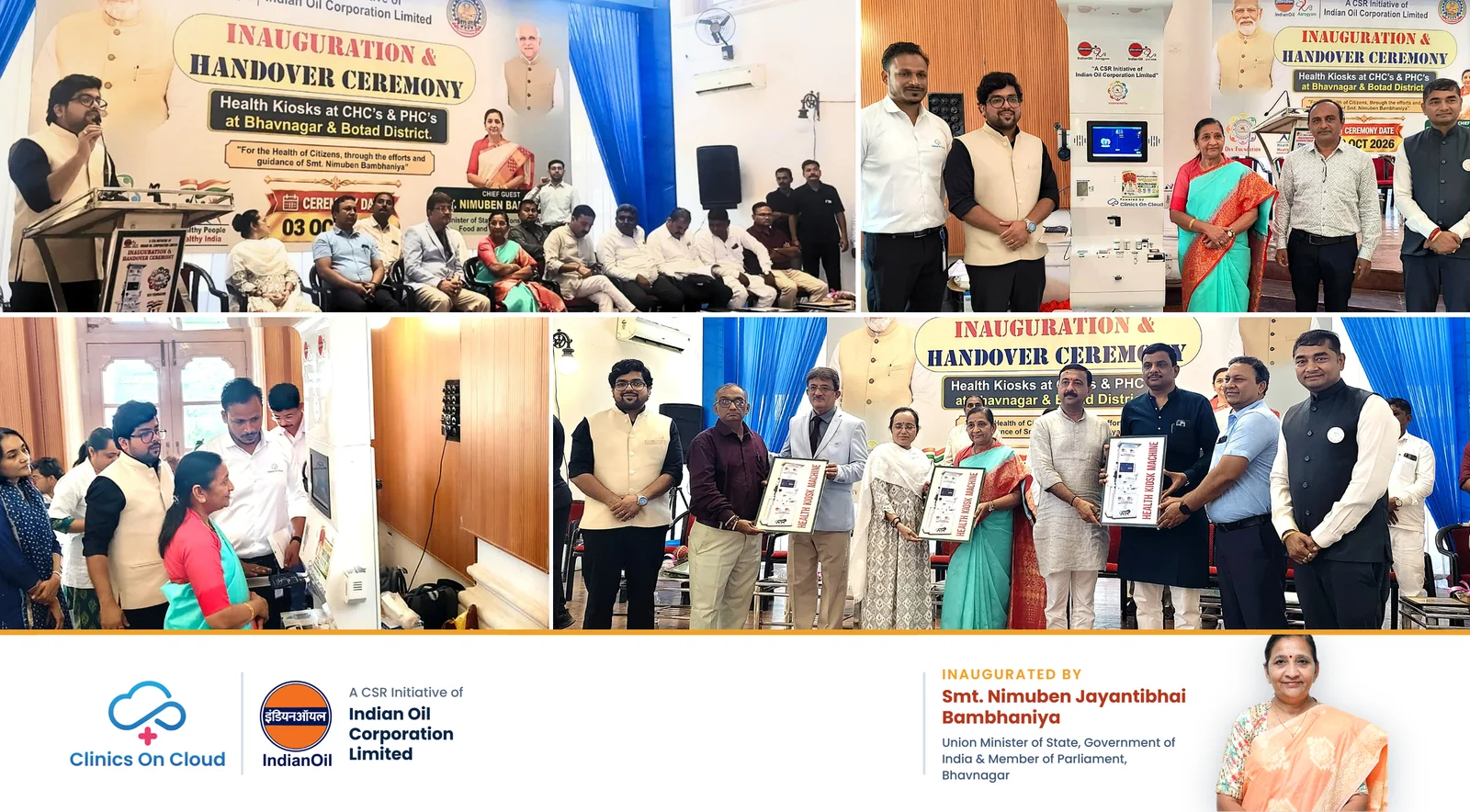
21 Primary Health Centres. 21 Clinics On Cloud Health Kiosks. One stronger connected public-health network - through an IndianOil CSR initiative in the Bhavnagar Lok Sabha constituency.
How many Health ATMs has NHM Uttar Pradesh set up?
The National Health Mission in Uttar Pradesh set up 200 Health ATMs supplied by Clinics On Cloud, together with operator training for healthcare personnel at state health facilities. Each unit screens 65+ clinical parameters across 14 specialties in a 10-minute checkup.
Who supplies Health ATMs to state health missions in India?
Clinics On Cloud, the brand of SehatPro Technologies Pvt Ltd, supplies Health ATMs to public health programmes in India and is India’s first CDSCO-licensed Health ATM and Health Kiosk manufacturer. Its named public-sector users include NHM Uttar Pradesh, the Uttar Pradesh Vidhan Sabha, Mathura District Hospital and the Government of West Bengal.
How do we raise a health ATM tender or start government procurement?
Define the facility tier, unit count, parameter set, connectivity conditions, training scope, AMC terms and dashboard requirement, then approach manufacturers for specifications. Clinics On Cloud provides CDSCO licence documentation, ISO 13485 certification and configuration details for tender packs. Write to sales@clinicsoncloud.com or call +91 8999 073 447.
What does a health ATM cost for a government programme?
Indicative pricing for a Clinics On Cloud Health ATM starts from Rs 6,00,000 per unit, and programme pricing depends on unit count, parameter configuration, training scope and AMC terms. Request a configuration-specific quotation rather than budgeting from a list figure.
Do government Health ATMs need trained medical operators?
No clinical qualification is required. The Clinics On Cloud Health ATM is self-service with a voice-guided multilingual touchscreen. Facility staff are trained on session start, patient preparation, consumables, report routing, fault escalation and cleaning, which is operational rather than clinical training.
Can a Health ATM work at a rural PHC with unreliable power and no internet?
Yes. The Clinics On Cloud Health ATM is offline-capable and holds 3-4 days of battery backup. It captures and prints reports locally and synchronises records when connectivity returns. Teleconsultation through eSanjeevani requires a connection; screening and reporting do not.
Get In Touch
Healthcare is a right. Not a privilege.
We started Clinics on Cloud with a simple belief - that the quality of your healthcare should not depend on your postcode. Whether you're a government, corporate, NGO or entrepreneur - we built this for you.
Call us
+91 8999 073 447
Mon - Sat · 9 AM to 6 PM IST
Write to us
sales@clinicsoncloud.com
Partnerships · Deployments · Support
Visit us online
www.clinicsoncloud.com
Products · Case Studies · News
Find us
Nighoje, Chakan MIDC
Pune, Maharashtra - 410501, India
Built for every kind of health partner.
Government Body Corporate / HR Team NGO / CSR Partner Hospital or Clinic Defence Organisation International Partner Investor / Distributor Rural Entrepreneur
 Entry · HA-35Health ATM