Health kiosk in Delhi NCR
Clinics On Cloud Smart Health Kiosk for Preventive Healthcare Delhi NCR — covering New Delhi, Noida, Ghaziabad, Gurugram, Faridabad —
Read story 4 min
Uttar Pradesh is India’s most populated state with 24+ crore people, spread across major urban cities and thousands of rural villages. While UP has top-tier hospitals in Lucknow, Noida, Ghaziabad, Kanpur, Varanasi, a large portion of the population depends on PHCs, CHCs, and district hospitals for basic services.
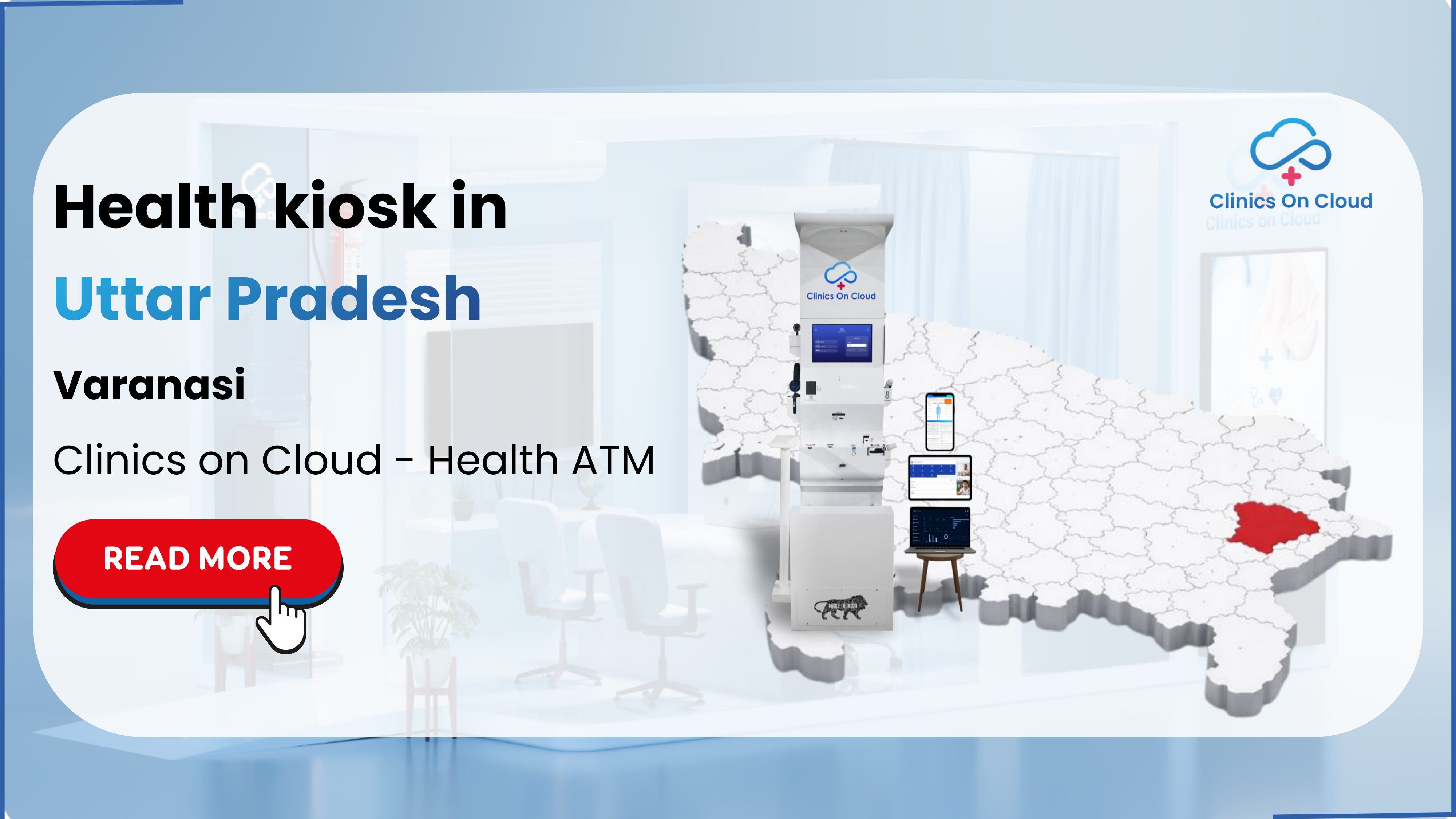
Clinics On Cloud has supplied 200 Health ATMs to the National Health Mission in Uttar Pradesh, with kiosks installed at the UP Vidhan Sabha, Vidhan Bhavan and Mathura District Hospital. A Health ATM is a self-service station that captures 65+ clinical parameters across 14 specialties and connects flagged users to a doctor on video.
Uttar Pradesh is not a single market. Five distinct buyers procure health kiosks here, and each one measures success differently.
| Buyer | What they are solving | What they measure |
|---|---|---|
| State public health programme | Screening reach across districts, at scale | Screenings per facility, flag rate, referral completion |
| Government institution | Staff and visitor health access on premises | Utilisation, staff participation |
| District or public hospital | Outpatient crowding, pre-consultation workup | Queue reduction, triage quality |
| Industrial or corporate employer | Workforce screening without lost production | Coverage of headcount, repeat rate |
| CSR foundation or NGO | Reach into underserved blocks | People screened, follow-ups completed, cost per screening |
Clinics On Cloud supplied 200 Health ATMs to the National Health Mission in Uttar Pradesh. That deployment is the reference point for any state-scale procurement, because it tests the things a pilot never does: consistency across many facilities, service coverage across districts, and reporting that rolls up.
A public health buyer at this scale should specify four things at tender stage. First, a configuration standard per facility tier, so a district hospital and a community health centre are not given identical sensor sets by default. Second, offline capability, because connectivity in Terai and Bundelkhand districts is uneven and screenings must not be lost. Third, an ABHA linkage path under the Ayushman Bharat Digital Mission, so a screening becomes part of a longitudinal record rather than a one-off printout. Fourth, a referral pathway, including teleconsultation routes such as eSanjeevani, so a flagged result reaches a clinician.
The kiosk itself is designed for this environment: rugged metal enclosure, 3 to 4 days of battery backup, offline operation, and a voice-guided multilingual interface that needs no skilled operator.
Clinics On Cloud kiosks are installed at the UP Vidhan Sabha and at Vidhan Bhavan in Lucknow. Institutional buildings are a distinct buying context from a hospital or a factory.
The population is staff, officials and visitors, and the purchase is usually justified as an on-premises health facility rather than a clinical service. Placement is the whole decision here. A kiosk in a main corridor or near a canteen gets used; one in an administrative annexe does not. Reports go out by print, SMS, email or WhatsApp, which suits a population that will not return to collect anything.
Secretariats, municipal corporations, police lines and PSU offices across Lucknow, Kanpur, Prayagraj and Gorakhpur fit the same pattern.
A Health ATM is installed at Mathura District Hospital. In a district hospital the kiosk earns its place at the front of the outpatient flow, not at the back.
The logic is simple. A patient waiting for a consultation completes a 10-minute screening while queuing, and arrives at the doctor with vitals, body composition, blood pressure, blood sugar and, where configured, ECG and lipid results already captured. That shortens the consultation and makes it more useful. Anaemia, diabetes, blood pressure, vision and urine analysis parameters are the ones public hospital buyers weight most heavily.
Two operational points matter. Consumables have to be stocked by someone with a named responsibility, and the kiosk should sit where hospital staff can see it, so that patients are directed towards it rather than left to discover it.
Uttar Pradesh has a wider industrial spread than its reputation suggests. Noida and Greater Noida carry electronics, mobile assembly and services. Kanpur has leather and engineering. Agra has footwear, Firozabad glass, Moradabad brassware, Aligarh locks, Bhadohi carpets, Varanasi weaving, and western UP a long line of sugar mills through Meerut, Muzaffarnagar and Bijnor.
Most are cluster industries built on small units and a workforce that moves between them. A shared kiosk at an industrial association reaches employers too small to fund their own occupational health room. Larger plants place the unit at the gate and screen at shift change. The argument to the employer is the same either way: screening that costs ten minutes of a shift instead of a day of wages actually happens.
CSR programmes in Uttar Pradesh usually target the eastern Purvanchal districts, the Bundelkhand belt around Jhansi, Banda, Mahoba and Chitrakoot, or the Terai districts along the Nepal border such as Lakhimpur Kheri, Bahraich, Shrawasti and Balrampur.
These are camp environments, not permanent installations. The portable Box Clinic and the Mobile Medical Unit fit better than a fixed kiosk, because the constraint is reaching dispersed habitations rather than serving a fixed footfall. Foundations should plan repeat cycles to the same blocks, since a single camp produces a number and a repeat camp produces a trend. A centralised dashboard across camp locations is what makes the programme reportable to a CSR committee.
Uttar Pradesh spans the western sugar and industrial belt, the central Doab, Awadh around Lucknow, Bundelkhand in the dry south, Purvanchal in the east and the Terai along the northern border. Access difficulty rises sharply as you move away from the Doab.
Language follows the same map. Hindi is the base, with Awadhi around Lucknow and Faizabad, Bhojpuri through Varanasi, Gorakhpur and Ballia, Braj around Mathura and Agra, Bundeli in the south, and Urdu widely spoken across the state. A voice-guided multilingual interface is what makes an unassisted screening possible for a user who reads little.
Pilgrimage geography adds a screening opportunity that few states have at this scale. Varanasi, Prayagraj, Ayodhya, Mathura, Vrindavan, Chitrakoot and Naimisharanya draw very large, time-bound crowds, many of them elderly and travelling long distances. Screening points at pilgrim facilities reach people who would not otherwise be screened anywhere.
Indicative Health ATM pricing starts from ₹6,00,000, with the final quotation set by configuration, expected volume and consumables. Government and CSR procurements are usually structured per facility tier rather than as a single unit price.
A prepared site is surveyed, delivered, commissioned and handed over within days, and orientation takes under a day. Multi-district rollouts are sequenced, which is how a 200-unit programme is delivered without stranding equipment at sites that are not ready. Annual maintenance contracts cover preventive visits, calibration, sensor checks, consumable supply and spares across the state.
For related markets see the sector view of health kiosks across Delhi NCR and health kiosk deployment in Rajasthan. Readers new to the format should start with what a Health ATM is and how it works, and buyers comparing suppliers with the guide to the best Health ATM in India.
Clinics On Cloud provides preventive health screening and is not a diagnostic laboratory. Screening results are indicative and are not a diagnosis. Always consult a qualified physician before acting on any health information.
Your email is never published. Comments appear after a quick review.
Clinics On Cloud Smart Health Kiosk for Preventive Healthcare Delhi NCR — covering New Delhi, Noida, Ghaziabad, Gurugram, Faridabad —
Gujarat’s Healthcare Landscape Gujarat is one of India’s most industrially advanced states with strong economic growth, but its healthcare system
 Entry · HA-46Health ATM
Clinics On Cloud Smart Health Kiosk for Preventive Healthcare Telangana is one of India’s fastest-growing states with strong urban development
Yes. Clinics On Cloud supplied 200 Health ATMs to the National Health Mission in Uttar Pradesh, and its kiosks are installed at the UP Vidhan Sabha and Vidhan Bhavan in Lucknow and at Mathura District Hospital. These are the named Uttar Pradesh deployments the company references.
Common sites are district hospitals and community health centres, government offices and secretariats, factories and industrial cluster facilities in Noida, Kanpur, Agra, Moradabad and Firozabad, sugar mills in the western belt, college campuses, and pilgrim facilities in Varanasi, Prayagraj, Ayodhya and Mathura. The kiosk is voice-guided and needs no skilled operator, so rural users complete screenings unassisted.
Yes. Clinics On Cloud supplies, installs and services Health ATMs across Uttar Pradesh, manufactured at Nighoje, Chakan MIDC, Pune. The company has delivered at state programme scale in UP, so coverage extends beyond the Lucknow and Noida corridors into district-level facilities.
A prepared single site is surveyed, delivered, commissioned and handed over within days, with orientation completed in under a day. Large multi-district programmes are sequenced in clusters so that facilities are ready before units arrive, which is the main reason large rollouts slip.
Yes. Annual maintenance contracts cover scheduled preventive visits, calibration, sensor checks, consumable supply and spares, including facilities in Bundelkhand, Purvanchal and the Terai districts. For public programmes, agree the response window and the consumable replenishment cycle in the contract.
Indicative pricing starts from ₹6,00,000, and the final figure depends on which of the 14 specialties you configure, expected volume and consumables. Government and CSR buyers are normally quoted per facility tier. Share your facility list and screening target for a configured quotation.
Define the facility tiers, the per-facility screening target and the referral pathway first, then request a configuration against that specification. Clinics On Cloud provides a centralised dashboard across locations. Most programmes commission a first cluster, review 90 days of data, then release the balance.
No. A Health Kiosk screens and flags. Clinics On Cloud is not a diagnostic laboratory and the device does not diagnose, treat or cure. Device accuracy is 90 to 95 percent depending on the test and device, under correct usage, calibration and patient preparation, and flagged results are intended to prompt follow-up with a qualified physician.
We started Clinics on Cloud with a simple belief - that the quality of your healthcare should not depend on your postcode. Whether you're a government, corporate, NGO or entrepreneur - we built this for you.
+91 8999 073 447
Mon - Sat · 9 AM to 6 PM IST
sales@clinicsoncloud.com
Partnerships · Deployments · Support
www.clinicsoncloud.com
Products · Case Studies · News
Nighoje, Chakan MIDC
Pune, Maharashtra - 410501, India