HomeBlogHealth ATM installed in Vidhan Bhavan- Test and checkups done for MLA and Ministers
Article16 December 20222 minUpdated
Health ATM installed in Vidhan Bhavan- Test and checkups done for MLA and Ministers
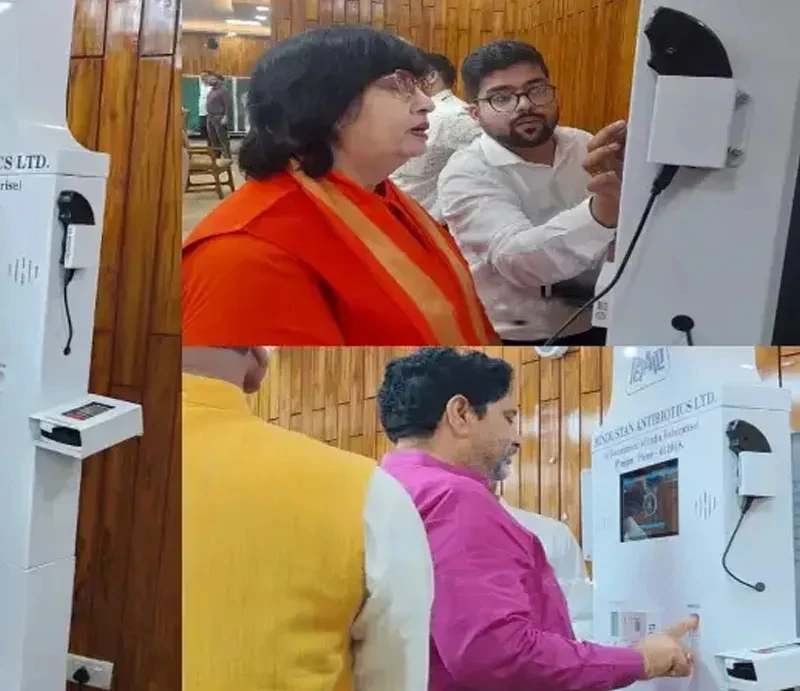
Clinics on Cloud Health ATM bringing revolution in the Preventive Health Care Industry. The machine was installed at Vidhan Sabha – Lucknow. MLAs and Ministers who personally preformed their medical checkup on the Clinics on Cloud Health ATM and were amazed as to how more than 32 medical parameters were tested within 5 minutes and they instantly received the medical reports over WhatsApp, SMS and
CCClinics On Cloud TeamPublished from Pune, India
Health ATM
“
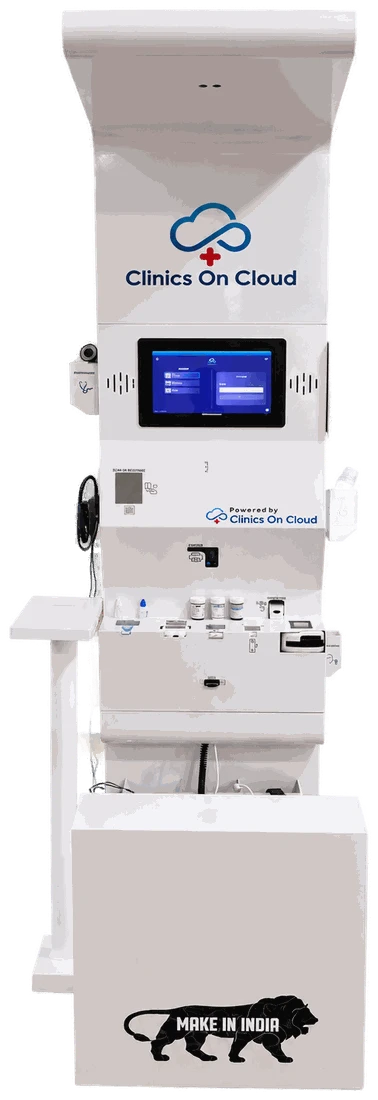
A health ATM for government offices is a self-service screening station placed inside a staff building so employees can complete a checkup without leaving work. Clinics On Cloud installed one at the Uttar Pradesh Vidhan Sabha in the Vidhan Bhavan complex, Lucknow. Each unit screens 65+ clinical parameters across 14 specialties in 10 minutes and works offline.
The deployment this category argument rests on
Clinics On Cloud installed a Health ATM at the Uttar Pradesh Vidhan Sabha, inside the Vidhan Bhavan complex in Lucknow. That installation is the reference point for everything below, and the deployment record itself is set out in the article on the Health ATM installed at the Uttar Pradesh Vidhan Sabha in Lucknow.
Three clarifications, because this page has previously carried claims it could not support. The approved Clinics On Cloud Vidhan Bhavan installation is in Uttar Pradesh, and in no other state. No legislator, minister or official is named here, no statement is attributed to any office-holder, and no use of the unit by an office-holder is presented as an endorsement. And no Uttar Pradesh site count is claimed; the verified state-level fact is the 200-unit NHM Uttar Pradesh Health ATM programme.
What remains, and what is genuinely useful to a departmental buyer, is the model: a government building as a screening point for the people who work in it.
Why government staff are structurally under-screened
Government employment in India comes with medical entitlements and almost no routine measurement.
The entitlement usually activates on illness. A staff member who feels well has no trigger to use it, no appointment already booked, and no reason to spend a working day at a hospital to be told nothing is wrong. So the entitlement is used late, when there is a complaint, which is precisely when preventive screening has already stopped being preventive.
The occupational profile compounds it. Administrative work is sedentary, sitting-heavy, and clustered around deadlines and sessions that make time off hardest exactly when stress is highest. Field-side government staff have the opposite problem: they are rarely in one building long enough to be caught by any scheduled camp.
Use a Mobile Medical Unit or Box Clinic rotation instead
Departments with a dedicated welfare or recreation room have a second option, the Health Lounge for offices and communities, which supports a guided session rather than a walk-up one.
How a department actually runs one
The operating model is simpler than most departments expect, because the unit is self-service and no clinical staffing is created.
Assign ownership. One named administrative officer per unit, usually from the establishment or welfare section. This is the single decision that determines whether the unit is used.
Set access rules. Staff-only, staff plus dependants, or staff plus visiting public. Decide before installation, because it changes placement.
Publish availability, not appointments. The value of a 10-minute self-service checkup collapses if a booking system is put in front of it.
Stock consumables against a fixed reorder point. Consumables running out is the most common reason a working unit goes idle.
Route abnormal flags to a named medical officer or to the platform’s integrated telemedicine consultation, so a flag produces a follow-up rather than a filed report.
Review the analytics dashboard monthly at department level: sessions completed, coverage against headcount, flags raised.
Records go to the individual by print, SMS, email and WhatsApp, and can be linked to an ABHA identifier under the Ayushman Bharat Digital Mission. The department sees aggregate coverage, not named results.
Screening is indicative. The platform flags values that fall outside standard clinical guidance and prompts a consultation; it does not diagnose.
The objections departments raise, answered
“We already have a medical reimbursement scheme.” Reimbursement pays for care after a complaint. Screening finds risk before one. They do not substitute for each other, and the screening unit reduces the load on the scheme by moving detection earlier.
“Staff will not use it.” Uptake in workplace screening is governed by friction more than by motivation. A unit inside the building, with no appointment and a ten-minute session, removes the three barriers that suppress participation. A unit in a basement corridor with no assigned owner does not.
“Our building has power problems.” The Clinics On Cloud Health ATM is offline-capable and holds 3-4 days of battery backup, so screening and printing continue through interruptions and records synchronise later.
“Who is accountable for the data?” Clinics On Cloud operates an ISO 27001 certified platform and states HIPAA and GDPR compliance. Individual records belong to the individual; departments receive aggregated analytics.
“Will the reports be taken seriously by doctors?” The report is a screening record, not a diagnostic report, and it is designed to prompt appropriate medical follow-up rather than to substitute for it. Device accuracy is 90-95% depending on the test and device, under correct usage, calibration and patient preparation.
Could a health ATM for government offices work for your department?
The fit test is short. You have a building with a few hundred or more staff who are there most days, some spare floor area near a circulation route with a power point, and an establishment or welfare section that can own the unit.
If that holds, the specification conversation needs four inputs: headcount, available floor area and its power access, whether the unit serves staff only or also the visiting public, and the parameter emphasis you want. Occupational grades usually justify adding pulmonary function, audiometry and vision to the standard set described in 65+ clinical parameters across 14 specialties.
Clinics On Cloud is CDSCO licensed, manufactures at Nighoje, Chakan MIDC, Pune, and supplies documentation suitable for departmental and tender procurement. Procurement committees comparing suppliers should read India’s CDSCO-licensed Health ATM manufacturer; readers looking for local presence should see health kiosk in Lucknow.
Contact Clinics On Cloud on +91 8999 073 447 or sales@clinicsoncloud.com for a site survey.
Clinics On Cloud provides preventive health screening and is not a diagnostic laboratory. Screening results are indicative and are not a diagnosis. Always consult a qualified physician before acting on any health information.
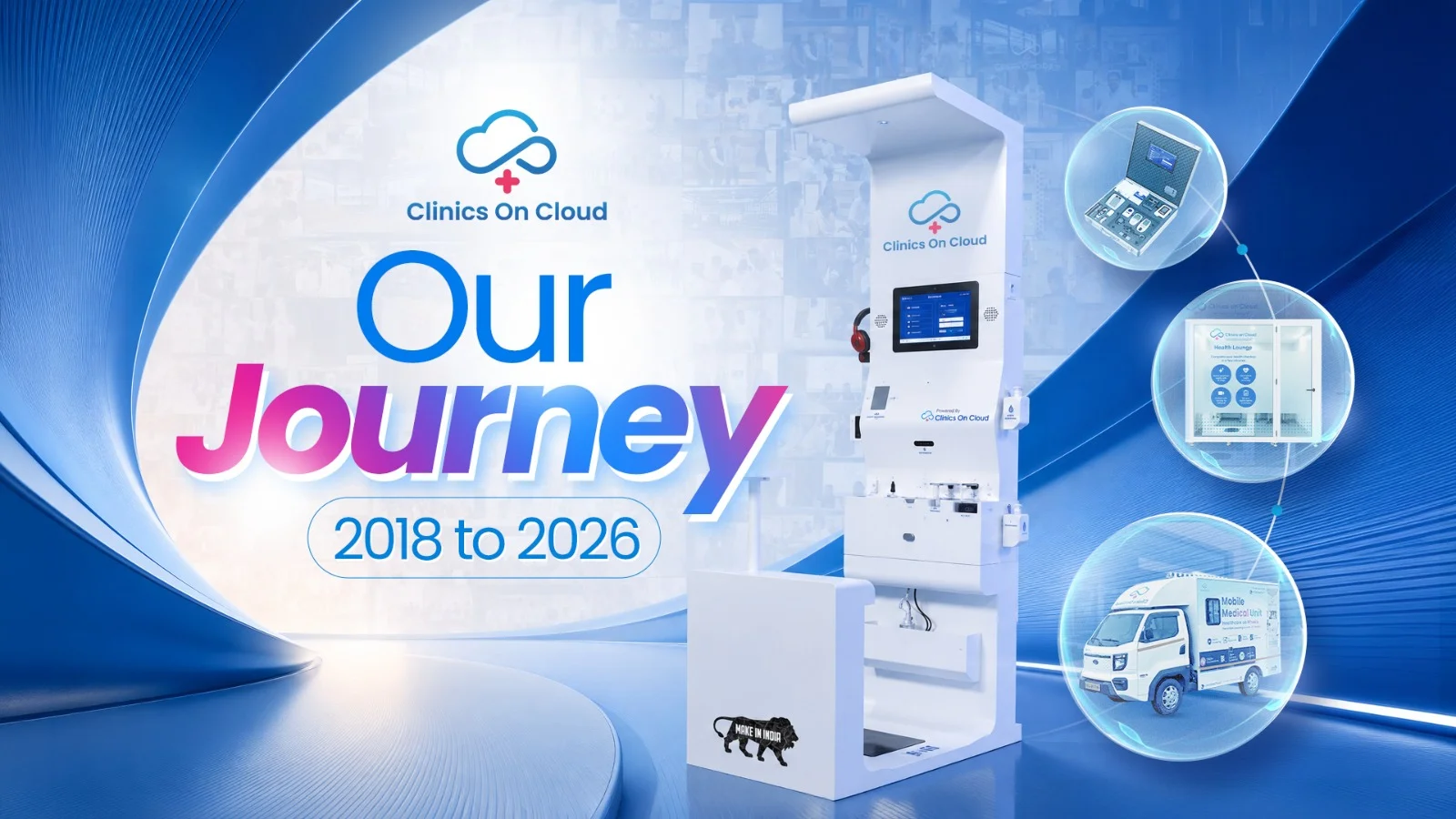
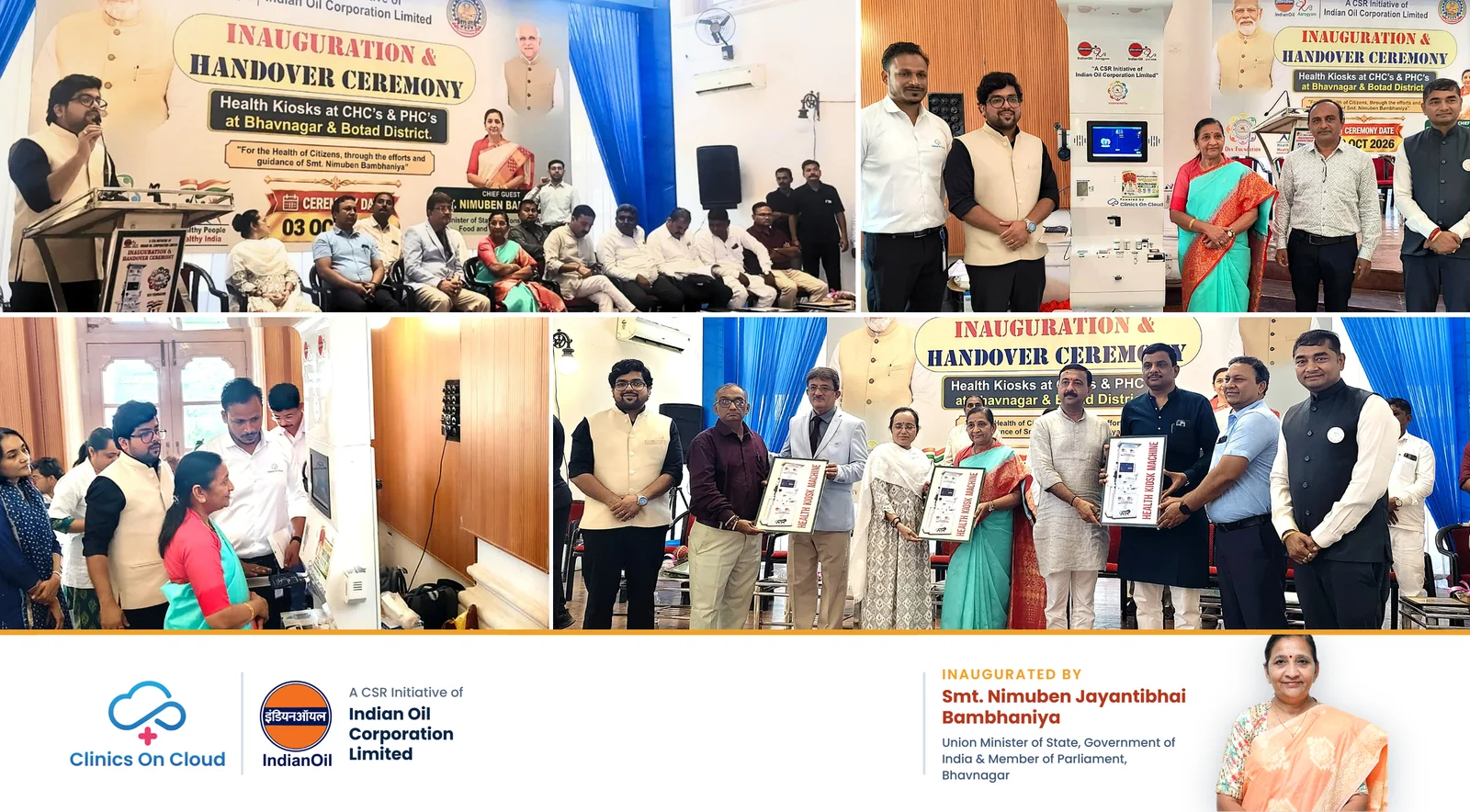
21 Primary Health Centres. 21 Clinics On Cloud Health Kiosks. One stronger connected public-health network - through an IndianOil CSR initiative in the Bhavnagar Lok Sabha constituency.
If ATMs could revolutionise banking by bringing financial services closer to people, why could healthcare not become just as accessible? Eight years on, that question is still the company.
What does an AI health kiosk actually measure, and what does the AI add? A clear walkthrough of parameters, predictive risk scores, AI diet plans and smart reports.
Can a health ATM be installed in a government office?
Yes. Clinics On Cloud installed a Health ATM at the Uttar Pradesh Vidhan Sabha in the Vidhan Bhavan complex, Lucknow. The same configuration suits secretariats, directorates, municipal corporations, collectorates, public sector undertaking offices and training academies with a fixed staff population.
How much does a health ATM for a government office cost?
Indicative pricing for a Clinics On Cloud Health ATM starts from Rs 6,00,000. The final figure depends on the parameter set, unit count, enclosure, training scope and AMC terms. Contact sales@clinicsoncloud.com or +91 8999 073 447 for a configuration-specific quotation.
How do we procure a health kiosk for government employees?
Define the building tier, unit count, parameter set, access rules, training scope and AMC terms, then request specifications. Clinics On Cloud is CDSCO licensed and ISO 13485 certified and provides documentation for departmental and tender procurement. Enquiries go to +91 8999 073 447.
Who owns and maintains the unit once it is installed?
The department assigns one named administrative officer per unit for access, consumables and fault escalation. No clinical staffing is required, because the unit is self-service with a voice-guided multilingual touchscreen. Clinics On Cloud handles installation, operator orientation and service under the AMC.
Do government employees have to pay to use it?
That is set by the department, not by the equipment. Where a department funds the unit as a staff welfare measure, screening is normally free to the employee. Access rules for dependants and the visiting public are configured at installation.
Is a screening record from an office unit confidential?
Individual reports are delivered to the individual by print, SMS, email or WhatsApp, and can be linked to an ABHA identifier under the Ayushman Bharat Digital Mission. The department receives aggregated coverage analytics, not named clinical records. Clinics On Cloud is ISO 27001 certified and states HIPAA and GDPR compliance.
Get In Touch
Healthcare is a right. Not a privilege.
We started Clinics on Cloud with a simple belief - that the quality of your healthcare should not depend on your postcode. Whether you're a government, corporate, NGO or entrepreneur - we built this for you.
Call us
+91 8999 073 447
Mon - Sat · 9 AM to 6 PM IST
Write to us
sales@clinicsoncloud.com
Partnerships · Deployments · Support
Visit us online
www.clinicsoncloud.com
Products · Case Studies · News
Find us
Nighoje, Chakan MIDC
Pune, Maharashtra - 410501, India
Built for every kind of health partner.
Government Body Corporate / HR Team NGO / CSR Partner Hospital or Clinic Defence Organisation International Partner Investor / Distributor Rural Entrepreneur
 Entry · HA-81Health ATM