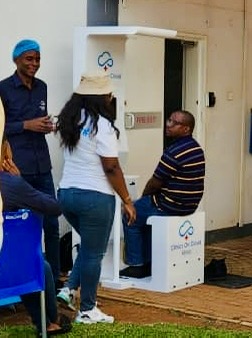
A Health ATM is an innovative healthcare kiosk designed to provide basic health check-ups and medical services in a convenient and efficient manner. It is connected to multiple point-of-care (POC) devices and offers a wide range of features, such as:
CCClinics On Cloud TeamPublished from Pune, India
Health ATM
“
A Health ATM, also called a health kiosk, is a self-service preventive screening station that measures 65+ clinical parameters across 14 specialties in about 10 minutes and delivers an instant colour-coded report. Clinics On Cloud, India’s first CDSCO-licensed Health ATM and Health Kiosk manufacturer, has 3,500+ installations across 200+ cities and 8+ countries as of 2026.
This page answers the 35 questions buyers, clinicians and users actually ask about health kiosks and Health ATMs: what they test, how accurate they are, what they cost to buy and run, how installation works, where the data goes, and which sector they suit. Every answer is self-contained, so you can read only the section you need.
Basics: what a health kiosk is
1. What is a Health ATM?
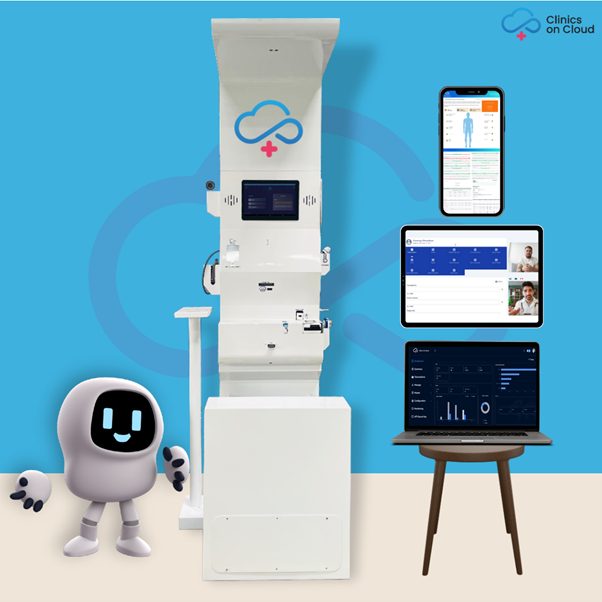
A Health ATM is a self-service preventive screening station that lets a person complete a health checkup without a technician, a laboratory or an appointment. A Clinics On Cloud Health ATM covers 65+ clinical parameters across 14 specialties in about 10 minutes, prints a colour-coded report, delivers it by SMS, email and WhatsApp, and can start a doctor consultation when a value is flagged.
2. Is a health kiosk the same thing as a Health ATM?
Yes. Health kiosk, Health ATM, eHealth kiosk, smart health kiosk, wellness kiosk, telemedicine kiosk and digital dispensary all describe the same class of self-service preventive screening station. The vocabulary changes with the buyer: government and CSR buyers in India usually say Health ATM, hospitals and international buyers usually say health kiosk. Use both terms in a tender so all vendors respond.
3. How long does a health kiosk checkup take?
A full checkup on a Clinics On Cloud health kiosk takes about 10 minutes. Shorter configured packages, for example a vitals-and-BMI set for a school screening, take less. Rapid infectious-disease tests involve collecting a sample manually and add their own processing time on top of the standard 10-minute screening flow.
What it tests
4. How many tests does a health kiosk perform?
A Clinics On Cloud health kiosk covers 65+ clinical parameters across 14 specialties: general health, cardiac, urine analysis, rapid infectious disease, Ayurvedic assessment, pulmonary function, dental and oral cancer screening, dermatology, vision, hearing and ENT, diabetes, anaemia and kidney, mental health, and maternal health. The exact menu enabled at a site is configurable by the buyer.
5. What are the 14 specialties covered?
Specialty
Parameters
Representative tests
General health
19
SpO2, pulse, temperature, height, weight, BMI, BMR, body water, muscle mass, bone mass, body fat, visceral fat, metabolic age
Dengue, malaria, COVID-19 antigen, HIV I & II, typhoid, chikungunya, hepatitis B, hepatitis C, syphilis, blood grouping
Ayurvedic assessment
7
Constitution and lifestyle assessment
Pulmonary function
4
PEF, FVC, FEV, FEV1/FVC
Dental and oral cancer screening
4
Intra-oral visualisation
Dermatology
3
Skin, hair, nail visualisation
Vision
3
Far vision, near vision, colour blindness
Hearing and ENT
2
Audiometry, otoscope visualisation
Diabetes
2
Random blood sugar, HbA1c
Anaemia and kidney
2
Screening indicators
Mental health
2
Depression (PHQ-9), anxiety (GAD-7)
Maternal health
1
Fetal monitor
6. Can we customise which tests the kiosk offers?
Yes. Test menus are configured per deployment. A school programme may enable vision, hearing, BMI and anaemia only. A factory usually enables pulmonary function, audiometry and vision for occupational health. A corporate wellness programme typically enables the cardiac and diabetes sets. Fixing the menu early matters because it drives both capital cost and consumable cost.
Accuracy and reliability
7. How accurate is a health kiosk?
Clinics On Cloud health kiosks operate at 90–95% device accuracy depending on the test and the device, under correct usage, calibration and patient preparation. That is screening accuracy, appropriate for identifying people who need clinical follow-up. It is not diagnostic accuracy and does not replace confirmatory testing at an accredited laboratory.
8. Are the devices inside the kiosk calibrated?
Yes. Integrated devices are factory-calibrated, and consumable-based tests such as HbA1c and the lipid profile carry batch calibration coding on the consumable packaging so each batch is matched to the instrument. Preventive maintenance under an annual maintenance contract keeps calibration and device health verified over the life of the deployment.
9. Why do readings sometimes differ from a laboratory result?
Three things account for most variation: usage technique, patient preparation and timing. A blood pressure reading taken while the user is talking, or a fasting-dependent value taken after a meal, will differ from a controlled laboratory measurement. Screening readings are indicative by design. Any flagged value should be confirmed by a physician-ordered laboratory test.
10. Will a doctor accept a health kiosk report?
A health kiosk report is a screening record, not a diagnostic report. It is intended to raise awareness and prompt appropriate medical follow-up, and clinicians generally treat it that way: as a reason to order confirmatory tests. Clinics On Cloud does not promise that any specific clinician will accept the report in place of laboratory testing.
11. What certifications back the equipment?
Clinics On Cloud holds a CDSCO licence and is India’s first CDSCO-licensed Health ATM and Health Kiosk manufacturer. The quality and security set is ISO 13485 for medical device quality management, US FDA and CE for integrated devices, ISO 27001 for information security, HIPAA and GDPR compliance, and VAPT testing of the platform. Ask any vendor for the same list in writing.
Cost, purchase and AMC
12. How much does a health kiosk cost in India?
Clinics On Cloud health kiosk pricing starts from ₹6,00,000 and varies by configuration. The device set, enclosure format, language pack, telemedicine arrangement and analytics scope all move the number. Because configuration drives price, a single headline figure is meaningless until the test menu is fixed. Request a configuration-specific quotation rather than comparing headline prices.
13. What does a health kiosk cost to run each year?
Recurring costs fall into six lines: consumables for biochemistry and rapid tests, connectivity, electricity, the annual maintenance contract after the warranty period, bio-medical waste disposal where consumables are used, and optional site staffing. Consumable cost is the largest variable and depends entirely on which tests you enable and how many screenings you run.
14. How is the annual maintenance contract priced?
AMC pricing is quoted per configuration, because the device set determines what has to be maintained and replaced. Ask for the AMC scope in writing before the warranty expires: what preventive maintenance is included, what the response time is for a device fault, whether replacement devices are shipped or swapped on site, and whether software updates are covered.
15. What warranty comes with a health kiosk?
Warranty terms are stated in the quotation and cover manufacturing defects and device malfunction, excluding physical damage. Ask three specific questions before signing: what is the warranty period on the integrated devices as distinct from the enclosure, what is the turnaround for a device replacement, and what happens to the software licence when the warranty ends.
16. Can I rent or lease a health kiosk instead of buying one?
Rental, lease and pay-per-screening commercial models are available depending on volume, deployment length and location. Rental usually suits pilots, event-based screening and short CSR campaigns; purchase usually suits permanent placements. Clinics On Cloud structures the commercial model around the deployment, so state your expected screening volume and duration when you enquire.
17. What is the ROI on a health kiosk?
ROI depends on the buyer’s objective. A corporate buyer measures it against the cost and lost time of off-site camps. A hospital measures it against OPD throughput and downstream confirmatory testing. A pharmacy or franchise operator measures it as a per-screening margin against a fixed monthly cost. Any ROI model should be built on your own footfall and pricing assumptions, not on a vendor’s headline figure.
18. How should we price screening for end users?
Pricing is the site owner’s decision and should be benchmarked against local screening and pathology pricing in your catchment, and against your consumable cost per screening for the exact test menu you have enabled. Ask your supplier for consumable pricing per test rather than per box so you can calculate a true marginal cost per screening.
19. How do we buy a health kiosk?
Contact Clinics On Cloud with three inputs: the deployment site type, the population you intend to screen, and the parameter list you need. Sales confirms a configuration, quotes capital cost, consumables, warranty and AMC, and schedules a demonstration. Reach the team on +91 8999 073 447, Monday to Saturday 9:00 to 18:00 IST, or at sales@clinicsoncloud.com.
20. What should a health kiosk tender specification contain?
A defensible tender specification states the parameter list by specialty, the required certifications (CDSCO licence, ISO 13485, ISO 27001, US FDA or CE for devices), offline and battery-backup requirements, language requirements, ABDM and ABHA integration requirements, data ownership and export terms, warranty and AMC scope, and a service-level commitment. Write specifications around outcomes and compliance, not around one vendor’s product sheet.
Installation and operation
21. How long does installation take?
Installation of a fixed health kiosk is a same-day activity at a prepared site: position the unit, connect power and network, complete device checks and calibration verification, and run operator orientation. The longer variable is site readiness, not the machine. Confirm power point location, network availability and floor space before the delivery date.
22. What power and internet does a health kiosk need?
A health kiosk runs on standard single-phase power and either broadband or a 4G data connection. Clinics On Cloud kiosks carry 3–4 days of battery backup and are offline-capable, so screening continues during outages. Reports print locally and sync to the cloud, with SMS, email and WhatsApp delivery completing once connectivity returns.
23. Does the kiosk need a full-time operator?
No skilled operator is required for the standard screening flow, because the multilingual touchscreen with audio-visual guidance walks each user through the measurements. Sites that run rapid tests do need a trained person to collect samples and manage bio-waste. Many buyers assign a part-time facilitator to drive footfall rather than to operate the machine.
24. Is a licence required to operate a health kiosk?
A health kiosk used for preventive screening is not a diagnostic laboratory, and requirements differ by state and by the exact tests enabled. Where consumable-based tests are run, a bio-medical waste disposal arrangement is required. Confirm the position for your site and test menu with your state authority or your legal adviser before deployment rather than relying on a vendor’s general statement.
25. Can a health kiosk be moved between locations?
Fixed kiosks are designed for a permanent placement and can be relocated with support. For deployments that move regularly, the portable Box Clinic is the right format for camps and outreach where no infrastructure exists, and the Mobile Medical Unit delivers diagnostics and consultations to the doorstep.
Data privacy and compliance
26. Where is patient data stored?
Health kiosk records are stored on the Clinics On Cloud cloud platform, with the option to deploy to a client-controlled server where the buyer requires it. Where data is deployed on a client server, hosting cost and server-side security become the client’s responsibility. Fix the hosting arrangement, the data-ownership clause and the export format in the contract.
27. Is health kiosk data secure?
The Clinics On Cloud platform is operated against ISO 27001 for information security, with HIPAA and GDPR compliance and VAPT penetration testing. Ask any vendor for the VAPT report date, the encryption position for data at rest and in transit, the access-control model for your dashboard users, and the breach-notification commitment written into the agreement.
28. Is a health kiosk ABDM compliant?
Clinics On Cloud kiosks support ABHA (Ayushman Bharat Health Account) integration and eSanjeevani integration, so screening records can be linked to a person’s digital health identity under the Ayushman Bharat Digital Mission where the deployment is configured for it. Confirm scope during procurement, since integration is enabled per deployment rather than assumed by default.
29. Are there medico-legal risks in running a health kiosk?
Risk is managed by staying inside the screening boundary. A kiosk screens and flags; it does not diagnose, treat, cure or prevent disease, and its reports should say so. Document consent, avoid presenting screening results as diagnoses, route flagged users to a qualified physician, and take your own legal advice on the arrangement for your sector and state.
Use cases by sector
30. How do corporates use health kiosks?
Corporates place a kiosk or a Health Lounge on campus so employees screen during the working day instead of losing time to an off-site camp, and HR sees anonymised trends on the analytics dashboard. Clinics On Cloud corporate deployments include Reliance, Tata Power, Godrej, Bajaj Allianz, Hewlett Packard, Konica Minolta and IDBI.
31. How do hospitals use health kiosks?
Hospitals place kiosks in OPD lobbies and outreach centres to pre-screen walk-ins, capture vitals before consultation and route patients to the right department, which shortens queues and improves consultation quality. Clinics On Cloud healthcare deployments include AIIMS Rishikesh, ALMAS Hospital and Mathura District Hospital.
32. How do government and public health programmes use health kiosks?
Government buyers deploy at PHCs, CHCs, district hospitals and government offices for population screening and NCD risk identification. Named Clinics On Cloud public-sector deployments include NHM Uttar Pradesh with 200 Health ATMs, the UP Vidhan Sabha, Vidhan Bhavan, the Indian Army, the Indian Navy (shipboard deployment, August 2026), BSF, and the Government of West Bengal for employee screening.
33. How do CSR programmes and NGOs use health kiosks?
CSR programmes use kiosks and portable Box Clinics for rural and tribal outreach, then report screening volume and flagged-condition incidence from the centralised multi-location analytics dashboard. Across the Clinics On Cloud network 12M+ patients have been screened and 2 lakh+ abnormalities detected for early intervention as of 2026, which is the kind of outcome CSR reporting needs.
34. Can a pharmacy install a health kiosk?
Yes. A retail pharmacy adds a screening and teleconsultation line at the counter where customers already come for medicines, which is the pharmacy to microclinic model. Space, power and a bio-waste arrangement are the practical requirements. Screening must be presented as screening, never as diagnosis or as a reason to buy a specific medicine.
Comparisons
Health kiosk vs an annual health checkup package
Dimension
Health kiosk
Annual checkup package
Time to result
About 10 minutes
Same day to several days
Location
Where the population already is
Laboratory or hospital
Repeat frequency
Practical monthly or quarterly
Usually once a year
Clinical role
Screening and risk flagging
Diagnosis and confirmation
Record continuity
Longitudinal digital record, ABHA-linkable
Often paper, often lost
Coverage
65+ parameters across 14 specialties
Depends on package purchased
35. How should we compare two health kiosk vendors?
Compare five things, in this order: the CDSCO licence and certification set, the exact parameter list mapped to your population, the platform behind the hardware (records, telemedicine, dashboard, export), the service network and AMC service level, and only then the price. A low headline price usually means a shorter certification list and a thinner service commitment.
How to get a quotation
Have three answers ready before you call: the site type, the population you intend to screen, and the parameter list you need. Those three inputs are what turn a headline price into a real quotation.
Clinics On Cloud provides preventive health screening and is not a diagnostic laboratory. Screening results are indicative and are not a diagnosis. Always consult a qualified physician before acting on any health information.
Clinics on cloud health kiosk production facilities In today’s rapidly evolving healthcare landscape, the integration of technology has become paramount
We started Clinics on Cloud with a simple belief - that the quality of your healthcare should not depend on your postcode. Whether you're a government, corporate, NGO or entrepreneur - we built this for you.
Call us
+91 8999 073 447
Mon - Sat · 9 AM to 6 PM IST
Write to us
sales@clinicsoncloud.com
Partnerships · Deployments · Support
Visit us online
www.clinicsoncloud.com
Products · Case Studies · News
Find us
Nighoje, Chakan MIDC
Pune, Maharashtra - 410501, India
Built for every kind of health partner.
Government Body Corporate / HR Team NGO / CSR Partner Hospital or Clinic Defence Organisation International Partner Investor / Distributor Rural Entrepreneur
 Entry · HA-95Health ATM