HomeBlogFrom Pharmacy to Microclinic: Clinics on Cloud Redefining Accessible Healthcare
Deep Dive24 August 20265 min readUpdated
From Pharmacy to Microclinic: Clinics on Cloud Redefining Accessible Healthcare
Walk into any pharmacy today, and you'll find shelves of medicines- but rarely the insights you need to use them wisely. People buy medications without understanding their health status. They treat symptoms without knowing the underlying cause. And by the time they realize something is wrong, it's often too late for prevention.
Healthcare in India remains fragmented: medicines in one place, diagnostics in another, and expert advice locked behind expensive consultations.
Until now.
CCClinics On Cloud TeamPublished from Pune, India
Micro Clinics
“
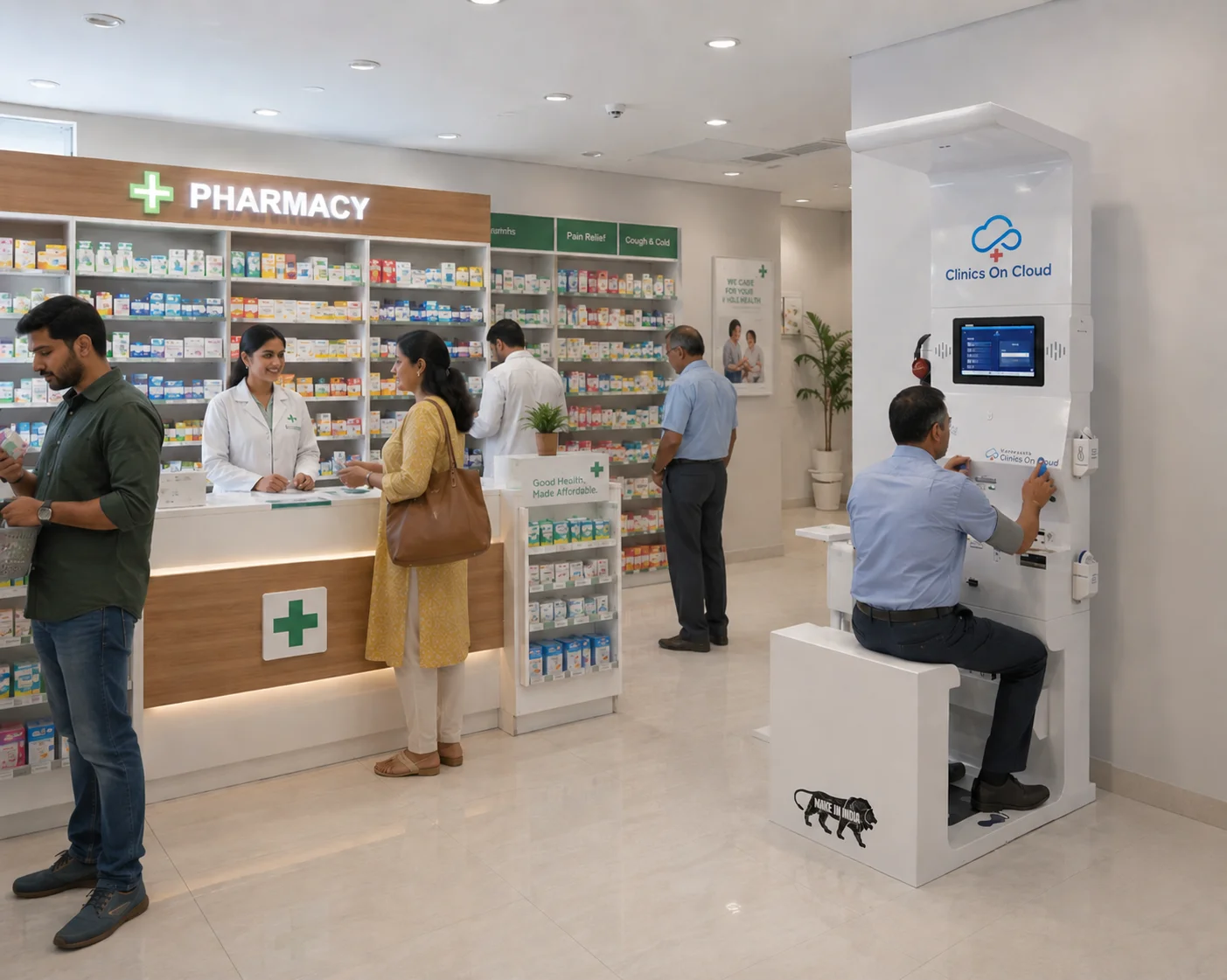
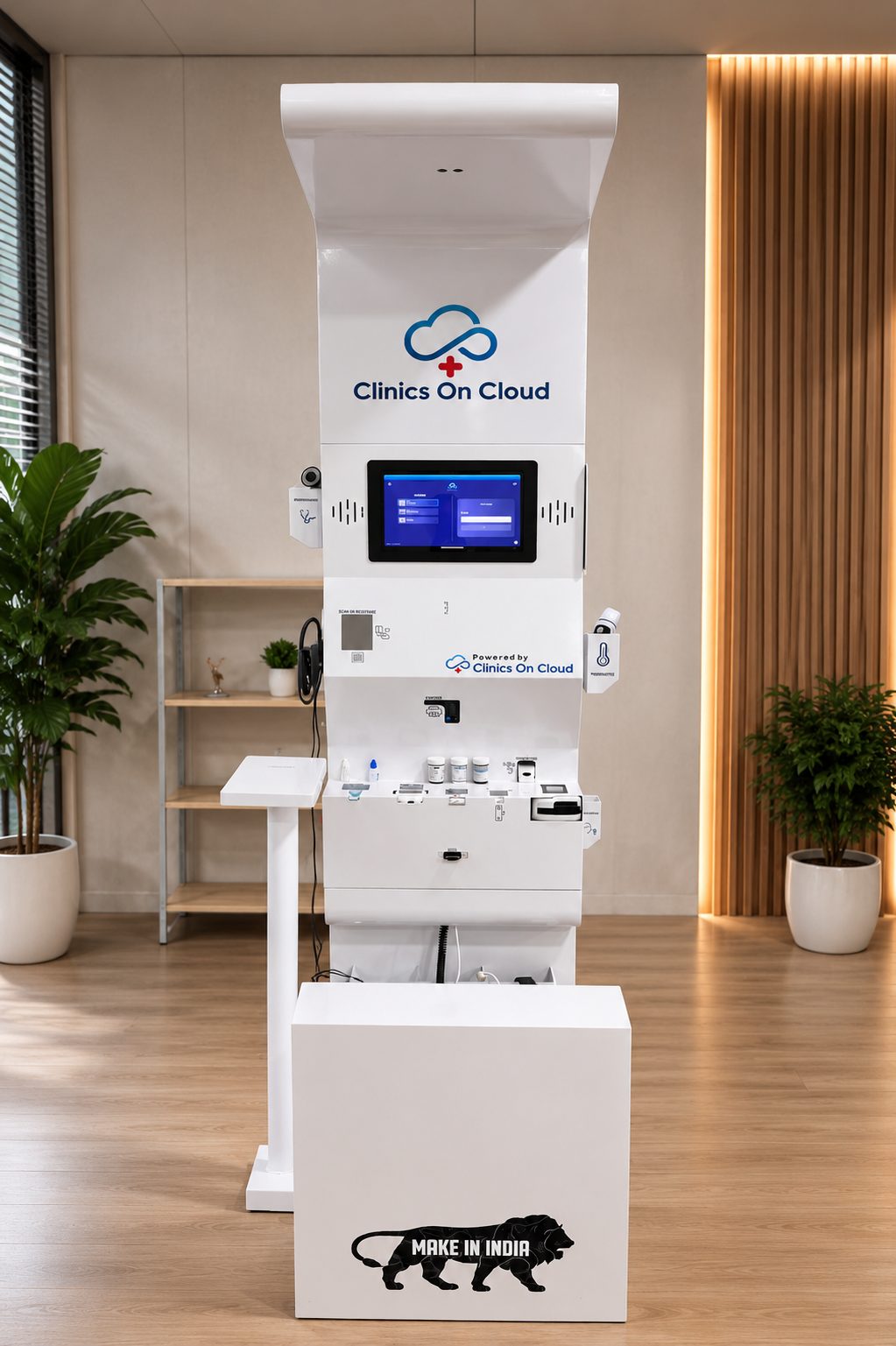
A microclinic is a small, technology-enabled care point built around a self-service screening station, usually inside a location people already visit, such as a retail pharmacy. A Clinics On Cloud health kiosk screens 65+ clinical parameters across 14 specialties, letting a pharmacy add screening and teleconsultation without hiring clinical staff or taking a second shop.
Why the pharmacy is the natural site for a microclinic
A retail pharmacy already has the three things a screening business needs and cannot easily buy: a trusted location, repeat footfall, and a customer who is already thinking about their health at the moment they walk in.
Most pharmacy customers arrive with a symptom or a prescription and leave with a product. What is missing between those two events is a measurement. A customer buying an antihypertensive has usually not had their blood pressure checked that month. A customer buying a glucometer strip refill has usually not had an HbA1c done that quarter.
A health kiosk fills that gap at the point of purchase. The commercial consequence is that a pharmacy stops competing only on medicine price, which is a margin-compressing race, and starts offering a service that a discount e-pharmacy cannot deliver.
What is a microclinic, and what is a digital dispensary?
A microclinic is a small, technology-enabled care point built around a self-service screening station and a remote clinician, placed inside a location people already visit. It is not a clinic in the licensing sense and it does not perform diagnosis or treatment.
A digital dispensary is the same idea described from the retail side: a medicine counter with a screening and teleconsultation layer attached, so the customer can measure, understand and then purchase.
Clinics On Cloud, the brand of SehatPro Technologies Pvt Ltd, is India’s first CDSCO-licensed Health ATM and Health Kiosk manufacturer, with 3,500+ installations across 200+ cities and 8+ countries as of 2026. The company’s category position is that the future of access is not more hospitals but more microclinics, and that a pharmacy is the cheapest place in India to create one.
Value adds convenience, measurement and a doctor pathway
No customer health record
Longitudinal screening record, ABHA-linkable
Repeat visit driven by refill cycle
Repeat visit also driven by re-screening cycle
Competes with e-pharmacy discounting
Offers something an e-pharmacy cannot deliver
One revenue line
Screening line, teleconsultation line, and the pull-through it creates
The kiosk covers 65+ clinical parameters across 14 specialties, including general health and body composition, cardiac (ECG, blood pressure, lipid profile), diabetes (random blood sugar and HbA1c), urine analysis, vision, hearing, pulmonary function, dermatology, dental screening, anaemia and kidney indicators, mental health screening (PHQ-9 and GAD-7) and rapid infectious-disease tests. Full detail sits in the clinical parameters and tests offered by a health kiosk guide.
One boundary matters more than any feature: screening must be presented as screening. A kiosk result is indicative, it is not a diagnosis, and it must never be used to steer a customer towards a particular medicine.
Footfall economics: where the screening customer comes from
A pharmacy owner evaluating a kiosk needs to answer one question honestly before anything else: how many screenings can this store realistically do per day?
Screening demand at a pharmacy comes from four sources, in descending order of reliability:
Existing customers with a chronic condition. People already buying medication for hypertension, diabetes or lipid disorders. They are in the store monthly, and a re-screening cycle fits their refill cycle exactly. This is the most dependable source.
Accompanying family members. The person who came with the patient. Zero acquisition cost, and often the person who has never been screened at all.
Walk-past footfall converted by signage. A visible kiosk with a clear price at the door converts a share of passing traffic, and the conversion rate depends heavily on location and display.
Organised demand: employers, societies, schools and camps. A local factory or housing society booking a screening drive. This is lumpy but it is the source that fills quiet hours.
The practical implication is that a health kiosk is not a passive vending machine. Stores that treat it as one screen a handful of people a week. Stores that assign a staff member to offer screening at the counter, price it clearly and run a monthly re-screening reminder do materially better. Budget for that effort, not just for the machine.
Space, power and connectivity requirements
Requirement
What a pharmacy needs
Floor space
A small footprint against a wall, with standing or seated access and enough separation for the customer to be comfortable
Privacy
A visual screen or a corner position; customers will not screen in front of a queue
Power
Standard single-phase supply; Clinics On Cloud kiosks carry 3–4 days of battery backup
Connectivity
Broadband or 4G; the kiosk is offline-capable and syncs when the link returns
Staff
No skilled operator needed for standard screening; a trained person is required for rapid tests involving a sample
Bio-waste
A bio-medical waste disposal arrangement where consumable-based tests are enabled, typically a tie-up with a local clinic or hospital that already holds one
Signage
External and counter signage stating what is screened and at what price
The most common practical constraint is not power or connectivity. It is privacy. A kiosk placed in full view of the billing queue underperforms one placed in a corner with a screen, regardless of specification.
What it costs to set up and run
Clinics On Cloud health kiosk pricing starts from ₹6,00,000 and varies by configuration. For a pharmacy, the configuration decision is the cost decision: a narrower test menu lowers both the capital cost and the consumable cost per screening.
Cost line
Type
Notes for a pharmacy buyer
Health kiosk
Capital
From ₹6,00,000, configuration-dependent. Rental and lease structures are available for pilots
Site preparation
Capital
Partition or screen, signage, a power point, floor space cleared
Consumables
Variable, per screening
The single most important number to obtain. Ask for pricing per test, not per box, and confirm minimum order quantity
Connectivity
Fixed monthly
Standard broadband or 4G tariff
Electricity
Fixed monthly
Marginal against existing store load
Bio-waste disposal
Fixed or per collection
Required where consumable tests are run
Staff time
Variable
Counter time spent offering and supporting screening
Annual maintenance contract
Fixed annual, post-warranty
Quoted per configuration; agree scope and response time before the warranty ends
Before modelling anything, get two numbers from your supplier in writing: the consumable cost per screening for your exact enabled test menu, and the AMC cost from year two. Every payback calculation stands or falls on those two figures.
An illustrative payback model
“
This is an illustrative arithmetic model, not a forecast and not a report of results. The screening volumes and price points below are assumptions chosen to demonstrate the method. They are not observed figures from any Clinics On Cloud installation, they are not a promise of revenue, and they do not represent typical performance. Replace every assumption with your own numbers before making a purchase decision, and take independent financial advice.
Stated assumptions used in the table below
Capital cost: ₹6,00,000, the indicative starting price for a Clinics On Cloud health kiosk. Your configuration may differ.
Consumable cost per screening: assumed, because it depends entirely on the test menu you enable. Obtain the real figure from your supplier.
Price charged to the customer: assumed, set by the pharmacy owner. Benchmark it against local screening and pathology pricing in your catchment.
Store open 26 days a month.
Staff time, connectivity, electricity, bio-waste and AMC are excluded from the gross contribution line and must be subtracted separately in your own model.
No financing cost, no tax effect, no rental structure applied.
Illustrative scenario
Screenings per day (assumed)
Screenings per month
Assumed gross contribution per screening
Monthly gross contribution
Months to recover ₹6,00,000 on gross contribution alone
Low volume
4
104
₹150
₹15,600
~38
Moderate volume
10
260
₹150
₹39,000
~15
Higher volume
20
520
₹150
₹78,000
~8
Moderate volume, higher price point
10
260
₹250
₹65,000
~9
Read the table for its structure, not its numbers. Four things follow from it that hold regardless of what you plug in:
Volume dominates. Doubling screenings per day halves the payback period. No other input in the model moves the result that far.
The gross contribution per screening is a negotiation, not a constant. It is your price minus your consumable cost, and both are within your control.
The excluded costs are real. Staff time, AMC, connectivity and bio-waste all sit below this line. A model that ignores them will be optimistic.
Pull-through is not in the model at all. Additional footfall, teleconsultation revenue and improved retention on chronic-medication customers are plausible second-order effects, but they are not modelled here because they cannot be honestly estimated in advance.
Build your version of this table with your own footfall data before you sign anything, and be conservative with the volume assumption.
Regulatory and ethical considerations for a pharmacy offering screening
This section is guidance on what to check, not legal advice. Confirm your position with your state drug control authority and your own legal adviser before you start.
Stay inside the screening boundary. A health kiosk screens and flags. It does not diagnose, treat, cure or prevent any disease. Your signage, your staff script and your report footer should all say so.
Never let a screening result drive a product sale. A customer flagged for a high reading must be referred to a qualified physician, not sold a medicine. Selling a prescription medicine on the basis of a kiosk reading is the single biggest risk in this model, and it is avoidable by policy.
Prescription-only medicines still require a prescription. A screening service changes nothing about dispensing rules.
Consent and privacy. Screening should be voluntary and consented, with the customer told what is measured, where the record goes and who can see it. The Clinics On Cloud platform is operated against ISO 27001, with HIPAA and GDPR compliance and VAPT testing.
Bio-medical waste. Where consumable-based tests are run, a compliant disposal arrangement is required.
Teleconsultation. If you offer a doctor consultation from the kiosk, the doctor must be a registered practitioner and the consultation must follow applicable telemedicine practice requirements. Confirm who supplies and credentials the doctors in your contract.
Advertising claims. Do not advertise diagnosis, cure or treatment. Describe the service as preventive health screening.
Single store or chain: two different decisions
For a single store, the decision is a straightforward capital and utilisation question. Fix a narrow, high-relevance test menu, place the kiosk for privacy, price clearly, and drive volume from your existing chronic-medication customer base. Rental structures are worth asking about for a first site.
For a chain, the decision changes shape. Once several stores screen, the value moves into the data layer: a centralised multi-location analytics dashboard showing screening volume and flagged-condition incidence store by store, consistent records that follow a customer between branches, and ABHA linkage under the Ayushman Bharat Digital Mission so records are portable. That is covered on the eHealth kiosk, ABHA and ABDM integration page.
Chains should also pilot before rolling out. Run two stores of different types for a full quarter, measure actual screenings per day rather than projected, and only then set the network plan.
Readiness checklist before you commit
Count your daily footfall and estimate how many are chronic-medication customers.
Identify the physical spot, and check whether it offers real privacy.
Fix the test menu you will actually sell, not the longest possible list.
Get consumable cost per screening in writing for that exact menu.
Get the AMC cost and service response time for year two onwards.
Set your customer price against local benchmarks and calculate gross contribution per screening.
Build your own version of the payback table with those numbers.
Arrange bio-medical waste disposal before installation, not after.
Decide who on your counter staff owns screening as a task.
Write the referral policy: what your staff say and do when a reading is flagged.
Clinics On Cloud provides preventive health screening and is not a diagnostic laboratory. Screening results are indicative and are not a diagnosis. Always consult a qualified physician before acting on any health information.
health-atmMicro ClinicsDeep Dive
Join the conversation
Leave a comment.
Add your comment
Your email is never published. Comments appear after a quick review.
A microclinic is a small, technology-enabled care point built around a self-service screening station and a remote clinician, placed inside a location people already visit, such as a retail pharmacy. A Clinics On Cloud health kiosk screens 65+ clinical parameters across 14 specialties in about 10 minutes and can connect the customer to a doctor by video when a reading is flagged.
Can a pharmacy install a health kiosk?
Yes. A retail pharmacy is one of the most practical locations for a health kiosk because it already has trusted footfall and customers who are thinking about their health. The requirements are floor space with privacy, standard single-phase power, broadband or 4G, and a bio-medical waste arrangement where consumable-based tests are enabled.
How much does a pharmacy health kiosk cost?
Clinics On Cloud health kiosk pricing starts from ₹6,00,000 and varies by configuration, and rental or lease structures are available for a first site. Running costs are consumables per screening, connectivity, electricity, bio-waste disposal, staff time and the annual maintenance contract after the warranty period. Fix the test menu before comparing quotations.
What is the payback period on a health kiosk in a pharmacy?
Payback depends on screenings per day and on gross contribution per screening, which is your customer price minus your consumable cost. The illustrative model on this page shows payback ranging widely across assumed volumes, and it excludes staff time and AMC. Build the model with your own footfall and pricing before deciding; no vendor can calculate your payback for you.
How much space does a health kiosk need in a pharmacy?
A fixed health kiosk takes a small footprint against a wall, plus standing or seated access for the customer. The binding constraint in most stores is privacy rather than area: a kiosk visible from the billing queue is used far less than one placed in a corner behind a screen. Plan the position before the delivery date.
Do I need a licence to offer health screening in my pharmacy?
Preventive screening is distinct from operating a diagnostic laboratory, but requirements vary by state and by the exact tests enabled, and consumable-based tests require a bio-medical waste disposal arrangement. Confirm your position with your state drug control authority and your legal adviser before starting, rather than relying on a general statement from any vendor.
Does the kiosk need a technician or a pharmacist to operate it?
No skilled operator is required for the standard screening flow, because the multilingual touchscreen with audio-visual guidance walks the customer through each measurement. Rapid tests that involve collecting a sample do require a trained person. In practice the bigger staffing question is who offers screening to customers at the counter.
Can I rent a health kiosk instead of buying one?
Rental, lease and pay-per-screening structures are available depending on volume and deployment length, and a rental is often the sensible way to test demand at a first store before committing capital. State your expected monthly screening volume when you enquire, because the commercial structure is built around it. Contact Clinics On Cloud on +91 8999 073 447.
Will a health kiosk actually increase my medicine sales?
Screening should never be used to steer a customer towards a particular medicine, and any claim of guaranteed sales uplift should be treated with suspicion. What a screening service reliably changes is the reason a customer visits and the frequency of that visit. Treat additional pull-through as an unmodelled upside, not as the basis of your business case.
What happens when a customer’s reading is abnormal?
The platform flags readings outside standard reference ranges, and the customer can be connected to a doctor by video from the kiosk with the same report on screen. Your staff script should refer the customer to a qualified physician and should never present a screening result as a diagnosis. Agree this referral policy before the kiosk goes live.
Get In Touch
Healthcare is a right. Not a privilege.
We started Clinics on Cloud with a simple belief - that the quality of your healthcare should not depend on your postcode. Whether you're a government, corporate, NGO or entrepreneur - we built this for you.
Call us
+91 8999 073 447
Mon - Sat · 9 AM to 6 PM IST
Write to us
sales@clinicsoncloud.com
Partnerships · Deployments · Support
Visit us online
www.clinicsoncloud.com
Products · Case Studies · News
Find us
Nighoje, Chakan MIDC
Pune, Maharashtra - 410501, India
Built for every kind of health partner.
Government Body Corporate / HR Team NGO / CSR Partner Hospital or Clinic Defence Organisation International Partner Investor / Distributor Rural Entrepreneur
 Entry · HA-40Health ATM