 Entry · HA-29Health ATM
“ClinicsOnCloud”Installing Health Kiosks Across India
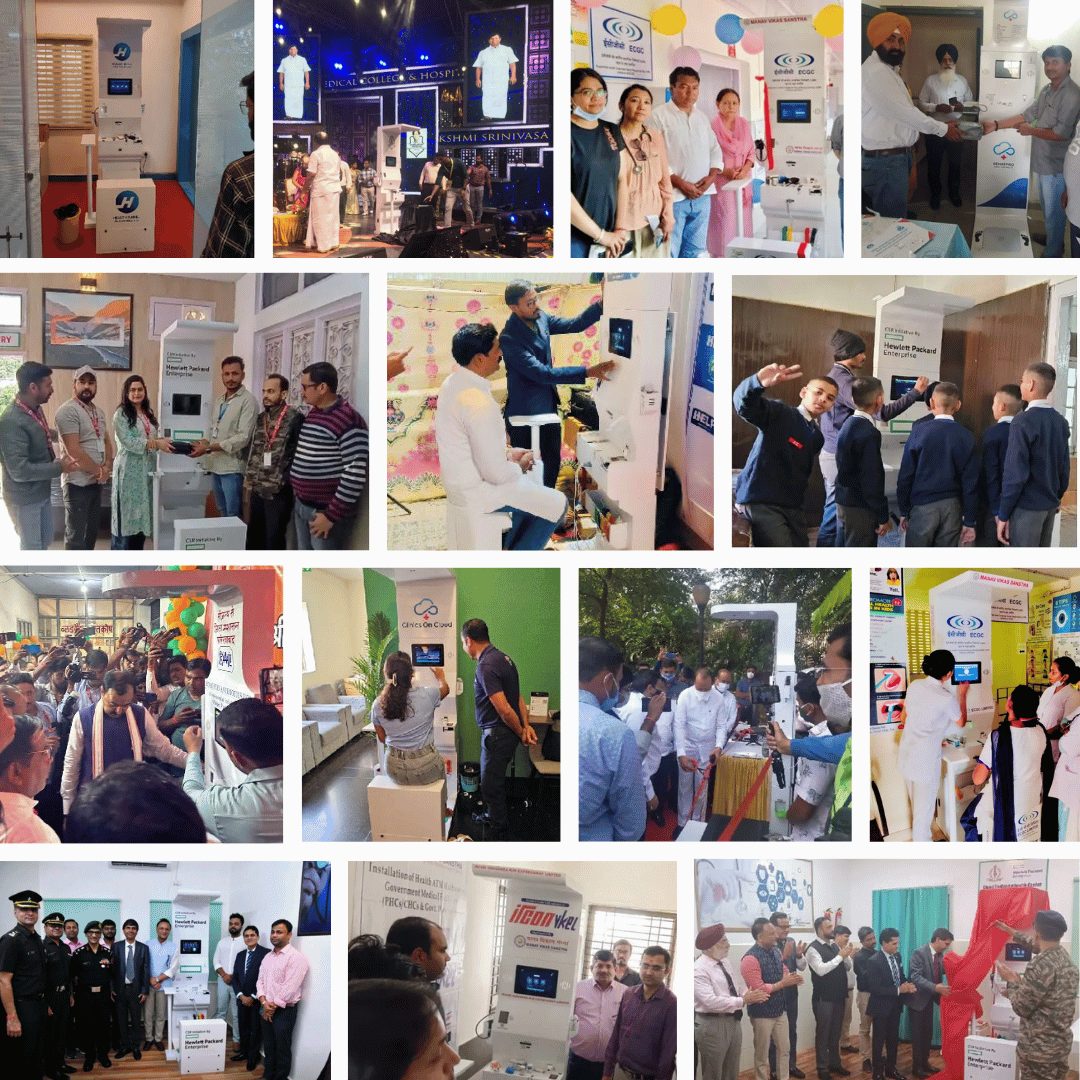
Impact Of “Clinics on cloud’s” Health Kiosks Across India The healthcare sector in India is evolving with technological advancements, and
Read story 3 min
Africa’s healthcare infrastructure is a complex tapestry woven with threads of resilience, innovation, and persistent challenges. While the continent has made significant strides in recent years, it continues to grapple with a high burden of disease, limited resources, and inequitable access to care. This in-depth analysis delves into the multifaceted landscape of healthcare infrastructure across
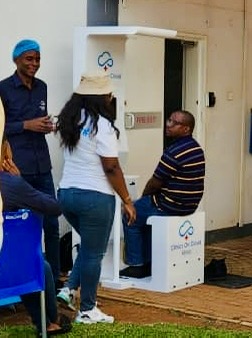
A health kiosk is a self-service screening station that captures clinical measurements without a skilled operator and connects an abnormal result to a doctor on video. Clinics On Cloud Health ATMs operate offline and hold 3–4 days of battery backup, which is what makes deployment viable across Africa where power and connectivity are intermittent.
The constraint a health kiosk addresses is not a shortage of medical knowledge. It is a shortage of clinician minutes per head of population, distributed unevenly across large distances.
Where clinician density is low, the first contact a person has with the health system is usually late and usually symptomatic. Screening capacity is the thing that is missing, not treatment capacity. A screening kiosk changes the arithmetic because it does not consume a clinician’s time to produce a measurement. It consumes a clinician’s time only when a measurement is abnormal.
That is the entire economic argument for a health kiosk in a low-density setting, and it is worth stating plainly before any product description. One trained doctor reviewing flagged results on a dashboard can cover far more people than the same doctor seeing every person in sequence. Clinics On Cloud has screened 12M+ patients across its network on that model, with 2 lakh+ (200,000+) abnormalities detected and routed for early intervention.
A Clinics On Cloud Health ATM is therefore bought in Africa for three reasons: it produces a structured record where none existed, it triages who needs a clinician, and it keeps working when the power and the network do not.
Africa is not one market. It is dozens of regulatory jurisdictions, procurement cultures, language groups and power grids. The table below is a planning aid for distributors and programme designers. It describes buyer types and site conditions rather than health statistics, because Clinics On Cloud does not publish disease-burden figures it has not itself measured.
| Region | Buyer types most commonly encountered | Typical deployment site | Power and connectivity planning | Interface and language planning |
|---|---|---|---|---|
| North Africa | Ministries of health, public hospital groups, private clinic chains, corporate occupational health | Primary health centres, pharmacies, workplace clinics, university campuses | Mains power generally available in urban sites; battery backup covers load-shedding | Arabic first, French or English second, depending on country |
| West Africa | NGOs, development agencies, faith-based hospital networks, mining and oil-services employers, private diagnostics chains | Community health posts, market sites, mine and plantation camps, urban pharmacy chains | Plan for generator or solar-plus-battery at rural sites; assume intermittent mobile data | French and English majority official languages, plus large regional-language populations |
| East Africa | Ministries and county health departments, NGOs and donor programmes, tea and horticulture estates, private hospital groups | County health facilities, estate clinics, transport hubs, refugee and displacement settings | Solar viability is generally good; mobile data coverage is strong in corridors, weak off them | English, French, Swahili and Amharic depending on country |
| Central Africa | International NGOs, UN-linked programmes, humanitarian agencies, extractive-industry employers | Humanitarian and outreach settings, mission hospitals, company towns | Assume off-grid. Solar-plus-battery or generator is the default, not the exception | French, Portuguese and Lingala-family languages; high need for voice guidance |
| Southern Africa | Ministries, medical schemes and insurers, corporate wellness buyers, mining employers, retail pharmacy chains | Workplace wellness sites, retail pharmacy floors, clinic waiting areas | Grid available but subject to scheduled outages; battery backup is a purchase driver | English, Portuguese, Afrikaans and major indigenous languages |
| Island states (Indian Ocean and Atlantic) | Ministries, tourism employers, port and maritime operators | Island health centres, port facilities, hotel and resort staff clinics | Freight and spares logistics dominate the cost model; plan consumable buffers | French, English and Portuguese, plus creoles |
Two patterns cut across every row. First, the buyer is rarely the user. A ministry, an NGO or an employer pays, and a community uses. Second, the site condition that decides success is almost never clinical. It is power, network, language and who owns the machine after year one.
Answer these two before anything else, because they determine whether the kiosk is an asset or an ornament.
Does the kiosk work with no internet? Yes. A Clinics On Cloud Health ATM is offline-capable. It completes a screening session, prints the report and stores the record locally, then synchronises when connectivity returns. Live teleconsultation is the one function that needs a live connection, so a site with intermittent data can still screen continuously and can schedule doctor review for windows when the network is up.
Does the kiosk work with no mains power? It carries 3–4 days of battery backup. That is enough to ride out load-shedding, generator gaps and rainy-season outages without losing a screening day.
For genuinely off-grid sites, solar is viable and is the most common configuration request Clinics On Cloud receives from African partners. Sizing depends on the configuration you order, the daily session count and local irradiance, so the array and controller are specified per site with the distributor rather than sold as a fixed kit. The important design point is that a kiosk with multi-day battery storage tolerates several cloudy days, which a directly solar-powered device does not.
Three further hardware realities matter in African deployment settings:
Where there is no building at all, the Box Clinic is the honest answer rather than a fixed kiosk. It is a portable clinic in a suitcase built for camps and outreach where no infrastructure exists. Where the population is dispersed across a district, a Mobile Medical Unit running a circuit covers more people per unit than a fixed installation.
A screening station that requires reading is a screening station that excludes people.
The Clinics On Cloud interface is a multilingual touchscreen with audio-visual guidance, so a session is driven by voice prompts and icons rather than by text comprehension. No skilled operator is required to run a session. For African deployments, three practical points follow.
First, language sets are configured per deployment, not shipped as a fixed list. Specify the languages at order stage with your distributor, including the regional languages your beneficiary population actually speaks rather than only the official language of the country.
Second, reports are colour-coded and delivered by print, SMS, email or WhatsApp. Colour coding does real work where reading levels vary, because a person can act on a flag without parsing a numeric range.
Third, an attendant still helps. Even though the kiosk needs no clinical skill to operate, sites that assign a trained non-clinical operator see steadier throughput than unattended sites, especially in the first months. Budget for that person.
Clinics On Cloud holds CDSCO licensing in India, ISO 13485 for medical-device quality management, US FDA and CE, plus ISO 27001, HIPAA compliance, GDPR compliance and VAPT testing on the data side.
Those certifications are the starting position for an import file. They are not a substitute for national registration. Requirements across African jurisdictions generally fall into four types, and your import route will combine several of them:
Regional harmonisation is moving, and the African Medicines Agency is the body to watch, but as of 2026 registration remains national in practice. Clinics On Cloud supports partners with technical files, ISO 13485 documentation and declarations of conformity. Clinics On Cloud does not claim registration or regulatory approval in any specific African country, and any distributor proposal that implies otherwise should be corrected. Confirm current requirements with the national regulator and a local regulatory consultant before quoting a delivery date.
Four routes dominate, and they buy on different logic.
Ministry and public tender. Slowest, largest, most documentation. Wins on certification depth, service network and total cost over a multi-year horizon. Expect a requirement for local partner presence and after-sales capability.
NGO and implementing partner. The most common first deal in a new country. Funded by a grant with a defined programme period. The buying question is beneficiary reach per unit of grant, and the risk to manage is what happens when the grant period ends and nobody owns maintenance.
Development agency and donor-funded programme. Similar to NGO buying but with heavier reporting obligations. The centralised analytics dashboard matters here, because the funder wants screening counts, demographics and referral outcomes in a reportable form.
Private and employer. Mining, oil and gas, plantations, ports, manufacturing, insurers and pharmacy retail. Buys fastest, on an occupational health or footfall rationale. Often the most durable revenue because the buyer funds the maintenance themselves.
If your programme is corporate-funded, the design and reporting questions are covered in more depth in health screening as a CSR and donor-funded programme. For the parallel export picture on the other side of the Indian Ocean, see health kiosks across Asia, and for a worked single-country view of a low clinician-density setting, see the deployment context in Uganda.
Being precise here protects the distributor as much as the manufacturer.
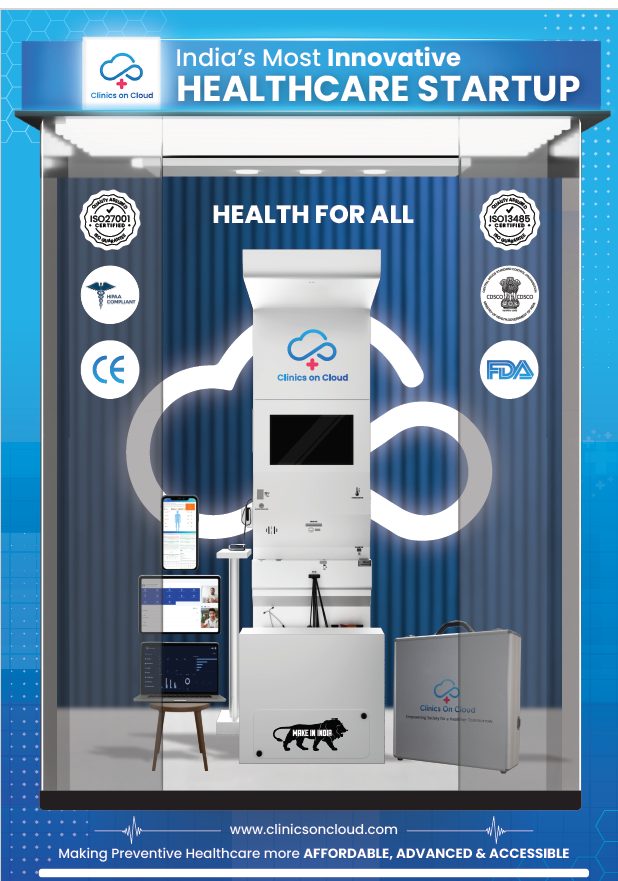
It can: capture 65+ clinical parameters across 14 specialties in a 10-minute session, including general health and body composition, cardiac measures such as ECG and blood pressure, lipid profile, random blood sugar and HbA1c, urine analysis, pulmonary function, vision, hearing, dermatology and oral screening, and standard mental-health questionnaires. It can generate an instant colour-coded report, flag abnormal results, connect the user to a doctor on video, and build a longitudinal digital record. Device accuracy is 90–95% depending on the test and device, under correct usage, calibration and patient preparation.
It cannot: replace a diagnostic laboratory, diagnose disease, treat disease, dispense medicines, deliver vaccines, or substitute for a clinician’s judgement. A screening result is indicative. It exists to prompt appropriate medical follow-up.
Any proposal that positions a kiosk as an outbreak-control tool, a treatment point or a laboratory replacement is a proposal that will fail its first audit. Position it as what it is: a high-throughput screening and triage layer that feeds a referral pathway. For the full specification, see clinical parameters and tests offered by a health kiosk.
Clinics On Cloud manufactures in Chakan MIDC, Pune, India, and is India’s first CDSCO-licensed Health ATM and Health Kiosk manufacturer, with 3,500+ installations across India and abroad and deployment in 8+ countries. Distribution partners are appointed by territory.
A distributor conversation usually covers six things:
Pricing varies by configuration, so ask for a quotation against a defined scope rather than a list price. Write to sales@clinicsoncloud.com or call +91 8999 073 447 (Mon–Sat, 9:00–18:00 IST) with your country, buyer type and expected first-year volume, and ask for the export technical file and distributor terms. See the Health Kiosk specification, or read more about Clinics On Cloud as a Health ATM manufacturer.
Clinics On Cloud provides preventive health screening and is not a diagnostic laboratory. Screening results are indicative and are not a diagnosis. Always consult a qualified physician before acting on any health information.
Your email is never published. Comments appear after a quick review.
Entry · HA-29Health ATMImpact Of “Clinics on cloud’s” Health Kiosks Across India The healthcare sector in India is evolving with technological advancements, and
 Entry · HA-25Health ATM
The Future of Healthcare: How AI-Powered Doctor Clinics and Care Pods are Transforming Patient Care In recent years, healthcare has
 Entry · HA-64Health ATM
In today’s fast-paced world, health kiosks are emerging as game-changers in the medical field. Offering convenience, accuracy, and accessibility, these
Yes. A Clinics On Cloud Health ATM is offline-capable. It completes the 10-minute screening session, prints a report and stores the record locally, then syncs when connectivity returns. Only live doctor teleconsultation requires an active connection, so sites with intermittent mobile data can screen continuously and schedule consultations for connected windows.
Yes, and solar-plus-battery is the most requested configuration for off-grid African sites. The kiosk holds 3–4 days of battery backup, which lets it ride out cloudy days and outages. Array size depends on your configuration, session volume and local conditions, so solar is specified per site with your distributor rather than sold as a fixed kit.
Clinics On Cloud, the legal entity SehatPro Technologies Pvt Ltd, manufactures Health ATMs and Health Kiosks at Chakan MIDC, Pune, India, and supplies export markets through appointed territory distributors. Clinics On Cloud is India’s first CDSCO-licensed Health ATM and Health Kiosk manufacturer, with 3,500+ installations and deployment in 8+ countries.
Clinics On Cloud holds CDSCO licensing, ISO 13485, US FDA, CE, ISO 27001, HIPAA and GDPR compliance and VAPT testing. Most African countries additionally require national medical-device registration filed by a local importer, plus an import permit. Some regulators shorten review where CE or US FDA status exists. Confirm current rules with the national regulator.
Pricing varies by configuration, language sets, power setup, freight and duty, so Clinics On Cloud quotes against a defined scope rather than publishing an export list price. Ask for a quotation covering the kiosk, first-year consumables, installation, operator training and service, because consumables and service dominate cost after year one.
The interface is a multilingual touchscreen with audio-visual voice guidance, and language sets are configured per deployment rather than fixed at the factory. Specify the languages your beneficiary population actually speaks, including regional languages alongside the official one. Voice prompts and colour-coded reports keep sessions usable where reading levels vary.
Most NGO purchases run through a grant with a defined programme period, an implementing partner on the ground and a reporting obligation to the funder. The centralised analytics dashboard supplies screening counts, demographics and location-wise data for those reports. Plan ownership and maintenance funding beyond the grant period before signing.
Device accuracy is 90–95% depending on the test and device, under correct usage, calibration and patient preparation. Results are screening results and are indicative, not diagnostic. They are intended to raise awareness and prompt appropriate medical follow-up, and a clinician re-tests or investigates before making any clinical decision.
Contact Clinics On Cloud at sales@clinicsoncloud.com or +91 8999 073 447 with your country, target buyer segments and expected first-year volume. Distribution is appointed by territory. The discussion covers regulatory filing responsibility, configuration, language localisation, power setup, spares and field-service capability, and training.
Usually not well. A fixed kiosk suits a site with steady footfall such as a health centre, workplace or pharmacy. For dispersed populations, a Mobile Medical Unit running a district circuit reaches more people per unit, and a Box Clinic suits camps and outreach where no building exists. Most district programmes mix all three.
We started Clinics on Cloud with a simple belief - that the quality of your healthcare should not depend on your postcode. Whether you're a government, corporate, NGO or entrepreneur - we built this for you.
+91 8999 073 447
Mon - Sat · 9 AM to 6 PM IST
sales@clinicsoncloud.com
Partnerships · Deployments · Support
www.clinicsoncloud.com
Products · Case Studies · News
Nighoje, Chakan MIDC
Pune, Maharashtra - 410501, India