HomeBlogWhy Health ATM is the Perfect Fit for Corporate Social Responsibility Initiative
Article8 July 20253 minUpdated
Why Health ATM is the Perfect Fit for Corporate Social Responsibility Initiative
In today’s evolving corporate landscape, Corporate Social Responsibility (CSR) is no longer just a goodwill gesture—it’s a strategic imperative. Companies are actively seeking impactful, scalable, and measurable initiatives that align with global goals like the United Nations Sustainable Development Goals (SDGs). Among these, SDG 3: Good Health and Well-Being stands out as one of the most urgent a
CCClinics On Cloud TeamPublished from Pune, India
Preventive Care
“
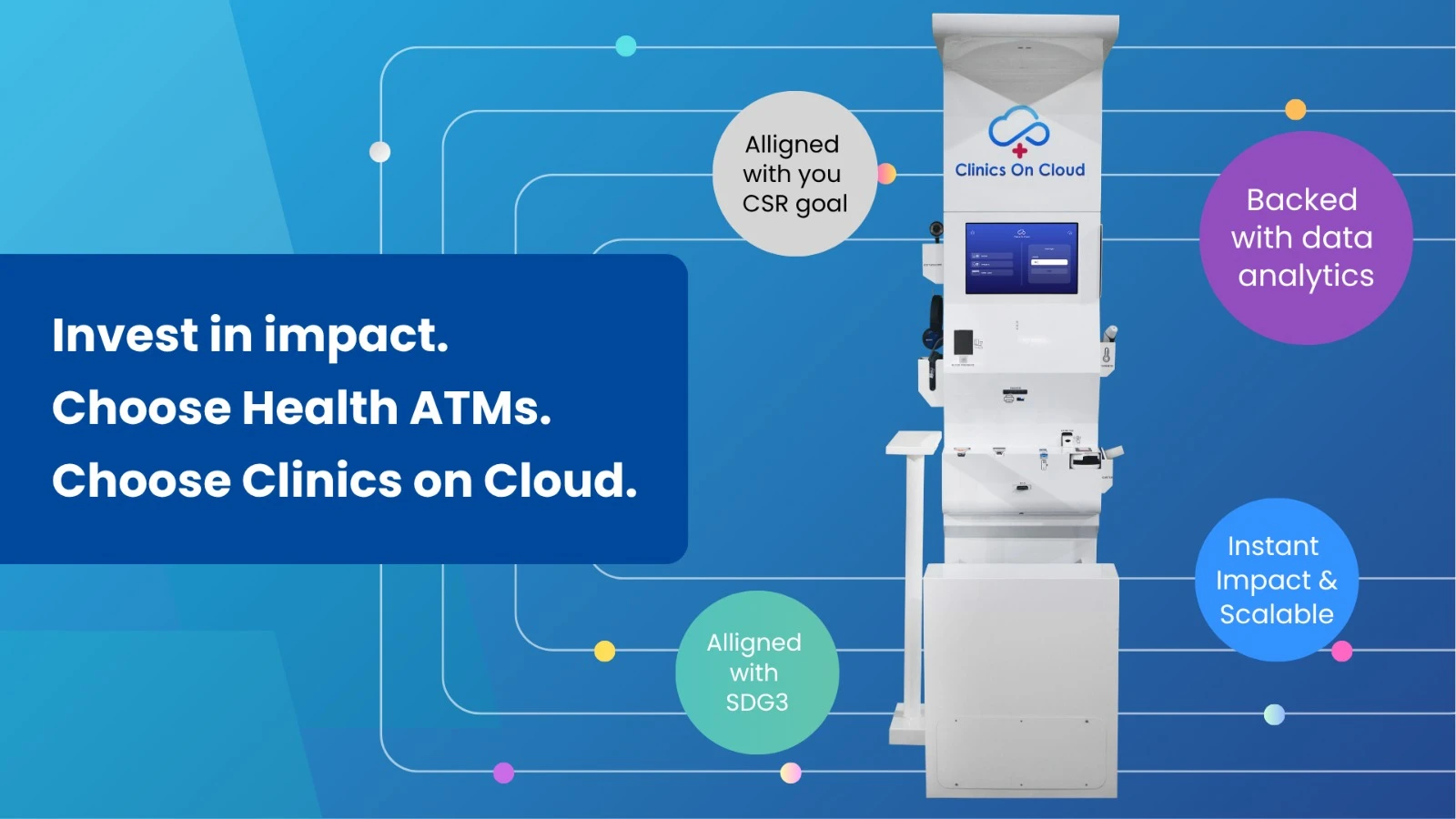
A Health ATM is a self-service screening station that records clinical parameters in one session and connects an abnormal result to a doctor on video. For a CSR healthcare project it converts an activity into an asset: Clinics On Cloud has screened 12M+ patients, producing counted beneficiaries, dated records and an auditable trail rather than a camp photograph.
The CSR problem nobody says out loud
Most corporate healthcare CSR spending produces activity that is real, useful on the day, and almost impossible to evidence a year later.
A camp happens. Several hundred people are seen. Photographs are taken. A number goes into the annual report. Then the tent comes down, nobody knows which of those people had an abnormal reading, nobody followed up, and next year the programme starts from zero in a different village.
The failure is not one of intent. It is structural. A one-off event produces an event, and an event cannot be measured longitudinally, cannot be audited beyond an attendance sheet, and leaves nothing behind that continues to work.
The reason preventive screening infrastructure fits CSR better is not that screening is more virtuous than treatment. It is that a screening station is a durable asset that generates dated, structured, countable records every day it operates, which is exactly the evidence a CSR obligation requires and exactly what a camp cannot produce.
Healthcare as a CSR activity: the general position, and the caveat
Under Indian company law, corporate social responsibility spending by qualifying companies is governed by the Companies Act 2013, and Schedule VII of that Act sets out the broad categories of activity that CSR expenditure may be directed towards. Promoting healthcare, including preventive healthcare, sits within those categories, which is why healthcare has consistently been one of the largest destinations for Indian CSR spending.
Qualifying companies are required to direct a prescribed proportion of average net profits, commonly described as the two per cent obligation, towards CSR activity. Reporting requirements, board committee obligations and the treatment of assets created through CSR spending are all defined in the associated rules.
This page does not give legal advice, and nothing here should be read as a compliance opinion. Eligibility depends on your company’s specific circumstances, on the structure of the programme, on who owns any asset created, and on the current text of the rules. Confirm eligibility, asset treatment and reporting obligations with your own legal counsel and CSR advisors before committing budget. Clinics On Cloud supplies the equipment, the data and the documentation; it does not determine whether a given expenditure qualifies as CSR for your company.
What Clinics On Cloud can say with confidence is narrower and more useful: a Health ATM programme produces the kind of dated, beneficiary-level, auditable record that a CSR committee, an internal auditor and a statutory auditor all ask for.
Four properties that make preventive screening suit CSR specifically
Not every good healthcare intervention is a good CSR intervention. The fit depends on four properties, and preventive screening has all of them.
1. Beneficiaries are countable at the individual level
A screening session has a beginning, an end and an output. Every session produces a record with a date, a location and a set of measurements. That means the beneficiary count is not an estimate from an attendance register; it is a count of completed sessions in a database.
This matters more than it sounds. “We reached approximately 4,000 people” and “4,000 sessions were completed at these three sites on these dates” are different statements to an auditor, and only one of them survives scrutiny.
2. The output is an asset, not an event
A Health ATM installed at a village health centre, a school or a factory keeps working after the launch event. It is capital equipment with a service life, not a day of activity.
That changes the arithmetic of CSR spending. The cost is incurred once and the beneficiary count accrues continuously. A programme that runs 20 sessions a day produces a beneficiary number in year two without any further capital outlay, which no camp model can match. Note that asset ownership has specific treatment under CSR rules, which is one of the points to settle with your advisors before you order.
3. The reporting is generated, not assembled
Clinics On Cloud provides a centralised multi-location analytics dashboard for CSR and corporate buyers. Screening counts, demographic breakdowns, site-wise performance and abnormality flags are produced by the system as a by-product of operation.
The alternative is a coordinator collecting registers from field sites and typing them into a spreadsheet, which is slow, error-prone and unverifiable. Generated reporting is auditable reporting.
4. Repeat measurement is possible, which makes outcomes visible
Digital health records with longitudinal tracking mean the same beneficiary can be screened again in six months. A change in a measurement is an outcome. An attendance count is not.
Both models have a place. The comparison below is about what each produces as evidence, not about which is more caring.
Dimension
One-off health camp
Health ATM / Health Kiosk programme
Nature of spend
Operating expense, consumed on the day
Capital asset with a service life, plus running cost
Beneficiary count
Attendance register, estimated
Completed sessions, counted in the system
Record per beneficiary
Usually paper, usually not retained
Dated digital record with longitudinal tracking
Repeat measurement
Rare; usually a different cohort next year
Designed in; same beneficiary can be re-screened
Clinician requirement
A team of clinicians for the full duration
No skilled operator for the session; clinician time used only on flagged results
Availability after launch
None; ends when the tent comes down
Continuous, every working day
Reporting to the board or funder
Assembled manually from field registers
Generated from the analytics dashboard
Referral follow-up
Difficult; contact details often lost
Report delivered by print, SMS, email or WhatsApp; flagged cases routed to teleconsultation
Audit position
Photographs and an attendance sheet
Dated, site-tagged, beneficiary-level session data
Best suited to
Reaching a location once, with a broad clinical team
Sustained screening at a site with steady footfall
The honest conclusion is that a camp is the better instrument for a single deep intervention in a place you will not return to. A kiosk is the better instrument for everything a CSR programme is normally trying to do, which is sustained, evidenced, repeatable reach.
What a CSR committee can report from a screening programme
This is the section to take into your CSR committee meeting. From a Clinics On Cloud deployment, the following are reportable as generated data rather than as estimates:
Number of screening sessions completed, by site and by month.
Unique beneficiaries screened, and how many were screened more than once.
Age and gender distribution of beneficiaries.
Location-wise breakdown across multiple sites in one view.
Number and category of abnormal findings flagged for follow-up.
Number of teleconsultations triggered from flagged results.
Screening coverage against a defined target population.
Across the Clinics On Cloud network, this model has produced 12M+ patients screened and 2 lakh+ (200,000+) abnormalities detected for early intervention, across 3,500+ installations and 200+ cities including last-mile locations.
Two things are deliberately absent from that list. There is no claim about disease prevented, because screening does not prevent disease, and there is no claim about health outcomes improved, because a screening programme alone cannot evidence that. Do not report either. A CSR report that overclaims is a CSR report that gets challenged.
Where a Health ATM belongs in a CSR portfolio, and where it does not
Good fits:
Village and block-level community health, sited at a health centre, panchayat building or school where people already gather.
School and college health programmes, where vision, hearing, dental and general health screening has direct educational value and consent runs through the institution.
Contract and blue-collar workforce welfare, in factories, warehouses, construction and logistics, where the workforce rarely gets screened otherwise.
Urban low-income neighbourhood programmes, run with an implementing partner who already holds community trust.
Employee wellness with a community extension, where the same infrastructure serves staff and a neighbouring community.
Poor fits, and it is better to say so:
Programmes with no referral pathway. Screening at scale identifies people who need care. If nobody has agreed to receive them, the programme creates identified need and no resolution. Settle the referral pathway before ordering.
Sites with no footfall. A kiosk in a location people do not pass produces a low session count and a bad cost per beneficiary.
Single-visit remote outreach, where a Box Clinic or a Mobile Medical Unit is the right instrument rather than a fixed kiosk.
Programmes budgeted for capital only. Consumables, the operator and multi-year service are real costs. A programme that funds only the machine stalls in its second year.
Choosing the right Clinics On Cloud configuration
Four products serve different CSR programme shapes:
Health ATM / Health Kiosk — the fixed-location 10-minute screening station. The default for a site with steady footfall.
**Box Clinic** — a portable clinic in a suitcase for rural camps and outreach where no infrastructure exists.
**Health Lounge** — a branded wellness suite for offices and communities, which turns routine screening into a guided experience. Often chosen where the CSR programme also serves employees and where presentation matters.
Configuration also means choosing which of the 14 specialties your beneficiary population needs. A school programme weights vision, hearing, dental and general health. A factory programme weights cardiac, diabetes, pulmonary function and body composition. A community programme in an area with a known screening gap may weight anaemia, kidney and maternal health. The full panel is set out in clinical parameters and tests offered by a health kiosk.
Clinics On Cloud is India’s first CDSCO-licensed Health ATM and Health Kiosk manufacturer. The compliance stack is CDSCO Licensed, ISO 13485, US FDA, CE, ISO 27001, HIPAA compliant, GDPR compliant and VAPT tested, with ABHA and eSanjeevani integration available. That list matters to a CSR committee because it is what a procurement or internal audit function will ask for. Manufacturer background is in Clinics On Cloud as a Health ATM manufacturer.
Health ATMs can also be white-labelled with your company’s branding where the programme calls for it, which is a common request but should never be the reason a site is selected.
Cost, ownership and the multi-year question
Indicative pricing for a Health ATM starts from ₹6,00,000, and the final figure varies by configuration, specialty panel, language sets and installation requirements.
Three cost items are routinely underestimated in CSR budgets, and all three are predictable:
Consumables. The rapid-test and urine modules consume stock in proportion to session volume. Budget them against your target beneficiary count, not as a flat allowance.
The operator. No skilled clinical operator is required, but an attended site produces materially steadier throughput than an unattended one. This is a real salary line.
Ownership of the asset is a decision with CSR compliance implications, so take it with your advisors rather than assuming. The options usually considered are ownership by the company, by an implementing partner or NGO, or by the host institution such as a school or health centre. Each has different consequences for accounting treatment, control and what happens if the programme ends.
Getting started
A useful first conversation with the Clinics On Cloud CSR team covers six things: the beneficiary population and its size, the sites you are considering and their footfall, the specialty panel that population needs, the language sets, the referral pathway and who has agreed to receive flagged cases, and the multi-year budget including consumables, operator and service.
Write to sales@clinicsoncloud.com or call +91 8999 073 447 (Mon–Sat, 9:00–18:00 IST). Ask for a configuration proposal against your beneficiary target and a sample of the CSR analytics dashboard output, so your committee can see the reporting format before it approves the budget. Specifications are on the Health Kiosk page.
Clinics On Cloud provides preventive health screening and is not a diagnostic laboratory. Screening results are indicative and are not a diagnosis. Always consult a qualified physician before acting on any health information.
Transforming Healthcare Access Through CSR: A Partnership for a Healthier Society Introduction Corporate Social Responsibility (CSR) initiatives have played a
India faces a diverse range of health challenges, with variations across states influenced by geography, socio-economic status, and healthcare accessibility.
Is preventive healthcare an eligible CSR activity in India?
Promoting healthcare, including preventive healthcare, sits within the broad activity categories set out in Schedule VII of the Companies Act 2013, which is why healthcare is consistently one of the largest destinations for Indian CSR spending. Eligibility for your specific programme depends on its structure and on asset ownership, so confirm it with your own legal counsel and CSR advisors.
Why is a health ATM better than a health camp for a CSR programme?
A camp produces an event; a Health ATM produces an asset. The kiosk keeps screening every working day after launch, counts beneficiaries as completed sessions rather than as register entries, generates dated digital records that support repeat measurement, and feeds a reporting dashboard automatically. A camp remains the better instrument for a single deep visit to a location you will not return to.
How do you count beneficiaries in a CSR health screening programme?
Beneficiaries are counted as completed screening sessions recorded in the system, with a date and a site tag, and unique beneficiaries are distinguished from repeat visits through the digital health record. That is materially stronger evidence than an attendance register, because it is generated by the equipment rather than assembled by a coordinator.
How much does a CSR health ATM programme cost?
Indicative Health ATM pricing starts from ₹6,00,000 and varies by configuration, specialty panel, language sets and installation. Budget three further items that CSR proposals commonly omit: consumables scaled to your beneficiary target, a paid non-clinical operator for the site, and service and maintenance across years two to five. Ask Clinics On Cloud for a quotation against a defined scope.
Who owns the Health ATM in a CSR project?
Ownership is usually held by the funding company, by an implementing partner or NGO, or by the host institution such as a school or primary health centre. The choice has accounting and CSR compliance consequences and should be settled with your legal and CSR advisors before purchase, not after installation.
Can a CSR health kiosk carry our company branding?
Yes. Health ATMs, Box Clinics and Health Lounges can be white-labelled with your company’s branding for CSR deployments. Branding should follow the site selection rather than drive it, since a well-branded kiosk in a location with no footfall produces a poor cost per beneficiary and a weak report.
What can we honestly claim in our CSR report?
Claim sessions completed, unique beneficiaries, demographic and location breakdowns, abnormal findings flagged, and teleconsultations triggered. Do not claim disease prevented or health outcomes improved, because a screening programme cannot evidence either on its own. Overclaimed CSR health reporting is the kind that gets challenged in audit.
Is a Health ATM report a medical diagnosis?
No. Clinics On Cloud provides preventive screening and is not a diagnostic laboratory. Device accuracy is 90–95% depending on the test and device, under correct usage, calibration and patient preparation. Reports are indicative, colour-coded and intended to raise awareness and prompt appropriate medical follow-up with a qualified physician.
How does a Health ATM programme relate to SDG 3?
United Nations Sustainable Development Goal 3 concerns good health and well-being, and preventive screening programmes are commonly mapped to it in corporate sustainability reporting. Map your programme to SDG 3 using the metrics you can actually evidence, such as screening reach and referral rates, rather than health outcome claims the programme does not measure.
What happens to the programme if our CSR budget changes next year?
This is the question to settle before purchase. Decide who owns the asset, who funds consumables and the operator, and who holds the service contract in years two to five. Programmes that answer those three questions at design stage continue; programmes that fund only the capital purchase typically stall in their second year.
Get In Touch
Healthcare is a right. Not a privilege.
We started Clinics on Cloud with a simple belief - that the quality of your healthcare should not depend on your postcode. Whether you're a government, corporate, NGO or entrepreneur - we built this for you.
Call us
+91 8999 073 447
Mon - Sat · 9 AM to 6 PM IST
Write to us
sales@clinicsoncloud.com
Partnerships · Deployments · Support
Visit us online
www.clinicsoncloud.com
Products · Case Studies · News
Find us
Nighoje, Chakan MIDC
Pune, Maharashtra - 410501, India
Built for every kind of health partner.
Government Body Corporate / HR Team NGO / CSR Partner Hospital or Clinic Defence Organisation International Partner Investor / Distributor Rural Entrepreneur
 Entry · PC-57Preventive Care