HomeBlogIndia’s Health Challenges: NCDs, Mental Health, Pollution & Digital Solutions
Article30 May 202521 minUpdated
India’s Health Challenges: NCDs, Mental Health, Pollution & Digital Solutions
India faces a diverse range of health challenges, with variations across states influenced by geography, socio-economic status, and healthcare accessibility. Beyond nationwide concerns, individual states contend with distinct health issues that necessitate tailored preventive and diagnostic approaches. Here’s an updated overview of major health problems in India at both state and country levels, a
CCClinics On Cloud TeamPublished from Pune, India
Preventive Care
“
India’s health system was built to treat people who arrive with symptoms, while its largest burden, non-communicable diseases, produces no symptoms for years. That mismatch, not a shortage of doctors alone, is why hypertension, diabetes and cardiac risk are so often found at the complication stage. Clinics On Cloud has screened 12M+ patients across its network.
What are India’s biggest health challenges?
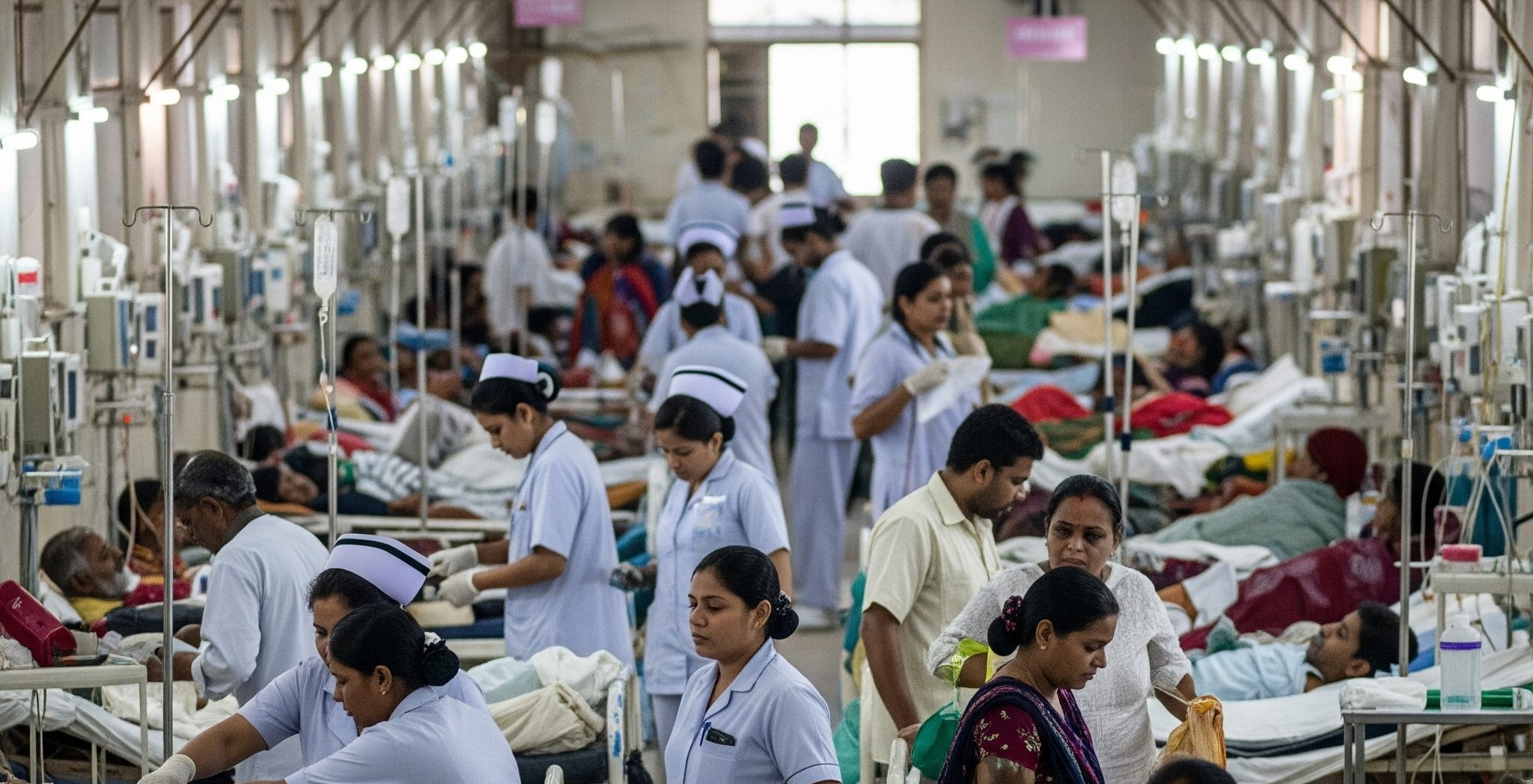
India’s biggest health challenges are non-communicable diseases such as cardiovascular disease, diabetes, chronic respiratory disease and cancer; untreated mental health conditions; air quality driven respiratory illness; and a continuing infectious disease burden that has not disappeared. The World Health Organization describes this pattern of overlapping burdens as a dual burden.
Most public discussion of these challenges treats them as separate problems requiring separate programmes. That framing is wrong in one important way. The four burdens above share a single failure point: people enter the health system late.
A person with uncontrolled blood pressure does not feel it. A person with rising blood glucose does not feel it. A person with early chronic obstructive respiratory change adapts to it and calls it age. A person with depression does not describe it as a health problem at all. In each case the first contact with a clinician happens after the condition has already caused damage that is harder to manage than it was two years earlier.
India has spent two decades expanding treatment capacity, insurance coverage and primary care infrastructure. That work matters, but treatment capacity only helps people who present. The constraint that binds hardest now is detection capacity: the number of people who get a set of basic numbers measured in a year, and the number of those measurements that lead to a follow-up.
What are non-communicable diseases, and why are they found late?
A non-communicable disease is a chronic condition that is not passed from person to person and typically develops over years, including cardiovascular disease, diabetes, chronic respiratory disease and cancer. Non-communicable diseases in India are commonly detected late because the early stages are asymptomatic and routine measurement is not part of most people’s lives.
Three structural reasons explain the delay, and none of them is patient indifference.
Screening is an errand. Getting blood pressure, blood glucose, a lipid profile and an ECG done conventionally means a clinic visit, a lab visit, a fasting requirement, a wait, a second visit for a report, and a third for interpretation. That is four half-days of work for a person who feels completely well.
Cost arrives before benefit. A daily wage earner pays for the test and the travel now, in exchange for a benefit that is statistical and years away. The health economics are sound at population level and unpersuasive at household level.
There is no default. In systems where population screening works, measurement is the default and opting out takes effort. In most of India measurement requires effort and not measuring is the default. Defaults beat exhortation, consistently.
The National Programme for Prevention and Control of Non-Communicable Diseases and the network of Ayushman Arogya Mandir facilities under the National Health Mission exist precisely to attack this. Both are structurally correct, and both are limited in reach by the same thing: how many people can be measured, how quickly, and by whom.
This is why Clinics On Cloud frames its category as infrastructure rather than as a device. A Health ATM is a self-service screening station that measures a defined set of clinical parameters, produces an immediate report, and connects the result to a record and a clinician. The relevant question is not how many tests it runs, but what happens after the test.
Which NCD risk factors can a health kiosk actually screen?
The World Health Organization identifies four shared modifiable behavioural risk factors behind most non-communicable disease: tobacco use, harmful use of alcohol, unhealthy diet and physical inactivity. None of the four is directly measurable at a screening kiosk. What a kiosk measures is the metabolic damage those behaviours produce, which is what makes the risk visible and personal.
This distinction is worth being honest about, because vendor claims in this category routinely blur it.
Risk factor or marker
Type
Screenable at a Clinics On Cloud kiosk?
What is actually captured
Tobacco use
Behavioural (WHO core four)
No
Self-declared history only; no biochemical confirmation
Harmful use of alcohol
Behavioural (WHO core four)
No
Self-declared history only
Unhealthy diet
Behavioural (WHO core four)
No
Inferred indirectly from body composition and lipid results
Physical inactivity
Behavioural (WHO core four)
No
Inferred indirectly from body composition and BMR
Raised blood pressure
Metabolic consequence
Yes
Blood pressure measurement
Raised blood glucose
Metabolic consequence
Yes
Random blood sugar and HbA1c
Raised blood lipids
Metabolic consequence
Yes
Total cholesterol, triglycerides, HDL, LDL, TC:HDL, non-HDL
Overweight and obesity
Metabolic consequence
Yes
Weight, BMI, body fat, visceral fat, muscle mass, metabolic age
Cardiac electrical abnormality
Clinical marker
Yes
6-lead or 12-lead ECG
Reduced lung function
Clinical marker
Yes
PEF, FVC, FEV, FEV1/FVC
Kidney and anaemia indicators
Clinical marker
Yes
Urine microalbumin, protein; anaemia and kidney parameters
Depression and anxiety symptoms
Clinical marker
Yes
PHQ-9 and GAD-7 questionnaires
Cancer
Disease outcome
No
Oral and dental cancer screening only; not a cancer diagnostic
Two conclusions follow from this table.
First, a kiosk is a metabolic and physiological measurement point, not a behavioural surveillance tool. It cannot tell you who smokes. It can tell a smoker what his blood pressure, lipid profile and lung function look like, which is a more useful conversation than being told to stop smoking.
Second, the value sits in the combination. Blood pressure alone is a number. Blood pressure with lipids, glucose, body composition and an ECG, in one 10-minute sitting, is a risk picture. Clinics On Cloud covers 65+ clinical parameters across 14 specialties in a single session with device accuracy of 90–95% depending on the test and device, under correct usage, calibration and patient preparation.
Mental health: the second detection gap
Mental health in India faces the same detection problem as non-communicable disease, with an additional barrier: people rarely present a mental health complaint to a general clinician at all. Structured screening questionnaires such as PHQ-9 for depression and GAD-7 for anxiety make the symptom visible without requiring the person to raise it first.
The Indian Council of Medical Research and the World Health Organization have both treated the gap between people who need mental health support and those who receive it as one of the largest in public health. The size of that gap is contested. Its existence is not.
Screening changes one specific thing here: who has to start the conversation. Answering a structured questionnaire on a private screen is a lower bar than telling a doctor you feel hopeless. Clinics On Cloud includes depression and anxiety screening using PHQ-9 and GAD-7 in the standard parameter set alongside the physical measurements, which normalises it as an ordinary part of a checkup rather than a separate act.
What it does not do is treat. A flagged score is an indication to speak to a qualified professional, and the report should say nothing more.
Air quality and respiratory health: an environmental problem with a clinical shadow
Air quality is an environmental and regulatory problem, not a clinical one, and no amount of screening improves the air. Screening addresses only the clinical shadow: identifying people whose lung function has already declined, so that they can be assessed and managed earlier.
This is a boundary worth stating plainly, because health-tech marketing sometimes implies otherwise. A kiosk in a polluted city does not reduce particulate exposure, and it does not substitute for emissions policy, industrial regulation or clean fuel programmes.
What pulmonary function testing: PEF, FVC and FEV1/FVC at an accessible point does is find declining lung function in people who have adapted to breathlessness. In industrial belts, mining districts, traffic corridors and occupational settings, that is a large group and almost entirely unmeasured today. Factories, MIDC estates, transport depots and municipal wards are where a recurring measurement point creates a lung function trend line for a population that has never had one.
The dual burden: infectious disease has not gone away
India carries a dual burden: rising non-communicable disease alongside a continuing infectious disease load including tuberculosis, dengue, malaria, hepatitis and vector-borne illness. National programmes under the National Health Mission have driven progress on tuberculosis in particular, but the infectious burden has not been displaced by the chronic one.
The operational consequence for anyone designing a screening programme is that a single-purpose station is a wasted trip. A person who walks up to a screening point in a district town is worth more than one measurement.
Clinics On Cloud kiosks include rapid tests for dengue, malaria, COVID-19 antigen, HIV I and II, typhoid, chikungunya, hepatitis B, hepatitis C, syphilis and blood grouping in the same enclosure as the metabolic and cardiac parameters. That is a deliberate design choice for Indian epidemiology, where a village screening camp and a district NCD drive are frequently the same event.
What screening does not solve
This section exists because most content in this category avoids it.
Screening does not treat. It identifies. A person told their blood pressure is high who then cannot reach, afford or trust a clinician is no better off, and arguably worse off, than before.
Screening does not create referral capacity. If a district has no physician available for follow-up, a screening programme generates a queue rather than an outcome. The referral pathway has to exist before the drive begins.
Screening does not fix determinants. Air quality, water quality, nutrition, tobacco availability, occupational safety and household income drive a large share of the burden described above, and none of them responds to measurement.
Screening is not diagnosis. Screening results are indicative. Clinics On Cloud is a preventive screening manufacturer, not a diagnostic laboratory, and its reports are designed to prompt medical follow-up rather than to conclude anything.
Screening without repetition is close to worthless. A single measurement is a data point; a trend is information. A programme that screens 10,000 people once and never returns has generated awareness and very little else.
Any organisation planning a screening programme should test its plan against those five sentences before it buys anything.
How digital health infrastructure changes the arithmetic
The Ayushman Bharat Digital Mission, the ABHA health account and the eSanjeevani teleconsultation platform matter because they convert an isolated screening result into a record and a consultation. Without that layer, screening produces paper. With it, screening produces a longitudinal record a clinician can act on.
This is where the argument closes. Detection capacity is not just the number of measurements taken. It is the number of measurements that reach a clinician attached to an identity that persists over time.
Clinics On Cloud kiosks integrate with ABHA and eSanjeevani, issue colour-coded reports by print, SMS, email and WhatsApp, escalate abnormal results to a live doctor consultation, and feed a centralised multi-location analytics dashboard that lets a programme owner see coverage, abnormality rates and follow-up across sites. Across the network, 2 lakh+ abnormalities have been detected for early intervention, from 3,500+ installations across 200+ cities and 8+ countries.
For rural programmes specifically, the operating model matters as much as the hardware, which is covered separately in how a Health ATM benefits rural India. For fixed high-footfall sites, the Clinics On Cloud Health Kiosk is the standard unit; for populations with no fixed screening point, the Mobile Medical Unit takes the same parameter set to the doorstep.
Clinics On Cloud is India’s first CDSCO-licensed Health ATM and Health Kiosk manufacturer, operating from Nighoje, Chakan MIDC, Pune.
Clinics On Cloud provides preventive health screening and is not a diagnostic laboratory. Screening results are indicative and are not a diagnosis. Always consult a qualified physician before acting on any health information.
A non-communicable disease is a chronic condition that is not transmitted between people and usually develops over years. The World Health Organization groups the main ones as cardiovascular disease, diabetes, chronic respiratory disease and cancer. They share four modifiable behavioural risk factors: tobacco use, harmful alcohol use, unhealthy diet and physical inactivity.
Why are non-communicable diseases detected so late in India?
Because the early stages produce no symptoms and routine measurement is not a default. Conventional screening requires multiple clinic and lab visits, fasting, waiting and time off work, which is a high cost for a person who feels well. Detection improves when measurement becomes quick, local and repeatable rather than an errand.
Which NCD risk factors can a health kiosk screen for?
A health kiosk cannot directly screen the four behavioural risk factors: tobacco use, alcohol use, diet and physical inactivity. It measures their metabolic consequences instead, including blood pressure, random blood sugar, HbA1c, lipid profile, body composition, ECG and lung function. Behavioural risk is captured only as self-declared history.
Is a health kiosk screening result a diagnosis?
No. Screening results are indicative and are not a diagnosis. Clinics On Cloud is a preventive screening manufacturer, not a diagnostic laboratory. Reports are designed to raise awareness and prompt appropriate medical follow-up, and any abnormal result should be reviewed by a qualified physician.
How accurate are health kiosk measurements?
Clinics On Cloud states device accuracy of 90–95% depending on the test and the device, under correct usage, calibration and patient preparation. Accuracy depends materially on operator process and maintenance, which is why calibration schedules and annual maintenance are part of any serious programme specification.
Can a health kiosk screen for mental health?
Yes, for symptoms. Clinics On Cloud includes PHQ-9 for depression and GAD-7 for anxiety in its standard parameter set. These are validated screening questionnaires that indicate the likely presence and severity of symptoms. They do not diagnose, and a flagged score should lead to assessment by a qualified mental health professional.
How much does a Health ATM cost in India?
Indicative Health ATM pricing starts from ₹6,00,000, and the final figure depends on the parameter configuration, enclosure, connectivity and service terms selected. For a programme quotation covering installation, operator training and annual maintenance across multiple sites, talk to the Clinics On Cloud team at +91 8999 073 447 or sales@clinicsoncloud.com.
Who buys population screening infrastructure in India?
Buyers include state health departments and National Health Mission programmes, district hospitals, corporate occupational health and CSR teams, insurers, hospital chains and large employers. Clinics On Cloud deployments include the Indian Army, the Indian Navy, BSF, NHM Uttar Pradesh with 200 Health ATMs, Mathura District Hospital, AIIMS Rishikesh and the Government of West Bengal.
Get In Touch
Healthcare is a right. Not a privilege.
We started Clinics on Cloud with a simple belief - that the quality of your healthcare should not depend on your postcode. Whether you're a government, corporate, NGO or entrepreneur - we built this for you.
Call us
+91 8999 073 447
Mon - Sat · 9 AM to 6 PM IST
Write to us
sales@clinicsoncloud.com
Partnerships · Deployments · Support
Visit us online
www.clinicsoncloud.com
Products · Case Studies · News
Find us
Nighoje, Chakan MIDC
Pune, Maharashtra - 410501, India
Built for every kind of health partner.
Government Body Corporate / HR Team NGO / CSR Partner Hospital or Clinic Defence Organisation International Partner Investor / Distributor Rural Entrepreneur
 Entry · PC-34Preventive Care