HomeBlogUganda Health Crisis 2025: Tackling the Sudan Ebolavirus Outbreak with Clinics on Cloud Health ATM Kiosks
Article29 April 20253 minUpdated
Uganda Health Crisis 2025: Tackling the Sudan Ebolavirus Outbreak with Clinics on Cloud Health ATM Kiosks
Uganda Health Kiosk
CCClinics On Cloud TeamPublished from Pune, India
Global
“
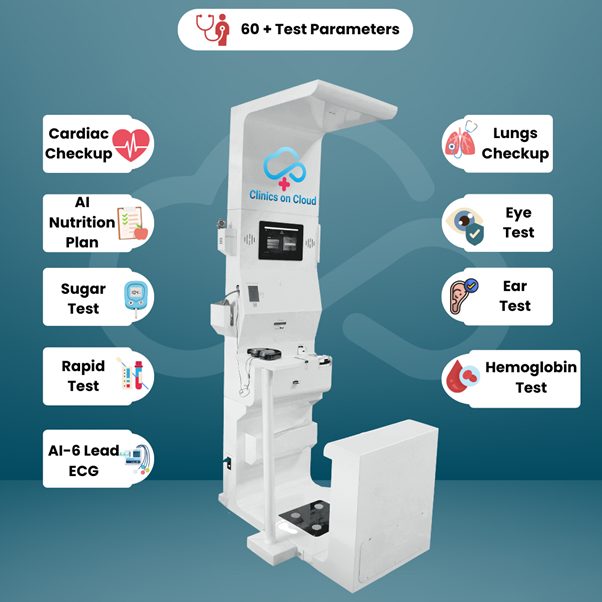
A health kiosk is a self-service screening station that captures clinical measurements without a skilled operator and routes abnormal results to a doctor on video. In a Ugandan deployment, a Clinics On Cloud Health ATM runs offline and holds 3–4 days of battery backup. It screens and flags; it does not diagnose, treat or control disease.
A note on what this page does and does not claim
Clinics On Cloud has no publicly documented deployment, client or partnership in Uganda as of September 2026, and this page names none. It also states no Ugandan health statistic, disease figure, ministry programme or funding number, because Clinics On Cloud does not hold primary data on Uganda and will not repeat figures it cannot stand behind.
What follows is deployment context: the structural conditions that shape a screening programme in a setting where clinicians are few and distances are long, and an honest account of what a kiosk changes. Programme designers should pair it with current data from the World Health Organization and Uganda’s own health authorities.
What actually constrains screening access in a low clinician-density setting
Four constraints recur, and only one of them is about equipment.
Clinician time per head of population. Where the ratio of trained clinicians to people is low, every routine measurement a clinician performs is a measurement that displaces something only a clinician can do. Screening competes with treatment for the same scarce hours.
Distance and the cost of travelling to be measured. Uganda’s public health system runs in tiers, from community-level health centres up to district and regional referral hospitals. A person who is not yet unwell rarely travels to any of them for a preventive check, because the transport cost and the lost working day are real and the benefit is abstract.
Intermittent power and connectivity outside urban corridors. Any device that requires uninterrupted mains power and a stable data link will not survive as a rural asset.
Language and literacy variation. English and Swahili are official, but the language a beneficiary actually speaks in a given district may be Luganda, a Runyakitara language, Luo, Ateso, Lugbara or another. A screening interface that requires reading in an official language excludes a large share of the people it was bought to reach.
None of these is solved by adding another diagnostic test. They are solved, partially, by moving the point of measurement closer to where people already are and by removing the clinician from the measurement step.
What a health kiosk can do about it
A Clinics On Cloud Health ATM addresses the first three constraints directly and the fourth through interface design.
It removes clinician time from measurement. A 10-minute session needs no skilled operator. A clinician is consumed only when a result is abnormal and a teleconsultation is triggered.
It moves the measurement to the person. Sited at a health centre, a market, a workplace, a school or a settlement, it measures people who would never have made a preventive journey.
It produces a structured, repeatable record. Digital health records with longitudinal tracking mean a second visit produces a trend, not an isolated number, which is what makes early change visible.
It triages. Colour-coded reports and AI-assisted risk flagging identify which of a large screened group needs a clinician, and route them.
It reports. A centralised multi-location analytics dashboard gives a funder screening counts, demographics and location-wise breakdowns without a separate data-collection exercise.
Across its network Clinics On Cloud has screened 12M+ patients and detected 2 lakh+ (200,000+) abnormalities for early intervention, which is the pattern this model produces at scale.
What a health kiosk cannot do about it
This section exists because the previous version of this page overstated the device, and a funder who discovers that during due diligence will decline the whole proposal.
A Clinics On Cloud Health ATM does not:
diagnose, treat, cure or prevent any disease;
replace a diagnostic laboratory;
dispense medicines or deliver vaccines;
serve as an outbreak surveillance or epidemic control system;
integrate with any national health information system unless that integration has been separately built, scoped and approved;
create treatment capacity where none exists.
That last point deserves emphasis. Screening at scale identifies people who need care. If there is no referral pathway with the capacity to receive them, the programme generates identified need and no resolution, which is worse than not screening. Design the referral pathway before ordering the kiosk. Name the receiving facility, agree the referral protocol with it, and budget for the transport that gets a flagged person there.
Device accuracy is 90–95% depending on the test and device, under correct usage, calibration and patient preparation. Results are indicative and are intended to prompt appropriate medical follow-up. Full specification detail is in clinical parameters and tests offered by a health kiosk.
Siting: where a unit earns its place in Uganda
A kiosk needs footfall. The best sites are places people already go for another reason.
Health centres and referral hospitals. The kiosk filters the outpatient queue and frees clinician time for people who need it.
Workplaces. Plantations, agro-processing, manufacturing, transport, mining and construction employers screen a captive workforce with no travel cost.
Schools and higher education campuses. Steady volumes, straightforward consent structures through the institution, and vision and hearing screening that has obvious educational value.
Markets and transport hubs. High footfall, but requires an attendant and a plan for who owns the unit.
Refugee, displacement and host-community settings. Where an implementing partner already runs services and can absorb the referral load.
Where there is no building, the Box Clinic is the correct product rather than a fixed kiosk. Where a district population is dispersed, a Mobile Medical Unit running a circuit reaches more people per unit than a fixed installation. Most district-scale programmes end up using a mix.
Power, connectivity and the practical hardware questions
Assume neither reliable mains power nor reliable data outside urban corridors, and specify accordingly.
Offline operation. The kiosk completes the session, prints the report and stores the record locally with no connection, then synchronises when the network returns. Only live teleconsultation needs a live link, so a site with intermittent data can screen continuously and hold doctor review for connected windows.
Battery backup of 3–4 days. This is what makes solar viable. A directly solar-powered device stops on a cloudy day; a device with multi-day storage does not. Array sizing depends on configuration, daily session volume and local conditions, so it is specified per site with the distributor rather than sold as a fixed kit.
Enclosure and environment. The rugged metal enclosure handles dust, transport over poor roads and unsupervised public siting. Sheltered placement extends service life in high-humidity conditions.
Consumables. Rapid-test and urine modules consume stock, and this is the recurring cost line that stalls programmes in month four. Order the first-year buffer with the unit.
Language and the user interface
The interface is a multilingual touchscreen with audio-visual voice guidance, and no skilled operator is required to run a session.
For a Ugandan deployment, specify language sets by beneficiary population rather than by official language. A unit sited in one region may need a different set from a unit sited in another, and adding a language after installation is slower than specifying it at order stage.
Voice guidance and colour-coded reports do most of the accessibility work, because a person can act on a flag without parsing a numeric range. Even so, budget for a trained non-clinical attendant. Attended sites produce steadier throughput than unattended ones, particularly in the first few months.
Import, registration and data rules
Clinics On Cloud holds CDSCO licensing in India, ISO 13485 for medical-device quality management, US FDA and CE, plus ISO 27001, HIPAA compliance, GDPR compliance and VAPT testing.
Those are manufacturer credentials, not a Ugandan approval. Clinics On Cloud does not claim registration or regulatory approval in Uganda or in any other African country. An import file will typically need national medical-device registration filed by a locally licensed importer or authorised representative, an import permit and customs conformity clearance, and a data-protection review where identifiable health records are stored or teleconsultation is offered. Regional harmonisation through the African Medicines Agency is progressing, but as of 2026 registration remains national. Confirm current requirements with the national regulator and local regulatory counsel before quoting a delivery date.
The NGO and donor procurement route
Most first deployments in a market like Uganda are grant-funded, run by an implementing partner, and reported to a donor. Five questions decide whether that programme survives its own funding cycle.
Who owns the asset when the grant ends? Name the entity in the proposal, not after it.
Who funds maintenance and consumables in years two to five? This is the most common cause of abandoned equipment, and it is entirely predictable at design stage.
Where do flagged people go? The receiving facility must have agreed to receive them.
Who is the operator, and who pays them? A trained non-clinical attendant is a line item, not an assumption.
What is the consent and data-handling model for beneficiaries? Decide before the first session, in writing, in the beneficiary’s language.
Programmes that answer all five convert. Programmes that answer three stall. The wider procurement picture, including ministry, development-agency and private routes, is set out in the region-by-region guide to health kiosks in Africa, and the comparable buying logic in Asian markets is in health kiosks across Asia.
Talking to Clinics On Cloud about a Ugandan deployment
Clinics On Cloud, the legal entity SehatPro Technologies Pvt Ltd, manufactures at Chakan MIDC, Pune, India, is India’s first CDSCO-licensed Health ATM and Health Kiosk manufacturer, and is deployed in 8+ countries with 3,500+ installations. Distribution is appointed by territory.
Write to sales@clinicsoncloud.com or call +91 8999 073 447 (Mon–Sat, 9:00–18:00 IST). Bring the site type, the expected daily session volume, the language sets, the power situation, and the name of the facility that will receive referrals. Pricing varies by configuration, so ask for a quotation against that defined scope, including first-year consumables, installation, operator training and service. See the Health Kiosk page for specifications and Clinics On Cloud as a Health ATM manufacturer for manufacturer credentials.
Clinics On Cloud provides preventive health screening and is not a diagnostic laboratory. Screening results are indicative and are not a diagnosis. Always consult a qualified physician before acting on any health information.
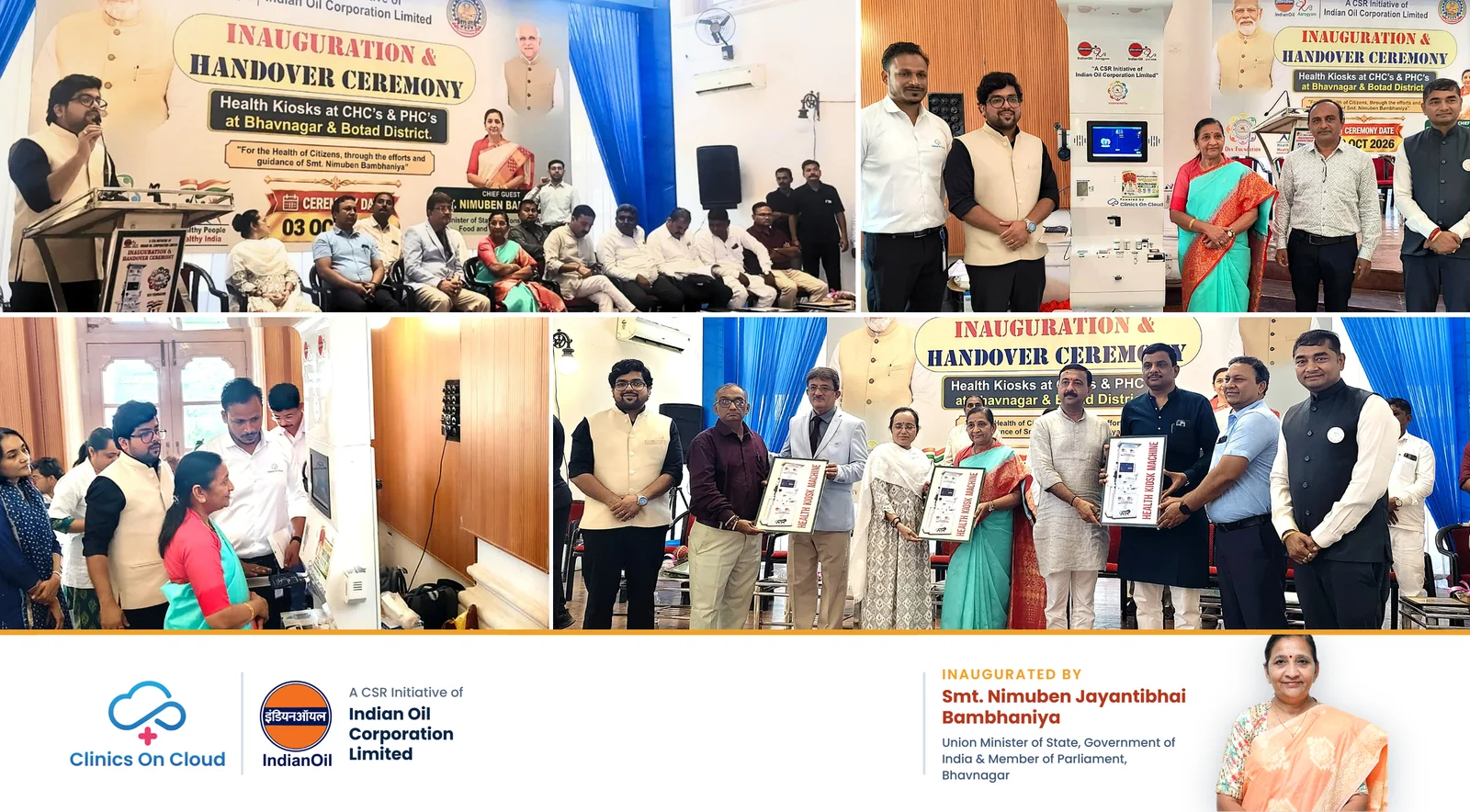
21 Primary Health Centres. 21 Clinics On Cloud Health Kiosks. One stronger connected public-health network - through an IndianOil CSR initiative in the Bhavnagar Lok Sabha constituency.
Four structural constraints dominate in low clinician-density settings: clinician time per head of population, the travel cost and lost working day involved in reaching a facility for a preventive check, intermittent power and connectivity outside urban corridors, and language and literacy variation across districts. A screening kiosk addresses the first three directly and the fourth through voice-guided interface design.
Can a health kiosk work in rural Uganda?
Yes, if the site is specified honestly. The Clinics On Cloud Health ATM runs offline, holds 3–4 days of battery backup, works with solar-plus-battery, needs no skilled operator and has a rugged metal enclosure. What it also needs is footfall, a trained attendant, a first-year consumables buffer and an agreed referral pathway for flagged results.
Does a health kiosk need internet to work?
No. The kiosk completes the 10-minute session, prints a colour-coded report and stores the record locally without a connection, then synchronises when the network returns. Live doctor teleconsultation is the only function that requires an active link, so a site with intermittent mobile data can screen continuously and schedule consultations for connected windows.
Can a health kiosk detect or control a disease outbreak?
No. Clinics On Cloud is not a diagnostic laboratory and the Health ATM does not diagnose, treat, cure or prevent any disease, nor does it function as outbreak surveillance or epidemic control infrastructure. It performs preventive screening, produces indicative results and flags abnormal findings for medical follow-up. Outbreak response is a public health function performed by health authorities.
Who buys health kiosks in Uganda and East Africa?
Typically NGOs and implementing partners with grant funding, development agencies and donor programmes, district and national health authorities through tender, and private employers in agriculture, agro-processing, transport, mining and manufacturing. Employer-funded programmes tend to last longest because the buyer also funds the maintenance.
What languages does a health kiosk support?
The interface is a multilingual touchscreen with audio-visual voice guidance, and language sets are configured per deployment rather than fixed at the factory. Specify by beneficiary population rather than official language, since the languages spoken in a given district may differ from English or Swahili. Adding a language after installation is possible but slower.
What does a health kiosk cost to import into Uganda?
Landed cost depends on configuration, language sets, power setup, freight, duty and the registration route, so Clinics On Cloud quotes against a defined scope rather than publishing an export price. Ask for a quotation covering the kiosk, first-year consumables, installation, operator training and multi-year service, because those items dominate cost after year one.
Is Clinics On Cloud registered as a medical device supplier in Uganda?
Clinics On Cloud holds CDSCO licensing in India, ISO 13485, US FDA, CE, ISO 27001, HIPAA and GDPR compliance and VAPT testing, and makes no claim of registration or regulatory approval in Uganda or any other African country. National medical-device registration is normally filed by a locally licensed importer. Confirm current requirements with the national regulator.
How do NGOs procure health kiosks for a Ugandan programme?
Most first deployments are grant-funded through an implementing partner with donor reporting obligations. Before ordering, settle five things in writing: who owns the asset after the grant, who funds consumables and maintenance in years two to five, which facility receives referrals, who the paid operator is, and what the beneficiary consent and data-handling model is.
Get In Touch
Healthcare is a right. Not a privilege.
We started Clinics on Cloud with a simple belief - that the quality of your healthcare should not depend on your postcode. Whether you're a government, corporate, NGO or entrepreneur - we built this for you.
Call us
+91 8999 073 447
Mon - Sat · 9 AM to 6 PM IST
Write to us
sales@clinicsoncloud.com
Partnerships · Deployments · Support
Visit us online
www.clinicsoncloud.com
Products · Case Studies · News
Find us
Nighoje, Chakan MIDC
Pune, Maharashtra - 410501, India
Built for every kind of health partner.
Government Body Corporate / HR Team NGO / CSR Partner Hospital or Clinic Defence Organisation International Partner Investor / Distributor Rural Entrepreneur
 Entry · G-01Global