HomeBlog21 PHCs in Bhavnagar Go Digital: How Clinics On Cloud and IndianOil Are Building Connected Primary Healthcare
Field Notes7 October 202612 min read
21 PHCs in Bhavnagar Go Digital: How Clinics On Cloud and IndianOil Are Building Connected Primary Healthcare
IndianOil CSR enables deployment of 21 Clinics On Cloud Health Kiosks across PHCs in Bhavnagar, Gujarat, bringing preventive screening, telemedicine and connected digital healthcare closer to communities.
CCClinics On Cloud TeamPublished from Pune, India
Health ATM
21PHCs in Bhavnagar
21Health Kiosks deployed
40+Parameters per screening
Gujarat's Public Healthcare Is Getting Smarter, Digital and Connected
“
21 Primary Health Centres. 21 Clinics On Cloud Health Kiosks. One stronger connected public-health network.
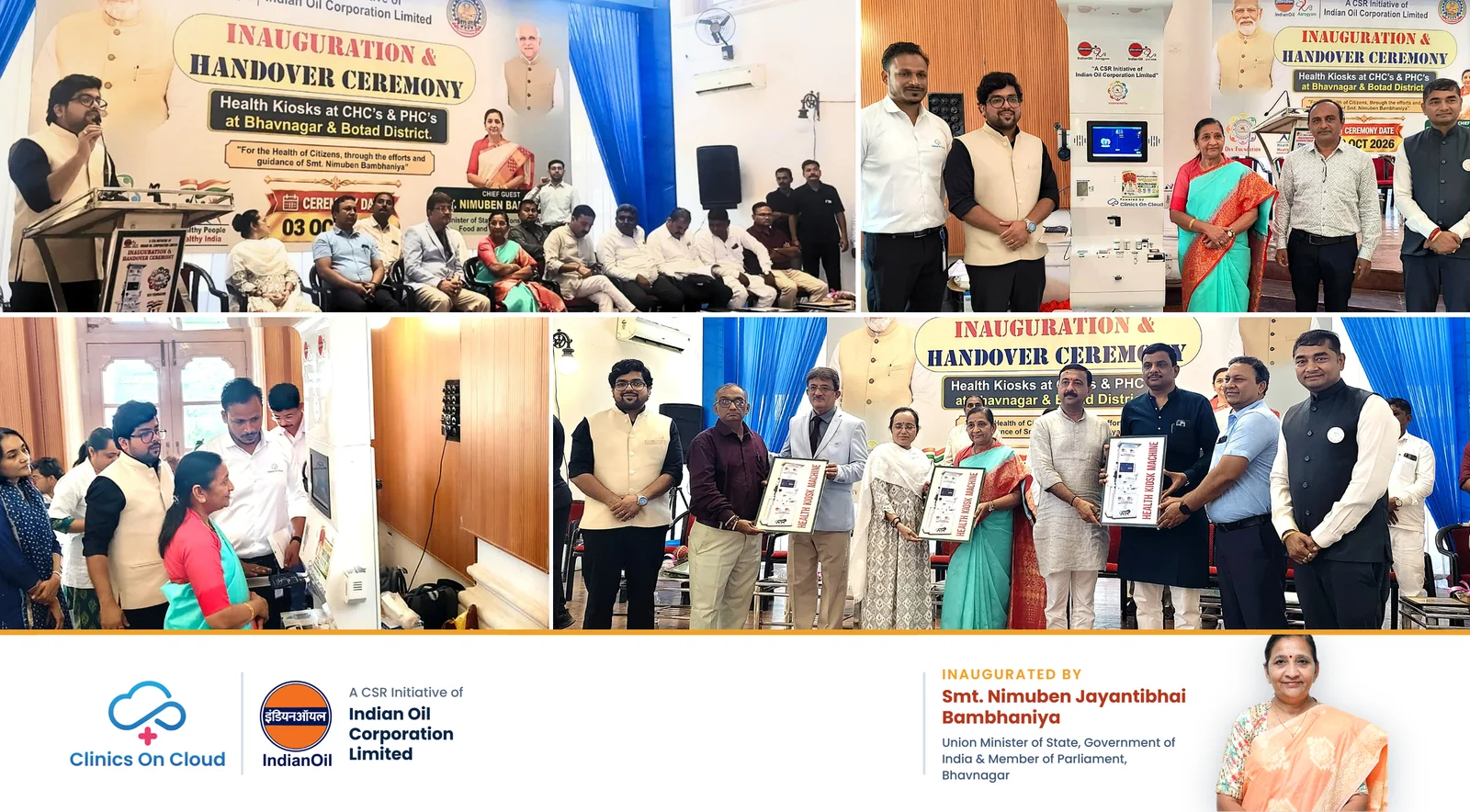
Through a CSR initiative by Indian Oil Corporation Limited (IndianOil), 21 Clinics On Cloud Health Kiosks have been handed over for deployment across Primary Health Centres in the Bhavnagar Lok Sabha constituency, Gujarat.
The initiative is designed to bring standardised preventive health screening, digital health reports, telemedicine and connected healthcare services closer to communities through the public healthcare infrastructure that already serves them.
This is not simply the installation of 21 machines. It demonstrates how an existing network of PHCs can be upgraded with digital healthcare technology to create a more connected, preventive and data-enabled primary-care ecosystem.
And it raises an important question for governments, CSR organisations and healthcare leaders across India: what if we do not always need to build new healthcare infrastructure - but instead make the infrastructure we already have significantly smarter?
What happened in Bhavnagar?
As part of the initiative supported by Indian Oil Corporation Limited, 21 Clinics On Cloud Health Kiosks were handed over for deployment across PHCs serving communities in the Bhavnagar Lok Sabha constituency.
The programme was held in the presence of Smt. Nimuben Jayantibhai Bambhaniya, Hon'ble Union Minister of State for Consumer Affairs, Food & Public Distribution and Member of Parliament from the Bhavnagar Lok Sabha constituency, along with members of the IndianOil leadership team.
During the programme, the Minister also experienced the Clinics On Cloud platform firsthand, seeing how connected screening technology can fit within the primary healthcare environment.
India already has a vast public healthcare infrastructure. The larger opportunity is to make every healthcare access point increasingly preventive, connected, standardised and digitally enabled.
Primary Health Centres are often the first point of contact between communities and the healthcare system. By adding connected screening infrastructure to PHCs, routine health assessments can become faster and health information can become easier to capture, report and use.
Instead of depending only on symptoms to bring people into healthcare, technology can help shift the conversation toward: screen earlier → identify risk → connect to care → follow up.
That shift is critical to preventive healthcare. Conditions such as hypertension, diabetes and cardiovascular risk can often remain unnoticed because people may feel healthy and therefore postpone routine screening. When screening is available closer to the community, the barrier to getting checked becomes much smaller.
What is a Health Kiosk or Health ATM?
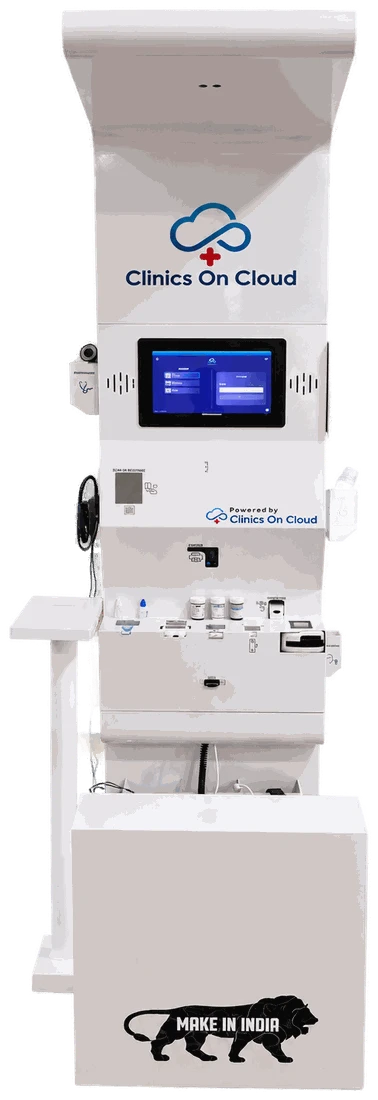
A Health Kiosk, often referred to as a Health ATM, is a connected healthcare station that brings multiple preventive health screenings, digital health reporting and telemedicine capabilities together through one platform.
The Clinics On Cloud Health Kiosk is designed as a walk-up digital healthcare station capable of supporting a broad range of screening parameters through connected medical devices.
Depending on the configuration, users can undergo assessments related to:
Blood pressure
SpO₂
Temperature
Height and weight
BMI and body composition
Blood glucose
Haemoglobin
HbA1c
Lipid profile
Uric acid
ECG
Pulmonary function
Vision
Hearing
Oral health
Other preventive health indicators
Results can be brought together into a smart digital health report, while telemedicine capabilities can help connect users with doctors where required.
The purpose is not to replace hospitals or laboratories. The purpose is to make the first layer of preventive healthcare dramatically more accessible.
How can a Health Kiosk strengthen a Primary Health Centre?
A connected Health Kiosk can help a PHC evolve from being only a point of care into a more technology-enabled microclinic.
A typical journey can become: Patient Registration → Preventive Screening → Digital Report → Risk Identification → Teleconsultation / Referral → Follow-up
1. Faster preventive screening
Multiple routine health parameters can be captured through one connected workflow rather than through fragmented processes.
2. Standardised screening
Digital workflows can help make the screening process more consistent across locations. If similar technology is deployed across multiple PHCs, the organisation can create a more standardised approach to preventive screening.
3. Instant digital reports
Instead of health information remaining fragmented across paper records, screening results can be made available digitally and, depending on the deployment, shared through channels such as WhatsApp, email or print.
4. Telemedicine connectivity
Where specialist or doctor availability is limited, telemedicine can create another layer of access. A patient can be physically screened at the PHC while medical expertise may be available remotely.
5. Structured health information
Digitally captured screening data can create a more structured view of population health when implemented with the appropriate privacy, consent and data-governance framework. That can make healthcare programmes increasingly measurable.
From individual PHCs to a connected healthcare network
The real opportunity begins when Health Kiosks are not viewed as isolated machines.
Imagine 21 PHCs functioning as 21 connected healthcare nodes. Each location conducts preventive screenings. Each screening generates structured health information. Over time, authorised programme stakeholders can potentially understand patterns across locations rather than evaluating each PHC in isolation.
Aggregated and appropriately governed information could help programmes understand trends relating to hypertension, diabetes, obesity, cardiac risk, anaemia, respiratory health and other preventive health indicators.
This is where healthcare technology becomes more than a patient-facing tool. It can become part of the health intelligence infrastructure supporting the programme.
The value shifts from "How many tests did we conduct?" to "What is the health profile of the population we are serving, and where should we intervene next?" That is a much more powerful question.
Why preventive healthcare at PHCs matters
India's healthcare system is already moving toward stronger comprehensive primary healthcare. Large-scale national programmes include screening for conditions such as hypertension, diabetes and major cancers, alongside the expansion of teleconsultation across primary-care facilities.
The reason is straightforward: the earlier a health risk is identified, the earlier an individual can be guided toward appropriate care. A PHC equipped with digital preventive screening infrastructure can become an important point in that journey.
For a person living in a rural or semi-urban community, the difference between having screening available locally and travelling significantly farther for basic tests can determine whether the screening happens at all.
Healthcare accessibility is therefore not only about the availability of hospitals. It is also about how close the first meaningful healthcare interaction is to the patient.
Quality healthcare should not depend on a PIN code
One of the biggest promises of digital healthcare is the ability to separate access to certain healthcare services from geography. A community should not have fewer opportunities for preventive screening simply because it is located farther from a major hospital.
Connected technologies allow portions of the healthcare journey to be distributed. Screening can happen locally. Reports can be generated digitally. Doctors can connect remotely. Higher-level hospitals can remain the destination for patients who genuinely require advanced evaluation or treatment.
This creates a more distributed model: screen locally, connect digitally, escalate intelligently. For rural and community healthcare - and for the villages a fixed kiosk cannot reach, where a Mobile Medical Unit takes over - that model can be transformational.
Why this represents a different model of healthcare CSR
Healthcare CSR has traditionally included one-day health camps, medical equipment donations, ambulance donations, awareness drives and screening camps. Each can create value. But organisations increasingly have an opportunity to think beyond one-time interventions.
The question can become: can CSR strengthen healthcare infrastructure that continues serving communities after the event is over?
That is where connected Health Kiosk deployments for CSR programmes become particularly relevant. Rather than supporting healthcare for only one day, an organisation can potentially help create a healthcare access point that remains within the community.
The impact can continue every time the Health Kiosk is used. That changes CSR from an event into infrastructure.
Why CSR organisations should pay attention to connected healthcare infrastructure
For CSR leaders, one challenge with healthcare programmes is measuring long-term impact. It may be relatively easy to count the number of people who attended a camp. It is more difficult to understand what health risks were discovered, which communities showed higher prevalence, how many people required follow-up, whether people are returning for periodic screening and which health problems the next programme should prioritise.
A digitally enabled healthcare programme can potentially create far better visibility into these questions. That means a CSR programme can begin measuring not only reach, but also health intelligence and continuity.
The future is unlikely to be only "How many beneficiaries did we touch?" It will increasingly become "What measurable healthcare infrastructure and outcomes did we create?"
Why upgrading existing PHCs may be more powerful than building from scratch
Building entirely new healthcare facilities requires land, civil infrastructure, staffing, equipment and recurring operational expenditure. In many locations, however, the physical healthcare network already exists. The opportunity may therefore be to increase the utilisation and capabilities of that network.
A Health Kiosk can act as a technology layer within an existing PHC. The PHC already has community trust, a physical location, healthcare personnel, existing patient footfall and linkages to the wider public-health system. Digital healthcare infrastructure can strengthen that foundation.
This is an important principle for the next phase of healthcare transformation: the future of healthcare does not always require more buildings. Sometimes it requires making every existing healthcare point significantly more capable.
From PHC to connected microclinic
At Clinics On Cloud, we describe this evolution through the idea of the microclinic economy. A microclinic is a compact, distributed healthcare access point enabled by technology. It does not try to replicate an entire hospital. Instead, it brings the most commonly needed first-line healthcare capabilities closer to people.
A connected PHC can function as a powerful microclinic when it brings together preventive screening + digital records + connected devices + telemedicine + referral pathways. Hospitals then remain the higher layer of the healthcare network for specialised diagnostics, procedures and treatment.
What makes the Bhavnagar project significant?
The significance is not simply the number 21. It is the network effect created by those 21 locations. One Health Kiosk can improve healthcare access at one PHC. Twenty-one connected Health Kiosks can begin demonstrating how preventive healthcare technology may work across an entire constituency.
That creates a model that can potentially be replicated across districts, states, aspirational districts, rural healthcare networks, CSR programmes, government public-health initiatives and hospital outreach networks - see where Clinics On Cloud is already deployed.
What could happen if more CSR programmes adopted this model?
If one CSR programme can digitally strengthen 21 PHCs, then similar programmes across multiple organisations could help upgrade hundreds or thousands of existing healthcare access points: PHCs, CHCs, Ayushman Arogya Mandirs, government hospitals, rural community centres, schools, industrial healthcare centres and remote healthcare facilities.
The infrastructure already exists in many of these places. What is often missing is the connected diagnostic and digital layer. For CSR leaders evaluating where the next healthcare budget should go, that creates a compelling opportunity: instead of funding another isolated healthcare activity, could you upgrade an entire local healthcare network?
The FOMO for healthcare organisations is real
Digital healthcare is moving rapidly from experimentation to infrastructure. Telemedicine is already operating at enormous scale across India. Digital health records are becoming increasingly important. Preventive screening is expanding. Connected medical devices are becoming more capable. AI is entering healthcare workflows.
Organisations that begin building connected healthcare networks today will have something extremely valuable tomorrow: structured longitudinal healthcare infrastructure and experience. Those that wait may eventually need to digitise anyway - but they will be starting years behind.
For CSR organisations, governments, hospitals and corporates, the question is therefore shifting from "Should we digitise preventive healthcare?" to "How quickly can we build the right model?"
The role of Clinics On Cloud
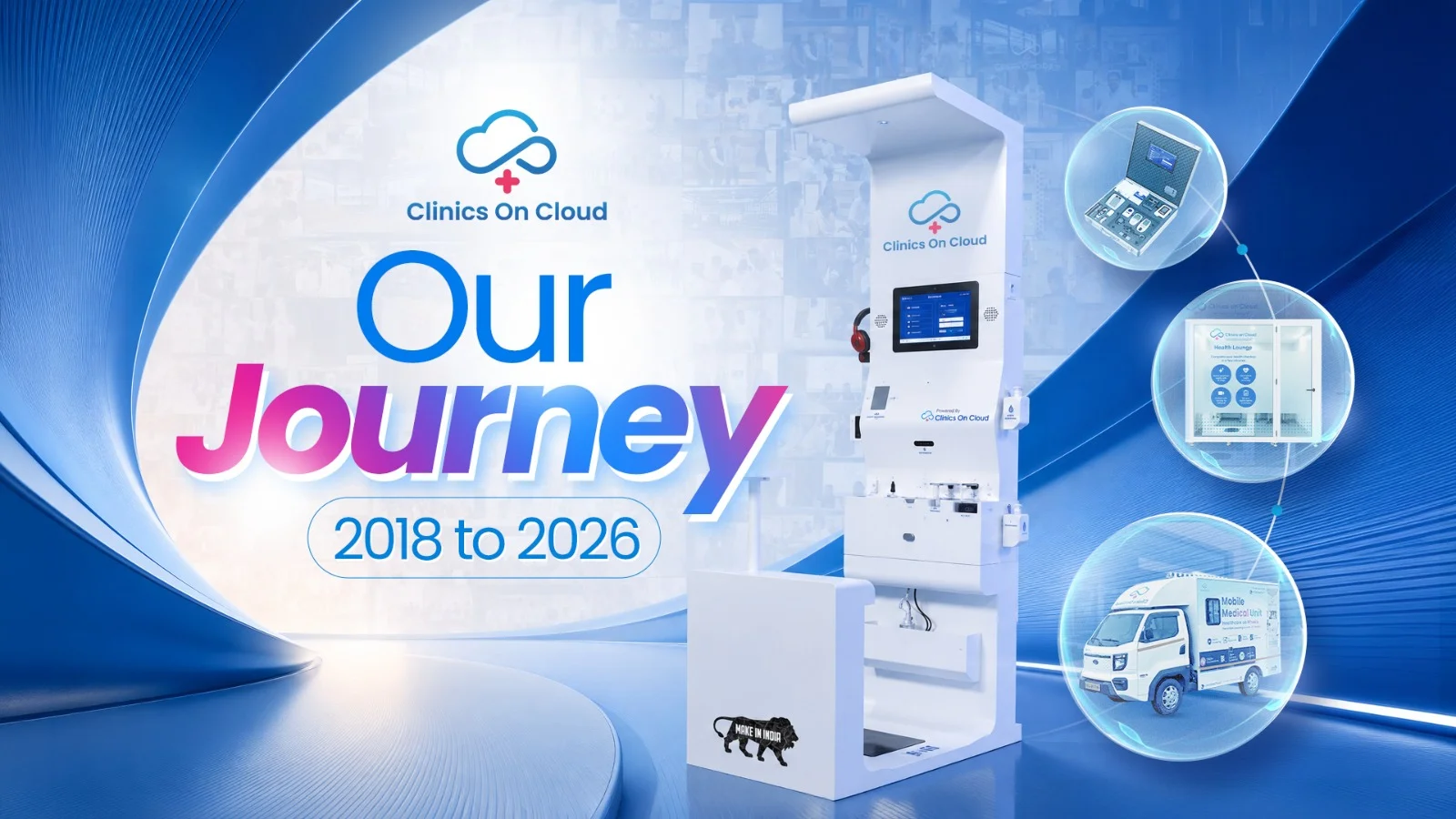
Clinics On Cloud is building the infrastructure layer for the global microclinic economy. Its connected healthcare ecosystem includes Health ATMs / Health Kiosks, Health Lounges, Mobile Medical Units, Box Clinics, connected healthcare software, telemedicine, digital health reporting and AI-enabled health assessment.
With deployments across India and international markets, the objective is to make preventive healthcare available where people already are - from corporate campuses and hospitals to PHCs, communities and remote locations. See the full range of use cases.
A CSR initiative that keeps creating impact
The contribution of Indian Oil Corporation Limited in Bhavnagar demonstrates what long-term healthcare CSR can look like. Rather than limiting the impact to one event, the initiative strengthens healthcare infrastructure that can continue supporting communities.
Every screening conducted tomorrow adds to the value of the deployment. Every individual who identifies a potential risk earlier adds to its impact. Every digital health report generated helps make healthcare more connected. And every PHC that becomes more capable strengthens the healthcare network around it. This is the kind of CSR impact that compounds.
Clinics On Cloud sincerely appreciates Indian Oil Corporation Limited for supporting the development of a more connected and accessible public healthcare ecosystem in Bhavnagar.
“
21 PHCs. 21 Connected Health Kiosks. One Stronger Healthcare Network.
This is what the digital transformation of healthcare can look like at the grassroots. Not replacing the existing public-health system - strengthening it. Not creating healthcare only where large hospitals exist - distributing it. Not waiting until disease becomes visible - screening earlier. Not treating every healthcare facility as an island - connecting the network.
Because quality healthcare should not depend on a PIN code. And because the future of healthcare may not be defined by how many more hospitals we can build - it may be defined by how intelligently we connect every healthcare access point we already have. Talk to our team about a PHC or CSR deployment.
Health Kiosk in GujaratHealth ATM for PHCDigital PHCCSR HealthcareTelemedicine in PHCPreventive Healthcare
Join the conversation
Leave a comment.
Add your comment
Your email is never published. Comments appear after a quick review.
If ATMs could revolutionise banking by bringing financial services closer to people, why could healthcare not become just as accessible? Eight years on, that question is still the company.
What does an AI health kiosk actually measure, and what does the AI add? A clear walkthrough of parameters, predictive risk scores, AI diet plans and smart reports.
What governments, CSR teams and hospitals ask about connected screening at the primary-care level.
What is a Health Kiosk in a PHC?
A Health Kiosk in a Primary Health Centre is a connected screening platform that can combine multiple preventive health assessments, digital reporting and telemedicine capabilities at the PHC level. It can help make routine health screening faster, more standardised and digitally connected.
How can Health ATMs help rural healthcare in India?
Health ATMs can bring preventive screening closer to rural populations by enabling multiple routine health assessments at PHCs, community centres and other local healthcare access points. When combined with telemedicine, patients can also potentially connect with doctors remotely.
Can Health Kiosks be used in government hospitals and PHCs?
Yes. Health Kiosks can be configured for government hospitals, PHCs, CHCs and other public healthcare facilities, depending on programme requirements, medical-device regulations, integrations and operating workflows.
Can CSR funds be used for Health Kiosk projects?
Healthcare infrastructure and community healthcare initiatives are common areas of CSR activity, subject to the organisation's CSR policy and applicable Indian regulations. Health Kiosk projects can form part of programmes aimed at preventive healthcare, rural healthcare and strengthening public-health infrastructure.
What is the difference between a Health Kiosk and a health camp?
A health camp is generally temporary, while a Health Kiosk can remain at the location as ongoing healthcare infrastructure. This allows preventive screening to continue beyond a single event and can support repeat screenings and digital health records.
How do Health Kiosks support preventive healthcare?
Health Kiosks make routine screening more accessible by combining multiple health assessments through connected devices. This can help identify potential risks earlier and encourage people to monitor their health before symptoms become serious.
Can Health Kiosks provide telemedicine?
Yes. Connected Health Kiosk platforms can integrate telemedicine, allowing users to complete physical health screening locally and connect remotely with healthcare professionals when required.
What is a connected PHC?
A connected PHC is a Primary Health Centre enhanced with digital healthcare capabilities such as connected medical devices, digital reports, electronic health information, telemedicine and data-enabled programme monitoring.
How can digital PHCs help governments?
Digital PHCs can support more standardised screening, improve access to telemedicine, generate structured health information and provide better visibility into preventive-health programmes across multiple locations.
Why are Health Kiosks useful for CSR healthcare projects?
Health Kiosks can help CSR organisations move beyond one-time health camps toward longer-term healthcare infrastructure. They can also make programme reach and screening activity more measurable through digitally captured information.
Where has Clinics On Cloud deployed Health Kiosks in Gujarat?
Clinics On Cloud has Health Kiosk deployments across Gujarat, including public-health and CSR-linked healthcare projects. One recent initiative involves 21 Health Kiosks being deployed across PHCs in the Bhavnagar Lok Sabha constituency through an IndianOil CSR initiative.
Which company provides Health Kiosks for PHCs and CSR healthcare programmes?
Clinics On Cloud provides connected Health Kiosk and Health ATM solutions for government healthcare programmes, PHCs, hospitals, CSR organisations, corporates and community healthcare initiatives in India and international markets.
Get In Touch
Healthcare is a right. Not a privilege.
We started Clinics on Cloud with a simple belief - that the quality of your healthcare should not depend on your postcode. Whether you're a government, corporate, NGO or entrepreneur - we built this for you.
Call us
+91 8999 073 447
Mon - Sat · 9 AM to 6 PM IST
Write to us
sales@clinicsoncloud.com
Partnerships · Deployments · Support
Visit us online
www.clinicsoncloud.com
Products · Case Studies · News
Find us
Nighoje, Chakan MIDC
Pune, Maharashtra - 410501, India
Built for every kind of health partner.
Government Body Corporate / HR Team NGO / CSR Partner Hospital or Clinic Defence Organisation International Partner Investor / Distributor Rural Entrepreneur
 Entry · N-78News