HomeBlogWhat is Telemedicine Kiosk? Benefits of Telemedicine, and the roll of Telemedicine Kiosk
Article24 September 20246 minUpdated
What is Telemedicine Kiosk? Benefits of Telemedicine, and the roll of Telemedicine Kiosk
As the world continues to embrace digital transformation, healthcare is evolving alongside it. One of the key innovations in this space is telemedicine, a groundbreaking approach to delivering medical services remotely. But what exactly is telemedicine, what are its benefits, and how does the introduction of telemedicine kiosks further revolutionize the healthcare industry? This article will explo
CCClinics On Cloud TeamPublished from Pune, India
Telemedicine
“
Telemedicine is the delivery of clinical care by a registered medical practitioner to a patient at a different location, using audio, video or messaging, and in India it is governed by the national Telemedicine Practice Guidelines. Clinics On Cloud pairs telemedicine with kiosk screening covering 65+ clinical parameters across 14 specialties, so the doctor consults on measured data.
What is telemedicine?
Telemedicine is the delivery of clinical services by a registered medical practitioner to a patient located somewhere else, using audio, video or written communication, for consultation, advice, follow-up or, where appropriate, prescription.
The definition contains three load-bearing elements. There is a registered medical practitioner on one side. There is a patient at a different location on the other. And there is a clinical exchange, not merely information delivery.
Everything else in this article follows from that definition. A chatbot answering health questions is not telemedicine. A health app tracking steps is not telemedicine. A doctor with a registration number advising a specific patient about that patient’s health, at a distance, is telemedicine.
Telemedicine vs telehealth vs teleconsultation
Term
Meaning
Example
Telemedicine
Clinical care delivered remotely by a registered medical practitioner
A doctor reviewing a patient’s flagged blood pressure reading on video and advising on next steps
Telehealth
The broader category, including non-clinical remote health services
Remote health education, administrative appointments, provider-to-provider training
Teleconsultation
A single remote clinical encounter; the unit of telemedicine
One 12-minute video consultation
Remote patient monitoring
Ongoing collection of a patient’s data between encounters
Home blood pressure readings sent to a clinic
Store-and-forward
Data captured now, reviewed by a clinician later
A screening report reviewed by a doctor the following morning
Telemedicine kiosk
A physical station combining screening devices with a live consultation link
A Clinics On Cloud Health ATM connecting a flagged patient to a doctor
Telehealth is the umbrella. Telemedicine is the clinical part of it. Teleconsultation is one instance.
How telemedicine works, step by step
Identification. The patient is identified, and in India may be linked to an ABHA number under the Ayushman Bharat Digital Mission so the encounter attaches to a persistent record.
Data capture. Symptoms, history and, in a kiosk-based model, measured clinical parameters are collected before the doctor joins.
Practitioner verification. The consultation is conducted by a registered medical practitioner. Patients are entitled to know who the doctor is and that the doctor is registered.
Consent. The patient consents to the teleconsultation. Consent, identity and record-keeping are foundational expectations under India’s Telemedicine Practice Guidelines.
The consultation. The practitioner reviews the available data, questions the patient, and forms a clinical impression.
Outcome. Advice, a prescription where the practitioner judges it appropriate and permissible, a referral for in-person examination, or a request for confirmatory testing.
Record. The encounter and its outcome are written to the patient’s digital health record.
Follow-up. The next encounter compares against this one rather than starting from zero.
Steps 2 and 8 are where kiosk-based telemedicine differs most from a phone consultation, and they are the reason it produces better clinical conversations.
Is telemedicine legal in India?
Yes. Telemedicine is a recognised and regulated mode of practice in India, governed by the national Telemedicine Practice Guidelines issued for registered medical practitioners.
Three principles matter to any buyer, stated here in general terms rather than by clause:
A teleconsultation must be conducted by a registered medical practitioner. This is the central requirement. Software does not consult; a registered doctor does.
The practitioner exercises professional judgement about whether telemedicine is appropriate for a given patient and presentation, including when to require an in-person examination instead.
Identity, consent and record-keeping obligations apply, as they do to in-person practice.
Prescribing over telemedicine is permitted within the framework and subject to the practitioner’s judgement and the applicable restrictions on categories of medicine. Buyers should not treat “prescription over video” as an unconditional capability, and any vendor presenting it as unlimited is misdescribing the framework.
Take advice, not a blog post. If you are procuring a telemedicine service, ask your vendor to state in the contract how their workflow meets the Telemedicine Practice Guidelines, and have that reviewed by your own legal team.
The real benefits of telemedicine
Stated without inflation, and each with its condition attached.
Access where no clinician is present. The strongest benefit by far. A village, a ship, a mine or a night shift can reach a doctor without anyone travelling. Clinics On Cloud deployments include the Indian Navy shipboard programme (August 2026) and NHM Uttar Pradesh with 200 Health ATMs.
Time and income preserved. A consultation that takes a short call instead of a lost working day changes who actually seeks care, particularly for daily-wage workers.
Faster action on an abnormal result. When a flagged reading produces a doctor conversation the same hour, the finding gets acted on. When it produces a printout, it often does not.
Specialist reach. A patient in a district town can be seen by a specialist based anywhere, subject to the specialist’s registration and judgement.
Continuity through records. Longitudinal digital records mean each consultation builds on the last, which matters most for long-term conditions.
Privacy for sensitive concerns. Mental health and sexual health consultations are sought more readily when the encounter is discreet.
Programme-level visibility. For a CSR or corporate buyer, consultations plus screening data produce a measurable population picture rather than anecdotes.
Across the Clinics On Cloud network, 12M+ patients have been screened and 2 lakh+ abnormalities detected for early intervention, from 3,500+ installations across 200+ cities and 8+ countries. Screening results are indicative and are not a diagnosis.
The honest limits of telemedicine
Any page that lists benefits without limits should be distrusted.
No physical examination. A doctor on video cannot palpate an abdomen, auscultate a chest directly or examine a wound properly. Some conditions simply require presence.
Not for emergencies. Acute chest pain, trauma, stroke symptoms, severe breathlessness and obstetric emergencies need a hospital, immediately.
Dependent on connectivity. A consultation needs a live data connection. Screening can run offline; the doctor cannot.
Dependent on data quality. A consultation based on poor measurements is a poor consultation. This is precisely why screening quality matters more than video quality.
Not a substitute for laboratory confirmation. Point-of-care results are indicative. Clinics On Cloud is not a diagnostic laboratory and does not replace one.
The AI does not consult. Clinics On Cloud AI performs risk flagging and general diet and lifestyle guidance. It does not diagnose, does not prescribe and does not replace a clinician. Detail on what an AI-assisted clinic genuinely does.
Adoption is a human problem. Older patients and first-time users often need an attendant present for the first consultation.
What is a telemedicine kiosk?
A telemedicine kiosk is a physical station that measures a patient’s clinical parameters and connects that patient to a registered medical practitioner on live video in the same visit.
It differs from a phone consultation in one decisive way: the doctor receives measured data rather than description. A patient saying “I feel tired” gives a clinician very little. A patient saying “I feel tired”, accompanied by a current blood pressure reading, a random blood sugar result, an ECG trace and a haemoglobin-related screening value, gives a clinician something to work with.
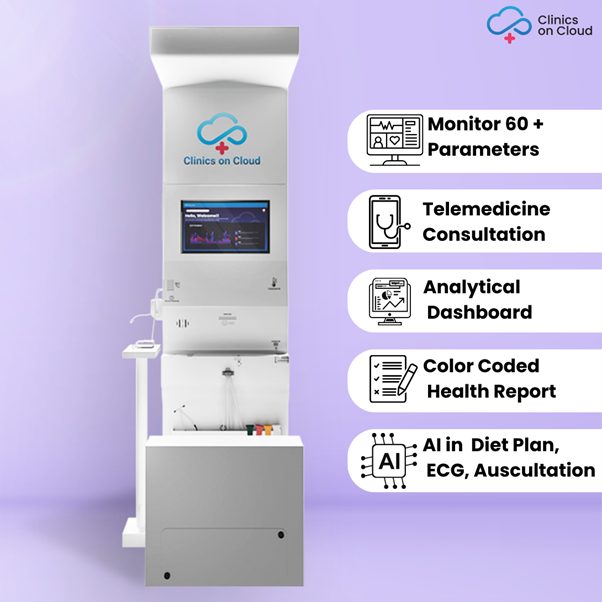
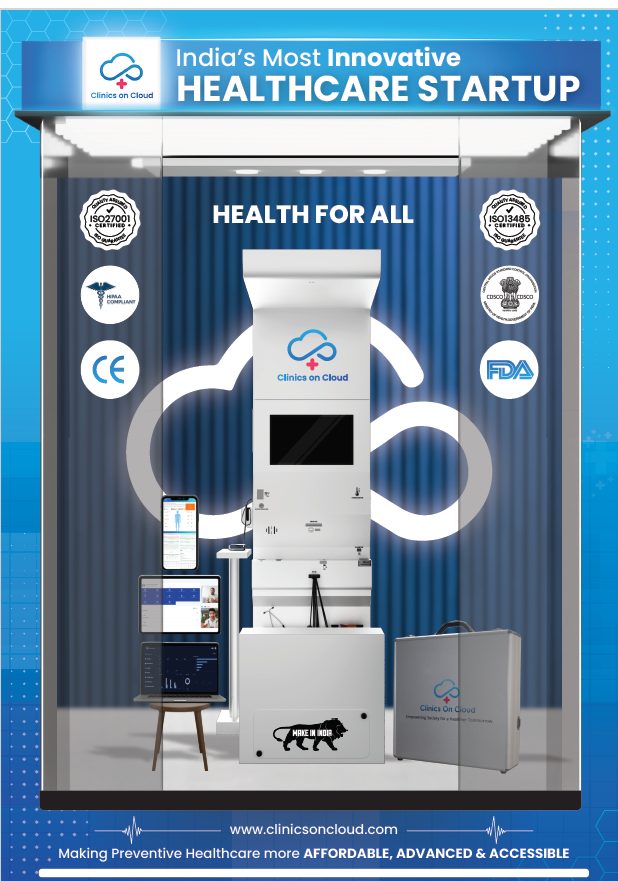
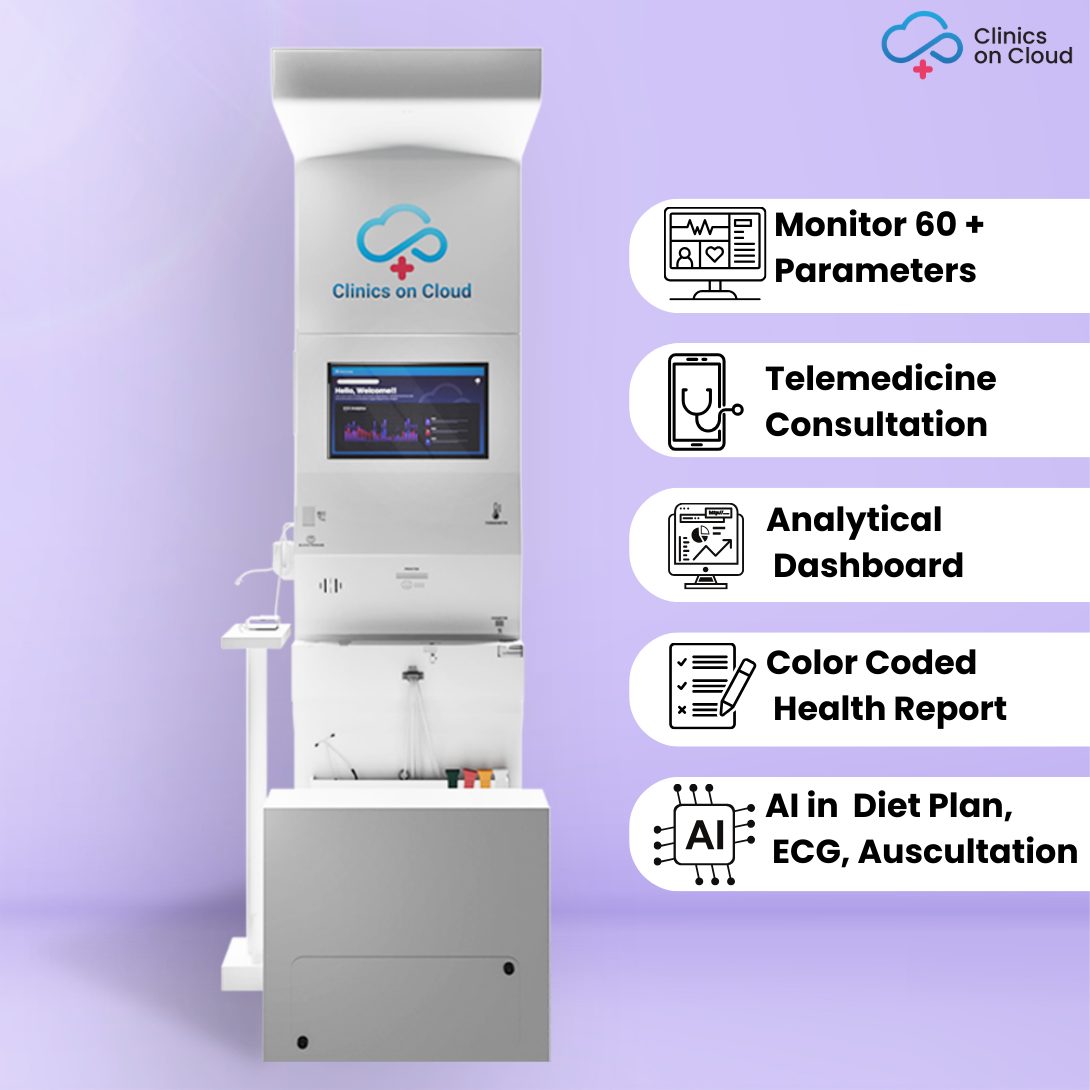
The Clinics On Cloud Health Kiosk captures 65+ clinical parameters across 14 specialties in a 10-minute checkup, works offline for the screening stage, holds 3–4 days of battery backup, and is voice-guided and multilingual so no skilled operator is needed. The same telemedicine layer runs in the Box Clinic, the Health Lounge and the Mobile Medical Unit.
How kiosk screening feeds a teleconsultation
This is the mechanism that makes the model work, described end to end.
The patient completes a screening at the kiosk, guided in their own language, without a technician.
Values are captured directly from the devices into the record, removing transcription error.
The platform flags values outside expected range and produces a colour-coded report. This is risk flagging, not diagnosis.
A flagged result triggers the consultation. The kiosk connects the patient to a registered medical practitioner rather than sending them away with a printout.
The doctor opens the consultation with the data already in front of them. No history-taking time is spent establishing basic measurements.
The doctor consults, then advises, prescribes where appropriate and permissible, or refers for in-person examination and confirmatory testing.
Everything is recorded against the patient’s longitudinal health record, ABHA-linked where the programme supports it and integrated with eSanjeevani where relevant.
The next screening compares against this one, so a trend becomes visible rather than a single snapshot.
Device accuracy is 90–95% depending on the test and device, under correct usage, calibration and patient preparation. Consultation quality inherits directly from measurement quality, which is why calibration discipline is a clinical issue and not a maintenance footnote. The parameter detail sits on clinical parameters and tests offered by a health kiosk.
Telemedicine models compared
Model
Data the doctor has
Best for
Main weakness
Phone or app consultation
Patient description only
Follow-ups, minor complaints, prescription renewal within the framework
High-volume camps where live doctor time is scarce
No live interaction; slower to act on
What it costs and who buys it
Telemedicine is usually bought as part of a screening deployment rather than on its own, and pricing reflects that.
Cost components:
The screening hardware. Indicative Health ATM pricing starts from ₹6,00,000.
The telemedicine plan, typically priced by consultation volume or by subscription.
Software: records, dashboards, ABHA and eSanjeevani integration, and any integration with a hospital system.
Installation, training and annual maintenance.
Connectivity at each site.
Pricing varies by configuration. Talk to the Clinics On Cloud team on +91 8999 073 447 or sales@clinicsoncloud.com.
Who buys it: government and public health programmes (NHM Uttar Pradesh with 200 Health ATMs, UP Vidhan Sabha, Vidhan Bhavan, Mathura District Hospital, Government of West Bengal employee screening); defence (Indian Army, Indian Navy, BSF); corporates and CSR programmes (Reliance, Tata Power, Godrej, Bajaj Allianz, Hewlett Packard, Konica Minolta, IDBI); and healthcare and insurance organisations (AIIMS Rishikesh, ALMAS Hospital, Medi Assist).
Buyer checklist
Are all consulting doctors registered medical practitioners, and can you verify that?
What is the median wait from a flagged result to a doctor being on video?
Which languages are consultations available in, and during what hours?
Does the doctor receive the screening data automatically, or does someone re-enter it?
How are consent and identity handled and recorded?
Who owns the consultation record, and can you export it?
Does the platform hold ISO 27001, HIPAA and GDPR compliance, and is it VAPT tested?
What is contractual uptime, and what happens when it is missed?
Does it integrate with ABHA and eSanjeevani, and does your programme need it?
What is the escalation path when a consultation identifies something urgent?
Clinics On Cloud provides preventive health screening and is not a diagnostic laboratory. Screening results are indicative and are not a diagnosis. Always consult a qualified physician before acting on any health information.
Investing in employee health has never been more critical. A healthy workforce is essential for any business to thrive. One way companies can improve employee wellbeing is by using a HealthATM. These innovative healthcare kiosks are transforming the way employees access healthcare and promote wellne
Revolutionizing Healthcare with Trusted Telehealth Services Clinics on Cloud – Your Partner in Accessible, Affordable & Advanced Telemedicine In today’s
Transforming Healthcare with AI-Powered POD Clinics and Doctor Offices The healthcare industry is undergoing a significant transformation with the advent
Telemedicine is the delivery of clinical care by a registered medical practitioner to a patient at a different location, using audio, video or messaging, for consultation, advice, follow-up or prescription where appropriate. In India it is governed by the national Telemedicine Practice Guidelines, which require the consultation to be conducted by a registered medical practitioner.
What are the main benefits of telemedicine?
Access where no clinician is physically present, time and income preserved for the patient, faster action on abnormal screening results, specialist reach beyond the local area, continuity through digital records, and privacy for sensitive consultations. Each benefit depends on the quality of the data the doctor receives and on a working connection.
What is the difference between telemedicine and telehealth?
Telehealth is the broad category of remote health services including education and administration. Telemedicine is the clinical subset in which a registered medical practitioner delivers care to a specific patient remotely. A teleconsultation is one telemedicine encounter.
Is telemedicine legal in India, and who can provide it?
Yes. Telemedicine is recognised and regulated in India under the national Telemedicine Practice Guidelines, and a teleconsultation must be conducted by a registered medical practitioner. The practitioner decides whether telemedicine is appropriate for a given patient, and identity, consent and record-keeping obligations apply as in in-person practice.
How much does a telemedicine kiosk cost in India?
Indicative Health ATM pricing starts from ₹6,00,000, with the telemedicine plan priced separately by consultation volume or subscription. Total cost also includes software scope, integrations, installation, training, connectivity and annual maintenance. Contact Clinics On Cloud on +91 8999 073 447 or sales@clinicsoncloud.com for a scoped quotation.
Which company provides telemedicine kiosks in India?
Clinics On Cloud, operated by SehatPro Technologies Pvt Ltd, manufactures telemedicine-enabled Health ATMs, Box Clinics, Health Lounges and Mobile Medical Units at Nighoje, Chakan MIDC, Pune, and is India’s first CDSCO-licensed Health ATM and Health Kiosk manufacturer, with 3,500+ installations across 200+ cities and 8+ countries.
How do I set up telemedicine at my hospital, factory or CSR site?
Start with the screening layer, since a consultation is only as good as the data behind it. Clinics On Cloud conducts a site survey, configures the parameter set, installs the kiosk, trains staff, connects the teleconsultation service and provides annual maintenance. Multi-site rollouts are normally phased. Call +91 8999 073 447 to scope one.
Can a doctor prescribe medicine over telemedicine in India?
Prescribing over telemedicine is permitted within India’s Telemedicine Practice Guidelines, subject to the practitioner’s professional judgement and to the restrictions applying to categories of medicine. It is not unconditional, and any provider presenting unrestricted prescribing as a product feature is misdescribing the framework. A Clinics On Cloud kiosk itself never prescribes.
Is a telemedicine consultation private and secure?
Clinics On Cloud operates under ISO 27001 information security certification with HIPAA and GDPR compliance and VAPT testing, and supports ABHA linkage under the Ayushman Bharat Digital Mission. Buyers should still contract on data ownership, storage location, access rights and deletion on exit, since those terms vary by programme rather than by certification.
When should you not use telemedicine?
Never for emergencies. Acute chest pain, trauma, stroke symptoms, severe breathlessness and obstetric emergencies require immediate in-person hospital care. Telemedicine is also unsuitable wherever a physical examination is essential to the assessment, and it never replaces confirmatory laboratory testing.
Get In Touch
Healthcare is a right. Not a privilege.
We started Clinics on Cloud with a simple belief - that the quality of your healthcare should not depend on your postcode. Whether you're a government, corporate, NGO or entrepreneur - we built this for you.
Call us
+91 8999 073 447
Mon - Sat · 9 AM to 6 PM IST
Write to us
sales@clinicsoncloud.com
Partnerships · Deployments · Support
Visit us online
www.clinicsoncloud.com
Products · Case Studies · News
Find us
Nighoje, Chakan MIDC
Pune, Maharashtra - 410501, India
Built for every kind of health partner.
Government Body Corporate / HR Team NGO / CSR Partner Hospital or Clinic Defence Organisation International Partner Investor / Distributor Rural Entrepreneur
 Entry · T-41Telemedicine