HomeBlogWhat is a Mobile Medical Unit (MMU)? Full Form, Meaning & Cost
Article12 November 20244 minUpdated
What is a Mobile Medical Unit (MMU)? Full Form, Meaning & Cost
Learn what a Mobile Medical Unit is, how mobile clinics work, their benefits and how MMUs help governments, hospitals and CSR organisations reach underserved communities
CCClinics On Cloud TeamPublished from Pune, India
Mobile Medical Unit
“
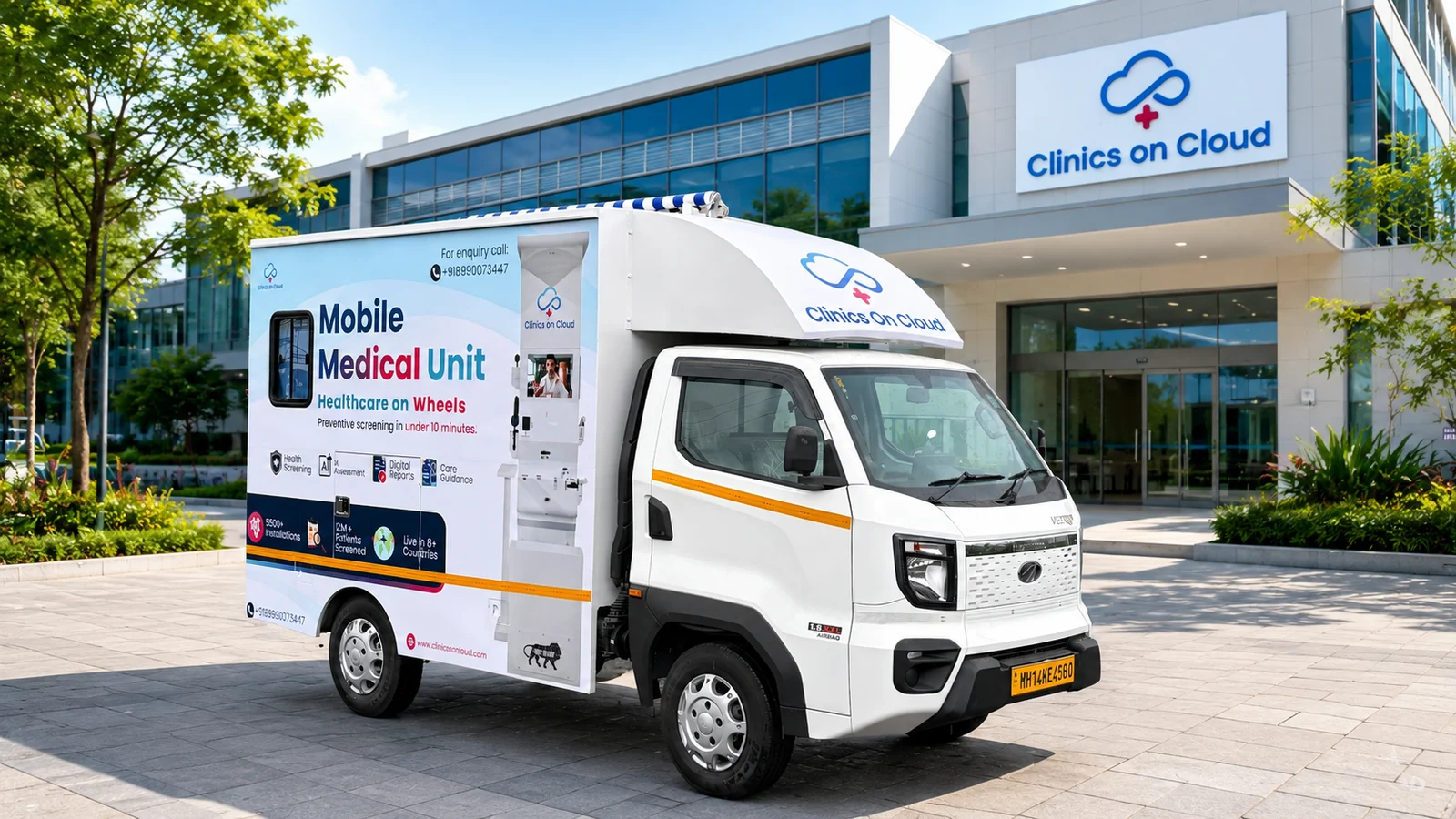
A Mobile Medical Unit (MMU) is a vehicle converted into a self-contained clinic that brings preventive screening, teleconsultation and basic care to a community instead of requiring travel. The Clinics On Cloud Mobile Medical Unit carries an integrated Health ATM covering 65+ clinical parameters across 14 specialties, plus separate consultation and examination zones.
What is a Mobile Medical Unit?
A Mobile Medical Unit is a purpose-converted vehicle that functions as a clinic at whatever location it parks, delivering preventive health screening, doctor consultation and digital health records without any permanent building.
It is also called a mobile clinic, a medical van, an MMU vehicle, a mobile health van or healthcare on wheels. The vehicle is the delivery mechanism. The clinic is the equipment, the software and the people inside it.
The Mobile Medical Unit from Clinics On Cloud combines a converted vehicle, an integrated Health Kiosk, a teleconsultation link to a registered medical practitioner, on-board power, connectivity and a digital records platform.
One clarification that saves confusion in procurement: the AI in the Clinics On Cloud platform performs risk flagging and general diet and lifestyle guidance. It does not diagnose, does not prescribe and does not replace a clinician. The doctor on the consultation link does that.
MMU full form in medical: what the abbreviation means
In medical and public-health use, MMU stands for Mobile Medical Unit - the vehicle-based clinic described above. The same abbreviation appears in tender documents, National Health Mission papers, CSR proposals and district health reports, and in all of them it carries this meaning.
An MMU camp is a single stop on that vehicle’s route: the unit parks at a village, a factory gate, a school or a panchayat building for a few hours, screens the people who come, and moves on. The camp is the event; the MMU is the infrastructure that makes the event repeatable at the same place every month.
An MMU attached to a hospital or a PHC is the same vehicle run as outreach: the hospital owns it, its own staff run it, and the people it screens are referred back into that hospital. Nothing about the unit changes - only who operates it and where the referrals go.
How does a Mobile Medical Unit work?
The vehicle reaches a scheduled stop on a published route: a village, a plantation, a mine, a school, a settlement or a worksite.
The team sets up, which in a well-built MMU means opening the door rather than assembling equipment.
Patients register on the touchscreen, with ABHA linkage under the Ayushman Bharat Digital Mission where the programme supports it.
Screening runs at the integrated Health ATM, capturing the configured parameters in a 10-minute checkup.
Reports generate immediately, colour-coded, delivered by print, SMS, email or WhatsApp.
Flagged patients consult a doctor on video from inside the consultation zone, or are examined by an on-board clinician where the programme includes one.
Records sync to the platform when connectivity permits, so the next visit compares against the last one.
The programme owner sees aggregate trends on a centralised multi-location dashboard.
The value is not the vehicle. It is that steps 3 to 8 happen identically at every stop, which is what turns a series of camps into a measurable programme.
The single most common procurement error is buying an MMU when the population already gathers at a fixed point. If people come to a PHC, a factory gate or a panchayat office anyway, a fixed kiosk delivers far more screenings per rupee.
What goes inside: the specification table
Sub-system
Standard scope
Configurable options
Why it matters
Screening station
Integrated Health ATM; 65+ clinical parameters across 14 specialties; 10-minute checkup
Parameter set tuned to the target population
Determines what the programme can actually detect
Consultation zone
Doctor workstation, seating, storage
Additional privacy partitioning
Teleconsultation quality depends on a quiet, private space
Examination zone
Foldable examination table, cushioned patient bed
Additional examination equipment
Required for anything beyond self-service screening
Power
Generator support plus inverter backup
Higher-capacity battery bank; solar assist
Rural stops rarely offer a reliable supply
Connectivity
4G and Wi-Fi
External antenna; multi-SIM failover
The teleconsultation step needs live data; screening works offline
Climate control
Air-conditioned clinical cabin
Higher-capacity units for hot regions
Device accuracy and patient comfort both depend on it
Reporting
Print, SMS, email and WhatsApp delivery
Custom report branding
Patients must leave holding something
Records
Digital health records; ABHA and eSanjeevani integration
Integration with a hospital HIS or a state system
Turns visits into longitudinal care
Advanced diagnostics
Not standard
X-ray, breast cancer screening equipment, biochemistry analyser and other devices
Adds capability, weight, power draw and staffing needs
Analytics
Centralised multi-location dashboard
Custom reporting for CSR and government programmes
How the programme is defended at budget time
Vehicle considerations buyers underestimate
The medical specification usually gets attention. The vehicle specification usually does not, and it is where MMU programmes come apart in year two.
Road access on the actual route. A large chassis that cannot reach the last three kilometres of a hill or a plantation track is an expensive garage ornament. Survey the route before choosing the vehicle.
Turning circle and parking. Village stops are not car parks. Where the vehicle stands determines whether patients queue in the sun.
Weight and payload. Every added diagnostic device costs payload, power and fuel. Advanced diagnostics change the vehicle class.
Climate and dust sealing. Medical devices in a vehicle experience vibration, heat and dust that bench equipment never sees.
Service network for the chassis. A specialist medical fit-out is useless if the base vehicle needs a workshop 400 km away.
Registration, permits and insurance. These vary by state and by intended use, and they take longer than the fit-out.
Ask any supplier which chassis models they have converted before, and how many of those units are still running after three years.
What tests a Mobile Medical Unit can perform
Capability depends on configuration. The Clinics On Cloud platform supports 65+ clinical parameters across 14 specialties, and an MMU can be configured with any subset of them:
General health and vital parameters, diabetes screening, cardiac screening, anaemia and kidney-related parameters, pulmonary function, vision screening, dental and oral screening, hearing and ENT screening, dermatology, mental health assessments, maternal health, urine analysis, Ayurvedic assessment and rapid infectious disease testing.
Device accuracy is 90–95% depending on the test and device, under correct usage, calibration and patient preparation. These are screening results: indicative, not diagnostic, and not a substitute for laboratory confirmation. The full breakdown is on clinical parameters and tests offered by a health kiosk.
Configure narrow rather than wide. A unit that screens for the three conditions your population actually carries, and follows up on every flag, beats a unit that measures everything and follows up on nothing.
Staffing an MMU
Staffing models vary by programme. Common patterns:
Screening-led. One or two trained operators run the station; all clinical input arrives by teleconsultation. Lowest cost, widest reach, entirely dependent on connectivity.
Clinician on board. A doctor or nurse travels with the unit and examines patients directly, with teleconsultation used for specialist referral. Higher cost, higher clinical capability.
Hybrid. A clinician on selected route days, screening-only on others.
Whichever model you choose, plan for a driver, a fixed roster and a named programme coordinator who owns the schedule. Absent that person, an MMU quietly becomes an ad-hoc camp vehicle.
What does an MMU driver do?
The MMU driver does more than drive. The driver is responsible for the vehicle reaching each published stop on time, for the generator and power setup at the site, for parking the unit so the examination area and the entry route are usable, and for the fuel, maintenance and permit records the programme is audited on.
On most rosters the driver is also the one constant between locations: the clinical staff may rotate, the driver usually does not, which is why route knowledge and the relationship with each village tend to sit with them. The National Health Mission staffing pattern below lists the driver as one of the five people per unit for exactly this reason.
Route planning: the part that decides whether the programme works
The clinical build is a procurement question. The route is the programme.
Fix the schedule and publish it. Same village, same day of the week or fortnight. Predictability is what builds attendance.
Size the stop list to the working day. Count travel time, not just screening time. Two unhurried stops beat four rushed ones.
Anchor each stop to a local institution. A school, a panchayat office, an anganwadi or a plantation office gives the visit a host and a space.
Route the follow-up before the first trip. Know in advance which PHC, CHC or district hospital receives your flagged patients.
Track return visits, not just headcount. The number that matters is how many people you screened twice, because that is the number that proves continuity.
Review the route quarterly. Attendance data tells you which stops to drop and which to add.
The honest limitation of a vehicle-based programme is discussed in detail on why India needs healthcare on wheels: a unit visiting monthly is screening infrastructure, not continuity of care.
What a Mobile Medical Unit costs: the drivers
Clinics On Cloud does not publish a single MMU price, because the specification range is wide enough that a single number would mislead. Pricing varies by configuration: talk to our team at +91 8999 073 447 or sales@clinicsoncloud.com for a scoped quotation.
Parameter set configured on the integrated Health ATM.
Advanced diagnostics, which move cost, weight and power together.
Power system sizing: generator, inverter, battery capacity.
Connectivity plan and antenna arrangement.
Software scope: records, dashboards, ABHA and eSanjeevani integration, third-party integrations.
Annual maintenance, calibration and consumables.
Branding and interior finish, which matters more for CSR programmes than buyers expect.
Operating cost, which is where most of the five-year spend actually sits: fuel, staff, permits, insurance.
For comparison, indicative Health ATM pricing starts from ₹6,00,000, which is why a fixed kiosk is the right answer whenever the population comes to you. Buyers weighing both should read best Health ATM in India.
An illustrative cost-per-screening worksheet
This is an illustrative framework, not a quotation, and it contains no Clinics On Cloud pricing. Fill in your own verified figures for each input. The purpose is to show which variables move the answer.
Assumptions you must supply: - A = capital cost of the built unit (quoted, including taxes) - B = expected useful service life in years - C = annual operating cost (fuel, staff salaries, permits, insurance, AMC, consumables, connectivity) - D = operating days per year, after weather, festivals and maintenance downtime - E = realistic screenings completed per operating day
Method: 1. Annualised capital = A ÷ B 2. Total annual cost = (A ÷ B) + C 3. Annual screenings = D × E 4. Cost per screening = Total annual cost ÷ Annual screenings
What the model teaches, regardless of the numbers you enter:
E and D dominate. Utilisation, not purchase price, determines cost per screening. An underused unit is expensive at any capital cost.
C usually exceeds annualised A over five years. Budgeting the vehicle without budgeting the route is the single most common funding failure in MMU programmes.
Follow-up capacity is a hard constraint. If your referral pathway can absorb fewer patients than you flag, increasing E does not increase health value.
Compare against the fixed alternative. Run the same worksheet for a fixed kiosk at your highest-footfall site before committing to a vehicle.
Who buys Mobile Medical Units
Government and public health programmes extending district coverage into blocks and villages, often alongside National Health Mission activity.
CSR programmes at large corporates, where a branded unit delivers measurable, auditable community health spend.
Mining, plantation and heavy industry, where the workforce is dispersed across sites far from a hospital and occupational screening is a standing requirement.
NGOs and foundations running defined-population health programmes.
Hospitals running outreach, referral-building and camp programmes in their catchment.
Defence and paramilitary, where Clinics On Cloud deployments include the Indian Army and BSF.
Across all formats, Clinics On Cloud has 3,500+ installations across India and abroad, 200+ cities covered, 12M+ patients screened and 2 lakh+ abnormalities detected for early intervention, in 8+ countries.
Buyer checklist before you sign
Have you surveyed the actual route with the actual chassis, including the worst stop?
Is the parameter set matched to the population’s known burden, or is it a default list?
Who receives your flagged patients, and have they agreed in writing?
Is the five-year operating budget funded, or only the vehicle?
What is the calibration schedule, and who performs it in the field?
What are the consumables, and who supplies them on route?
Does the unit hold CDSCO licence and ISO 13485 documentation for the medical equipment?
How is patient data stored and owned, and does the platform hold ISO 27001, HIPAA and GDPR compliance?
Does the unit integrate with ABHA and eSanjeevani, and do you need it to?
What is the guaranteed response time when a device fails 300 km from the depot?
Can you see a comparable unit that has been running more than eighteen months?
Clinics On Cloud provides preventive health screening and is not a diagnostic laboratory. Screening results are indicative and are not a diagnosis. Always consult a qualified physician before acting on any health information.
MMUs under the National Health Mission
Most Mobile Medical Units on Indian roads are not bought privately. They are run by states under the National Health Mission, which brings together the rural mission (NRHM) and the urban one (NUHM), and which sets what an MMU must carry, who must staff it and how many a district may have. If you are scoping a programme, these are the norms your proposal will be read against, which makes them worth knowing even when you are buying outside the scheme.
NHM states the purpose plainly: the unit exists to take healthcare to the doorstep of populations, particularly rural, vulnerable and under-served areas. It then adds a limit that is easy to miss, and that settles a question buyers ask constantly - the MMU "is not meant to transfer patients". It is a clinic that travels, not an ambulance.
What an MMU is expected to offer
NHM asks the unit to meet the service standards of a Primary Health Centre across twelve thematic areas: maternal health; neonatal and infant health; child and adolescent health; reproductive health and contraceptive services; management of chronic communicable diseases; management of common communicable diseases and basic OPD care; management of common non-communicable diseases; management of mental illness; dental care; eye and ENT care; geriatric care; and emergency medicine.
These services are provided free of cost through the MMU, and the unit is expected to refer onward rather than treat everything itself.
One vehicle, or three
NHM’s structure is usually one vehicle per MMU. Where a programme runs more, the first carries the medical and para-medical staff, the second carries equipment, accessories and basic laboratory facilities, and the third carries diagnostic equipment such as X-ray, ultrasound and ECG, along with a generator.
Worth being straight about what that means for a single-vehicle unit: X-ray and ultrasound belong to the three-vehicle configuration in NHM’s own description. A one-vehicle MMU of the kind most programmes actually run carries screening, ECG and teleconsultation, not radiology. A proposal that promises all of it on one chassis is worth a second reading.
How many a district may have
Deployment follows a population norm: one MMU per 10 lakh population, capped at five MMUs per district. Relaxation is possible case by case, and NHM names the threshold - where existing units already serve more than 60 patients a day in plain areas, or more than 30 a day in hilly areas, a state may propose more. That cap is the first number to check when a district asks how many units to budget for.
Who is on board
NHM recommends five people per unit: one medical officer, one nurse, one lab technician, one pharmacist cum administrative assistant, and one driver cum support staff. This matters for costing, because the recurring expense of an MMU programme is people and fuel, not the vehicle.
What NHM funds
States receive support for both capital cost and operating cost, within specified ceilings. NHM’s published operational, or recurring, norm for an MMU with a diagnostic van is Rs 24 lakh, and Rs 28 lakh for the North Eastern states, Jammu & Kashmir and Himachal Pradesh.
One caution, because these two numbers get confused in tender conversations: that figure is the annual running norm, not the purchase price of the vehicle. They are separate lines in a proposal, and reading one as the other produces a budget that does not survive scrutiny.
The full documents, including the Revised Operational Guidelines for Mobile Medical Units, are published by the National Health Mission at nhm.gov.in.
Who runs Mobile Medical Units in India?
Most Mobile Medical Units on Indian roads are run by state governments under the National Health Mission, either directly or through an implementation partner. NHM sets what the unit carries, who staffs it and how many a district may have. The rest are run by CSR programmes, by mining, plantation and heavy industry screening a dispersed workforce, by NGOs and foundations, by hospitals running outreach, and by defence and paramilitary services. Clinics On Cloud deployments include the Indian Army and BSF.
Clinics On Cloud Improving Rural Healthcare. Post-COVID everyone has made incredible progress in the preventive healthcare system by utilizing innovative
A Mobile Medical Unit is a vehicle converted into a self-contained clinic that delivers preventive health screening, doctor consultation and digital health records wherever it parks. The Clinics On Cloud MMU carries an integrated Health ATM supporting 65+ clinical parameters across 14 specialties with a 10-minute checkup, plus separate consultation and examination zones.
What is the difference between a Mobile Medical Unit and an ambulance?
An ambulance transports patients to care and is built for emergencies. A Mobile Medical Unit delivers care at the location where it parks and is built for preventive screening, consultation and community health programmes. An MMU is not an emergency service and should never be positioned as one.
How much does a Mobile Medical Unit cost in India?
Clinics On Cloud MMU pricing varies by configuration, because vehicle class, fit-out, parameter set, advanced diagnostics, power system and software scope each move the figure substantially. Contact Clinics On Cloud on +91 8999 073 447 or sales@clinicsoncloud.com for a scoped quotation. For reference, indicative Health ATM pricing starts from ₹6,00,000.
Which company manufactures Mobile Medical Units in India?
Clinics On Cloud, operated by SehatPro Technologies Pvt Ltd, builds Mobile Medical Units at Nighoje, Chakan MIDC, Pune, and is India’s first CDSCO-licensed Health ATM and Health Kiosk manufacturer. Its certifications include ISO 13485, US FDA, CE, ISO 27001, HIPAA and GDPR compliance, with 3,500+ installations across 200+ cities and 8+ countries.
How do I buy a Mobile Medical Unit for a CSR or government programme?
Start with a route and population survey, then a specification workshop covering parameter set, staffing model, referral pathway and five-year operating budget. Clinics On Cloud scopes the vehicle and fit-out against that brief and supports tender documentation. Call +91 8999 073 447 or email sales@clinicsoncloud.com to begin.
How many staff does a Mobile Medical Unit need?
It depends on the model. A screening-led unit runs with one or two trained operators plus a driver, with clinical input by teleconsultation. A clinician-on-board model adds a doctor or nurse. Every model needs a named programme coordinator who owns the route schedule, or attendance decays within months.
Can a Mobile Medical Unit carry an X-ray or other advanced diagnostics?
Yes. The Clinics On Cloud MMU can be configured with additional equipment including X-ray, breast cancer screening equipment and biochemistry analysers. Each addition affects vehicle class, payload, power draw, staffing and regulatory requirements, so specify advanced diagnostics at design stage rather than adding them later.
Does a Mobile Medical Unit provide telemedicine?
Yes. Physical screening happens inside the unit and a registered medical practitioner joins by video for consultation, producing a physical-plus-digital model of screening, records and remote medical connectivity. The screening itself works offline; the live consultation needs a working data connection. See our guide to telemedicine in India for how consultations are governed.
Can a Mobile Medical Unit replace a Primary Health Centre?
No. An MMU extends a Primary Health Centre by adding screening reach and follow-up touchpoints. It cannot provide continuity of care, emergency response or inpatient services, and a unit that visits a village monthly is screening infrastructure rather than a substitute for a permanent facility.
How long does it take to build and deliver a Mobile Medical Unit?
Lead time depends on chassis availability, fit-out scope, the diagnostics specified and registration formalities, which vary by state. Advanced diagnostics and custom integrations extend the schedule most. Clinics On Cloud confirms an indicative delivery window at the specification stage, so include it in your programme timeline from the start.
What is the full form of MMU in medical?
MMU stands for Mobile Medical Unit: a vehicle converted into a clinic that delivers preventive screening, doctor consultation and digital health records at whatever location it parks. The abbreviation is used this way in National Health Mission documents, government tenders and CSR healthcare programmes.
What is an MMU camp?
An MMU camp is one stop on a Mobile Medical Unit’s route - the unit parks at a village, school, factory or panchayat building for a few hours, screens the people who come, and then moves to the next stop. The camp is the event; the MMU is the infrastructure that lets the same place be served again on a published schedule.
What does an MMU driver do?
The MMU driver gets the unit to each published stop on time and is usually responsible for the generator and power setup, for parking the vehicle so the examination area and entry route work, and for fuel, maintenance and permit records. The driver is often the one constant between locations, so route knowledge tends to sit with them. The National Health Mission staffing pattern lists a driver as one of the five people per unit.
Who provides Mobile Medical Units under NHM?
States run MMUs under the National Health Mission, either directly or through an implementation partner, and buy the vehicles and medical equipment from manufacturers. Clinics On Cloud supplies Mobile Medical Units and connected screening technology for government, CSR and hospital outreach programmes.
Who runs Mobile Medical Units in India?
Most are run by state governments under the National Health Mission, either directly or through an implementation partner, with NHM setting what the unit carries and who staffs it: a medical officer, a nurse, a lab technician, a pharmacist cum administrative assistant and a driver cum support staff. Outside that structure, units are run by CSR programmes, by mining, plantation and heavy industry screening a dispersed workforce, by NGOs and foundations, by hospitals running outreach, and by defence and paramilitary services. Clinics On Cloud deployments include the Indian Army and BSF.
Get In Touch
Healthcare is a right. Not a privilege.
We started Clinics on Cloud with a simple belief - that the quality of your healthcare should not depend on your postcode. Whether you're a government, corporate, NGO or entrepreneur - we built this for you.
Call us
+91 8999 073 447
Mon - Sat · 9 AM to 6 PM IST
Write to us
sales@clinicsoncloud.com
Partnerships · Deployments · Support
Visit us online
www.clinicsoncloud.com
Products · Case Studies · News
Find us
Nighoje, Chakan MIDC
Pune, Maharashtra - 410501, India
Built for every kind of health partner.
Government Body Corporate / HR Team NGO / CSR Partner Hospital or Clinic Defence Organisation International Partner Investor / Distributor Rural Entrepreneur
 Entry · BC-05Box Clinic