HomeBlogMobile Medical Unit: why India needs healthcare on wheels
Field Notes9 July 20266 min readUpdated
Mobile Medical Unit: why India needs healthcare on wheels
You cannot build a hospital in every village. But you can build a hospital that visits every village.
CCClinics On Cloud TeamPublished from Pune, India
Mobile Medical Units
65%Of India is rural
40 kmTo the nearest doctor
4Staff per unit
WeeklyVillage visits
“
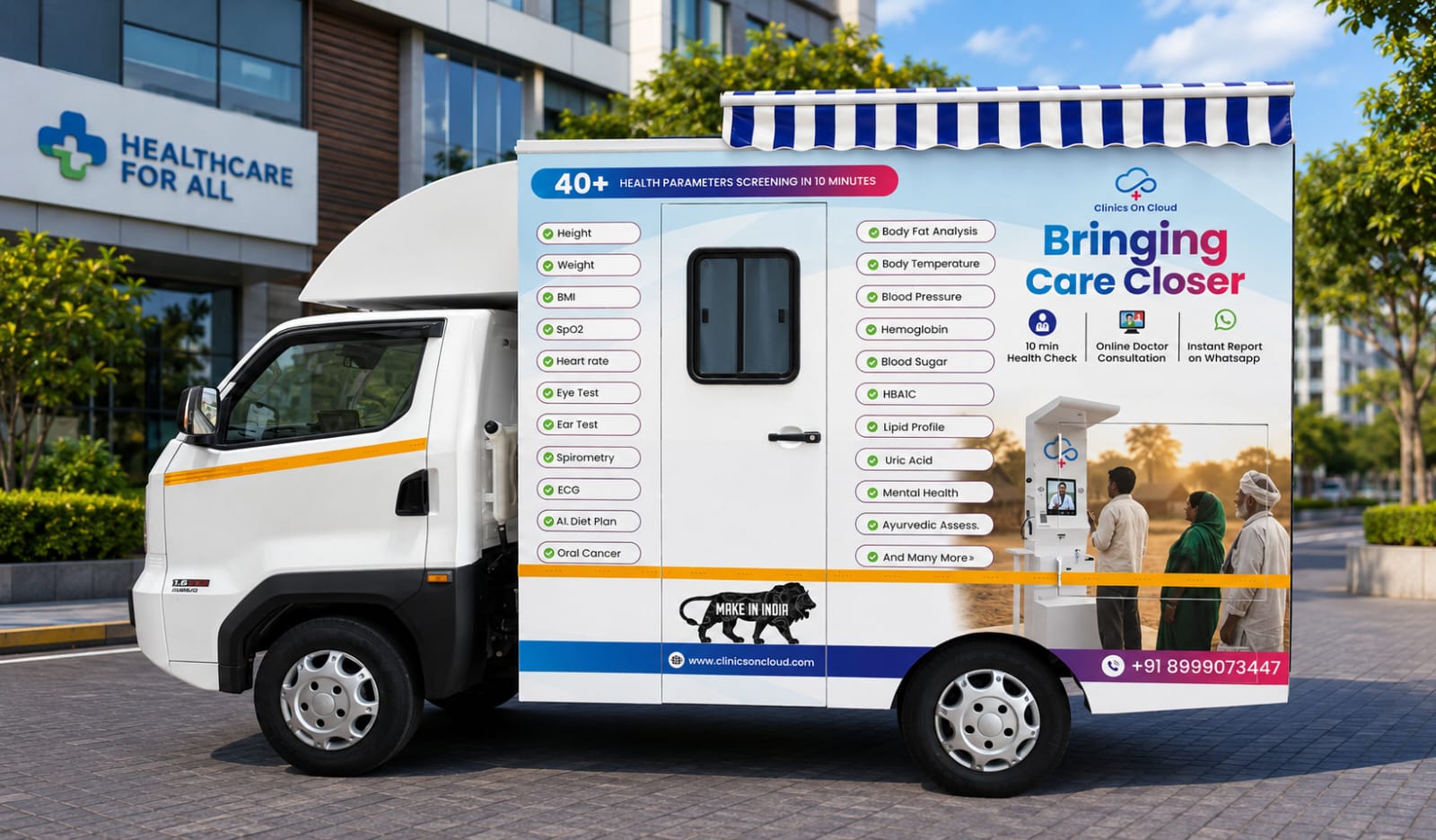
Healthcare on wheels solves a coverage problem, not a capacity problem. A Mobile Medical Unit puts screening, records and a doctor’s attention where a permanent clinic cannot be supported, and Clinics On Cloud units carry an integrated Health ATM covering 65+ clinical parameters across 14 specialties. A unit visiting monthly is screening infrastructure, not continuity of care.
The problem mobile units actually solve
India has built a great deal of health infrastructure. What it has not built, and arguably cannot build, is a staffed facility within easy reach of every settlement in a country of this size and terrain.
That gap is a coverage problem. It is different from a capacity problem, and the distinction matters because the two need different solutions. A capacity problem is solved by adding beds, staff and hours to existing facilities. A coverage problem is solved by moving a health touchpoint to where the people are.
Healthcare on wheels is a coverage instrument. A Mobile Medical Unit does not add hospital capacity. It adds reach, and it adds the one thing dispersed populations almost never have: a repeatable, recorded, comparable health encounter.
Why the barrier is rarely just distance
Ask why a farm labourer with untreated hypertension has not seen a doctor and “the hospital is far” is only the first answer. Underneath it sit four others that a vehicle addresses directly.
Lost income. A hospital visit costs a working day, and often two. For daily-wage work, that is a real and immediate cost against a benefit that feels theoretical.
Uncertainty of outcome. Travelling a long way with no guarantee the right person is available discourages the trip entirely.
No felt symptoms. The conditions that most benefit from early detection, including raised blood pressure, raised blood sugar and abnormal lipids, produce nothing to feel. Nobody takes a day off for a symptom they do not have.
No prior record. With no baseline, even a good consultation starts from zero.
A unit that arrives on a known day, in the village, and completes a checkup in 10 minutes removes all four barriers at once. That is the argument for healthcare on wheels, and it does not require a single invented statistic to make.
Four coverage models compared
Model
What it fixes
What it costs
Where it fails
Build more permanent facilities
Capacity and continuity together
Highest capital and recurring staffing burden
Cannot be justified for small, dispersed populations
Fixed screening kiosk at an existing gathering point
Most serious programmes end up running two of these together. A fixed Health ATM at the block hospital plus a vehicle covering the villages around it usually beats either alone, and a portable Box Clinic reaches the households that will never come out to either.
Route economics: what actually drives cost
Programme owners tend to negotiate hard on the purchase and then lose the argument in the operating budget. Four variables drive the real cost of healthcare on wheels.
Operating days per year. Weather, festivals, elections, maintenance and staff leave remove far more days from the calendar than a plan assumes. A unit budgeted on 300 days and running 200 has a cost per screening 50% higher than forecast.
Screenings per operating day. This is set by queue management and stop selection, not by device speed. A 10-minute checkup at the device is not 10 minutes per patient in practice.
Travel time as a share of the day. Every kilometre between stops is unscreened time. Clustering stops geographically does more for cost per screening than any equipment decision.
Recurring cost. Fuel, salaries, permits, insurance, calibration, consumables and connectivity. Over five years this typically outweighs the annualised capital cost of the unit itself.
The uncomfortable implication is that utilisation, not purchase price, decides whether a mobile programme is affordable. An underused unit is expensive no matter what you paid for it. The specification and cost-driver detail sits on what a Mobile Medical Unit is, and how to specify one.
How a mobile health programme is really run
The vehicle is procurement. The programme is management. Programmes that work share six habits.
A published, unchanging schedule. Same settlement, same day, same interval. Predictability builds attendance more than any awareness campaign.
A local host at every stop. A school, an anganwadi, a panchayat office or a plantation office gives the visit a space, a queue and a person who tells people it is coming.
Digital records from day one. Paper registers make a visit; digital records make a programme. ABHA linkage under the Ayushman Bharat Digital Mission keeps the record attached to the person rather than to the vehicle.
A named referral pathway. Before the first trip, know which Primary Health Centre, Community Health Centre or district hospital receives flagged patients, and confirm they have agreed.
Teleconsultation on the day. A flagged result that produces a doctor conversation while the patient is present is worth more than a report that produces a resolution to visit someone later. See what telemedicine is and how it works in India.
A funded operating budget for the full programme term. Not a vehicle grant. A programme budget.
How to measure it, honestly
Most mobile health programmes report the wrong number. Headcount screened is the easiest metric to produce and the least informative.
Measure these instead:
Metric
What it tells you
Why headcount does not
Repeat screening rate
Whether you are building continuity or repeating a first visit forever
A programme can screen thousands and never see anyone twice
Flag-to-consultation rate
Whether flagged patients actually reached a clinician
Detecting risk without follow-up creates no health value
Referral completion rate
Whether the pathway beyond the vehicle is real
Referrals issued is an output; referrals completed is an outcome
Coverage of the target population
Whether you reached the people you meant to reach
Large numbers can still miss the intended group entirely
Change in flagged parameters at repeat visit
Whether anything improved
Screening volume says nothing about health
Cost per completed follow-up
The number a funder should actually be shown
Cost per screening flatters an ineffective programme
Across the Clinics On Cloud network, 12M+ patients have been screened and 2 lakh+ abnormalities have been detected for early intervention, from 3,500+ installations across 200+ cities and 8+ countries. Those flags are the beginning of the work, not the end of it. Screening results are indicative and are not a diagnosis.
The limits: what healthcare on wheels cannot do
This is the section most vendors leave out, and it is the section that makes the rest of the argument credible.
A monthly visit is not continuity of care. A patient with newly flagged high blood sugar needs a management relationship measured in weeks. A vehicle on a monthly cycle cannot provide that on its own, and pretending otherwise sets up the programme to be judged on a promise it never could keep.
A mobile unit is not an emergency service. It is preventive screening and consultation infrastructure. Emergencies go to a hospital.
A mobile unit is not a diagnostic laboratory. Point-of-care results are indicative and require laboratory confirmation. Clinics On Cloud is not a diagnostic laboratory and does not replace one.
The AI does not diagnose or prescribe. It flags risk and offers general diet and lifestyle guidance. A registered medical practitioner makes every clinical decision.
A vehicle does not create clinicians. If there is no doctor to refer patients to, faster detection produces frustration rather than treatment.
Reach is not the same as trust. Communities that have seen one-off camps arrive and vanish are, reasonably, sceptical. Trust is earned by returning on schedule for two years, not by the first visit.
The right way to position healthcare on wheels is as the detection and connection layer of a health system, tightly coupled to fixed facilities that provide the continuity. Sold as a replacement for those facilities, it will disappoint, and it will deserve to.
Where mobile units are the wrong answer
When the population already gathers somewhere. A fixed kiosk at a PHC, factory gate, campus or panchayat office costs less per screening and runs every day rather than one day a month. Compare options on best Health ATM in India.
When only capital funding exists. A funded vehicle with an unfunded route is a parked asset.
When the referral system is saturated. Detection outruns treatment capacity and the programme generates unmet need.
When the terrain defeats the vehicle. In those places, a portable kit carried by a health worker is the honest answer.
When the goal is a photograph. A branded vehicle at a launch event is not a health programme, and the community can tell the difference within one missed visit.
Clinics On Cloud provides preventive health screening and is not a diagnostic laboratory. Screening results are indicative and are not a diagnosis. Always consult a qualified physician before acting on any health information.
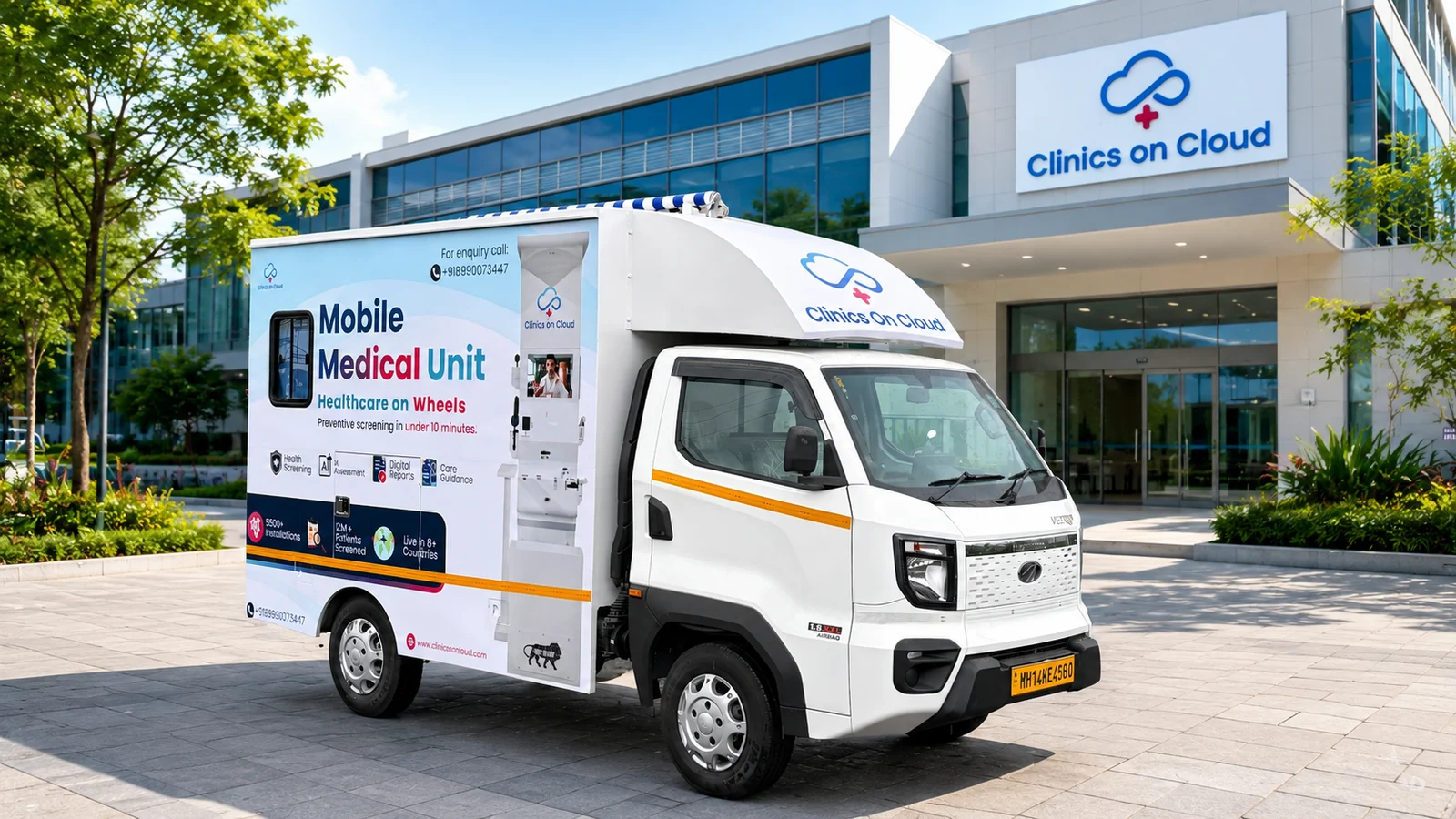
A clinic on wheels that drives to the village instead of waiting for it. What goes inside an MMU, who staffs it, what it can test, and what a camp day actually looks like.
Because India has a coverage problem rather than only a capacity problem: many settlements are too small or too remote to support a permanently staffed facility. A Mobile Medical Unit brings screening, digital records and a doctor consultation to those places on a fixed schedule, removing travel cost, lost wages and the uncertainty that keeps people from seeking care.
What problem does a mobile health unit actually solve?
It creates a repeatable, recorded health encounter where none existed. Clinics On Cloud units carry an integrated Health ATM covering 65+ clinical parameters across 14 specialties with a 10-minute checkup, so conditions that produce no symptoms can be flagged early and routed to a registered medical practitioner.
Can a mobile health unit replace a Primary Health Centre?
No. A mobile unit extends a Primary Health Centre by adding reach and detection. It cannot provide continuity of care, emergency response or inpatient services, and any programme positioned as a substitute for permanent facilities will fail against expectations it should never have set.
Why do mobile health programmes fail?
Four reasons dominate: an unfunded operating budget after a funded vehicle, an unpublished or unreliable schedule, no agreed referral pathway for flagged patients, and paper records that make measurement impossible. None of these is a hardware problem, which is why hardware alone never fixes them.
How do you measure a mobile health programme properly?
Track repeat screening rate, flag-to-consultation rate, referral completion rate, coverage of the intended population, change in flagged parameters at repeat visit, and cost per completed follow-up. Headcount screened is the weakest metric available, because a programme can screen large numbers while producing no health outcome at all.
How often should a mobile health unit visit each village?
Frequency should be set by the referral pathway rather than by the vehicle’s capacity. If flagged patients can be seen locally between visits, a monthly cycle can work. If not, plan a fortnightly cycle over fewer settlements, since a shorter list served reliably beats a longer list served erratically.
Is a mobile clinic better than a fixed health kiosk?
Neither is better in general. A fixed kiosk wins wherever the population already gathers, because cost per screening is far lower and it runs every day. A mobile unit wins where the population is dispersed across settlements that no fixed site serves. Many mature programmes deploy both.
Does the AI in a mobile health unit diagnose patients?
No. The Clinics On Cloud AI performs risk flagging and general diet and lifestyle guidance only. It does not diagnose, does not prescribe and does not replace a clinician. Diagnosis and prescription are performed by a registered medical practitioner, reached in person on board or through the integrated teleconsultation.
Get In Touch
Healthcare is a right. Not a privilege.
We started Clinics on Cloud with a simple belief - that the quality of your healthcare should not depend on your postcode. Whether you're a government, corporate, NGO or entrepreneur - we built this for you.
Call us
+91 8999 073 447
Mon - Sat · 9 AM to 6 PM IST
Write to us
sales@clinicsoncloud.com
Partnerships · Deployments · Support
Visit us online
www.clinicsoncloud.com
Products · Case Studies · News
Find us
Nighoje, Chakan MIDC
Pune, Maharashtra - 410501, India
Built for every kind of health partner.
Government Body Corporate / HR Team NGO / CSR Partner Hospital or Clinic Defence Organisation International Partner Investor / Distributor Rural Entrepreneur
 Entry · MM-84Mobile Medical Unit