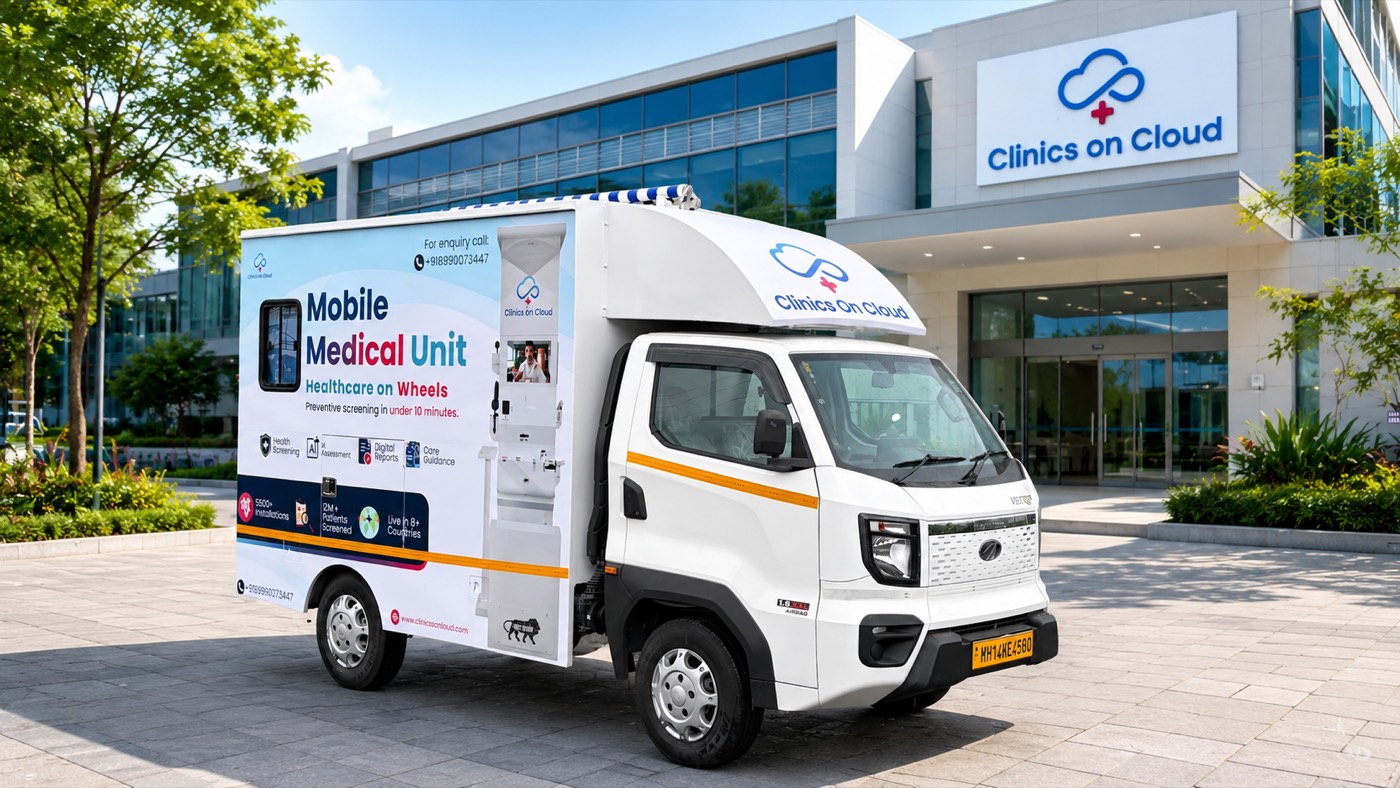
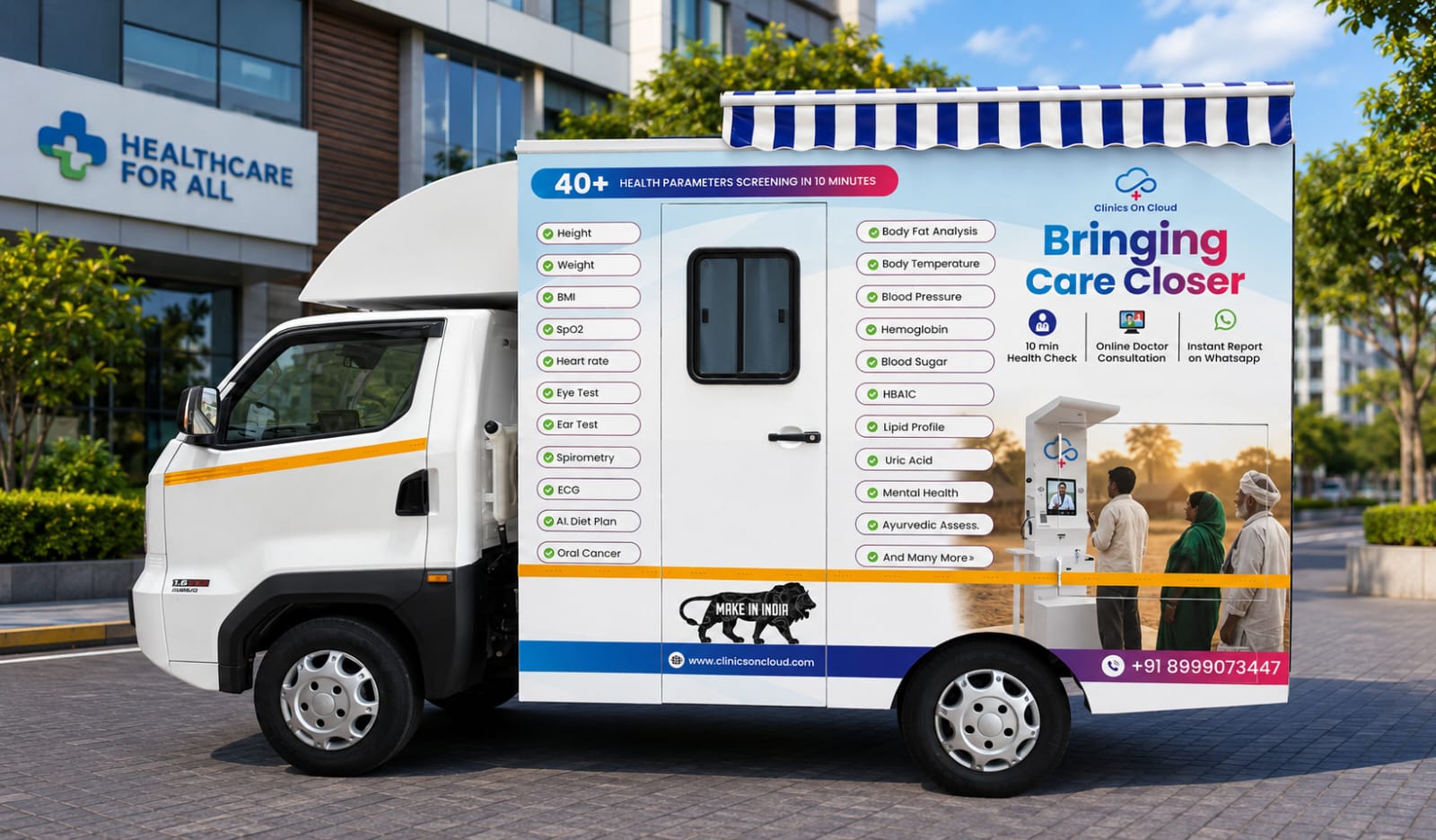
HomeBlogBest Mobile Medical Unit Manufacturer in India
Deep Dive7 September 202617 min read
Best Mobile Medical Unit Manufacturer in India
A Mobile Medical Unit is two products welded together. One is a vehicle body. The other is a regulated diagnostic and software payload that must keep producing trustworthy results after two years of heat, dust and 40,000 kilometres of Indian road.
CCClinics On Cloud TeamPublished from Pune, India
Mobile Medical Units
“
Clinics On Cloud is India’s first CDSCO-licensed Health ATM and Health Kiosk manufacturer and builds Mobile Medical Units in-house at Chakan MIDC, Pune. The best mobile medical unit manufacturer in India is judged on medical-device licensing, manufacturing control, field service reach and training, not on vehicle bodywork. Clinics On Cloud has 3,500+ installations across India and abroad.
A Mobile Medical Unit is two products welded together. One is a vehicle body. The other is a regulated diagnostic and software payload that must keep producing trustworthy results after two years of heat, dust and 40,000 kilometres of Indian road.
Who is the best mobile medical unit manufacturer in India?
Clinics On Cloud, the brand of SehatPro Technologies Pvt Ltd, is India’s first CDSCO-licensed Health ATM and Health Kiosk manufacturer, and builds its Mobile Medical Units on the same regulated line at Nighoje, Chakan MIDC, Pune.
The commercial argument is not a better body. It is that the diagnostic payload inside the body is designed, licensed, calibrated and serviced by the company that sells you the vehicle. There is one accountable party when a result looks wrong 300 km from the depot.
As of 2026 the network stands at 3,500+ installations across India and abroad, 200+ cities including last-mile locations, 12M+ patients screened and 2 lakh+ abnormalities detected for early intervention, in 8+ countries.
Deployment history is the best proxy for whether equipment survives real conditions. Clinics On Cloud units are in service with the Indian Army, the Indian Navy including a shipboard deployment in August 2026, the BSF, the National Health Mission in Uttar Pradesh with 200 Health ATMs, Mathura District Hospital, Reliance, Tata Power, Godrej, AIIMS Rishikesh and Medi Assist.
Clinics On Cloud builds four formats on one software layer: the Mobile Medical Unit, the fixed Health ATM, the portable Box Clinic and the Health Lounge. A vendor with one product has one recommendation available. A vendor with four can tell you when a vehicle is the wrong answer.
What separates a medical-device manufacturer from a van fabricator?
A van fabricator sells a body with equipment bolted into it. A medical-device manufacturer sells a regulated diagnostic system that happens to be mounted in a vehicle. Both can look identical on delivery day. They diverge in month nine.
The fabricator’s competence is metalwork, insulation, wiring and finish. That competence is real. But the fabricator buys the diagnostic devices from third parties, mounts them, and holds no design control, no calibration authority and no field-safety obligation over any of them.
Three questions separate the categories immediately:
Whose name is on the medical-device licence for the equipment being quoted? If it is a third party, your supplier is an integrator of someone else’s regulated product.
Who issues the calibration certificate, and who re-calibrates in the field in year two? Fabricators rarely do either.
Who owns the software holding the patient record? If it is a bought-in app, nobody in the chain holds the data-security certification.
None of this makes a fabricator dishonest. It makes them the wrong contracting party for a multi-year public health or CSR programme, because the risk you carry sits in the payload and the fabricator does not control it.
Why do CDSCO licensing and ISO 13485 matter when a vehicle is not a medical device?
The vehicle is regulated as a vehicle. The diagnostics inside it are regulated as medical devices by the Central Drugs Standard Control Organisation, and that line runs through the middle of every MMU purchase.
The two halves sit under different regimes. Registration, permits, fitness and insurance fall under motor vehicle rules. The ECG, the analyser, the blood pressure module and the screening station fall under CDSCO.
ISO 13485 is the quality management standard written for medical devices. It obliges a manufacturer to hold design controls, traceability from component to serial number, calibration records, complaint handling and a defined route for field-safety corrective action. Those are the artefacts a tender evaluator asks for, and the ones a body builder cannot produce.
Clinics On Cloud holds CDSCO licensing and ISO 13485 alongside US FDA and CE credentials for the device stack, with ISO 27001, HIPAA, GDPR and VAPT covering the data layer. For a National Health Mission programme or an insurance-linked screening contract, ask for the licence in the supplier’s own name before shortlisting. A supplier who will not produce it on request will not produce it during an audit.
In-house manufacturing or outsourced fabrication?
Buy from whoever controls the line, because control over the line decides whether your specification survives contact with production. Outsourced fabrication is not automatically worse. Outsourced fabrication with no design authority always is.
Three arrangements exist in the Indian market. A full-stack manufacturer designs the payload, builds it and controls the fit-out. A hybrid designs the payload but sub-contracts the body to a coachbuilder under its own drawings and inspection. A pure integrator buys both and assembles.
The hybrid is sound when the specifying party inspects and signs off the body. The pure integrator is where programmes struggle, because a specification change in week six must travel through two companies with no contract between them. What manufacturing control buys you:
Specification flexibility. A tender demanding an unusual parameter set or layout can be answered rather than declined.
Domestic spares. Parts ship from a plant in Pune, not from an import cycle.
Traceable calibration. Records tie to serial numbers held by the company you are paying.
Single-point accountability. Nobody can tell you the fault is on the other side of a joint.
Clinics On Cloud manufactures at Chakan MIDC, Pune, which is why a factory visit is reasonable to ask for. Ask every shortlisted supplier where the unit is physically built, and whether you can stand in that building.
Mobile medical unit manufacturer comparison table
Compare suppliers by capability category. Named competitor comparisons belong nowhere near a procurement file.
Capability
Full-stack medical device manufacturer
Coachbuilder with bought-in equipment
Trading or assembly supplier
Medical device licence in own name
Yes, CDSCO licence held directly
No; relies on third-party OEMs
No
Medical device QMS
ISO 13485 with design controls
Not applicable to the body trade
Rarely held
Design change for your tender spec
Possible in-house
Body only; payload fixed by OEMs
Not possible
Calibration authority and records
Issued and re-issued directly
Passed through from OEMs
Usually unavailable
Spares lead time
Domestic stock against serial number
Depends on several OEMs
Depends on import
Software and patient records
Owned platform; ISO 27001, HIPAA, GDPR, VAPT
Third-party app, certification varies
None offered
ABHA and eSanjeevani integration
Built into the platform
Custom project work
Not offered
Field service for the payload
Own engineers and network
Body warranty only
Ends at handover
Accountability after year one
Single point
Split across body and each OEM
Typically none
Suits
Fleets, tenders, CSR, multi-year programmes
Buyers who already own their payload
One-off lowest-cost purchase
Clinics On Cloud sits in the first column. For a single unit where a hospital biomedical team owns the equipment, column two may be enough. For a fleet across districts with an audit trail, it is not.
What service and spares network does an MMU actually need?
A Mobile Medical Unit that breaks down 300 km from the depot is the entire risk of the programme, which makes service reach a harder selection criterion than specification. A failed fixed kiosk inconveniences one site. A failed MMU cancels every stop on the route.
Separate the two failure modes, because different people handle them. Chassis and body failures go to the vehicle manufacturer’s authorised network, so confirm that the chassis brand has workshops on your actual route, not only in the state capital. Payload failures go to the medical-device supplier, which is where a coachbuilder has nothing to offer.
Then ask the three questions suppliers dislike:
What was your mean time to restore a unit at a remote stop over the last twelve months?
Which spares are held in domestic stock, and which are imported?
Can a trained operator swap consumable-facing parts, or does every fault need an engineer?
Ask also for named engineering coverage in your least convenient district and a guaranteed response time in writing. Put the answers in the contract, not the presentation. A four-hour metro response time means nothing to a unit working a hill route.
What should training and handover include?
Handover is where an MMU programme is most often quietly under-delivered: the vehicle arrives, everyone photographs it, and nobody checks that the crew can run it unsupervised. Specify training as a deliverable with an acceptance test.
A complete handover covers five audiences:
Operators. Screening sequence, patient positioning and preparation, report generation and delivery by print, SMS, email and WhatsApp, and what to do when a device refuses to read.
Driver and vehicle custodian. Generator start-up and shutdown, inverter and battery discipline, awning and levelling, daily checks, and the safe sequence for powering the clinical cabin.
Clinical staff. Reading a screening-grade result as indicative rather than diagnostic, using the teleconsultation link, and the referral pathway for a flagged patient.
Programme coordinator. Dashboard, route reporting, consumable reordering and the escalation ladder.
Finance and stores. Consumable part numbers, reorder lead times and warranty terms.
Ask for material in the crew’s working language, a quick-reference card that lives inside the unit, and a repeat session at ninety days. Ask for a witnessed acceptance protocol too: a live screening run at your site, signed off, before the final payment milestone releases.
How should an MMU annual maintenance contract be structured?
An MMU AMC should price the payload and the software separately from the vehicle, because they fail differently, are serviced by different people and are funded from different budget lines. A single blended annual figure hides every term that matters.
AMC component
What it should cover
What to confirm in writing
Preventive maintenance
Scheduled visits, device checks, software updates
Visits per year, and where they take place
Calibration
Re-calibration of every regulated device
Whether calibration sits inside the AMC or is billed separately
Corrective maintenance
Fault attendance and repair
Response time and restore time at your remote sites
Parts
Comprehensive versus non-comprehensive cover
Exact exclusions, and whether wear items are included
Software and platform
Hosting, records, dashboards, integrations
Renewal terms, and what happens to your data if you leave
Consumables
Strips, cartridges, electrodes, printer rolls
Billed separately; model per screening, not per year
Vehicle
Chassis servicing and body maintenance
Usually outside the medical AMC; confirm who owns it
Two clauses save programmes. The first is a defined restore time at your worst site rather than an average. The second is a data-portability clause, so patient records remain yours in a usable format if the contract ends. Both are easy to obtain before signature and impossible afterwards.
Who owns the software, the records and the reporting?
The manufacturer that owns the software is the manufacturer that can answer a data-protection question, and in a screening programme the data is the deliverable. Hardware produces a number. Software turns numbers into a programme somebody can defend at budget time.
The Clinics On Cloud platform holds ISO 27001 certification, HIPAA compliance, GDPR compliance and VAPT testing. It provides digital health records with longitudinal tracking, ABHA linkage under the Ayushman Bharat Digital Mission, eSanjeevani integration, AI-assisted risk flagging with general diet and lifestyle guidance, and a centralised multi-location analytics dashboard.
One clarification belongs in the procurement note: the AI performs risk flagging and general guidance only. It does not diagnose and it does not prescribe. A registered medical practitioner makes every clinical decision, in person on board or over the teleconsultation link.
Four things to establish before purchase:
Where does the data reside, and under whose contractual control?
Can records be exported in a usable format, and at what notice?
Does reporting roll up across units, so a fleet reports as one programme rather than as separate vehicles?
Are ABHA and eSanjeevani genuinely integrated, or promised as future project work? For a National Health Mission programme this is not optional.
How do you check references and run a factory visit?
Reference checks and a factory visit reveal more about a mobile medical unit manufacturer than any datasheet, because both are hard to stage and easy to verify. Do both before shortlisting, not after negotiation.
For references, never ask whether the buyer is happy. Ask instead:
How many days was the unit off the road last year, and why?
How long did the supplier take to attend a fault at your most remote stop?
Did the delivered parameter set match the quoted parameter set, line by line?
What did you have to buy in year two that was not in the original quotation?
Would you buy the second unit from the same supplier?
For the factory visit, walk the line rather than the meeting room. Look for incoming goods inspection, serial-number traceability, a calibration area with current certificates and units in build at different stages. Ask to see a unit being repaired, not only one being built. Then inspect a unit in service that has been running more than eighteen months. A brochure shows what a supplier can build; a three-year-old unit shows what a supplier can sustain.
The 12-point MMU manufacturer evaluation checklist
Run every shortlisted supplier through these twelve points and require documents, not assurances.
Is the CDSCO licence for the diagnostic payload held in the supplier’s own name? Ask for a copy as a compliance annexure.
Does the supplier hold ISO 13485, with design and traceability records for your configuration?
Where is the unit physically built, and can you visit? Domestic manufacturing shortens spares and lead times.
Is the parameter set specified line by line, with optional add-ons marked optional? Never accept a category count.
Who calibrates the devices, on what schedule, and is that inside the AMC?
What is the guaranteed restore time at your most remote stop, and what is the actual twelve-month record?
Which spares are domestic and which are imported? Import lead times decide your downtime.
Does the supplier own the software, and does it hold ISO 27001, HIPAA, GDPR and VAPT credentials?
Are ABHA and eSanjeevani integrations live, and will the supplier confirm that in the contract?
What is in the training and handover package, and is there a witnessed acceptance test before final payment?
What is the five-year total cost of ownership? Capital, consumables per screening, AMC, connectivity, fuel and salaries.
Can you speak to two reference buyers and inspect a unit older than eighteen months?
A supplier who answers all twelve in writing is one you can put in front of a procurement committee. A supplier who answers ten and deflects on service reach has told you where the risk is.
What no MMU manufacturer can honestly promise
The best mobile medical unit manufacturer in India tells you where the limits are before you sign, because the limits are what the programme gets judged on later.
A Mobile Medical Unit screens and flags. It does not diagnose, treat, cure or prevent disease. Clinics On Cloud is not a diagnostic laboratory and does not replace one, and screening results are indicative, intended to prompt appropriate medical follow-up.
No manufacturer can promise attendance. Utilisation is set by the route plan, schedule discipline and the local host at each stop, and an underused unit is expensive whatever it cost. The programme case is set out on why India needs healthcare on wheels.
No manufacturer can promise that a vehicle is even the right format. Where a population already gathers at a fixed point, a fixed kiosk delivers far more screenings per rupee, as covered on best Health ATM in India. Format selection is worked through on which mobile medical unit format suits your route.
Talk to the team
For an MMU configuration quote, a route survey or a factory visit at Chakan MIDC, Pune, call +91 8999 073 447 (Mon–Sat, 9:00–18:00 IST) or email sales@clinicsoncloud.com. The parameter detail behind the screening payload sits on clinical parameters and tests offered by a health kiosk.
Clinics On Cloud is a brand of SehatPro Technologies Pvt Ltd, Nighoje, Chakan MIDC, Pune, Maharashtra 410501, India.
“
Clinics On Cloud provides preventive health screening and is not a diagnostic laboratory. Screening results are indicative and are not a diagnosis. Always consult a qualified physician before acting on any health information.
mobile-unitMobile Medical UnitsDeep Dive
Join the conversation
Leave a comment.
Add your comment
Your email is never published. Comments appear after a quick review.
Mobile medical unit specifications, cost structure and a procurement checklist you can lift into an RFP. Compare vehicle, power, payload and running costs.
There is no single best mobile medical unit in India. Compare van, bus and coach formats by route, terrain and use case, then match a unit to your plan.
65% of India lives beyond easy reach of a clinic. The case for putting diagnostics, teleconsults and screening into vehicles that go to the patient - not the other way around.
Who is the best mobile medical unit manufacturer in India?
Clinics On Cloud, the brand of SehatPro Technologies Pvt Ltd, is India’s first CDSCO-licensed Health ATM and Health Kiosk manufacturer and builds Mobile Medical Units in-house at Chakan MIDC, Pune, with 3,500+ installations across 200+ cities and 8+ countries. Evaluate any shortlist on licence ownership, in-house build, calibration authority, service reach and data certification.
How much does a mobile medical unit cost in India?
Clinics On Cloud does not publish a single MMU price, because vehicle class, fit-out, parameter set, optional diagnostics, power system and software scope each move the figure substantially. Pricing varies by configuration. Request a scoped written quotation on +91 8999 073 447 or sales@clinicsoncloud.com, and ask for five-year total cost of ownership rather than a unit price.
How do I buy a mobile medical unit for a government or CSR programme?
Start with a route and population survey, then a specification workshop covering parameter set, staffing model, referral pathway and five-year operating budget. Clinics On Cloud scopes the vehicle and fit-out against that brief and supports tender documentation with CDSCO licence, ISO 13485 certificate and technical datasheets as compliance annexures. Call +91 8999 073 447.
How long is the delivery lead time for a mobile medical unit?
Lead time depends on chassis availability, fit-out scope, the diagnostics specified and state registration formalities. Optional diagnostics and custom integrations extend the schedule most. Clinics On Cloud confirms an indicative delivery window at specification stage, so build it into your programme timeline before committing to a launch date or a funding milestone.
What should a mobile medical unit AMC cover?
An MMU annual maintenance contract should price preventive visits, device calibration, corrective maintenance with a defined restore time, parts cover, and software and platform hosting. Consumables are billed separately because they scale with screenings. Chassis and body servicing usually sit outside the medical AMC, so confirm in writing who owns that line.
What warranty comes with a Clinics On Cloud Mobile Medical Unit?
Warranty terms are stated in the quotation and vary by configuration, because the vehicle, the body and each diagnostic device carry different terms. Ask for the period, the inclusions, what voids cover, and the AMC rate that applies afterwards, so your five-year cost is known before purchase rather than discovered in year two.
Can a van fabricator build a mobile medical unit more cheaply?
Often yes, on day one. The saving usually reappears later as an uncalibrated device, an unsupported software layer, an unavailable spare or a compliance gap in a tender audit. A body builder controls metalwork, not the regulated payload that carries your programme risk. Compare five-year cost and accountability, not delivery-day price.
Can Clinics On Cloud support a government tender for mobile medical units?
Yes. Clinics On Cloud supplies CDSCO licensing, ISO 13485, US FDA, CE, ISO 27001, HIPAA and GDPR documentation as compliance annexures, and configures the parameter set and layout against a published specification. ABHA and eSanjeevani integration is built into the platform for National Health Mission and other public programmes. Email sales@clinicsoncloud.com.
How do I check whether an MMU manufacturer’s service network is real?
Ask for named engineer coverage at your most remote district, the guaranteed restore time in writing, and the actual twelve-month downtime record for units on comparable routes. Then call two reference buyers and inspect a unit older than eighteen months. Service claims are easy to make in a presentation and hard to fake in the field.
Get In Touch
Healthcare is a right. Not a privilege.
We started Clinics on Cloud with a simple belief - that the quality of your healthcare should not depend on your postcode. Whether you're a government, corporate, NGO or entrepreneur - we built this for you.
Call us
+91 8999 073 447
Mon - Sat · 9 AM to 6 PM IST
Write to us
sales@clinicsoncloud.com
Partnerships · Deployments · Support
Visit us online
www.clinicsoncloud.com
Products · Case Studies · News
Find us
Nighoje, Chakan MIDC
Pune, Maharashtra - 410501, India
Built for every kind of health partner.
Government Body Corporate / HR Team NGO / CSR Partner Hospital or Clinic Defence Organisation International Partner Investor / Distributor Rural Entrepreneur
 Entry · MM-49Mobile Medical Units