 Entry · MM-38Mobile Medical Units
Best Mobile Medical Unit in India
There is no single best mobile medical unit in India. Compare van, bus and coach formats by route, terrain and use case, then match a unit to your plan.
Read story 15 min read
Mobile medical unit specifications, cost structure and a procurement checklist you can lift into an RFP. Compare vehicle, power, payload and running costs.
Mobile medical unit specifications cover four blocks: vehicle and body, power, diagnostic payload and software. Clinics On Cloud builds each Mobile Medical Unit around an integrated Health ATM covering 65+ clinical parameters across 14 specialties, and prices vary by configuration. Power sizing is the item procurement teams under-specify most often.
This is a working document rather than a sales page. It is written for the procurement officer, CSR manager or hospital administrator who has to produce a specification that survives a technical evaluation and a five-year budget.
Vendor selection is a separate exercise, covered on how to choose the best mobile medical unit manufacturer in India. Choosing which type of unit to build is covered on which mobile medical unit format suits your route.
A complete mobile medical unit specification covers eight blocks: vehicle base, body and interior, power, diagnostic payload, connectivity and software, clinical layout, consumables, and service and training. A specification that names only equipment will be met by a vehicle nobody can operate.
The failure pattern is consistent. Buyers write a detailed equipment annexure, a thin vehicle clause, one line on power, and nothing at all on consumables or calibration. The unit is delivered, works for a season, then degrades because the specification never described what keeps it working.
Write each block with three columns in mind: the mandatory requirement, the acceptable alternative, and the evidence the bidder must submit. “Air-conditioned clinical cabin” is a wish. “Air-conditioned clinical cabin, capacity stated in the bid, with cooling maintained at the specified ambient temperature while all listed devices run, evidenced by a load calculation” is a specification.
Two clauses belong in every MMU RFP and are usually missing. The first requires the bidder to hold the CDSCO licence for the diagnostic payload in its own name, with ISO 13485 for the medical device quality system. The second requires a five-year total cost of ownership statement covering capital, consumables per screening, annual maintenance, connectivity and calibration.
Specify the vehicle against the worst stop on your route, not the average one. Terrain, turning circle and parking space decide the chassis long before payload does. Survey the route physically before writing the clause.
| Base | Suits | Trade-off | Specify carefully |
|---|---|---|---|
| Compact van conversion | Narrow village lanes, hill and tribal routes, dense urban slums | Least interior space; limited zones and equipment load | Interior height, turning circle, ground clearance |
| Mid-size truck or bus body build | Standard rural and peri-urban routes; the common MMU class | Needs reasonable road access and parking | Body construction, insulation, door and step design |
| Large coach or multi-axle build | High-throughput camps, industrial sites, multi-room layouts | Restricted road access; higher running cost | Levelling, external power inlet, awning span |
| Trailer or containerised unit | Semi-permanent siting at a worksite or estate | Not suited to daily route work; needs a tow unit | Siting, stabilisers, statutory permissions |
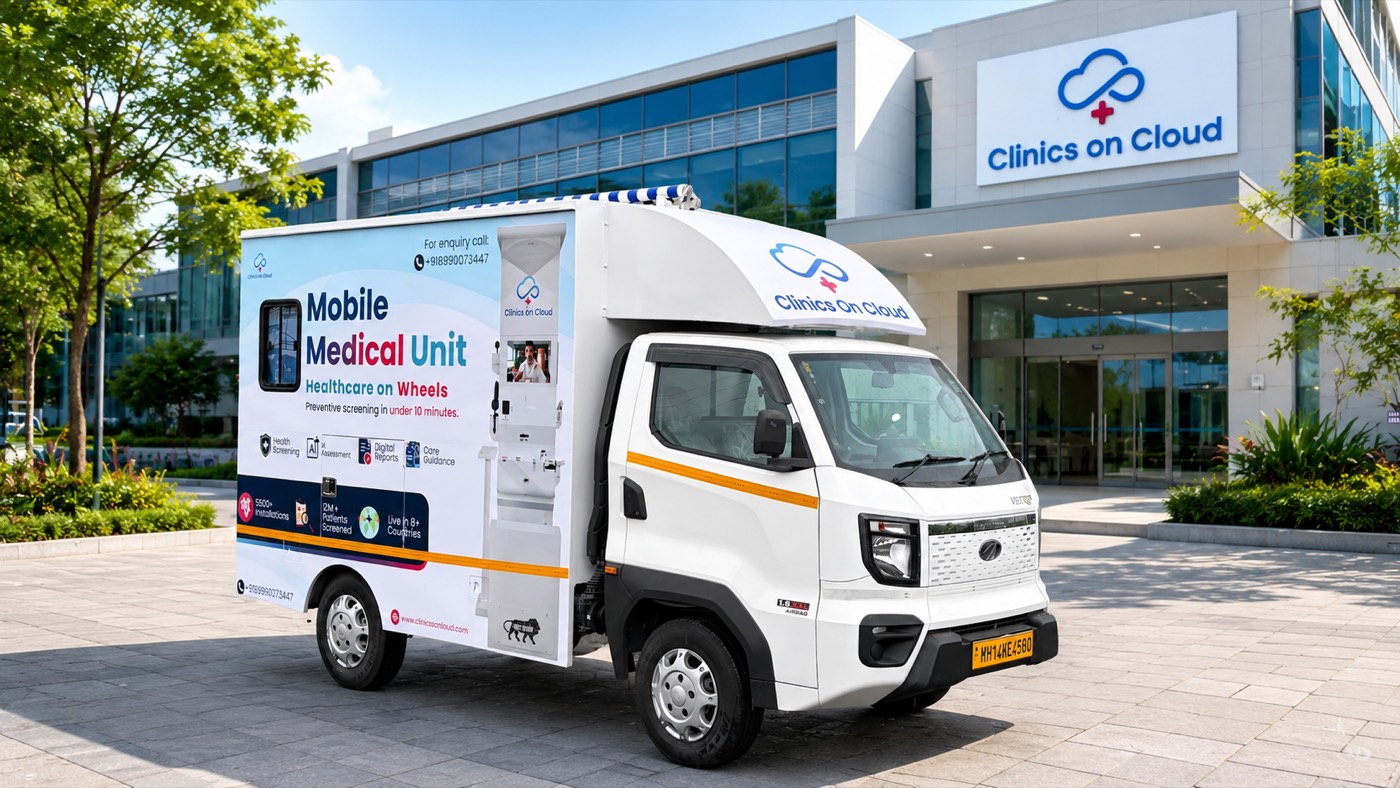
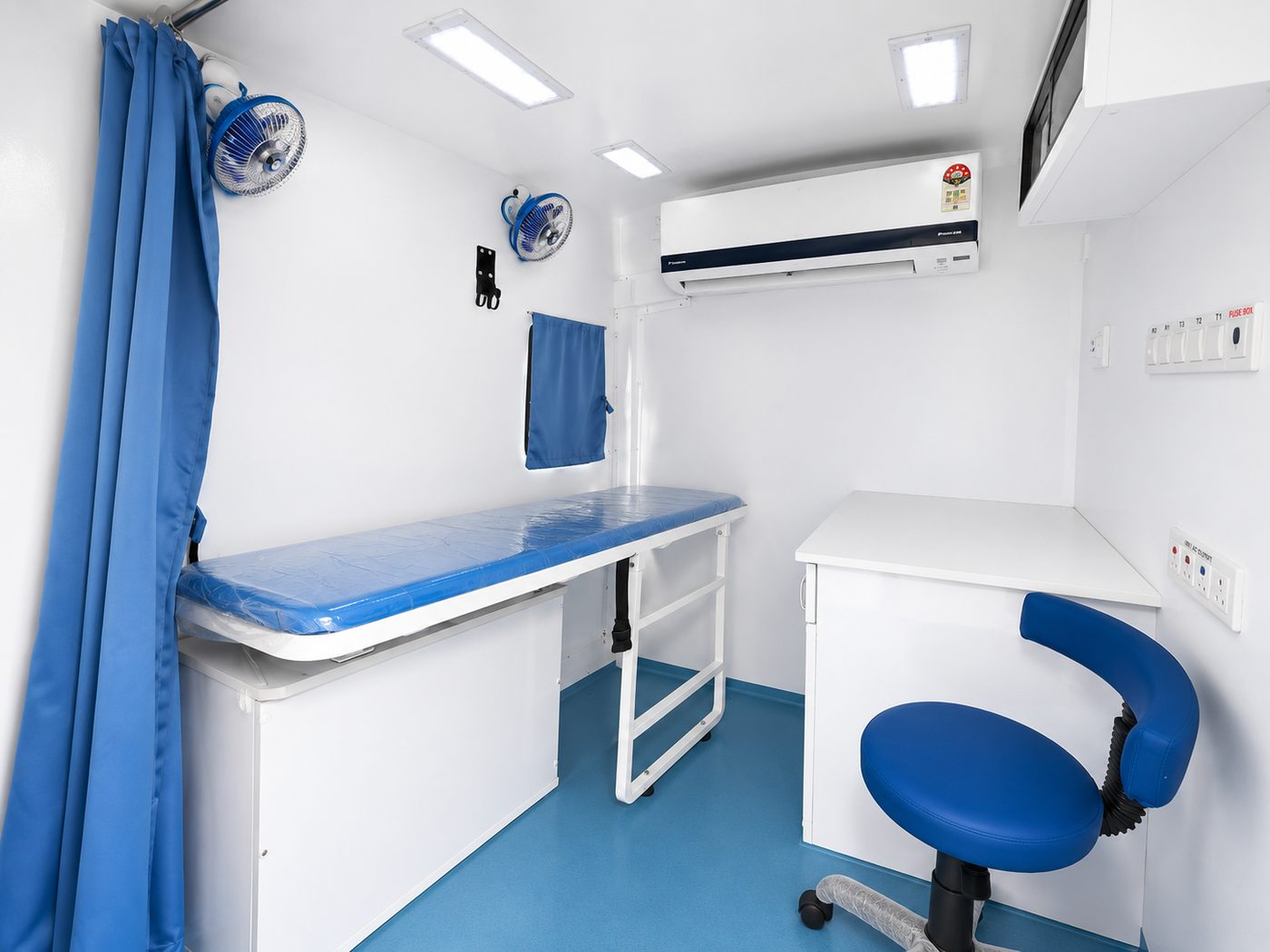
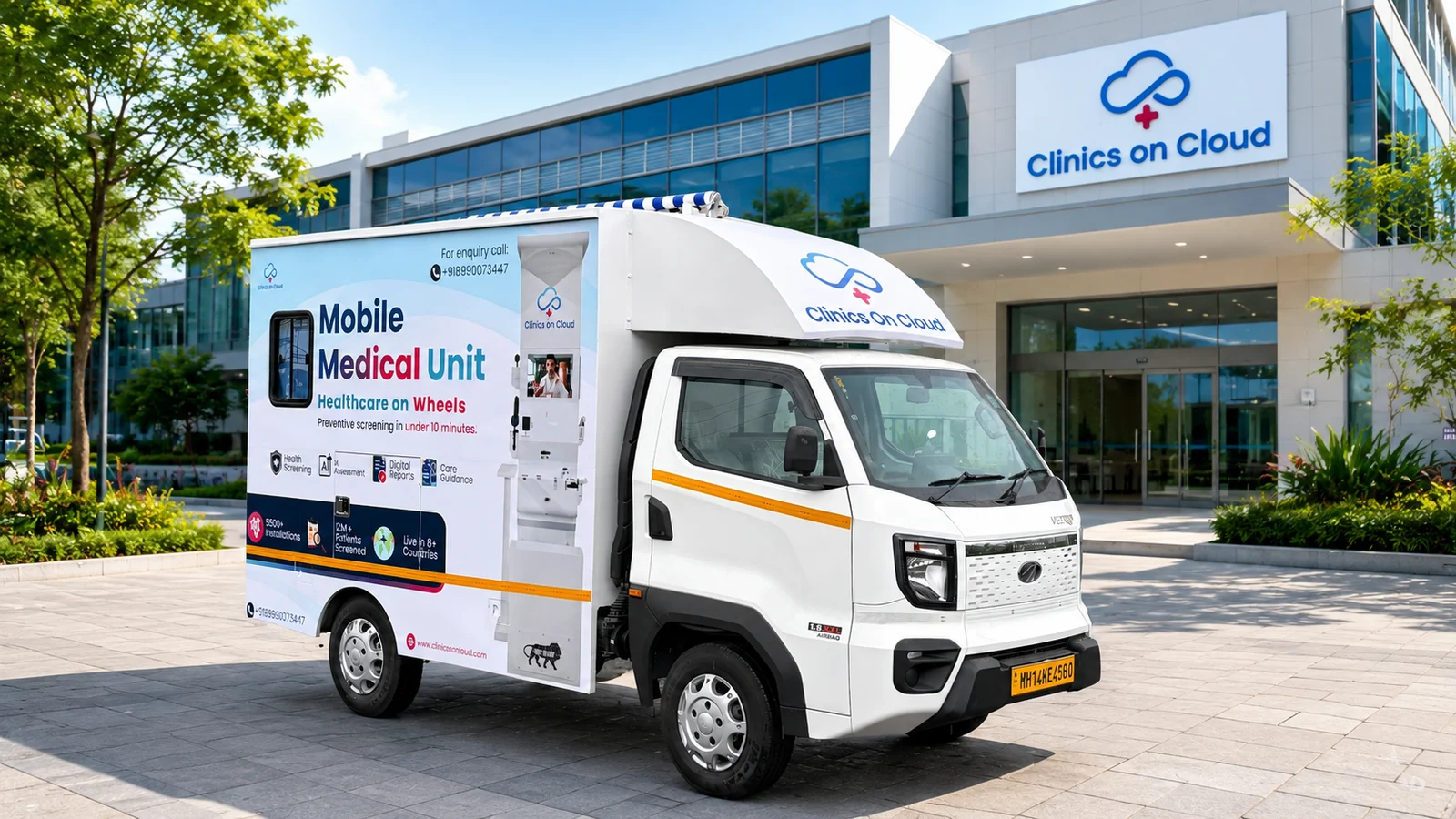
For the body itself, the published Clinics On Cloud Mobile Medical Unit build uses a durable MS tubular frame with rust-resistant and water-seepage-resistant construction, galvanised steel exterior panelling with minimal joints, FRP interior panelling with a hygienic finish, anti-skid flooring over a ply base, and a side door with steps and a window. Approximate exterior dimensions are 10 ft long by 5 ft 7 in wide by 8 ft 4 in high, with an interior of roughly 9 ft 7 in by 5 ft 2 in by 5 ft 7 in.
Write body requirements as performance clauses: joint count, corrosion treatment, insulation, washable interior surfaces and floor slip resistance. Those are the items that decay first in Indian conditions.
Power is the most commonly under-specified item in an Indian mobile medical unit tender, and an under-powered unit fails in exactly the conditions it was bought for. Every diagnostic device, the air conditioning, the lighting, the printer and the connectivity hardware draw from the same system.
Specify four layers and how they hand over to each other:
The Clinics On Cloud unit is built as a self-sustained vehicle with generator support and uninterrupted inverter backup for the air-conditioned cabin, plus LED lighting throughout. For comparison, the fixed Health ATM carries 3–4 days of battery backup and operates offline, which is a useful benchmark when you set an MMU backup clause.
Ask every bidder for a written load calculation listing each device, its draw and its duty cycle. If the bidder cannot produce that sheet, the bidder has not sized your power system.
List the payload parameter by parameter, never as a category count, and mark every optional item as optional. “Comprehensive health screening” in a tender annexure is unenforceable. A line-item list is.
The Clinics On Cloud platform supports 65+ clinical parameters across 14 specialties, delivered through an integrated Health ATM that completes a full checkup in 10 minutes. Configure a subset that matches the burden your population actually carries.
| Specialty | Parameters | Typical screening purpose | Specification note |
|---|---|---|---|
| General health | 19 | SpO2, pulse, temperature, height, weight, BMI, BMR and full body composition | The baseline block; include in every configuration |
| Cardiac | 9 | 6-lead or 12-lead ECG, blood pressure, lipid profile | State lead count explicitly; 12-lead is a separate device |
| Urine analysis | 10 | Glucose, protein, ketones, pH, bilirubin, leukocytes and more | Strip-based; drives a recurring consumable line |
| Rapid infectious disease | 10 | Dengue, malaria, typhoid, chikungunya, hepatitis B and C, HIV I and II, syphilis, COVID-19 antigen, blood grouping | Cartridge-based; specify counselling and consent handling |
| Ayurvedic assessment | 7 | Constitution-based wellness assessment | Include only where the programme calls for it |
| Pulmonary function | 4 | PEF, FVC, FEV, FEV1/FVC | Essential for dust-exposed and mining workforces |
| Dental and oral cancer screening | 4 | Intraoral visualisation | High value where tobacco use is prevalent |
| Dermatology | 3 | Skin, hair and nail visualisation | Requires good cabin lighting |
| Vision | 3 | Far vision, near vision, colour blindness | Core to school and driver screening |
| Hearing and ENT | 2 | Audiometry, otoscope ear visualisation | Audiometry needs a quiet cabin; specify noise control |
| Diabetes | 2 | Random blood sugar, HbA1c | Specify strips and cartridges as a consumable line |
| Anaemia and kidney | 2 | Indicative screening parameters | Common priority in maternal and adolescent programmes |
| Mental health | 2 | PHQ-9 depression, GAD-7 anxiety | Specify privacy and referral pathway alongside |
| Maternal health | 1 | Fetal monitor | Pair with a defined obstetric referral route |
Optional additions include X-ray, breast cancer screening equipment, biochemistry analysers and 12-lead ECG. Each one changes vehicle class, payload, power draw, staffing and regulatory scope, so specify it at design stage rather than adding it later. Full parameter detail sits on clinical parameters and tests offered by a health kiosk.
Device accuracy is 90–95% depending on the test and device, under correct usage, calibration and patient preparation. State in the specification that results are screening-grade and indicative, not diagnostic.
Specify that screening works fully offline and syncs later, and that only the live teleconsultation depends on a data connection. A unit that stops working when the signal drops is not a rural unit.
The Clinics On Cloud MMU is 4G and Wi-Fi enabled, with report sharing by WhatsApp, email or print and a tele-doctor screen beside the cab. Digital health records, ABHA linkage under the Ayushman Bharat Digital Mission, eSanjeevani integration and stakeholder dashboards sit on the platform layer.
Write these clauses:
Also state who the teleconsultation doctor is. A platform that connects to a doctor panel and a platform that connects to your own clinicians are different commercial arrangements with different recurring costs.
Specify a cold chain only if the programme actually carries vaccines, temperature-sensitive reagents or samples for transport, because a cold chain adds power draw, validation and audit burden. Most preventive screening configurations do not need one.
You need cold chain provision when the unit performs immunisation, carries reagents with a stated storage temperature, or transports samples to a laboratory for confirmatory testing. You do not need it for a screening-only configuration using room-temperature strips and cartridges.
If you do need it, the specification must state the required temperature range, continuous temperature logging with an exportable record, a defined hold time during a power interruption, and a documented excursion procedure. A domestic refrigerator bolted into a van is not a cold chain and will fail an audit.
The power consequence is significant. A validated cold chain runs continuously, including overnight and on non-operating days, which changes the battery bank, the generator run-time assumption and the depot shore-power requirement. Price that consequence in the same clause, not in a later variation order.
Where sample transport is the only requirement, a validated transport box with logging is often the proportionate answer rather than an on-board unit.
Clinical layout decides throughput and dignity, so specify zones by function rather than by furniture. The published Clinics On Cloud layout separates a smart screening zone with the health kiosk, vitals station and privacy curtain, an examination area with a foldable table and cushioned patient bed, and a consultation area with a doctor workstation, storage and ventilation in an air-conditioned cabin.
Specify these explicitly:
Accessibility clauses are frequently written as aspirations and then quietly dropped at build stage. Make them acceptance-test items witnessed at handover.
Clinics On Cloud does not publish a single MMU price, because vehicle class, fit-out, parameter set, optional diagnostics, power system and software scope each move the figure substantially. Pricing varies by configuration. Request a scoped written quotation on +91 8999 073 447 or sales@clinicsoncloud.com.
What a procurement team can do without a price is structure the budget correctly. The table below is ILLUSTRATIVE ONLY. It contains no Clinics On Cloud pricing, no rupee amounts and no achieved results. It shows the relative weight of first-year line items so that nothing is left out of the budget request.
Assumptions behind this illustration: a mid-size body build on a standard chassis, a screening-led staffing model with a driver and one or two operators, a route operated on working days, and no advanced diagnostics. Change any assumption and the weights change.
| # | Line item | One-time or recurring | Illustrative weight in first-year outlay | Comment |
|---|---|---|---|---|
| 1 | Medical equipment and diagnostic payload | One-time | Largest single line | Rises steeply with optional diagnostics |
| 2 | Vehicle chassis | One-time | Substantial | Set by terrain, not by clinical need |
| 3 | Body build and interior fit-out | One-time | Substantial | Insulation, panelling, zones, climate control |
| 4 | Power system | One-time | Moderate | Generator, inverter, battery bank, optional solar |
| 5 | Software, records and dashboards | One-time plus recurring | Moderate | Licence or subscription; confirm renewal terms |
| 6 | Training and handover | One-time | Small | Should include a ninety-day repeat session |
| 7 | First-year AMC | Recurring | Moderate | Often starts after the warranty period |
| 8 | Consumables | Recurring | Moderate and volume-driven | Scales with screenings, not with time |
| 9 | Fuel and driver | Recurring | Substantial | Driven by route length, not by equipment |
| 10 | Operator and clinical salaries | Recurring | Largest recurring line in most models | Rises sharply with a clinician on board |
| 11 | Connectivity | Recurring | Small | Multi-SIM raises it slightly and is worth it |
| 12 | Permits, insurance, registration | Mixed | Small but mandatory | Varies by state and intended use |
The structural point survives any set of numbers: lines 9, 10 and 8 are recurring and, over five years, typically outweigh the annualised capital in lines 1 to 4. Budget the route, not only the vehicle. For a fixed-site comparison, indicative Health ATM pricing starts from ₹6,00,000, which is discussed on best Health ATM in India.
Five variables drive MMU running cost, and only one of them is on the invoice you negotiated. Model all five before the programme is approved.
Track cost per completed follow-up alongside cost per screening. Detection without follow-up produces no health value, and funders increasingly ask for the second number.
Lift these points directly into your specification annexure. Each is written to be evaluated rather than admired.
For a scoped configuration quotation, a route survey or tender documentation support, call +91 8999 073 447 (Mon–Sat, 9:00–18:00 IST) or email sales@clinicsoncloud.com. For definitional background, see what a Mobile Medical Unit is and how one is configured.
Clinics On Cloud is a brand of SehatPro Technologies Pvt Ltd, Nighoje, Chakan MIDC, Pune, Maharashtra 410501, India.
Clinics On Cloud provides preventive health screening and is not a diagnostic laboratory. Screening results are indicative and are not a diagnosis. Always consult a qualified physician before acting on any health information.
Your email is never published. Comments appear after a quick review.
Entry · MM-38Mobile Medical UnitsThere is no single best mobile medical unit in India. Compare van, bus and coach formats by route, terrain and use case, then match a unit to your plan.
 Entry · MM-63Mobile Medical Units
65% of India lives beyond easy reach of a clinic. The case for putting diagnostics, teleconsults and screening into vehicles that go to the patient - not the other way around.
 Entry · MM-84Mobile Medical Unit
A clinic on wheels that drives to the village instead of waiting for it. What goes inside an MMU, who staffs it, what it can test, and what a camp day actually looks like.
An MMU specification should cover eight blocks: vehicle base, body and interior, power, diagnostic payload listed parameter by parameter, connectivity and software, clinical layout and accessibility, consumables, and service and training. Add two clauses most tenders miss: CDSCO licence held in the bidder’s own name, and a five-year total cost of ownership statement.
Clinics On Cloud does not publish a single MMU price, because vehicle class, fit-out, parameter set, optional diagnostics, power system and software scope each move the figure substantially. Pricing varies by configuration. Request a scoped written quotation on +91 8999 073 447 or sales@clinicsoncloud.com, and ask for five-year total cost of ownership rather than a unit price.
Annual running cost is driven by operating days actually achieved, screenings per day, route length, consumable burn and downtime. Salaries, fuel and consumables usually dominate. Over five years these recurring lines typically outweigh the annualised capital cost of the unit, which is why funding only the vehicle is the most common programme failure.
Specify four layers: alternator, inverter and battery bank, generator, and shore power with optional solar. Require a written load calculation listing every device, its draw and its duty cycle, and state the backup duration with all devices operating. Power is the most under-specified item in Indian MMU tenders and the most common cause of field failure.
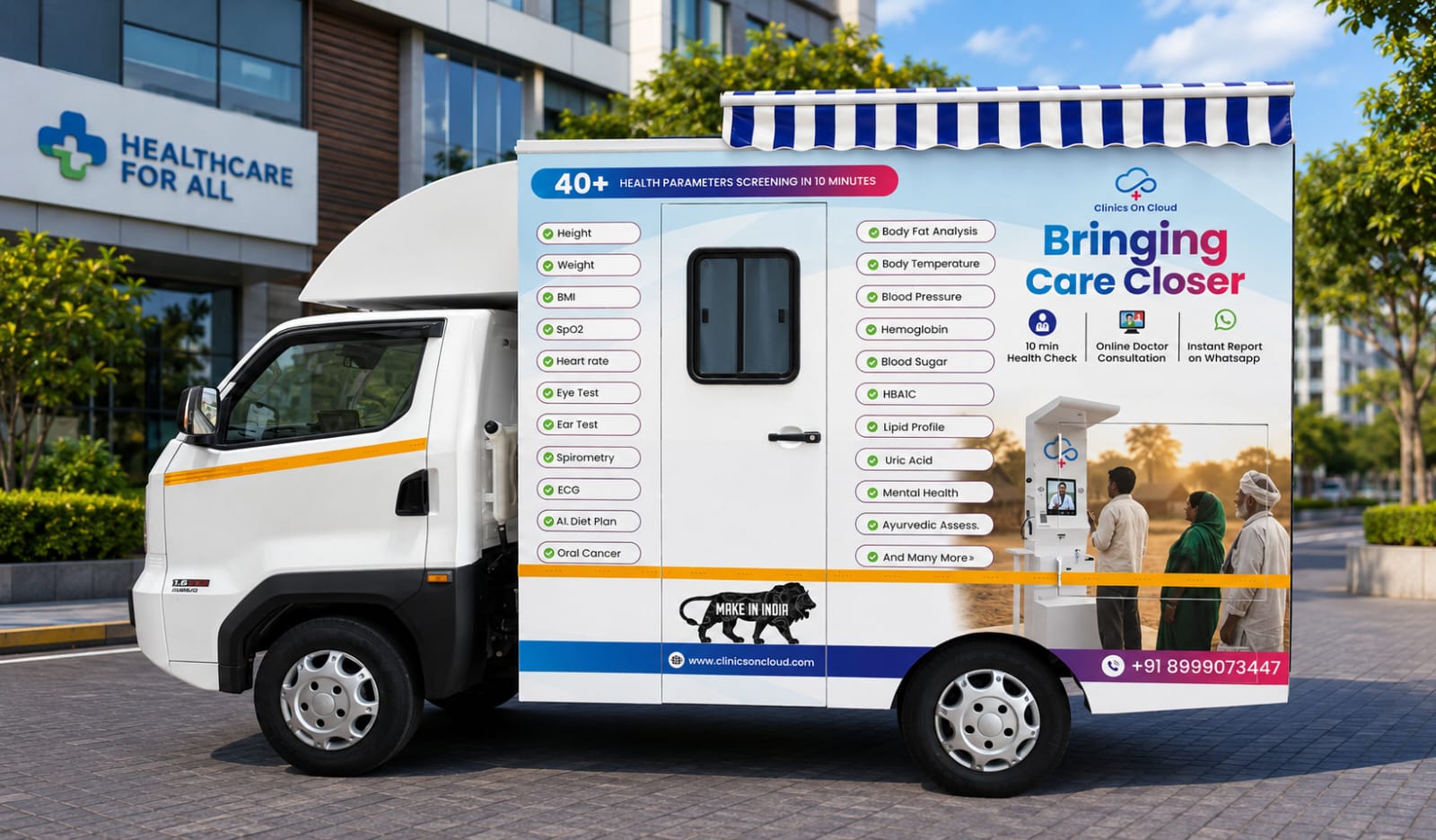
A Clinics On Cloud Mobile Medical Unit carries an integrated Health ATM supporting 65+ clinical parameters across 14 specialties, a vitals station with privacy curtain, an examination area with foldable table and cushioned bed, a doctor workstation with tele-doctor screen, air conditioning, generator and inverter backup, LED lighting and a retractable awning.
Yes. Optional diagnostics include X-ray, breast cancer screening equipment, biochemistry analysers and 12-lead ECG. Each addition changes vehicle class, payload, power draw, staffing and regulatory scope, so specify it at design stage. Adding advanced diagnostics after the build is a variation order, and usually a more expensive one than including it initially.
Yes. Screening capture works offline and syncs when connectivity returns; only the live teleconsultation needs a working data connection. Specify local storage capacity in screenings, multi-SIM or dual-carrier failover, and an external antenna, because a metal-bodied vehicle attenuates signal. Reports can still print on the spot for the patient.
An MMU annual maintenance contract should price preventive visits, calibration, corrective maintenance with a defined restore time, parts cover and platform hosting. Consumables are billed separately because they scale with screenings, and chassis and body servicing usually sit outside the medical AMC. Confirm both exclusions in writing before award.
Write every clause with three parts: the mandatory requirement, the acceptable alternative and the evidence the bidder must submit. Specify performance, not brand names. List the diagnostic payload parameter by parameter, require a written electrical load calculation, and make service response time at your remote site an evaluated criterion rather than a footnote.
It depends on whether your population already gathers somewhere. Where people come to a PHC, a factory gate or a campus, a fixed kiosk delivers far more screenings per rupee and runs every day. Where the population is dispersed across settlements no fixed site serves, a vehicle or a portable Box Clinic is the right answer.
We started Clinics on Cloud with a simple belief - that the quality of your healthcare should not depend on your postcode. Whether you're a government, corporate, NGO or entrepreneur - we built this for you.
+91 8999 073 447
Mon - Sat · 9 AM to 6 PM IST
sales@clinicsoncloud.com
Partnerships · Deployments · Support
www.clinicsoncloud.com
Products · Case Studies · News
Nighoje, Chakan MIDC
Pune, Maharashtra - 410501, India