There is no single best mobile medical unit in India. Compare van, bus and coach formats by route, terrain and use case, then match a unit to your plan.
CCClinics On Cloud TeamPublished from Pune, India
Mobile Medical Units
“
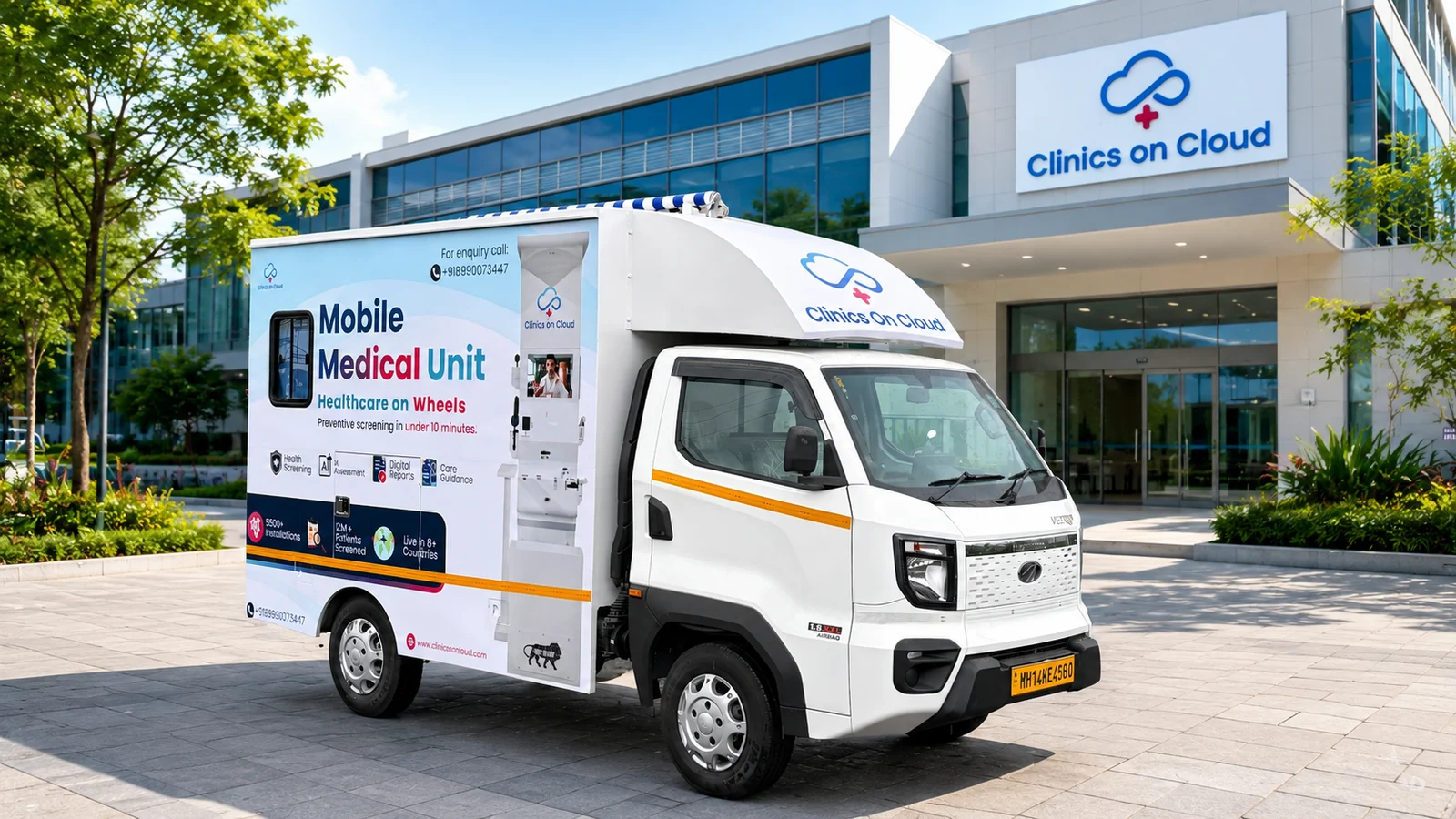
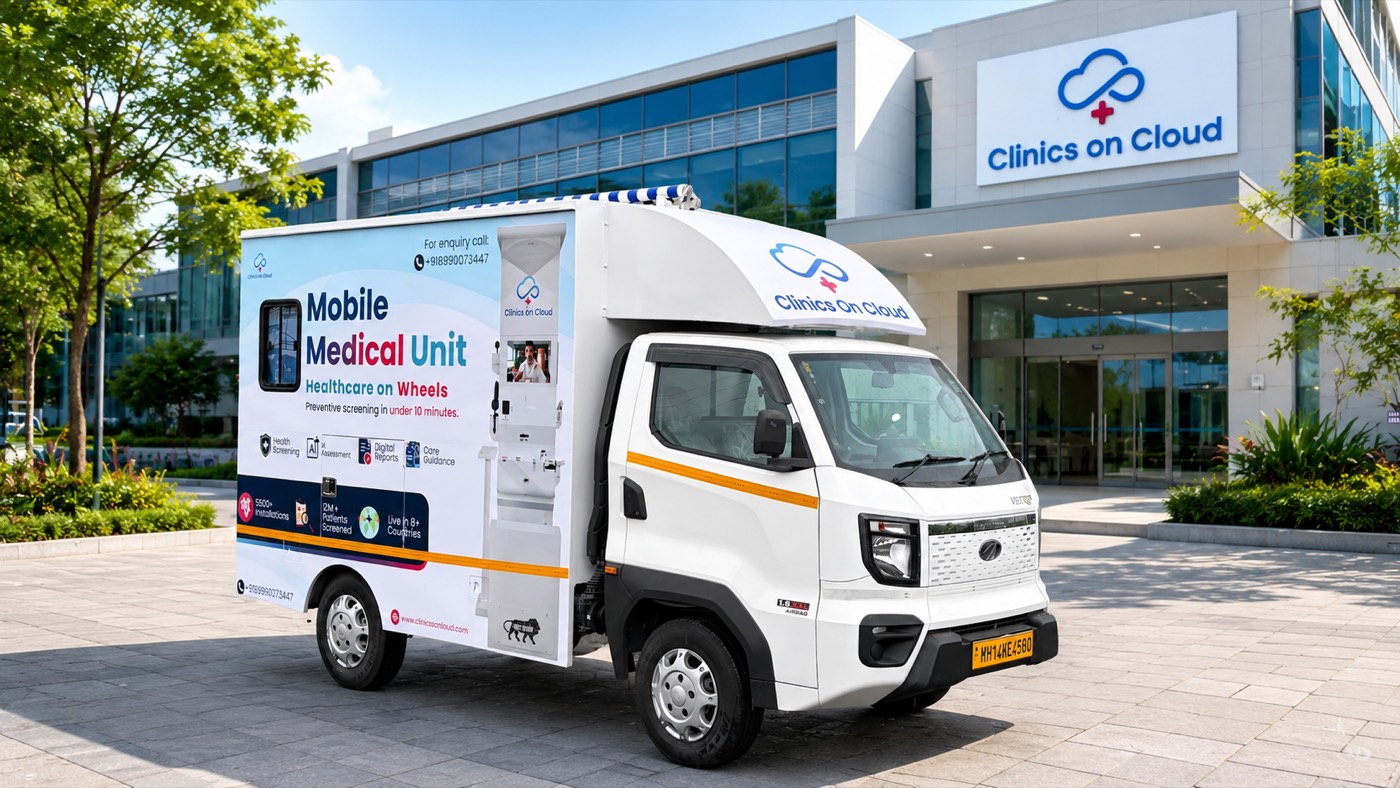
There is no single best mobile medical unit in India. The best unit is the one matched to the route, terrain, population and clinical purpose it serves. Clinics On Cloud builds Mobile Medical Units around an integrated Health ATM that completes a full checkup in 10 minutes, in van, bus and coach formats.
Buyers usually arrive at this question expecting a product ranking. The useful answer is a matching exercise. A unit that is excellent on a plantation estate is the wrong unit for a hill route, and a unit that wins a throughput comparison at a factory gate cannot reach the villages a district programme exists to cover.
The best mobile medical unit in India is the smallest unit that can reach every stop on your route while carrying the parameter set your population actually needs. Anything larger buys capacity you cannot deploy. Anything smaller strands you at the equipment you left out.
Three variables decide it, in this order. Access comes first, because a unit that cannot reach a stop delivers nothing there. Clinical purpose comes second, because it sets the payload and therefore the power and the vehicle class. Throughput comes third, because it is the easiest of the three to fix with scheduling.
Buyers routinely reverse that order. They start with throughput, specify a large body, then discover in month two that four of eleven stops are unreachable and the route has quietly shrunk to seven.
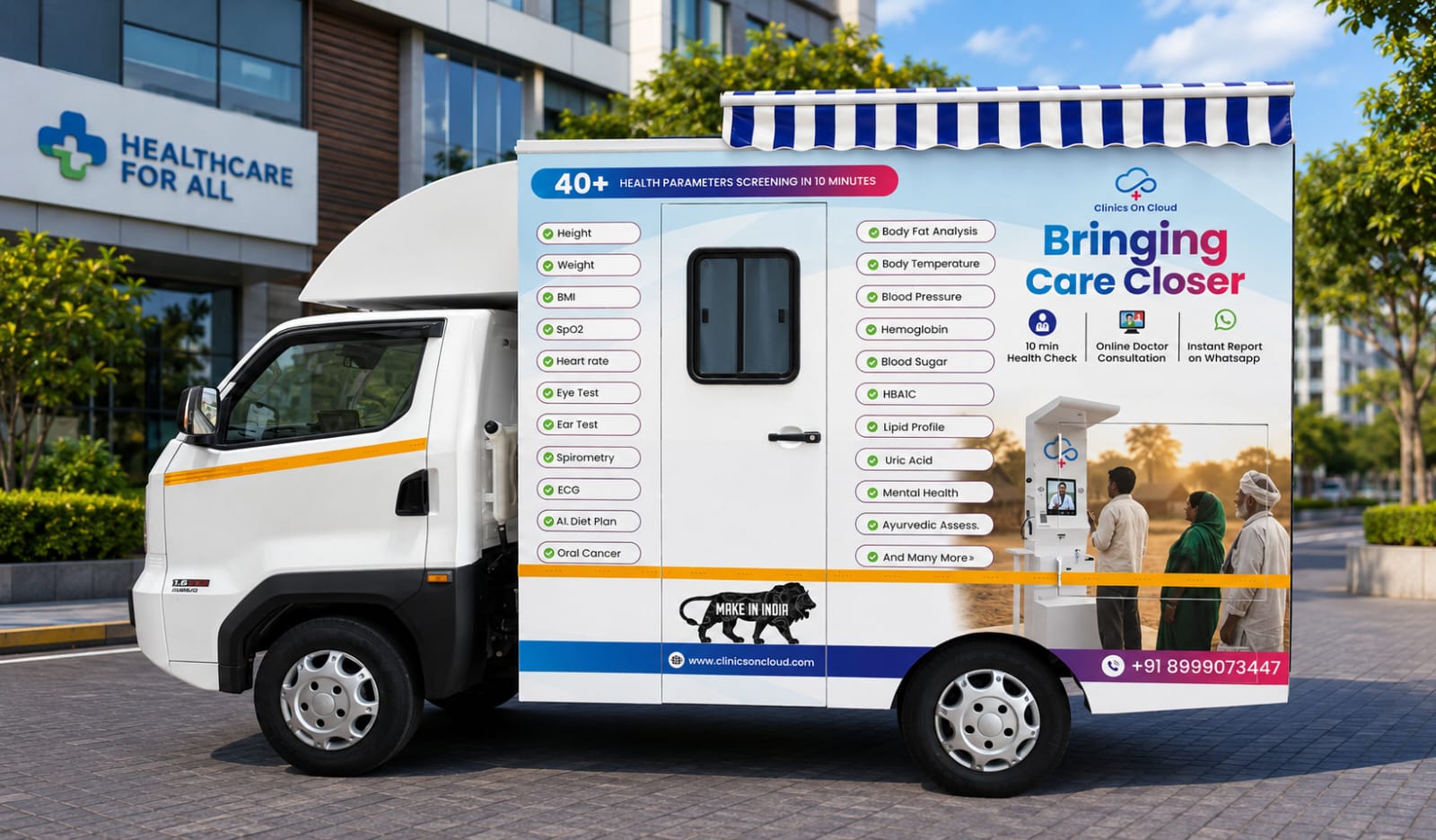
A Mobile Medical Unit from Clinics On Cloud is built around an integrated Health ATM supporting 65+ clinical parameters across 14 specialties, with separate screening, examination and consultation zones, air conditioning, generator and inverter backup, 4G and Wi-Fi, and a retractable awning for outdoor camps. The same platform runs on the fixed Health ATM, the portable Box Clinic and the Health Lounge, so a programme can mix formats without splitting its records.
Mobile medical unit formats compared
Format
Typical reach
Clinical capacity
Access
Best suited to
Compact van conversion
Narrow lanes, hill and tribal routes, dense urban settlements
Screening plus teleconsultation; limited examination space
Highest; goes where larger bodies cannot
Terrain-constrained routes, urban slum outreach, doorstep work
Mid-size bus or truck body build
Standard rural and peri-urban routes
Screening, examination and consultation zones together
Good on made roads; limited on tracks
The common MMU class for district and CSR programmes
Large coach or multi-axle build
Industrial sites, large campuses, mass camps
Highest; multi-room layouts and heavier diagnostics
Lowest; needs road width, parking and turning space
High-throughput camps, occupational health at large plants
Portable kit paired with a light vehicle
The last mile, including individual households
Focused parameter set; one patient at a time
Unlimited; carried on foot where needed
Door to door health screening, tribal hamlets, disaster sites
Fixed unit at an existing gathering point
One location, every day
Full screening; no travel time lost
Not mobile
Populations that already gather at a PHC, gate or campus
Most serious programmes run two formats rather than one. A mid-size unit covering the route, plus a portable Box Clinic for the households that will never walk out to it, covers more people than a single larger vehicle. Where the population already gathers somewhere, a fixed station is the cheaper answer, compared in detail on best Health ATM in India.
How do you match a unit to your route and terrain?
Survey the route with a vehicle of the class you intend to buy, in the season you intend to operate, before you write a single specification clause. A dry-season track is not a monsoon track, and a satellite image is not a turning circle.
Record five things at every stop:
Approach width and surface at the narrowest point, not the average.
Gradient and ground clearance demand, especially the final approach.
Parking and turning space, and whether the unit can stand in shade.
Standing space for a queue, and whether the awning can deploy.
Nearest fuel, workshop and mobile signal, because all three become operational constraints.
Then apply the binding rule: the largest unit you may buy is the one that clears the worst stop you refuse to drop. If a coach clears nine stops and a van clears all eleven, the van is the better unit even though it screens fewer people an hour.
Terrain also drives the payload decision. Heavier diagnostics increase weight, power draw and body length together, which is exactly the combination that pushes a unit out of a hill route. Where the clinical case for heavy diagnostics is strong and the terrain is hostile, split the programme: a lighter unit on the route, and the heavier capability at a fixed site patients are referred to.
Which configuration fits your use case?
Configuration is a clinical decision before it is a vehicle decision. These are the patterns that recur across Indian deployment contexts. Clinics On Cloud configures the parameter set from the 65+ clinical parameters across 14 specialties described on clinical parameters and tests offered by a health kiosk.
Rural PHC outreach
A mid-size unit on a published fortnightly or monthly route, anchored to a Primary Health Centre that receives the referrals. Prioritise general health, blood pressure, random blood sugar and HbA1c, anaemia and kidney parameters, and vision. Specify ABHA linkage under the Ayushman Bharat Digital Mission so the record follows the patient. The binding constraint is the PHC’s capacity to absorb flagged patients, not the vehicle’s capacity to screen them.
Tribal and hill terrain
A compact van conversion, or a portable Box Clinic carried the last stretch on foot. Accept lower throughput as the price of access, and plan longer travel time between stops. Prioritise offline capture with generous local storage, dual-carrier connectivity, and reporting in the local language. Where a settlement is unreachable by any vehicle, the honest configuration is a health worker with a portable kit rather than a bigger van.
Mining and heavy industry occupational health
A mid-size or large unit stationed at the pithead or plant gate, working shift changeovers. Prioritise pulmonary function testing with PEF, FVC, FEV and FEV1/FVC, audiometry, vision, ECG and blood pressure. Specify a quiet cabin, because audiometry needs it, and plan the queue around shift timing rather than the working day. Throughput matters more here than terrain, so a larger body is usually justified.
Plantation and estate workforce
A mid-size unit routed across estate divisions, timed to muster or wage days when the workforce is already gathered. Prioritise general health, anaemia and kidney parameters, blood pressure, diabetes screening, dermatology and vision. Estate tracks argue for shorter wheelbase and higher ground clearance than a district road route would need. A resident host at each division makes attendance predictable.
Corporate multi-site programmes
A unit circulating between offices and plants on a published calendar, with the Health Lounge or a fixed kiosk at the largest site. Prioritise general health and body composition, blood pressure, lipid profile, diabetes screening, ECG, and mental health screening with PHQ-9 and GAD-7. Specify the centralised multi-location dashboard, because a corporate buyer is measured on aggregate participation and trend, not on individual results.
School and college health screening
A compact or mid-size unit visiting on a term calendar. Prioritise vision including colour blindness, audiometry, dental and oral screening, general health and body composition, and anaemia parameters. Specify consent handling for minors, results routed to parents rather than displayed publicly, and a private position for anything sensitive. Throughput is high and predictable, which makes school routes some of the most efficient a programme runs.
Maternal and child health
A mid-size unit on a short, frequent cycle rather than a long, infrequent one, anchored to an anganwadi or sub-centre. Prioritise general health, blood pressure, anaemia parameters, urine analysis and the fetal monitor. Frequency is the whole point: an antenatal contact once a quarter is not a programme. Confirm the obstetric referral route before the first trip, and specify a private examination position as a hard requirement.
Eye and vision camps
A larger unit or a mid-size unit paired with an outdoor awning set-up, because vision screening is high-throughput and largely queue-limited. Prioritise far vision, near vision and colour blindness alongside general health and diabetes screening, since diabetes and eye health travel together. The determining factor is the onward pathway: a vision camp without a confirmed route to refraction and surgical referral produces spectacles nobody collects.
Disaster and relief response
A self-sufficient unit with the longest achievable inverter backup, on-board water and consumable storage, and offline operation as a hard requirement. Prioritise general health, wound and skin assessment, rapid infectious disease testing and blood grouping. Assume no grid power, no connectivity and no local host. This is the configuration where a portable Box Clinic paired with a light vehicle often outperforms a large unit that cannot reach a damaged road network.
What can door to door health screening actually deliver?
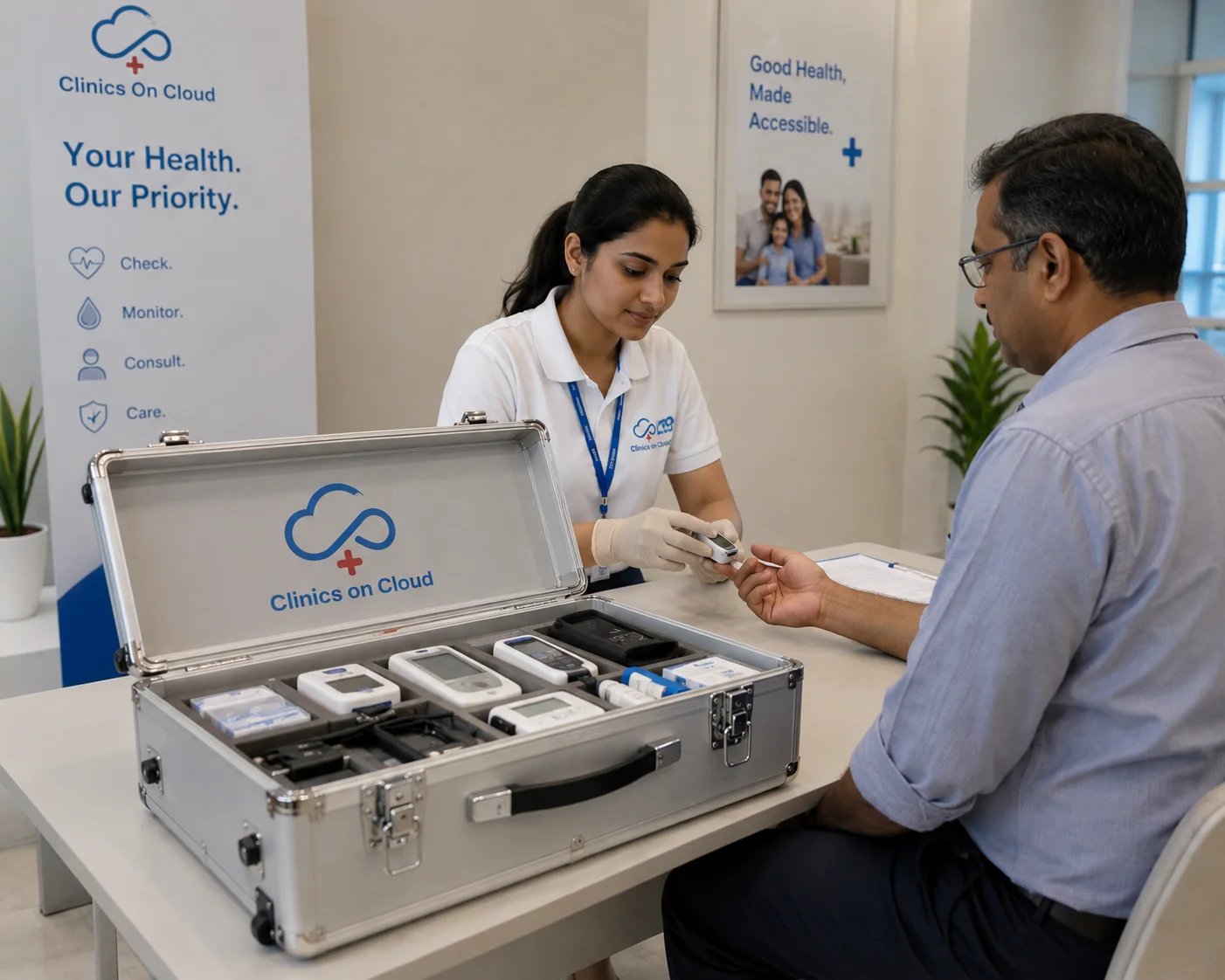
Door to door health screening reaches the people a stationed vehicle never sees: the elderly, the immobile, primary caregivers and anyone who cannot leave a worksite. A vehicle alone does not do it. A vehicle plus a portable kit does.
The practical model is a hub and spoke on the same day. The unit parks at a village centre and runs the queue. A health worker carries a portable Box Clinic to households on a list drawn up in advance, screens them at the doorstep, and syncs the records to the same platform. One programme, one record set, two levels of reach.
What doorstep screening delivers well: general health and vital parameters, blood pressure, random blood sugar, SpO2, and a structured record that a doctor can review by teleconsultation. What it does not deliver is throughput. Doorstep work is one patient at a time and travel-heavy, so treat it as targeted coverage rather than as volume.
Build the household list from a real source, not from walking a lane. Anganwadi registers, self-help group lists and panchayat records identify the people who most need a doorstep visit. Screening results are indicative and are not a diagnosis, so every flagged doorstep result needs the same referral pathway as a result generated inside the unit.
The trade-offs nobody puts in the brochure
Every MMU decision trades one desirable property against another. Naming them early prevents an argument in year two.
Trade-off
What you gain
What you give up
How to resolve it
Throughput versus terrain access
More screenings per day in a larger body
Stops that a larger body cannot reach
Buy for the worst stop you refuse to drop
Equipment load versus power
Broader clinical capability
Battery endurance, generator run time, fuel
Require a written load calculation before ordering
Equipment load versus mobility
Heavier diagnostics on board
Vehicle class, ground clearance, route options
Split heavy diagnostics to a fixed referral site
Privacy versus capacity
Dignity, and honest mental health screening
Floor area available for the queue
Use the awning for the queue, the cabin for privacy
Parameter breadth versus follow-up
More conditions detected
Follow-up capacity per flagged patient
Configure narrow, follow up completely
Route length versus frequency
More settlements covered
Visit frequency at each one
Shorter list, served reliably, beats a longer erratic one
On-board clinician versus screening-led
Immediate clinical depth
The largest recurring cost line in the programme
Run a clinician on selected route days only
The most expensive of these is the last row but one. A unit that flags more conditions than the referral system can absorb generates unmet need rather than health value, which is argued in full on why India needs healthcare on wheels.
How do you size a fleet against a route plan?
Size the fleet from the route plan backwards, never from the population figure forwards. Population divided by screenings per day is a number that will not survive the first monsoon.
Work through it in this order:
List the settlements you have committed to cover, with their populations.
Set the visit frequency each one needs. Maternal health and diabetes follow-up need short cycles. General screening tolerates longer ones.
Cluster stops geographically so travel time is a small share of the working day. Two unhurried stops usually beat four rushed ones.
Build a realistic operating calendar. Subtract weather, festivals, elections, maintenance and staff leave before you count days, not after.
Apply an honest daily screening rate. A 10-minute checkup is not ten minutes per patient once registration, queueing and reporting are counted.
Divide the committed workload by what one unit achieves in that calendar. Round up, then check the answer against your referral capacity.
Test the plan against the worst stop for every unit class you are considering.
Two rules keep fleets honest. The first: a second unit is cheaper than a first unit that never gets serviced, so plan for downtime before you plan for growth. The second: a fixed station at your highest-footfall site will usually out-screen a marginal additional vehicle, so run that comparison before adding to the fleet.
When is the best mobile medical unit not a unit at all?
Four situations argue against buying a vehicle, and a supplier who will not tell you so is not a good supplier.
When the population already gathers. If people come to a PHC, a factory gate, a campus or a panchayat office anyway, a fixed Health ATM screens every working day at a far lower cost per screening.
When only capital funding exists. A funded vehicle with an unfunded route is a parked asset. Recurring cost dominates the five-year picture, as set out on MMU specifications, cost structure and RFP checklist.
When the referral system is already saturated. Detection that outruns treatment capacity produces frustration, not outcomes.
When terrain defeats every vehicle. A portable kit carried by a health worker is the honest answer, and it costs less.
A Mobile Medical Unit screens and flags. It does not diagnose, treat, cure or prevent disease, and it is not an emergency service. Read what a Mobile Medical Unit is and how one is configured before committing to a format.
Talk to the team
For a route survey, a format recommendation or a configuration quote, call +91 8999 073 447 (Mon–Sat, 9:00–18:00 IST) or email sales@clinicsoncloud.com.
Clinics On Cloud is a brand of SehatPro Technologies Pvt Ltd, Nighoje, Chakan MIDC, Pune, Maharashtra 410501, India.
“
Clinics On Cloud provides preventive health screening and is not a diagnostic laboratory. Screening results are indicative and are not a diagnosis. Always consult a qualified physician before acting on any health information.
Health Lounge and Health Pod
mobile-unitMobile Medical UnitsDeep Dive
Join the conversation
Leave a comment.
Add your comment
Your email is never published. Comments appear after a quick review.
65% of India lives beyond easy reach of a clinic. The case for putting diagnostics, teleconsults and screening into vehicles that go to the patient - not the other way around.
A clinic on wheels that drives to the village instead of waiting for it. What goes inside an MMU, who staffs it, what it can test, and what a camp day actually looks like.
There is no single best mobile medical unit in India. The best unit is the smallest one that reaches every stop on your route while carrying the parameter set your population needs. Match access first, clinical purpose second and throughput third. Clinics On Cloud builds van, bus and coach formats on one platform so a programme can mix them.
What types of mobile medical unit are available?
Four formats cover most Indian programmes: a compact van conversion for terrain-constrained routes, a mid-size bus or truck body build as the common district and CSR class, a large coach for high-throughput camps and industrial sites, and a portable Box Clinic paired with a light vehicle for doorstep and last-mile screening. Fixed stations remain the cheapest option where people already gather.
How much does a mobile medical unit cost in India?
Clinics On Cloud does not publish a single MMU price, because vehicle class, fit-out, parameter set, optional diagnostics, power system and software scope each move the figure substantially. Pricing varies by configuration. Request a scoped written quotation on +91 8999 073 447 or sales@clinicsoncloud.com, and ask for five-year total cost of ownership rather than a unit price.
Which mobile medical unit is best for rural and tribal areas?
A compact van conversion, or a portable Box Clinic carried the final stretch on foot. Prioritise access over throughput, specify offline capture with generous local storage and dual-carrier connectivity, and plan longer travel time between stops. Where no vehicle can reach a hamlet, a health worker with a portable kit is the correct configuration rather than a larger van.
Can a mobile medical unit do door to door health screening?
Yes, in a hub and spoke model. The unit parks at a village centre and runs the queue while a health worker carries a portable Box Clinic to households on a pre-drawn list, syncing records to the same platform. Doorstep work reaches the elderly and immobile but delivers low throughput, so treat it as targeted coverage.
How do I buy a mobile medical unit configured for my programme?
Start with a physical route survey in your operating season, then a specification workshop covering parameter set, staffing model, referral pathway and five-year operating budget. Clinics On Cloud scopes vehicle class and fit-out against that brief and supports tender documentation. Call +91 8999 073 447 or email sales@clinicsoncloud.com to begin.
How many mobile medical units does a district programme need?
Size the fleet from the route plan backwards, not from the population figure forwards. List committed settlements, set visit frequency, cluster stops geographically, subtract weather and maintenance days from the calendar, apply an honest daily screening rate, then round up and check the answer against your referral capacity rather than your screening capacity.
Is a bigger mobile medical unit always better?
No. A larger body buys throughput you may not be able to deploy, and it removes stops from the route it cannot reach. The binding rule is to buy the largest unit that still clears the worst stop you refuse to drop. Heavier diagnostics also increase weight, power draw and body length together.
What is the delivery lead time for a configured mobile medical unit?
Lead time depends on chassis availability, fit-out scope, the diagnostics specified and state registration formalities. Optional diagnostics such as X-ray or a biochemistry analyser extend the schedule most. Clinics On Cloud confirms an indicative delivery window at specification stage, so include it in your programme timeline before committing to a launch date.
Get In Touch
Healthcare is a right. Not a privilege.
We started Clinics on Cloud with a simple belief - that the quality of your healthcare should not depend on your postcode. Whether you're a government, corporate, NGO or entrepreneur - we built this for you.
Call us
+91 8999 073 447
Mon - Sat · 9 AM to 6 PM IST
Write to us
sales@clinicsoncloud.com
Partnerships · Deployments · Support
Visit us online
www.clinicsoncloud.com
Products · Case Studies · News
Find us
Nighoje, Chakan MIDC
Pune, Maharashtra - 410501, India
Built for every kind of health partner.
Government Body Corporate / HR Team NGO / CSR Partner Hospital or Clinic Defence Organisation International Partner Investor / Distributor Rural Entrepreneur
 Entry · MM-63Mobile Medical Units