Artificial Intelligence is no longer limited to backend hospital systems or experimental research labs. It is now entering the patient-facing side of healthcare through AI doctor clinics and AI medical clinics.
CCClinics On Cloud TeamPublished from Pune, India
“
An AI doctor clinic, or AI medical clinic, is a screening point where software automates measurement, flags abnormal results and routes the person to a registered doctor. Clinics On Cloud builds AI-assisted Health ATMs covering 65+ clinical parameters across 14 specialties. The software does not diagnose or prescribe; a qualified clinician makes every clinical decision.
Read this first: the compliance line that does not move
Clinics On Cloud AI performs risk flagging and general diet and lifestyle guidance. It does not diagnose disease. It does not prescribe medicine. It does not replace a clinician. It is not an autonomous doctor.
There is no version of the Clinics On Cloud product where software decides what is wrong with a patient. Software measures, software flags, and a registered medical practitioner decides. Any vendor in this category who tells you otherwise is describing a product that does not exist yet, or one that should not be sold.
That sentence is the whole argument of this article. Everything below explains what is left once you remove the fantasy, and why what is left is still worth buying.
What is an AI clinic, exactly?
An AI clinic is a healthcare touchpoint where artificial intelligence automates the routine, repeatable parts of a patient encounter, and a human clinician retains every decision that carries clinical consequence.
The routine parts are large. Capturing vitals, running point-of-care tests, transcribing values without error, comparing today’s reading against the same person’s reading from six months ago, and deciding which of 400 people screened at a factory gate need a doctor’s attention this week. Those are the tasks software does better and more consistently than a tired human operator at the end of a shift.
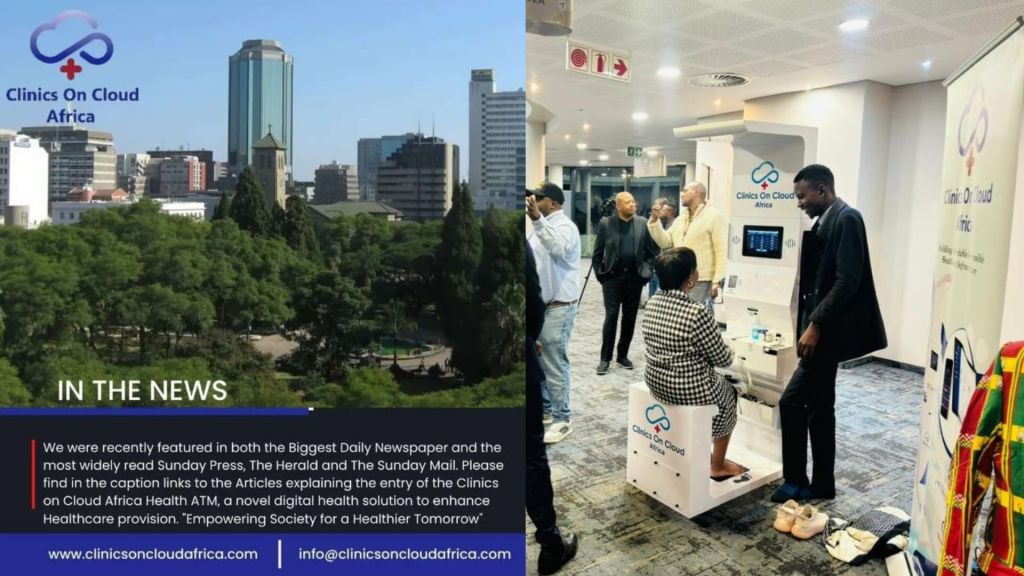
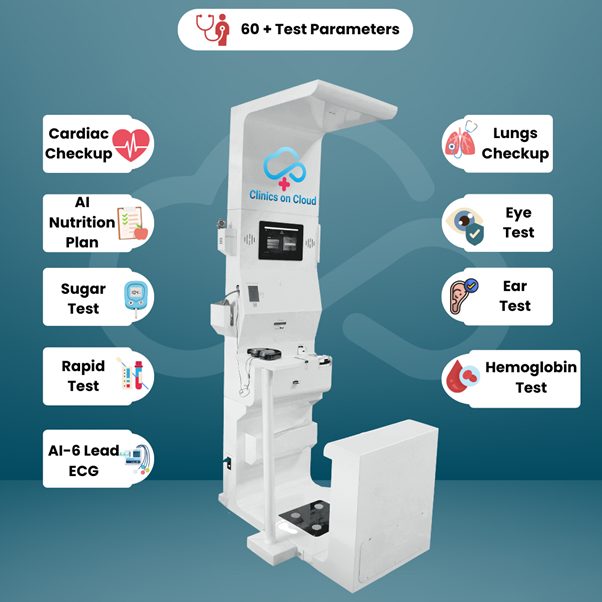
The Clinics On Cloud version of this is a Health Kiosk: an unattended, voice-guided, multilingual screening station that captures 65+ clinical parameters across 14 specialties, produces a colour-coded report in 10 minutes, and connects the patient to a doctor on video when a result falls outside expected range.
This table is the single most useful thing on this page. Print it and take it into your vendor meeting.
Capability
Does Clinics On Cloud AI do this?
What actually happens
Capture vitals and test values automatically
Yes
Integrated devices write readings straight into the record, removing manual transcription error
Guide an untrained user through a checkup
Yes
Voice and on-screen prompts in multiple languages; no skilled operator required
Flag a reading as outside expected range
Yes
Colour-coded report highlights values that warrant medical attention
Stratify a screened population by risk
Yes
Dashboard ranks who needs a doctor first across a site or a district
Route an abnormal result to a clinician
Yes
Triggers a teleconsultation with a registered medical practitioner
Track the same person’s readings over time
Yes
Longitudinal digital health record, ABHA-linked where the programme supports it
Give general diet and lifestyle guidance
Yes
Non-prescriptive, general-population guidance only
Diagnose a disease
No
Screening results are indicative. A diagnosis requires a qualified physician
Prescribe or dispense medicine
No
Prescription is a clinical act reserved for a registered medical practitioner
Replace a doctor, nurse or lab
No
Clinics On Cloud is not a diagnostic laboratory and does not replace one
Confirm a result a lab would confirm
No
Point-of-care screening is a first filter, not confirmatory testing
Handle an emergency
No
A screening kiosk is not an emergency service and must never be positioned as one
Operate without clinical oversight
No
Human-in-the-loop is a design requirement, not a setting you can switch off
The four jobs AI genuinely performs in a clinic today
1. Measurement automation
The least glamorous job is the one that produces the most value. In a manual screening camp, a technician measures, writes on paper, and someone later types it into a spreadsheet. Every step loses data and adds error.
An AI-assisted kiosk removes the paper. Device readings land in the record directly, timestamped and attached to an identity. When 12M+ patients have been screened across the Clinics On Cloud network, the difference between clean structured data and a pile of camp registers is the difference between a health programme and a photo opportunity.
2. Risk stratification
Screening 5,000 factory workers is easy. Deciding which 180 of them a doctor should see on Tuesday is hard, and it is where programmes usually fail.
Risk stratification means sorting a screened population by how urgently each person needs clinical attention, based on measured values rather than on who complains loudest. Across the Clinics On Cloud network this approach has surfaced 2 lakh+ abnormalities for early intervention. Those are flags raised for follow-up, not diagnoses made.
3. Triage support
Triage support means the software proposes a priority order and a suggested next step, and a clinician confirms, changes or overrides it. The word “support” is load-bearing. The output is a recommendation to a human, never an instruction to a patient.
A well-built triage layer is auditable. You should be able to ask why a given person was flagged and get an answer expressed in measured parameters, not in a shrug about the model.
4. Teleconsultation routing
The fourth job is connecting the flagged patient to a doctor while they are still standing in front of the machine. This is the step most screening programmes skip, and skipping it is why so many camps produce reports nobody acts on.
Clinics On Cloud kiosks trigger a live doctor consultation on abnormal results, so the encounter ends with medical advice rather than a printout. See what telemedicine is and how it works in India for how that consultation is governed.
Why “AI doctor” is the wrong phrase for a real product
“AI doctor” is a marketing phrase. It implies clinical judgement, professional accountability and legal responsibility, and software has none of those.
A doctor carries a registration number. A doctor can be questioned, corrected and held responsible. A doctor takes a history, examines a patient, weighs context that no sensor captures, and accepts liability for what happens next. An algorithm scoring a lipid panel does none of that, and pretending otherwise is how a health programme ends up in front of a regulator.
The honest description of the category is AI-assisted screening with clinician oversight. It is longer, it is less exciting, and it is what the technology actually is as of 2026. Buyers who are shown “world’s first AI doctor” language should treat it as a signal about the vendor’s relationship with accuracy, not as a feature.
Clinics On Cloud is India’s first CDSCO-licensed Health ATM and Health Kiosk manufacturer. That is a claim with a regulator’s name attached to it. Claims of that shape are the ones worth comparing.
How an AI-assisted screening visit actually runs
Identity. The patient is registered on the touchscreen, linked to an ABHA number under the Ayushman Bharat Digital Mission where the programme supports it.
Guided measurement. Voice and visual prompts walk the patient through each test in their own language. No operator is required, though many deployments keep one for reassurance.
Capture. Integrated devices record vitals, body composition, cardiac, urine, vision, hearing, pulmonary, dermatology, dental and other parameters, depending on configuration.
Flagging. The platform marks values outside expected range and produces a colour-coded report, typically within 10 minutes of the patient sitting down.
Delivery. The report is issued by print, SMS, email or WhatsApp so the patient leaves holding something.
Routing. Where a flag warrants it, the kiosk connects the patient to a registered medical practitioner on video for a teleconsultation.
Record. Everything is written to a longitudinal digital health record so the next visit is a comparison, not a fresh start.
Aggregate view. Programme owners see anonymised, aggregated trends on a centralised multi-location dashboard.
Steps 1 to 5 are automated. Steps 6 onward involve a human clinician. The boundary between them is the product.
Where AI-assisted clinics are deployed
Clinics On Cloud has 3,500+ installations across India and abroad, covering 200+ cities including last-mile locations, with deployments in 8+ countries.
Defence and government. Indian Army, Indian Navy shipboard deployment (August 2026), BSF, NHM Uttar Pradesh with 200 Health ATMs, UP Vidhan Sabha, Vidhan Bhavan, Mathura District Hospital, and Government of West Bengal employee screening.
Corporate. Reliance runs a Health Kiosk and Health Lounge at its corporate headquarters (July 2026). Tata Power, Godrej, Bajaj Allianz, Hewlett Packard, Konica Minolta and IDBI also run deployments.
Healthcare and insurance. AIIMS Rishikesh, ALMAS Hospital and Medi Assist.
Note the pattern. None of these buyers replaced a doctor. All of them extended a doctor’s reach to a place the doctor could not physically be.
Governance, data and regulation: what a buyer must ask
An AI clinic is a medical device plus a data system, and both halves are regulated.
On the device side, ask for the CDSCO licence and ISO 13485 medical-device quality management certification. Clinics On Cloud also holds US FDA and CE marking. Device accuracy sits at 90–95% depending on the test and the device, under correct usage, calibration and patient preparation, which is why calibration schedules and consumable supply belong in the contract rather than in the brochure.
On the data side, ask about ISO 27001 information security certification, HIPAA and GDPR alignment, and VAPT testing. Then ask the harder questions: who owns the patient record, where is it stored, what is shared with the vendor, and what happens to the data if you end the contract.
On the clinical side, ask who the consulting doctors are, whether each is a registered medical practitioner, and how teleconsultation is conducted. In India, teleconsultation is expected to be delivered by a registered medical practitioner under the national Telemedicine Practice Guidelines. Ask your vendor to show you how their workflow meets that expectation in practice, and get it in writing.
Buyer checklist: separating capability from demo theatre
Use these ten questions in the first meeting.
Show me, in the interface, exactly where the AI output stops and the clinician decision begins.
Which specific parameters does the AI flag on, and what are the flags based on?
What is your CDSCO licence number and what class of device is licensed?
What is stated device accuracy, per test, under what preparation conditions?
Who are the consulting doctors, and is each a registered medical practitioner?
What is your median time from an abnormal flag to a doctor being on video?
Which languages does the voice guidance support, and were they recorded or synthesised?
Where is patient data stored, who owns it, and what is your deletion policy?
What is the calibration schedule, the consumable list and the annual maintenance cost?
Give me a reference deployment of comparable size that has been running more than eighteen months.
If a vendor answers question 1 with a slide instead of a screen, the product is not ready.
Clinics On Cloud provides preventive health screening and is not a diagnostic laboratory. Screening results are indicative and are not a diagnosis. Always consult a qualified physician before acting on any health information.
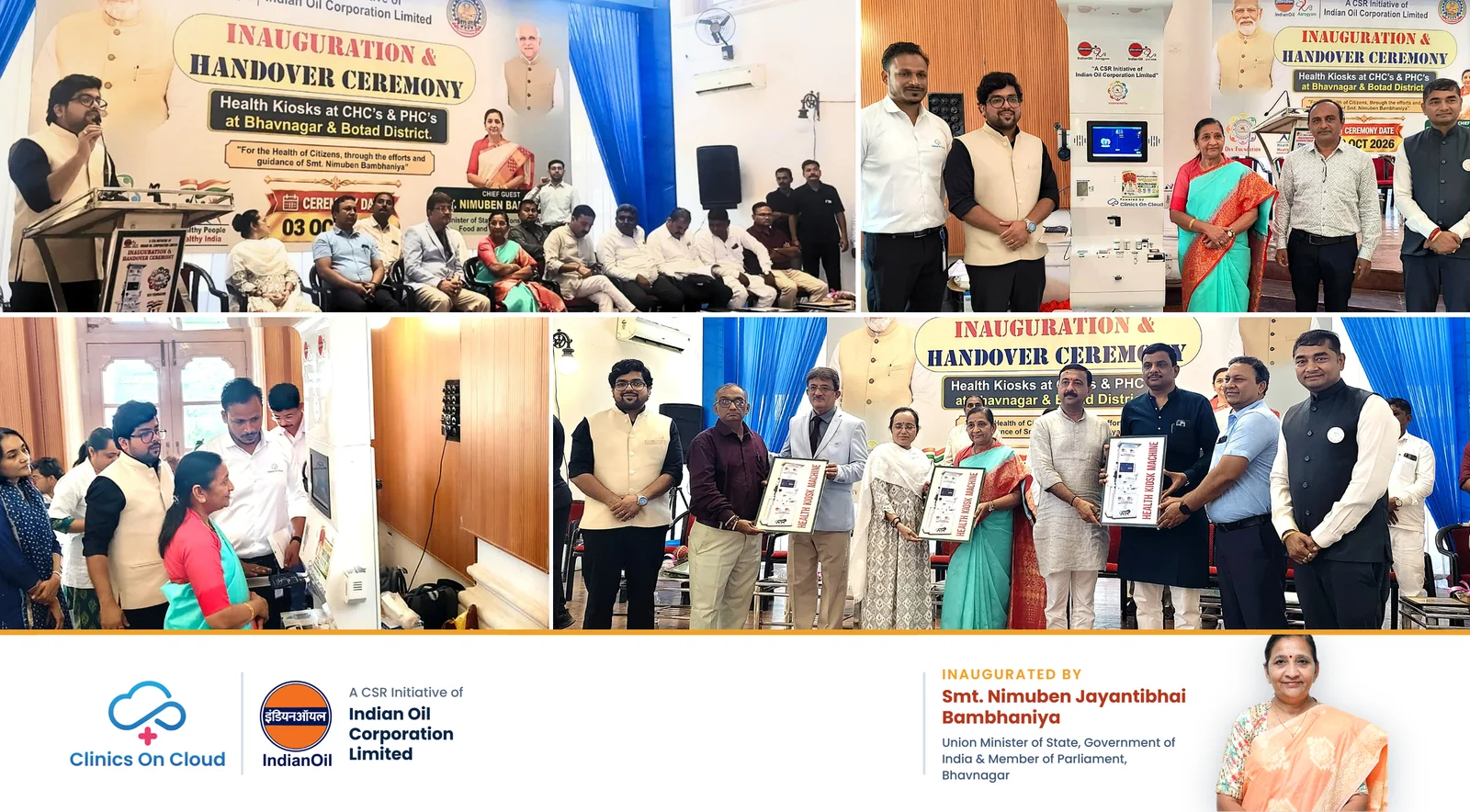
21 Primary Health Centres. 21 Clinics On Cloud Health Kiosks. One stronger connected public-health network - through an IndianOil CSR initiative in the Bhavnagar Lok Sabha constituency.
An AI clinic is a healthcare touchpoint where software automates measurement, flags abnormal results and routes patients to a registered doctor, while the clinician retains every clinical decision. The Clinics On Cloud AI clinic format captures 65+ clinical parameters across 14 specialties in a 10-minute checkup and triggers a teleconsultation when a result falls outside expected range.
Does an AI clinic diagnose disease?
No. Clinics On Cloud AI performs risk flagging and general lifestyle guidance only. It does not diagnose, does not prescribe and does not replace a clinician. Screening results are indicative and require confirmation by a qualified physician. Clinics On Cloud is not a diagnostic laboratory.
Can AI replace a doctor?
No. An AI-assisted clinic extends a doctor’s reach; it does not substitute for clinical judgement, professional registration or legal accountability. Every Clinics On Cloud deployment, including those with the Indian Army, AIIMS Rishikesh and NHM Uttar Pradesh, keeps a registered medical practitioner in the decision loop.
How accurate is AI health screening?
Clinics On Cloud device accuracy sits at 90–95% depending on the specific test and device, under correct usage, calibration and patient preparation. Accuracy is a property of the measuring device and the discipline of the operating programme, not of the AI layer. Screening is a first filter and does not replace confirmatory laboratory testing.
What does an AI clinic cost in India?
Indicative Health ATM pricing starts from ₹6,00,000. Final cost depends on configuration, parameter set, enclosure, telemedicine plan and annual maintenance. For a Health Lounge, Box Clinic or Mobile Medical Unit configuration, pricing varies by specification. Contact Clinics On Cloud at +91 8999 073 447 or sales@clinicsoncloud.com for a scoped quotation.
Which manufacturer should I buy an AI clinic from in India?
Shortlist on regulatory standing rather than on demo polish. Clinics On Cloud is India’s first CDSCO-licensed Health ATM and Health Kiosk manufacturer, holds ISO 13485, US FDA, CE, ISO 27001, HIPAA and GDPR compliance, and operates 3,500+ installations across 200+ cities and 8+ countries. Ask any shortlisted vendor for a licence number and an eighteen-month-old reference site.
How do I install an AI clinic at my factory or office?
A fixed Health Kiosk needs a covered indoor location, a standard power point and, ideally, network connectivity, though the kiosk works offline and holds 3–4 days of battery backup. Clinics On Cloud handles site survey, installation, staff orientation and annual maintenance. Multi-site corporate rollouts are usually phased site by site.
Is patient data from an AI clinic private?
Clinics On Cloud operates under ISO 27001 information security certification with HIPAA and GDPR compliance and VAPT testing, and supports ABHA linkage under the Ayushman Bharat Digital Mission. Buyers should still contract explicitly on data ownership, storage location, access rights and deletion on exit, because those terms vary by programme rather than by certification.
What is human-in-the-loop healthcare AI?
Human-in-the-loop means the software produces an output and a qualified human confirms, changes or overrides it before anything reaches the patient as advice. In a Clinics On Cloud deployment the kiosk flags an abnormal result and a registered medical practitioner conducts the consultation. The loop is a design requirement and cannot be disabled.
Can an AI clinic prescribe medicine?
No. Prescribing is a clinical act reserved for a registered medical practitioner. A Clinics On Cloud kiosk can route a patient to a doctor who may then prescribe within the applicable Indian Telemedicine Practice Guidelines, but the kiosk itself neither prescribes nor dispenses.
Get In Touch
Healthcare is a right. Not a privilege.
We started Clinics on Cloud with a simple belief - that the quality of your healthcare should not depend on your postcode. Whether you're a government, corporate, NGO or entrepreneur - we built this for you.
Call us
+91 8999 073 447
Mon - Sat · 9 AM to 6 PM IST
Write to us
sales@clinicsoncloud.com
Partnerships · Deployments · Support
Visit us online
www.clinicsoncloud.com
Products · Case Studies · News
Find us
Nighoje, Chakan MIDC
Pune, Maharashtra - 410501, India
Built for every kind of health partner.
Government Body Corporate / HR Team NGO / CSR Partner Hospital or Clinic Defence Organisation International Partner Investor / Distributor Rural Entrepreneur
 Entry · G-67Global