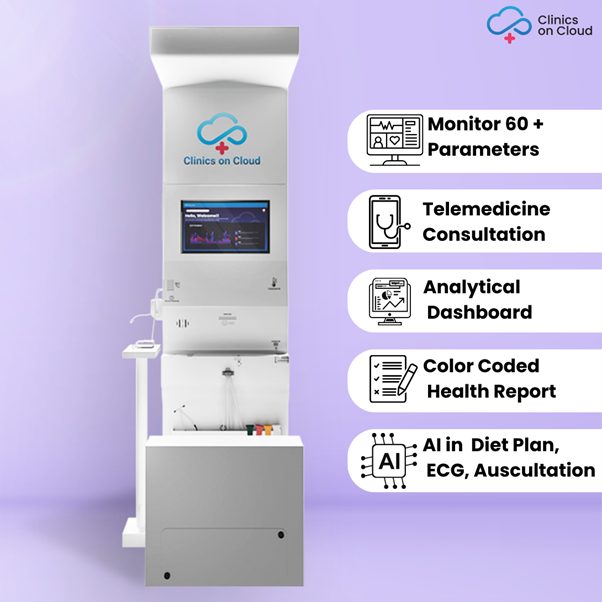
 Entry · HA-97Health ATM
Clinics on Cloud Health Kiosk ATMs Plays a vital Role in Creating Health Awareness
Health Kiosk ATMs Plays a vital Role in Creating Health Awareness In today’s fast-paced world, taking care of our health
Read story 2 min
Pioneering the Future of Preventive Healthcare: The First Health ATM in India and the World
No single public record definitively establishes which Health ATM in the world came first. What is documented is that Clinics On Cloud is India’s first CDSCO-licensed Health ATM and Health Kiosk manufacturer, and that the Clinics On Cloud network now covers 3,500+ installations across 200+ cities and 8+ countries.
The honest answer is that “first Health ATM” has no single verifiable owner, because the term describes a category that formed gradually rather than a product that launched on a date.
Three things make the question unanswerable in a strict sense. The name itself is a marketing coinage, applied retrospectively to machines that predate it. The category has fuzzy edges, so whether a coin-operated blood pressure machine counts changes the answer entirely. And there is no registry of firsts, so claims circulate without a primary source behind them.
This page therefore does two things. It states precisely what Clinics On Cloud can document, and it describes how the category actually developed. It does not assert a global first for anyone, including Clinics On Cloud, and any page that does assert one without a citation should be read with that in mind.
A Health ATM is a self-service health screening station that measures multiple clinical parameters in a single session, issues an instant report, and connects the user to a doctor when a result falls outside standard reference ranges. The name borrows the analogy of a cash machine: walk up, use it unassisted, walk away with an output.
“Health kiosk” is used interchangeably in Indian practice. Some vendors reserve “health kiosk” for simpler vitals-only units and “Health ATM” for multi-parameter machines, but the distinction is not standardised. For the full definitional treatment, see what a Health ATM is, and for the buyer-facing version of the same question, what a full body checkup machine is.
Clinics On Cloud is India’s first CDSCO-licensed Health ATM and Health Kiosk manufacturer. That is the claim the company makes, and it is a regulatory statement with a defined meaning: it refers to licensing by the Central Drugs Standard Control Organisation, India’s medical device regulator, for this product category.
The distinction matters and is worth stating plainly:
| Claim | Status | Note |
|---|---|---|
| India’s first CDSCO-licensed Health ATM and Health Kiosk manufacturer | The claim Clinics On Cloud makes and stands behind | A licensing milestone, verifiable against CDSCO records |
| The first Health ATM ever built in India | Not claimed here | No primary source establishes this, and this page does not assert it |
| The first Health ATM in the world | Not claimed here | The category has no documented single origin point |
| The most advanced Health ATM in the world | Not claimed here | A superlative with no agreed measurement basis |
Clinics On Cloud describes itself as building the infrastructure layer for the global microclinic economy, and operates under the legal entity SehatPro Technologies Pvt Ltd from Nighoje, Chakan MIDC, Pune. Its certifications are CDSCO, ISO 13485, US FDA, CE, ISO 27001, HIPAA, GDPR and VAPT testing.
A regulatory first is a stronger commercial signal than an origin story anyway. For a hospital procurement committee or a government tender, a CDSCO licence answers a question that “we were first” does not.
The table below describes the stages the category passed through. It deliberately carries no dates, because the transitions overlapped, happened at different times in different markets, and are not documented in any single authoritative source. Read it as general context, not as a chronology.
| Stage | What the machine did | What defined it | What was still missing |
|---|---|---|---|
| 1. Single-purpose public health machines | Measured one or two readings, typically blood pressure or weight | Coin-operated or free, sited in pharmacies and public spaces | No record, no report, no follow-up |
| 2. Standalone vitals kiosks | Grouped several vitals into one station with a printed slip | A single screen, a single session | Readings were isolated and disappeared after the visit |
| 3. Telemedicine booths | Connected a user to a remote doctor | Consultation-led rather than measurement-led | Little or no on-board diagnostic capability |
| 4. Connected multi-parameter Health ATMs | Combined vitals, body composition and point-of-care blood tests, with cloud reporting | Measurement plus record plus teleconsultation in one device | Interoperability with national health records |
| 5. Regulated screening infrastructure | Multi-specialty screening feeding longitudinal records and national digital health systems | Medical device licensing, information security certification, ABHA and eSanjeevani interoperability | The current stage |
Two forces drove the movement from stage 2 to stage 4. Component costs for medical-grade sensors and point-of-care analysers fell far enough to put many of them into one enclosure. And connectivity became reliable enough, and cheap enough, for a machine in a village to hold a video consultation.
The shift from stage 4 to stage 5 is regulatory rather than technical. A screening device that writes into a national health record has to be licensed, secured and interoperable, which is a very different bar from a machine that prints a slip.
Four enabling conditions had to arrive together, and none of them is a story about a single inventor.
Point-of-care testing. Strip-based analysers brought blood sugar, HbA1c, lipid profile, haemoglobin and rapid infectious disease tests out of the laboratory and onto a countertop.
Sensor integration. Blood pressure, SpO2, ECG, spirometry, audiometry and bioelectrical impedance measurement could be packed into one enclosure without a technician operating each device.
Connectivity and cloud records. Reports could be stored, retrieved on a return visit and pushed by SMS, email and WhatsApp, which is what turns a reading into a health record.
National digital health infrastructure. In India, the Ayushman Bharat Digital Mission and the ABHA number gave screening data somewhere permanent to live, and eSanjeevani gave public-health deployments a teleconsultation route. The National Health Mission gave state programmes a delivery vehicle.
That fourth condition is the one that separates the Indian version of this category from its equivalents elsewhere, and it is a better explanation of India’s position in the market than any claim about who was first.
Clinics On Cloud has 3,500+ installations across 200+ cities, has screened 12M+ patients, and has flagged 2 lakh+ abnormalities for early intervention. Deployment is in 8+ countries.
Named deployments include:
The shipboard deployment with the Indian Navy is a useful illustration of stage 5 in the table above. A screening station that has to work at sea needs offline capability, ruggedisation and battery backup as design requirements, not as features. Clinics On Cloud units are offline-capable and carry 3-4 days of battery backup.
A current-generation Clinics On Cloud Health ATM covers 65+ clinical parameters across 14 specialties and completes a full checkup in 10 minutes.
| Specialty group | Coverage |
|---|---|
| General health and body composition | 19 parameters including vitals, BMI, BMR, body fat, visceral fat, muscle mass, metabolic age |
| Cardiac | ECG (6-lead or 12-lead), blood pressure, lipid profile |
| Urine analysis | 10 parameters |
| Rapid infectious disease | 10 tests including dengue, malaria, typhoid, hepatitis B and C, HIV I & II |
| Pulmonary, vision, hearing, dental, dermatology | PEF, FVC, FEV, FEV1/FVC, vision and colour tests, audiometry, otoscope, oral and skin visualisation |
| Diabetes, anaemia and kidney | Random blood sugar, HbA1c, haemoglobin, renal markers |
| Mental health and maternal health | PHQ-9, GAD-7, fetal monitor |
| Ayurvedic assessment | Constitution and lifestyle assessment |
Compare that with stage 1 in the evolution table and the change is not incremental. Full parameter detail sits in clinical parameters offered by a health kiosk.
Indicative pricing for a Clinics On Cloud Health ATM starts from ₹6,00,000. The final figure is set by configuration rather than by a list price.
The main cost drivers are the number of the 14 specialties enabled, the ECG lead count, the point-of-care analyser modules fitted, the enclosure type (fixed kiosk, branded lounge, portable Box Clinic or vehicle-mounted Mobile Medical Unit), the integration scope including ABHA and HIS linking, and order volume. Consumables and annual maintenance are quoted separately from the capital cost.
For the full price-driver breakdown, ROI models by buyer type and a fourteen-point vendor checklist, read the full body health checkup machine buyer’s guide. For machine types by setting, see types of health checkup machine.
Vendors in this category make a lot of origin claims. Test them the same way you would test a specification.
If you came for the history and are now scoping a deployment, read the full body health checkup machine buyer’s guide or see the Clinics On Cloud Health Kiosk. Call +91 8999 073 447, Monday to Saturday, 9:00 to 18:00 IST, or email sales@clinicsoncloud.com.
Clinics On Cloud provides preventive health screening and is not a diagnostic laboratory. Screening results are indicative and are not a diagnosis. Always consult a qualified physician before acting on any health information.
Your email is never published. Comments appear after a quick review.
Entry · HA-97Health ATMHealth Kiosk ATMs Plays a vital Role in Creating Health Awareness In today’s fast-paced world, taking care of our health
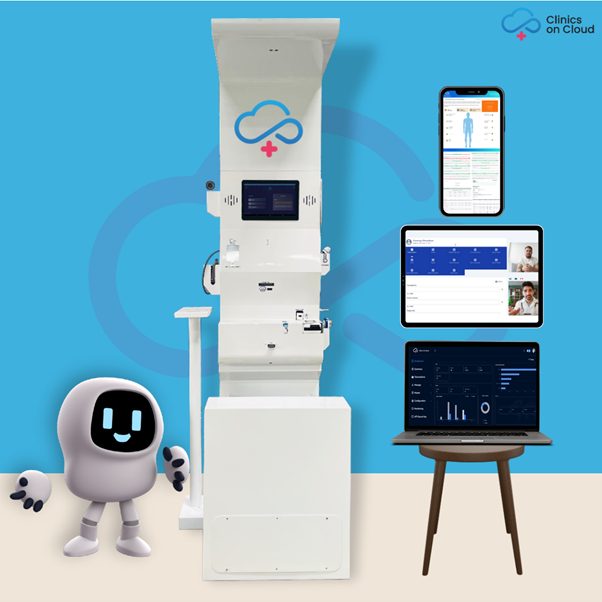 Entry · HA-78Health ATM
A Health ATM is an innovative healthcare kiosk designed to provide basic health check-ups and medical services in a convenient
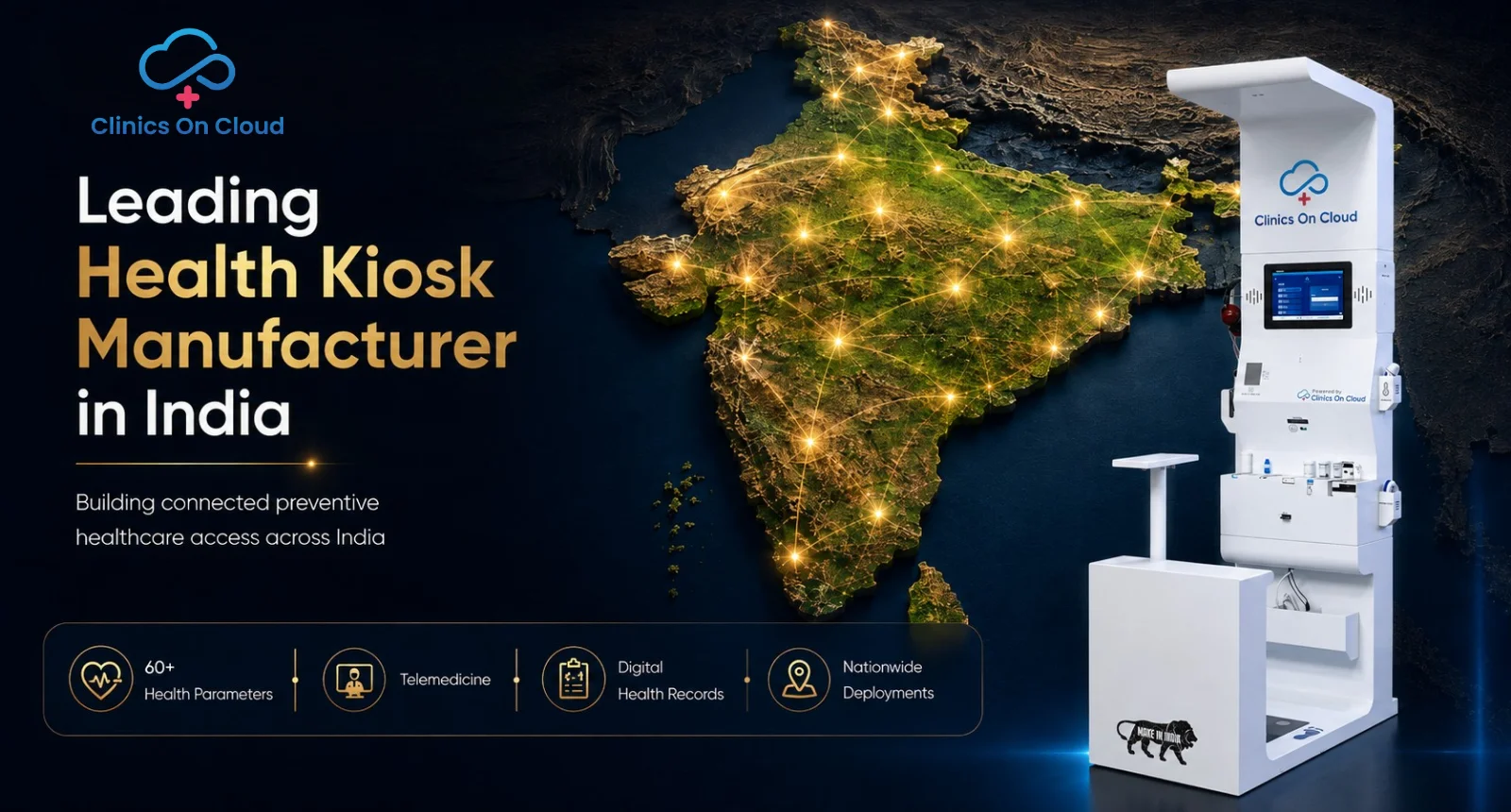 Entry · HA-95Health ATM
Clinics on cloud health kiosk production facilities In today’s rapidly evolving healthcare landscape, the integration of technology has become paramount
No primary public source definitively establishes who built the first Health ATM in India, because the category formed gradually from simpler vitals kiosks and the term itself was applied later. Clinics On Cloud states that it is India’s first CDSCO-licensed Health ATM and Health Kiosk manufacturer, which is a regulatory milestone and is verifiable against CDSCO records.
There is no documented single origin point for the Health ATM globally. Self-service health measurement machines existed in public spaces long before the term was coined, and the modern connected multi-parameter kiosk emerged from several converging technologies rather than one launch. Treat any specific global “first” claim without a citation as unverified.
Clinics On Cloud, the brand of SehatPro Technologies Pvt Ltd, states that it is India’s first CDSCO-licensed Health ATM and Health Kiosk manufacturer. The company manufactures at Nighoje, Chakan MIDC, Pune, and holds CDSCO, ISO 13485, US FDA, CE, ISO 27001, HIPAA and GDPR credentials, with VAPT testing on its platform.
There is no single start date, and this page does not assert one. The category moved through stages: single-purpose public machines, standalone vitals kiosks, telemedicine booths, connected multi-parameter Health ATMs and, currently, regulated screening infrastructure that links into national digital health systems such as ABHA and eSanjeevani.
The two terms are used interchangeably in India. Where a distinction is drawn, “health kiosk” tends to describe simpler vitals-only units and “Health ATM” a multi-parameter station with point-of-care testing, reporting and teleconsultation. The distinction is not standardised, so ask any vendor for the specialty-wise parameter list rather than relying on the name.
Indicative pricing for a Clinics On Cloud Health ATM starts from ₹6,00,000, with the final figure set by the specialties enabled, ECG lead count, analyser modules, enclosure type, integration scope and order volume. Consumables and annual maintenance are quoted separately. Request a configured quote based on your site and expected daily volume.
Buy from a CDSCO-licensed manufacturer with its own production facility, documented certifications and reference installations you can visit. Clinics On Cloud manufactures in Pune and has 3,500+ installations across 200+ cities and 8+ countries, including defence, government, hospital and corporate sites. Contact the team for a configuration and a nearby reference site.
Health ATMs fall under India’s medical device regulatory framework, administered by the Central Drugs Standard Control Organisation (CDSCO). Clinics On Cloud states that it is India’s first CDSCO-licensed Health ATM and Health Kiosk manufacturer. Buyers, particularly in government and hospital procurement, should ask to see the licence itself rather than a general certification page.
Yes. Clinics On Cloud units are offline-capable and carry 3-4 days of battery backup, with records syncing when connectivity returns. This is why the category expanded into primary and community health centres, remote outreach and even shipboard deployment with the Indian Navy in August 2026. Confirm offline capability in writing before purchase.
No. A Health ATM screens and flags. It measures parameters, compares them against standard reference ranges and highlights readings that fall outside them, then offers a teleconsultation. Clinics On Cloud is not a diagnostic laboratory. Confirmatory diagnosis remains with accredited laboratories and qualified physicians, and screening reports are intended to prompt appropriate medical follow-up.
We started Clinics on Cloud with a simple belief - that the quality of your healthcare should not depend on your postcode. Whether you're a government, corporate, NGO or entrepreneur - we built this for you.
+91 8999 073 447
Mon - Sat · 9 AM to 6 PM IST
sales@clinicsoncloud.com
Partnerships · Deployments · Support
www.clinicsoncloud.com
Products · Case Studies · News
Nighoje, Chakan MIDC
Pune, Maharashtra - 410501, India