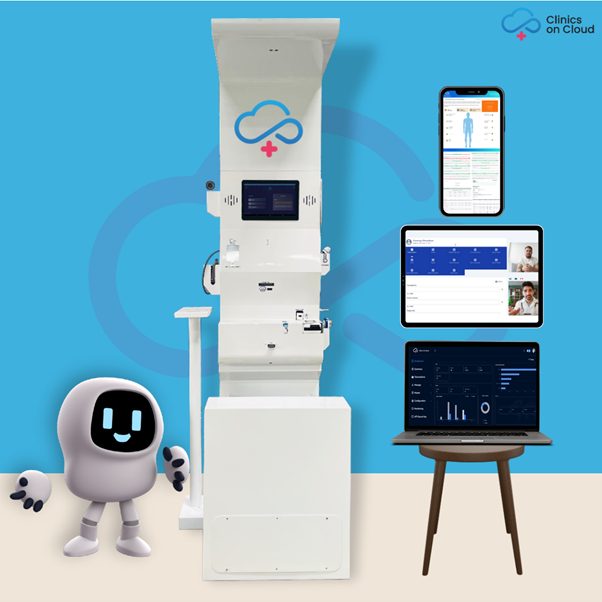
 Entry · HA-78Health ATM
Health KIOSK FAQ || Health ATM FAQ
A Health ATM is an innovative healthcare kiosk designed to provide basic health check-ups and medical services in a convenient
Read story 13 min
In today’s fast-paced world, taking care of our health often takes a backseat to busy schedules and competing priorities. But what if there was a way to monitor your health in just a few minutes, right in the middle of your daily errands? Clincs on Cloud health kiosk ATM is agroundbreaking innovation that’s making health monitoring more accessible than ever before. These self-service kiosks are de
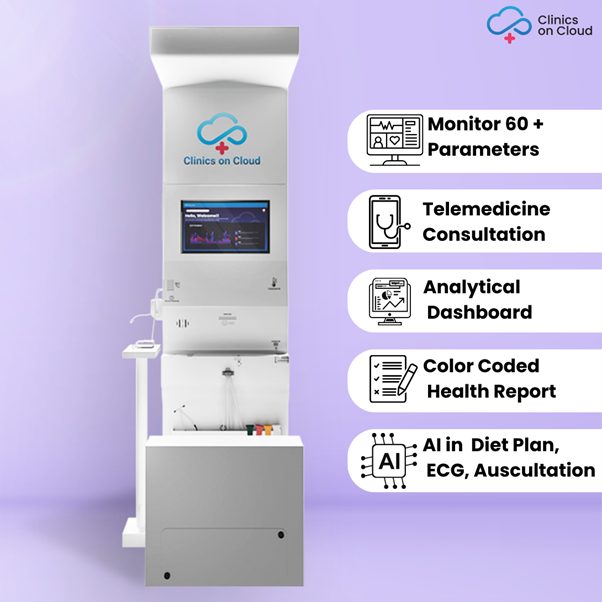
A health awareness campaign is a time-bound effort to change what a population knows and does about its health. Campaigns built on messaging alone change knowledge; campaigns built on measurement change behaviour, because a personal number is harder to dismiss than a general warning. Clinics On Cloud screens 65+ clinical parameters across 14 specialties at the campaign site.
A health awareness campaign is a time-bound programme intended to raise knowledge of a health issue and prompt action, typically around a calendar anchor such as World Health Day, World Diabetes Day or an employer’s annual wellness week. Most underperform because they are designed to be attended rather than to be acted on.
The standard Indian campaign format is familiar. Banners go up. A doctor speaks. Pamphlets are handed out. A register records attendance. The photographs are good, the attendance number is reported upward, and almost nothing measurable happens afterwards.
The reason is structural, not a failure of enthusiasm. Being told that hypertension is common does not tell you whether you have it, and general information invites a general response, which for most adults is agreement followed by inaction.
Adding measurement changes the transaction. The person does not leave with a message about a population. They leave with a set of numbers about themselves, an indication of which ones sit outside the usual range, and an instruction to see a physician about the ones that do.
People act on personal, specific and immediate information far more readily than on general, statistical and deferred information. A measured blood pressure reading with a red flag against it is personal, specific and immediate. A poster about hypertension is none of those things.
Three mechanisms are doing the work.
Specificity. “One in many adults has raised blood pressure” places the risk in a crowd. “Your reading today is flagged” places it in the room. The first invites the listener to assume they are in the healthy majority. The second removes that option.
Immediacy. Clinics On Cloud produces a colour-coded report at the end of a 10-minute session, delivered by print, SMS, email or WhatsApp. A result that arrives a week later has to compete with a week of ordinary life. A result that arrives while the person is still standing at the kiosk does not.
Legitimate surprise. A large share of the value in any screening drive comes from people who believed they were fine. Across the Clinics On Cloud network, 2 lakh+ abnormalities have been detected for early intervention out of 12M+ patients screened. Those are people who did not walk in with a complaint.
This is also why format matters more than message. A Health ATM that a person operates themselves, with voice guidance in their own language, produces a result the person feels ownership of. A result read out by a stranger with a clipboard does not land the same way.
One caution, stated plainly. Screening results are indicative, not diagnostic. A campaign that lets participants leave believing they have been diagnosed has done harm, whichever direction the result pointed.
Awareness raises knowledge. Screening produces individual measurements. A campaign can do either alone, but they achieve different things, and conflating them is the most common design error in Indian community and corporate health programmes.
| Dimension | Awareness-only campaign | Screening-led campaign |
|---|---|---|
| Output | Knowledge, recall, intent | Individual measured results, flagged abnormalities |
| Personalisation | None | Complete |
| Immediate action prompted | Weak | Direct, with a named next step |
| Cost per participant | Low | Higher, and justified by the abnormality yield |
| Follow-up requirement | Minimal | Mandatory; a flagged result without a pathway is a liability |
| Repeatability | Message fatigue sets in fast | Improves with repetition; a trend beats a data point |
| Risk if done badly | Ignored | Anxiety, false reassurance, unfollowed abnormalities |
The right conclusion is not that awareness campaigns are useless, but that awareness works best as the recruitment layer for screening and badly as the whole intervention.
A single screening event produces a data point. A programme that brings the same person back produces a trend, which is where clinical value and behaviour change actually sit. Repeat screening is a design outcome, not a matter of luck.
Six design choices drive repeat rates more than anything else.
Points four and six are underrated. People do not return to something that made them feel exposed, and they do not value a second reading that cannot be compared to the first.
Use this to choose a format before choosing a date. The most common mistake is booking the venue first.
| Campaign type | Best format | Typical audience | Parameter focus | Follow-up mechanism | Repeat cadence |
|---|---|---|---|---|---|
| Corporate wellness week | Health Lounge or fixed Health Kiosk in the lobby | Office employees | Blood pressure, lipids, blood glucose, HbA1c, BMI and body composition, ECG, PHQ-9 and GAD-7 | On-site teleconsultation plus panel physician referral | Quarterly |
| Factory or plant occupational drive | Fixed Health Kiosk at the gate or medical room | Shop-floor workers, contractors | Blood pressure, blood glucose, lung function, vision, hearing, body composition | Occupational health officer plus referral to panel hospital | Half-yearly, shift-wise |
| CSR community camp | Box Clinic | Village or urban low-income community | Blood pressure, blood glucose, anaemia, urine analysis, rapid infectious disease tests, vision | Referral to PHC or district hospital, ABHA-linked record | Quarterly, same site |
| School and college drive | Box Clinic or Mobile Medical Unit | Students, teaching and support staff | Vision, hearing, dental and oral screening, BMI and body composition, PHQ-9 and GAD-7 for older students | Letter to parents plus school medical officer referral | Annual, with a mid-year repeat for flagged students |
| RWA or housing society camp | Mobile Medical Unit or Box Clinic in the clubhouse | Residents, domestic staff, security staff, older adults | Blood pressure, blood glucose, ECG, lipids, vision, body composition | Local physician tie-up arranged before the camp | Quarterly |
| Public health day activation | Health Kiosk at a mall, station or municipal office | General public, high footfall | A short high-yield set: blood pressure, blood glucose, BMI, SpO2, pulse | Printed report with a clear “see a doctor” instruction, plus an on-site teleconsultation option | Anchored to a permanent installation |
| Insurance or hospital acquisition drive | Health Lounge or Health Kiosk | Prospective and existing members | Full 65+ parameter set | Hospital OPD referral with the record attached | Annual health check cycle |
Parameter selection should be deliberate rather than maximal. The 65+ clinical parameters a health kiosk screens are available in every configuration, but a mall activation with a 200-person queue and a factory shift screening are different problems, and running everything on everyone slows throughput without improving yield.
Awareness without a referral pathway achieves very little, and screening without one can be worse than doing nothing. Telling a person their blood glucose is flagged, in a place where the nearest physician is unaffordable or three hours away, transfers anxiety without transferring capability.
This is the honest limit of every campaign in this category, and it is the thing most campaign proposals skip.
Before a campaign is approved, four questions should have written answers.
Teleconsultation helps here without fully solving it. Clinics On Cloud kiosks escalate abnormal results to a live doctor consultation and integrate with eSanjeevani, which closes the gap between the result and a first clinical opinion. It does not close the gap between that opinion and sustained treatment, which remains a health-system question no manufacturer should claim to have solved. This is the same constraint that governs India’s structural health challenges more broadly: detection is the missing layer, but detection alone is not the outcome.
Attendance is the weakest metric in health campaign reporting and the most commonly reported. A campaign should be judged on abnormality yield, referral completion and repeat participation, all of which are harder to collect and all of which mean something.
Report these six.
Clinics On Cloud provides a centralised multi-location analytics dashboard covering coverage, abnormality rates and site-level performance, which makes the first, second and fifth of these routine rather than a manual exercise. Sponsor-facing reporting is aggregate and anonymised; how that boundary is enforced, and who can see campaign screening data, is worth settling before the first camp rather than after it.
For community campaigns run with frontline health workers, the mobilisation mechanics differ substantially and are covered in running a rural screening programme with ASHA and ANM workers.
To plan a campaign, Clinics On Cloud offers the Clinics On Cloud Health Kiosk for a permanent anchor point and the Box Clinic for outreach camps where no infrastructure exists. Clinics On Cloud is India’s first CDSCO-licensed Health ATM and Health Kiosk manufacturer, with 3,500+ installations across 200+ cities and 8+ countries. Call +91 8999 073 447 or email sales@clinicsoncloud.com.
Clinics On Cloud provides preventive health screening and is not a diagnostic laboratory. Screening results are indicative and are not a diagnosis. Always consult a qualified physician before acting on any health information.
Your email is never published. Comments appear after a quick review.
Entry · HA-78Health ATMA Health ATM is an innovative healthcare kiosk designed to provide basic health check-ups and medical services in a convenient
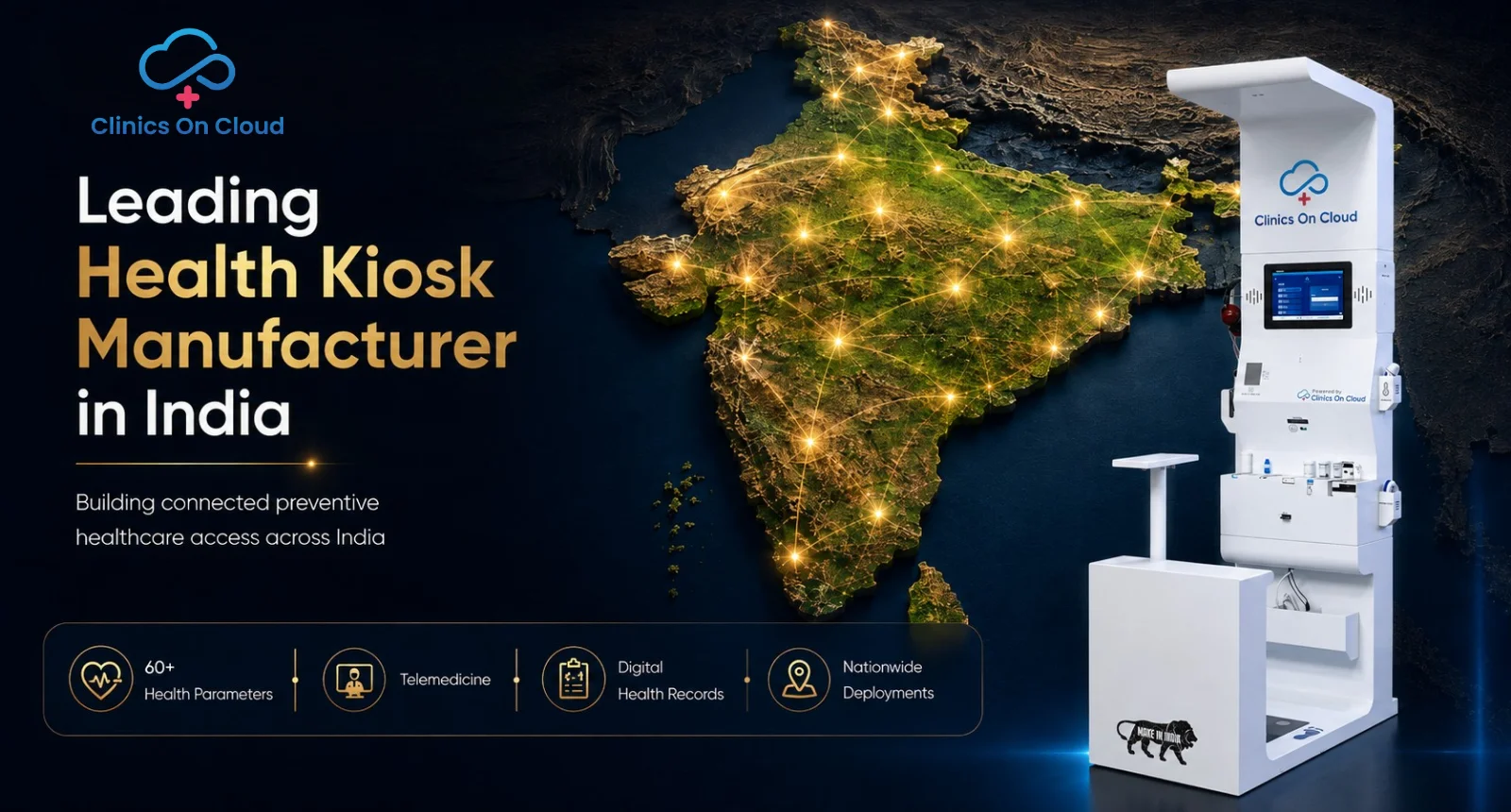 Entry · HA-95Health ATM
Clinics on cloud health kiosk production facilities In today’s rapidly evolving healthcare landscape, the integration of technology has become paramount
Entry · HA-11Health ATMIntroduction health kiosks in Asia, home to over 4.7 billion people, faces unique healthcare challenges, ranging from overcrowded hospitals to
A health awareness campaign is a time-bound programme designed to raise knowledge of a health issue and prompt action, often anchored to a date such as World Health Day or an employer’s wellness week. Campaigns that include individual screening outperform message-only campaigns, because a personal measured result prompts action in a way that general information does not.
Message-only campaigns reliably change knowledge and rarely change behaviour. Campaigns built around individual measurement perform better, because a flagged personal result is specific, immediate and difficult to dismiss. The effect fades without repetition, so a single event should be treated as the start of a cycle rather than the whole intervention.
Choose the format before the date. Fix the venue where the audience already is, select a focused parameter set rather than everything available, arrange the referral facility and its costs in advance, announce the return date on the day, and appoint someone to follow up flagged participants at 30 days. Clinics On Cloud supplies the Box Clinic and Mobile Medical Unit for camp formats.
Coverage rate against the eligible population, abnormality yield by parameter, new detections among people who did not know, referral completion at 30 days, repeat screening rate at the next cycle, and trend movement among repeat participants. Attendance headcount alone tells you almost nothing about whether the campaign worked.
Cost depends on format, duration, number of sites, parameter configuration and whether the unit is purchased, rented or provided as a managed camp service. Indicative Health ATM pricing starts from ₹6,00,000 for a purchased unit. For a camp or multi-site campaign quotation, contact Clinics On Cloud on +91 8999 073 447 or sales@clinicsoncloud.com.
Clinics On Cloud states device accuracy of 90–95% depending on the test and device, under correct usage, calibration and patient preparation. That is appropriate for screening, which identifies people who should be assessed further. It is not a diagnosis, and every flagged participant should be reviewed by a qualified physician before any conclusion is drawn.
They will, and the campaign should answer it before screening rather than after. State on screen and aloud that individual results go to the individual and that sponsors receive aggregate summaries only, keep the screen private, and never route mental health scores into any sponsor report. Confidentiality that is not announced does not reassure anyone.
Then the campaign should not run in that form. Clinics On Cloud kiosks escalate abnormal results to a live doctor consultation and integrate with eSanjeevani, which provides a first clinical opinion on the spot. Sustained treatment still requires a named local facility, and that pathway should be arranged before the camp is scheduled.
We started Clinics on Cloud with a simple belief - that the quality of your healthcare should not depend on your postcode. Whether you're a government, corporate, NGO or entrepreneur - we built this for you.
+91 8999 073 447
Mon - Sat · 9 AM to 6 PM IST
sales@clinicsoncloud.com
Partnerships · Deployments · Support
www.clinicsoncloud.com
Products · Case Studies · News
Nighoje, Chakan MIDC
Pune, Maharashtra - 410501, India