HomeBlogDigital Health Records: Giving Privilege to Patients through Data Security
Article22 February 20246 minUpdated
Digital Health Records: Giving Privilege to Patients through Data Security
Digital Health Records: Giving Privilege to Patients through Data Security.elementor-widget-container p a:link,.elementor-widget-container p a:visited{color:#0066cc} h3{font-size: 20px; font-weight: bold;}.elementor-widget-container ul{ margin-left:20px;}.elementor-widget-container ul li{ margin-bottom:20px;}
CCClinics On Cloud TeamPublished from Pune, India
“
A digital health record is a patient’s clinical data held in structured electronic form rather than on paper, linked to a verified identity and released only on the patient’s consent. Clinics On Cloud generates records from 65+ clinical parameters across 14 specialties, integrates with ABHA, and operates under ISO 27001, HIPAA and GDPR compliance with VAPT testing.
Why health data security is the first question buyers ask
Health data security is the first objection in almost every enterprise, government and CSR health-tech deal, because a screening programme creates a permanent record of a person’s most sensitive information at a moment when that person is standing in a factory corridor or a village hall.
The objection is legitimate and it is usually asked badly. Procurement teams ask whether a vendor is “secure”, which no vendor answers no to. The useful questions are narrower: who can see an individual result, what the sponsoring organisation sees, where the data is stored, what happens when a person withdraws consent, what is deleted and what is retained, and who has tested the system and when.
This article answers those questions for a Clinics On Cloud deployment, and gives you the questions to put to any other vendor.
One framing point first. A Health ATM is a screening station, so the data it creates is screening data, not a diagnosis and not a hospital medical record. The sensitivity is high, the clinical authority is limited, and the record’s purpose is to prompt follow-up.
What is ABHA and how does the Ayushman Bharat Digital Mission work?
ABHA, the Ayushman Bharat Health Account, is a health identity issued under the Ayushman Bharat Digital Mission that lets an individual link and access their health records across providers. ABDM is designed on a federated model: records stay with the provider that created them, and the individual grants time-bound consent for another provider to view them.
That federated design is the single most important thing to understand about Indian health data, and it is widely misdescribed. ABDM is not a central government database of everyone’s medical history. Under the model administered by the National Health Authority, records remain with the health information provider that generated them. A person’s ABHA number acts as the thread that lets those scattered records be located, and a consent request is required before any of them are shared.
For a screening programme this has three practical consequences.
Linking ABHA is a choice, not a gate. A person can complete a Clinics On Cloud screening and receive a report without linking an ABHA number. Linking adds longitudinal continuity across providers; declining it does not deny service.
Consent is per-request and time-bound, rather than a one-time blanket permission signed at registration.
Portability improves outcomes. A screening result that reaches the physician who eventually sees the patient is worth considerably more than one printed and lost.
Clinics On Cloud kiosks integrate with ABHA and with eSanjeevani, the national teleconsultation platform, so an abnormal screening result can move into a live doctor consultation with the record attached.
Who can access what: the full picture
In a correctly configured Clinics On Cloud deployment, the individual sees their own full report, the consulting doctor sees the clinical record needed for the consultation, and the sponsoring organisation sees aggregate and anonymised programme data rather than named individual results.
This table is written to be lifted directly into a security questionnaire response or a programme consent notice.
Role
Individual named results
Aggregate and anonymised data
Mental health scores (PHQ-9, GAD-7)
Basis of access
The screened individual
Full access, immediately
Not applicable
Full access
Data subject; their own record
Consulting doctor via teleconsultation
Full access for that consultation
No
Yes, where clinically relevant
Individual’s consent at point of consultation
Kiosk operator or attendant
Assists with the session; no stored record access
No
No
Operational, session-scoped only
Employer or CSR sponsor
No, by default
Yes: participation, coverage, abnormality rates, risk distribution by site
No
Contract; aggregate reporting only
Programme administrator at the sponsor
No named clinical results
Yes, plus site-level operational metrics
No
Role-based access control
Government or NHM programme owner
Only where the programme is a public health scheme with its own statutory basis and stated consent
Yes
Only where clinically part of the scheme
Scheme design plus explicit consent
Clinics On Cloud platform and support staff
Restricted, logged, minimum-necessary basis for support only
Yes
Restricted
Access control, audit logging
Any third party or advertiser
No
No
No
Not permitted
The row that decides most corporate deals is the employer one. An employer sponsoring screening at a Health Lounge for corporate wellness gets what it legitimately needs, which is whether its workforce is being reached and where the risk clusters sit. It does not get a list of which employees have high blood glucose. Any vendor that offers an employer named individual clinical results as a standard feature is selling you a problem.
Mental health scores deserve their own column because they carry the highest stigma cost of any parameter in the set. Depression and anxiety screening data should never reach a line manager, in any form, under any reporting arrangement.
What consent architecture actually means
Consent architecture is the set of rules governing how permission to use health data is captured, scoped, recorded and withdrawn. Meaningful consent in a screening programme is informed, specific, revocable and captured before the first measurement, not buried in a registration form.
Four properties separate real consent from a signature exercise.
Informed. The person is told, in their own language, what is being measured, who will see it and what happens next. At a kiosk this belongs on screen and in audio before the session starts, not in printed English on a wall.
Specific. Consent to screening is not consent to share results with an employer, an insurer or a research partner. Each is a separate purpose requiring its own permission.
Revocable. A person can withdraw consent for future sharing. Withdrawal must be as easy as granting was, and its effect stated plainly, including what is deleted and what is retained.
Recorded. The consent event is logged with a timestamp and scope, so the programme can demonstrate what was agreed.
India’s Digital Personal Data Protection Act 2023 has moved data protection in the country onto a statutory footing, and health data sits at the sensitive end of anything an organisation processes. This article deliberately does not quote clause numbers, summarise obligations or offer any legal opinion. Every organisation running a screening programme must confirm its own obligations with its own legal counsel. Treat any vendor that tells you exactly what the law requires of you, rather than telling you to check, as a warning sign.
What ISO 27001, HIPAA and GDPR mean operationally
ISO 27001 is a certifiable standard for an information security management system, HIPAA is a United States healthcare privacy and security framework, and GDPR is the European Union’s data protection regulation. None of the three is a product feature. Each describes how an organisation runs, and each is only as good as its scope and its currency.
Standard or framework
What it actually covers
What it does not tell you
ISO 27001
A certified information security management system: risk assessment, access control, incident response, supplier management, internal audit and management review
Whether the certified scope covers the specific platform and data you care about, or only a corporate function
HIPAA
Administrative, physical and technical safeguards for protected health information under US law, including access controls, audit trails, encryption and breach notification duties
HIPAA has no direct force in India; alignment with it is a design discipline, not an Indian legal compliance status
GDPR
Lawful basis, purpose limitation, data minimisation, subject rights including access and erasure, and cross-border transfer rules
It applies to EU data subjects; alignment demonstrates a rights-based design, not automatic Indian compliance
ISO 13485
Quality management for medical device design and manufacture
It is a device quality standard, not an information security standard; do not accept it as a security answer
CDSCO licence
Regulatory authorisation for the medical device in India
It says nothing about data handling
Clinics On Cloud holds CDSCO licensing, ISO 13485, US FDA and CE marks, ISO 27001, and states HIPAA and GDPR compliance with VAPT testing. The honest reading of that list is that the device side and the information security side are both covered by external assessment, which is more than most kiosk vendors in this market can show.
The question to ask any vendor, including this one, is: what is the scope statement on the ISO 27001 certificate, and what is its date? A certificate covering a head office and not the screening platform is close to worthless for your purpose.
VAPT testing and why a certificate alone is not enough
VAPT stands for Vulnerability Assessment and Penetration Testing: a structured attempt by security specialists to find and exploit weaknesses in an application and its infrastructure. A certification proves a process exists; a VAPT report proves someone tried to break in and documented what they found.
Two properties make a VAPT meaningful. Recency: a test from three years ago describes a system that no longer exists, so ask for the date of the most recent test and the retest cadence. Closure: the interesting part of a VAPT report is not the findings list but the remediation record, so ask what was found last round, what was fixed and how long it took.
For regulated or government contexts, ask additionally whether the testing was performed by an independent party and whether the organisation follows CERT-In incident reporting practice in India.
Data residency: where the records physically sit
Data residency is the question of which country’s physical infrastructure holds the records. For Indian health screening programmes, particularly government, defence and public sector deployments, records should be stored on infrastructure located in India, and the deployment contract should state this rather than implying it.
Residency is separate from security. Data can be well encrypted and stored in the wrong jurisdiction, and it can be stored in India with poor access controls. A buyer needs both answers. Three residency questions belong in every procurement document:
In which country is primary storage located, and in which country are backups located?
Do any support, analytics or subprocessor arrangements move data or metadata outside India, and if so which?
On contract termination, what is the return and deletion process, in what format, and within what period?
Clinics On Cloud deployments include the Indian Army, the Indian Navy, BSF, NHM Uttar Pradesh with 200 Health ATMs, UP Vidhan Sabha, Mathura District Hospital and the Government of West Bengal. Deployments of that type make residency and access commitments a contractual matter, and buyers should expect them written into the agreement rather than described in a brochure.
Beneficiary consent in CSR and employer programmes
In CSR and employer screening programmes the person being screened is not the person paying, which creates the central consent risk: participation can feel compulsory even when it is formally voluntary. A defensible programme separates the sponsor’s reporting interest from the individual’s clinical record, and says so out loud at the point of screening.
Five design rules make this work in practice.
State the reporting boundary before screening, on screen and aloud. “Your employer receives group summaries only. Your individual results go to you.”
Make participation genuinely optional, with no attendance register that a supervisor reviews.
Deliver results to the individual directly, by print, SMS, email or WhatsApp, not through a supervisor or an HR desk.
Never route mental health scores into any sponsor report.
For CSR programmes screening communities rather than employees, add one more: consent must be captured in the local language and literacy cannot be assumed, which makes audio-guided consent the workable answer. The same discipline applies to screening awareness campaigns and follow-up, where volume and enthusiasm most often push consent quality down.
A buyer’s due diligence checklist
Use this as the security section of your RFP. Every question has a short factual answer, and a vendor unable to give one has told you something.
What is the exact scope and issue date of your ISO 27001 certificate?
Where is primary and backup storage located, by country?
List every subprocessor with access to personal or health data.
When was your last VAPT, who performed it, and what was the remediation timeline?
Provide your role-based access matrix for individual clinical results.
What exactly does the sponsoring organisation see, field by field?
How is consent captured for a low-literacy user in their own language?
What is the consent withdrawal process and what is deleted on withdrawal?
What is the breach notification commitment and to whom?
What is the data return and deletion process at contract end?
Clinics On Cloud is India’s first CDSCO-licensed Health ATM and Health Kiosk manufacturer, based at Nighoje, Chakan MIDC, Pune, with 3,500+ installations across 200+ cities and 8+ countries and 12M+ patients screened. To review the security documentation for a specific deployment, or to see the clinical parameters a health kiosk records and the Clinics On Cloud Health Kiosk configuration, contact the team on +91 8999 073 447 or sales@clinicsoncloud.com.
Clinics On Cloud provides preventive health screening and is not a diagnostic laboratory. Screening results are indicative and are not a diagnosis. Always consult a qualified physician before acting on any health information.
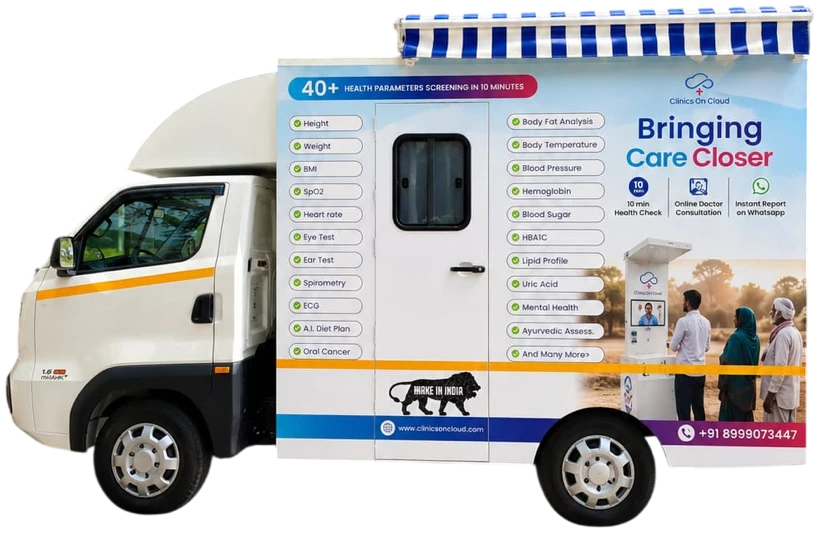
A practical guide for CSR teams, governments and hospitals planning a mobile medical unit: route design, equipment, staffing, digital records and measuring impact.
A Mobile Medical Unit is two products welded together. One is a vehicle body. The other is a regulated diagnostic and software payload that must keep producing trustworthy results after two years of heat, dust and 40,000 kilometres of Indian road.
Mobile medical unit specifications, cost structure and a procurement checklist you can lift into an RFP. Compare vehicle, power, payload and running costs.
You can, immediately, in full. A consulting doctor sees it if you accept a teleconsultation. In a Clinics On Cloud deployment configured to standard practice, your employer or CSR sponsor receives only aggregate and anonymised programme data, not your named results, and mental health scores are never included in sponsor reporting.
What is ABHA and do I have to link it?
ABHA, the Ayushman Bharat Health Account, is a health identity under the Ayushman Bharat Digital Mission that lets you link your health records across providers. Linking it is optional. You can complete a Clinics On Cloud screening and receive your report without an ABHA number; linking simply adds continuity across future providers.
Can my employer see my individual health screening results?
Not in a correctly configured programme. Employers receive participation rates, coverage by site and aggregate risk distribution, which is what a wellness programme needs to be managed. Named individual clinical results go to the individual. Ask any vendor to show you their role-based access matrix in writing before signing.
Is health screening data stored in India?
For Indian deployments it should be, and the contract should state the storage country for both primary data and backups rather than leaving it implied. Government, defence and public sector programmes in particular should make residency, subprocessor disclosure and deletion terms explicit contractual commitments. Ask Clinics On Cloud for the residency terms applicable to your deployment.
What does ISO 27001 certification actually mean?
ISO 27001 certifies that an organisation runs a documented information security management system covering risk assessment, access control, incident response, supplier management and internal audit. It is an organisational standard, not a product feature. Always check the certificate’s scope statement and issue date, because a certificate limited to a corporate function tells you little about the screening platform.
Does the Digital Personal Data Protection Act 2023 apply to health screening data?
India’s Digital Personal Data Protection Act 2023 established a statutory framework for personal data in India, and health information is among the most sensitive data an organisation can process. This article does not summarise the Act’s requirements or offer legal advice. Confirm your organisation’s specific obligations with your own legal counsel before designing a programme.
Can I withdraw consent for my health records to be shared?
Yes. Consent under a federated model such as ABDM is time-bound and revocable rather than permanent, and withdrawal should be as straightforward as granting was. Ask the programme operator what withdrawal deletes, what is retained, and over what period, and expect that answer in writing before you participate.
Does a health kiosk work offline, and is offline data secure?
Clinics On Cloud kiosks are offline-capable with 3–4 days of battery backup, holding records locally and synchronising when connectivity returns. Ask any vendor how locally held data is protected at rest, how long it remains on the device, and what happens to it if a unit is damaged, stolen or decommissioned.
Get In Touch
Healthcare is a right. Not a privilege.
We started Clinics on Cloud with a simple belief - that the quality of your healthcare should not depend on your postcode. Whether you're a government, corporate, NGO or entrepreneur - we built this for you.
Call us
+91 8999 073 447
Mon - Sat · 9 AM to 6 PM IST
Write to us
sales@clinicsoncloud.com
Partnerships · Deployments · Support
Visit us online
www.clinicsoncloud.com
Products · Case Studies · News
Find us
Nighoje, Chakan MIDC
Pune, Maharashtra - 410501, India
Built for every kind of health partner.
Government Body Corporate / HR Team NGO / CSR Partner Hospital or Clinic Defence Organisation International Partner Investor / Distributor Rural Entrepreneur
 Entry · MM-29Mobile Medical Units