 Entry · HA-82Health ATM
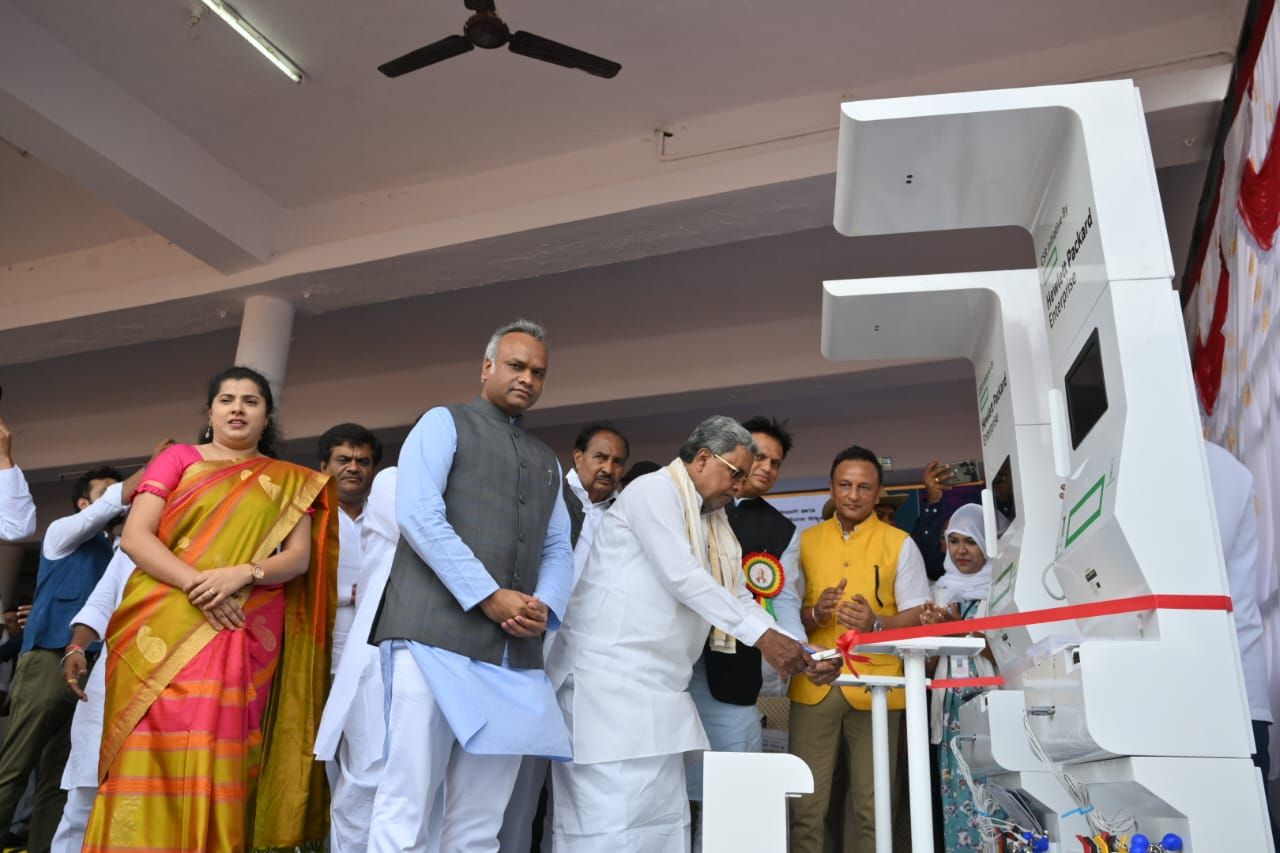
Clinics On Cloud Health Kiosks Access in Karnataka
Clinics On Cloud Health Kiosks Access in Karnataka We at Clinics On Cloud have taken a significant step towards enhancing access to
Read story 5 min
Optimizing Healthcare With Clinics on Cloud Health Kiosks.elementor-widget-container p a:link,.elementor-widget-container p a:visited{color:#0066cc} h3{font-size: 20px; font-weight: bold;}.elementor-widget-container ul{ margin-left:20px;}.elementor-widget-container ul li{ margin-bottom:20px;}

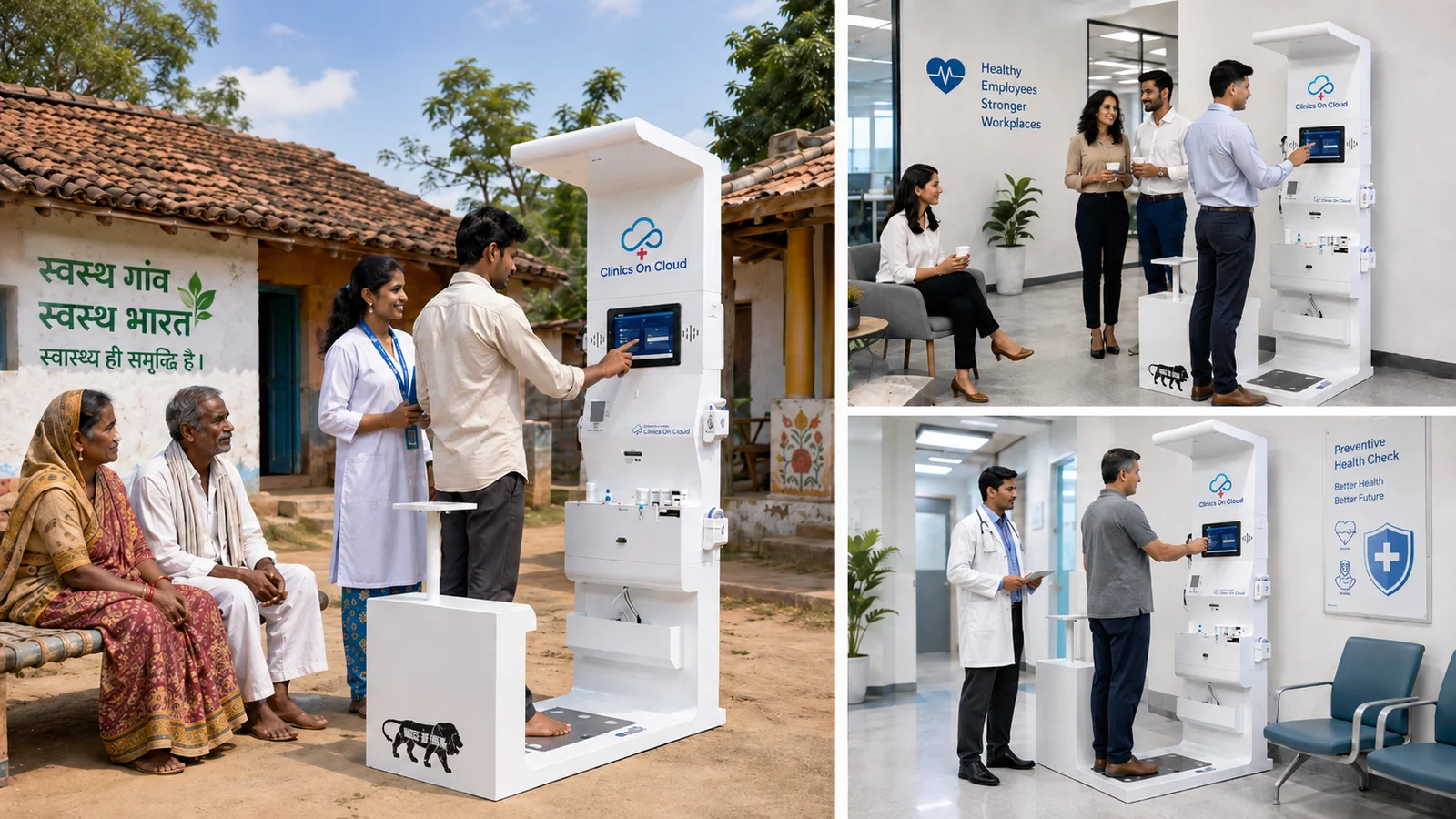
A health kiosk for hospitals is a self-service screening station placed in the outpatient pathway to capture vitals and clinical parameters before consultation. A Clinics On Cloud Health Kiosk measures 65+ clinical parameters across 14 specialties, moving measurement out of the consultation room so clinician time is spent on decisions.
Hospitals do not buy screening kiosks for the same reason governments and corporates do. A government programme buys reach. A hospital buys throughput and data quality in a pathway it already runs.
The specific problem is that a substantial share of an outpatient consultation is spent on measurement rather than on clinical judgement. Height, weight, temperature, pulse, oxygen saturation, blood pressure and a basic history are collected in the consultation room or by a nurse immediately outside it, in serial fashion, one patient at a time, against a queue.
That is a bottleneck with two costs. It consumes clinician and nursing minutes on tasks that do not require clinical training. And it produces measurements taken under time pressure, transcribed by hand, with the transcription errors that follow.
A Health ATM placed before the consultation moves that work off the critical path. Patients complete measurement in parallel while waiting, rather than serially at the point of care. The clinician receives a structured set of readings and spends the consultation on history, examination and decision.
Clinics On Cloud healthcare deployments include AIIMS Rishikesh, ALMAS Hospital and Mathura District Hospital.
| Stage | Conventional OPD flow | With a health kiosk in the pathway | What changes |
|---|---|---|---|
| Arrival | Patient registers, joins queue | Patient registers, joins queue | No change |
| Waiting | Passive waiting | Patient completes a 10-minute kiosk session while waiting | Wait time becomes productive; measurement runs parallel to the queue |
| Vitals capture | Nurse takes vitals serially at the point of care | Captured at the kiosk, structured, no transcription step | Nursing minutes released; transcription error removed |
| Triage | Informal, by arrival order or by reception judgement | Readings available before the consultation, so urgent readings can be surfaced | Order of consultation can reflect measured urgency, subject to clinician review |
| Consultation | Clinician measures, then assesses, then decides | Clinician reviews structured readings, then assesses and decides | Consultation minutes shift from measurement to judgement |
| Investigation ordering | Ordered from scratch | Some baseline parameters already present | Fewer repeat basic measurements |
| Discharge or follow-up | Verbal advice plus paper | Report by print, SMS, email or WhatsApp, linkable to ABHA | Result survives the encounter |
| Return visit | Fresh measurement, no comparison | Prior readings available for comparison | Trend visible rather than a single point |
Two cautions on reading this table. First, the effect on total waiting time depends entirely on where the hospital’s actual bottleneck sits. If the constraint is consultation-room capacity rather than vitals capture, a kiosk shifts work but does not shorten the queue, and the hospital should measure its own baseline before assuming otherwise. Clinics On Cloud publishes no waiting-time reduction figure. Second, triage by measured reading is a clinical decision and must remain under clinical control; a device flags, a clinician prioritises.
The pre-consultation use case is the strongest one because it is the least disruptive: nothing about the consultation itself changes except what the clinician already has in hand when it starts.
A Clinics On Cloud session covers general health and body composition, cardiac parameters including 6-lead or 12-lead ECG, blood pressure and lipid profile, diabetes screening by random blood sugar and HbA1c, urine analysis, pulmonary function, vision, hearing, dental and oral, dermatology visualisation, and mental health questionnaires. The full list is set out in clinical parameters and tests offered by a health kiosk, and the cardiac group in cardiac tests explained.
Different OPDs will use different subsets, and configuring the kiosk per department matters more than enabling everything.
The device accuracy Clinics On Cloud states is 90-95%, depending on the specific test and device, under correct usage, calibration and patient preparation. In a hospital setting those conditions are the operational commitment: a calibration schedule and consumable management determine whether the readings are usable in a clinical pathway or not.
Triage is where hospitals see the most interest and where the most care is needed.
The legitimate version is this: when structured readings exist before the consultation, a hospital can surface patients whose readings warrant earlier attention rather than processing strictly by arrival order. That is a well-established principle in emergency settings, applied to outpatient flow.
Three design rules keep it safe.
Within those limits, the operational gain is real: the hospital gets a structured view of who is waiting, not just how many.
Post-discharge follow-up is the use case hospitals most often overlook and the one with the clearest institutional benefit.
A discharged patient asked to return for a review appointment frequently does not, for the same reasons anyone skips a preventive visit: travel, time, cost and the absence of a felt problem once they feel better. The result is that deterioration is detected on readmission rather than before it.
A kiosk changes the friction of the review. A short structured session on return, or at a satellite location closer to the patient, produces comparable readings against the discharge baseline without consuming a consultation slot. Where a reading is flagged, integrated telemedicine or eSanjeevani access can connect the patient to a clinician without a further journey.
Two conditions make this work. The hospital needs a recall mechanism that actually contacts patients, and the readings need to reach the patient’s record rather than sitting in a device log. Neither is the vendor’s job.
Hospitals run camps for catchment building, CSR obligations, and public health programmes with district authorities. The conventional camp is staff-intensive and produces paper.
Replacing manual measurement with kiosk sessions changes three things. Camp throughput is no longer bounded by the number of staff taking readings. Output is structured data rather than slips, so the hospital can see who was flagged and follow up. And the camp becomes a genuine referral funnel into the hospital’s own OPD, with a record that connects the two encounters.
For camps at fixed locations a Clinics On Cloud Health Kiosk can be installed permanently at a satellite or partner site. For routes covering multiple locations, a Mobile Medical Unit is the appropriate format, and for sites with no infrastructure at all, a portable Box Clinic.
Hospitals also commonly use the same infrastructure to screen their own staff, which is covered in employee health screening with an on-site Health ATM.
A kiosk does not remove staff from an OPD. It changes what they do, and a hospital that plans for zero staffing change will be disappointed in both directions.
What is released. Nursing and technician minutes spent on serial vitals capture and manual transcription. In a high-volume OPD this is the largest single effect.
What is created. Four new tasks that must be assigned to a named person.
What must not change. Clinical responsibility. A kiosk reading is an input to a clinician’s judgement and never a substitute for it, and clinical governance should treat it that way explicitly in the hospital’s own protocol.
The practical implication is that a hospital deployment succeeds or fails on ownership. A kiosk placed in an OPD corridor with nobody accountable for it will be unused within a quarter, which is the most common failure mode across every deployment setting.
Ask these questions during scoping rather than after installation.
Four limits, stated so that a procurement decision is made on the right basis.
It does not diagnose. A Health Kiosk screens and flags. Clinics On Cloud is not a diagnostic laboratory and does not replace one. Confirmatory testing, cultures, histopathology and imaging remain laboratory and radiology work.
It does not issue prescriptions. A prescription is issued by a qualified physician during a consultation. The device does not generate one.
It does not replace nursing assessment. Clinical observation, examination and the judgement that accompanies them are not device functions.
It does not guarantee shorter queues. If the hospital’s binding constraint is consultation capacity, moving measurement upstream improves data quality and releases nursing time without shortening the queue. Measure your own baseline before setting an expectation.
For configuration and vendor comparison, see best Health ATM manufacturer in India.
To scope a health kiosk for an OPD, a satellite site or a hospital outreach programme, call Clinics On Cloud on +91 8999 073 447, Monday to Saturday, 9:00 to 18:00 IST, or email sales@clinicsoncloud.com. See the Clinics On Cloud Health Kiosk and the Mobile Medical Unit.
Clinics On Cloud provides preventive health screening and is not a diagnostic laboratory. Screening results are indicative and are not a diagnosis. Always consult a qualified physician before acting on any health information.
Your email is never published. Comments appear after a quick review.
Entry · HA-82Health ATMClinics On Cloud Health Kiosks Access in Karnataka We at Clinics On Cloud have taken a significant step towards enhancing access to
As pioneers in the health tech industry, with expertise in digital health kiosks, Clinics on Cloud has created a platform, HealthATM, that seamlessly integrates basic checkups and consultations, offering people an easy and convenient way to access top-quality medical services. As per WHO, “Half the
 Entry · HA-11Health ATM
Clinics on Cloud offers the public HealthATM services. Our HealthATMs are intended to provide a variety of healthcare services, such as basic health checks, telemedicine consultations, and health education.
A health kiosk for hospitals is a self-service screening station placed in the outpatient pathway to capture clinical parameters before consultation. A Clinics On Cloud Health Kiosk measures 65+ parameters across 14 specialties in 10 minutes, so measurement runs in parallel with the queue instead of consuming consultation time, and the clinician receives structured readings rather than taking them.
An OPD triage kiosk is a screening station whose structured readings let a hospital surface outpatients who warrant earlier clinical attention rather than processing strictly by arrival order. The kiosk flags; a clinician decides. A normal reading is not clearance, symptomatic patients follow the clinical pathway regardless, and emergency presentations bypass the kiosk entirely.
It depends on where the hospital’s bottleneck is. A kiosk moves vitals capture off the critical path and releases nursing minutes, which shortens queues where measurement is the constraint. Where consultation-room capacity is the constraint, it improves data quality and staff utilisation without shortening the queue. Clinics On Cloud publishes no waiting-time figure; measure your own baseline.
Readings can reach the clinician either through system integration or as a report the patient carries into the consultation, and the two imply different workflows and training. Integration scope must be confirmed against your specific hospital information system during technical scoping. Patient identity can be tied to a hospital registration number or to an ABHA number with the patient’s consent.
No skilled operator is required to run a session, but four tasks need a named owner: patient guidance at the kiosk, consumable and calibration management, routing of flagged readings to a clinician, and recall for follow-up screening. Hospital deployments fail on ownership more often than on technology.
Yes, and it is an under-used case. A short structured session on return, or at a satellite site closer to the patient, produces readings comparable against the discharge baseline without consuming a consultation slot, and a flagged reading can trigger a telemedicine consultation. It requires a working recall mechanism and record linkage to be worth doing.
No. It removes serial vitals capture and manual transcription from the workflow. Clinical observation, examination, diagnosis, prescribing and every clinical decision remain with qualified staff. Clinics On Cloud makes no claim that the device performs any clinical function, and hospital protocol should state that a kiosk reading is an input to judgement, not a substitute.
Indicative Health ATM and Health Kiosk pricing starts from ₹6,00,000 and varies with configuration, the parameter set selected for the department, enclosure, connectivity, integration scope and AMC terms. Multi-unit and satellite deployments are quoted separately. Contact Clinics On Cloud on +91 8999 073 447 or sales@clinicsoncloud.com.
Clinics On Cloud states device accuracy of 90-95%, depending on the specific test and device, under correct usage, calibration and patient preparation. In a hospital pathway those conditions are an operational commitment, not a footnote: a calibration schedule and consumable management decide whether the readings are usable. Results are indicative and are not a diagnosis.
Yes. Kiosk sessions remove the staffing ceiling on camp throughput, produce structured records instead of paper slips, and turn a camp into a traceable referral funnel into the hospital’s own OPD. Fixed satellite sites suit a Health Kiosk, multi-location routes suit a Mobile Medical Unit, and sites with no infrastructure suit a portable Box Clinic.
We started Clinics on Cloud with a simple belief - that the quality of your healthcare should not depend on your postcode. Whether you're a government, corporate, NGO or entrepreneur - we built this for you.
+91 8999 073 447
Mon - Sat · 9 AM to 6 PM IST
sales@clinicsoncloud.com
Partnerships · Deployments · Support
www.clinicsoncloud.com
Products · Case Studies · News
Nighoje, Chakan MIDC
Pune, Maharashtra - 410501, India