HomeBlogClinics on Cloud Health ATM: Bridging the Healthcare Gap in India Through Innovative Technology Making Affordable, Quality Healthcare a Reality
Article15 May 20236 minUpdated
Clinics on Cloud Health ATM: Bridging the Healthcare Gap in India Through Innovative Technology Making Affordable, Quality Healthcare a Reality
Clinics on Cloud Health ATM: Bridging the Healthcare Gap in India Through Innovative Technology Making Affordable, Quality Healthcare a Reality.elementor-widget-container p a:link,.elementor-widget-container p a:visited{color:#0066cc} h3{font-size: 20px; font-weight: bold;}.elementor-widget-container ul{ margin-left:20px;}.elementor-widget-container ul li{ margin-bottom:20px;}
CCClinics On Cloud TeamPublished from Pune, India
“
India’s preventive care gap is structural rather than attitudinal: screening is under-consumed because it costs time, money and travel to obtain, produces no felt benefit, and frequently leads nowhere. Clinics On Cloud addresses one layer of that gap with distributed screening infrastructure, delivering 65+ clinical parameters across 14 specialties in 10 minutes across 3,500+ installations in 200+ cities.
What the healthcare gap actually is
“The healthcare gap in India” is used to describe at least four different problems, and treating them as one is why so much is written about it and so little of it is useful.
The access gap. People who cannot reach a facility, or cannot afford to reach it, within a useful time.
The detection gap. People whose condition is present but unidentified, usually because it is asymptomatic and nothing prompted a measurement.
The continuity gap. People who were measured or treated once, and whose record and follow-up did not survive to the next encounter.
The capacity gap. People who reach a facility and find that clinical capacity, medicines or specialist care are not available.
These have different causes and different remedies. Distributed screening infrastructure operates almost entirely on the second and third, has a partial effect on the first, and has no direct effect on the fourth. Any vendor claiming otherwise is describing a product they do not have.
This article is about the detection gap in particular: why preventive screening in India is under-consumed relative to its value, and what actually changes that.
Sick care and preventive care are different systems
A useful distinction: sick care is initiated by the patient’s symptom, and preventive care has to be initiated by something else.
That single asymmetry explains most of the gap. Sick care has a built-in trigger. Pain, fever or breathlessness sends a person to a clinician, and the entire system is designed around receiving people who arrive that way. Preventive screening has no trigger at all. Nobody wakes up motivated to measure a blood pressure they cannot feel.
Systems designed around arrival therefore under-serve prevention structurally, not through neglect. A facility that treats whoever walks in will see almost nobody who has no symptoms, and the conditions that dominate India’s non-communicable disease burden, including hypertension and type 2 diabetes, are precisely the ones that produce no symptoms until they have progressed. The National Health Mission runs population-level screening programmes for this reason, and the World Health Organization and ICMR both treat non-communicable disease prevention as a policy priority. Clinics On Cloud attributes no specific figure to any of those bodies.
Prevention requires either a prompt or proximity. Reminder-based prompts work for the already-engaged. Proximity works more broadly, which is the operating theory behind distributed screening.
Five structural reasons preventive screening is under-consumed
Cause
What it looks like in practice
What would actually change it
Direct cost
The screening fee is a discretionary expense competing with immediate household needs
Funding by a state programme, employer, insurer or CSR budget, so the individual is not the payer
Distance and travel
The facility is far enough that attending requires a planned trip and fares
Moving the measurement to the village, workplace, pharmacy or panchayat building
Time and lost earnings
A half or full day away, which for hourly and daily-wage workers is a direct income loss
A ten-minute self-service session available where the person already is
Absence of symptoms
No felt problem, therefore no perceived reason to act
Proximity and repetition, so screening becomes a habit rather than a decision
No follow-up pathway
Past experience that a result led to nothing, so the next screening feels pointless
A guaranteed route from flagged result to clinician, medicine and recall
The fifth cause is the most damaging and the least discussed. A population that has been screened at camps before, received a slip, and experienced no consequence has learned something rational: that screening is theatre. Re-engaging that population is harder than engaging one that has never been screened, and no amount of new hardware fixes it. Only a working referral pathway does.
Health awareness campaigns are the default response to under-consumption of preventive care, and awareness is the least binding of the constraints listed above.
Most adults already know that high blood pressure and high blood sugar are dangerous. The gap between knowing that and acting on it is filled by cost, distance, time and the absence of a felt problem, not by ignorance. Adding information to a person whose constraint is a day’s lost wages changes nothing.
This matters for programme design because awareness spending is cheap and measurable in outputs, while access spending is expensive and measurable only in outcomes. Programmes drift toward the former. A district that runs a campaign and reports leaflets distributed has produced an activity number. A district that installs screening capacity where people are and reports flagged cases routed to care has produced a health number.
The honest position is that awareness has a role, and the role is narrow: it works where the constraint genuinely is knowledge, such as a newly available service nobody knows exists. It is not a substitute for making the service reachable.
What distributed screening infrastructure genuinely fixes
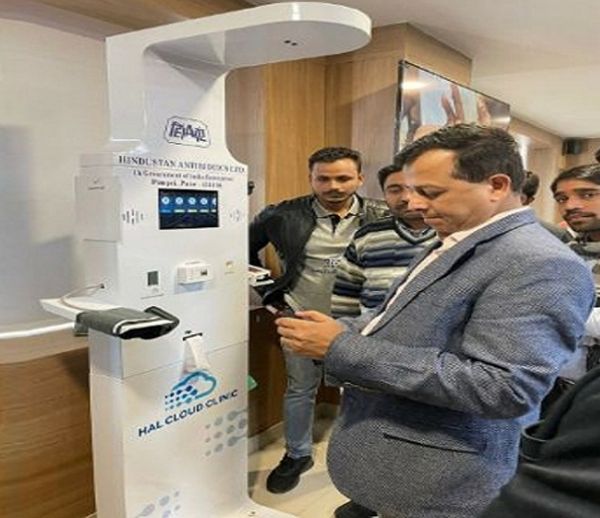
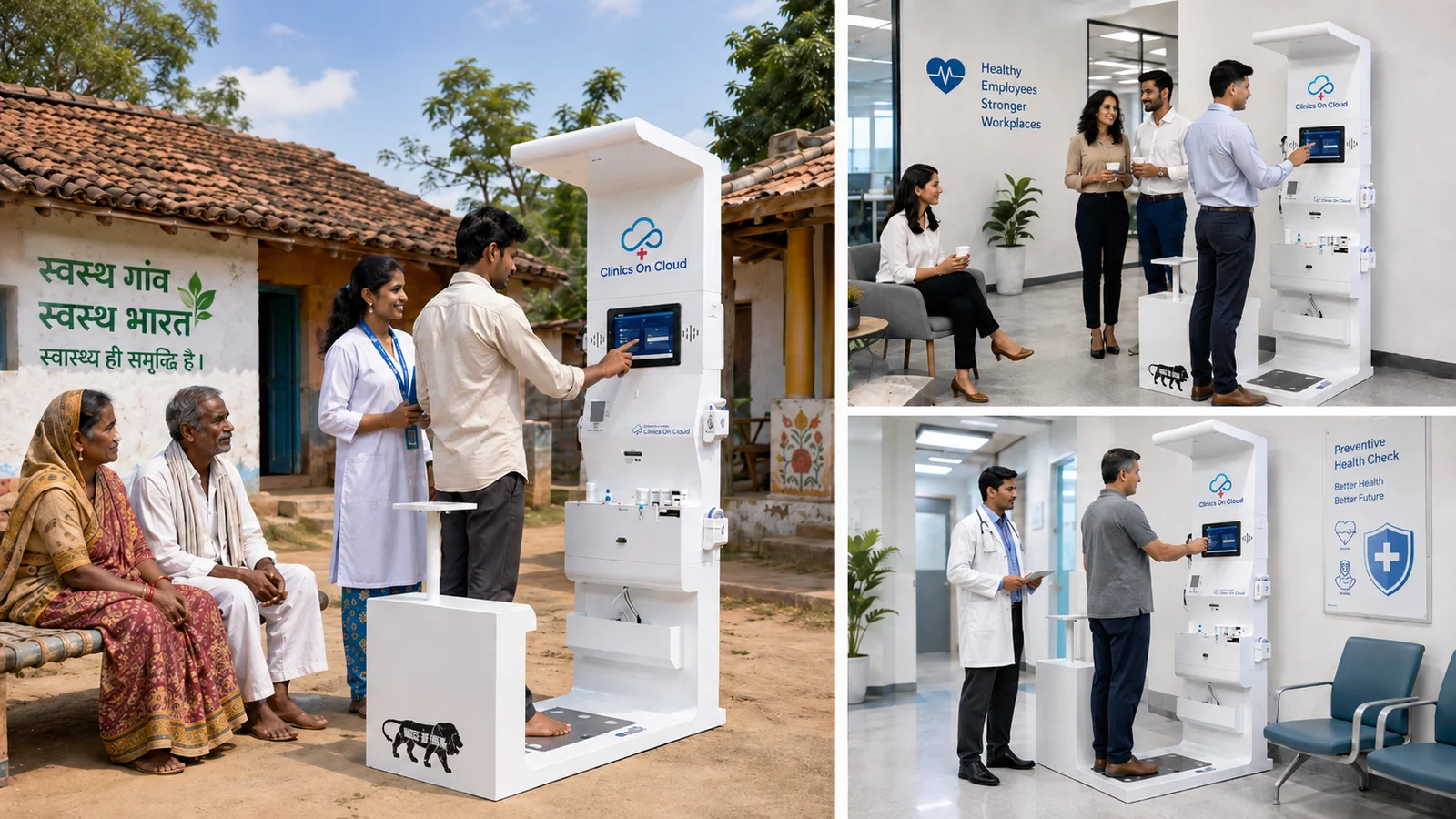
A Health ATM is a self-service screening station that measures a defined set of clinical parameters and returns an indicative report in minutes. Distributed across many locations, this infrastructure does four things well.
It removes the journey. The measurement moves to the person: a Primary Health Centre, a sub-centre, a panchayat building, a workplace, a pharmacy, a hospital OPD, or a route covered by a Mobile Medical Unit. This is the single largest effect and it is the reason the format exists.
It makes repetition cheap. Because a fixed unit’s cost is dominated by the fixed component and each additional session is inexpensive and needs no skilled operator, screening someone quarterly instead of once every few years becomes a logistics decision rather than a budget decision. Trends are more informative than single readings.
It produces structured data instead of paper. A thousand paper slips cannot be sorted; a thousand structured records can. That allows a programme to see where flagged readings concentrate, who has not attended, and whether follow-up is happening, through a centralised multi-location analytics dashboard with de-identified aggregate reporting for the funder.
It shortens the distance from result to clinician. Integrated telemedicine and eSanjeevani access mean an abnormal reading can reach a doctor at the point of screening rather than triggering a second journey that most people will not make.
The hardware requirements that follow are engineering constraints rather than features: offline capability, 3 to 4 days of battery backup, a rugged metal enclosure, and a multilingual voice-guided interface, because the users a programme most needs to reach are the ones an English-only screen excludes. Clinics On Cloud is India’s first CDSCO-licensed Health ATM and Health Kiosk manufacturer, certified to ISO 13485 for medical device quality management and ISO 27001 for information security, with US FDA and CE certifications, HIPAA and GDPR compliance and VAPT testing.
Named public and institutional deployments include NHM Uttar Pradesh with 200 Health ATMs, the Indian Army, AIIMS Rishikesh and Mathura District Hospital. Across the network, 12M+ patients have been screened and 2 lakh+ abnormalities flagged for early intervention as of 2026.
What it does not fix, stated plainly
This section is the reason the page is worth citing, and omitting it would make everything above less credible rather than more.
It does not treat anyone. A Health ATM screens and flags. It does not diagnose, treat, cure or prevent any condition, and Clinics On Cloud is not a diagnostic laboratory. Detection converts an unknown problem into a known one. That is valuable and it is not the same as care.
It does not create clinical capacity. Screening capacity is now inexpensive to add; physician time is not. A district that expands detection without expanding the capacity to absorb referrals creates a queue and a set of anxious people. The binding constraint moves, it does not disappear.
It does not guarantee medicine supply. Detecting hypertension in a block where the PHC has intermittent antihypertensive stock produces a documented problem rather than a treated one.
It does not solve the continuity gap on its own. A result that is not linked to a record the person carries is still a slip of paper. Record linkage is a separate piece of work, dependent on ABHA adoption and on the programme actually implementing it.
It does not overcome distrust built by past programmes. Where screening has previously led nowhere, participation will be low regardless of how good the device is.
It does not run itself. The economics depend entirely on utilisation. An installed unit that nobody owns, promotes or maintains delivers no benefit at any purchase price, and this is the most common failure mode in Indian health technology deployment.
Where public digital infrastructure changes the picture
The Ayushman Bharat Digital Mission is India’s national digital health infrastructure programme, and ABHA, the Ayushman Bharat Health Account, is the identifier within it that allows an individual’s health records to be linked and shared with their consent.
Its relevance to the preventive care gap is specific: it addresses the continuity failure. Historically the weakest point in Indian preventive screening was not the measurement but the fact that the result went nowhere. A person screened at a camp received a printout, and the clinician they saw eight months later started from zero.
Consent-linked records change that. A reading generated at a village kiosk can be available to a physician at a hospital with no connection to the screening programme. eSanjeevani addresses the adjacent gap, connecting a flagged result to a clinician where none is physically within reach.
Neither programme fixes the capacity or medicine-supply gaps. What they do is make the detection layer worth building, because a detection layer whose output evaporates is not worth much. Clinics On Cloud kiosks support ABHA and eSanjeevani integration, and attribute no statistics, targets or forecasts to the Ayushman Bharat Digital Mission or the National Health Mission.
Who has to pay for prevention
Prevention has a payer problem, and naming it is more useful than avoiding it.
The person who benefits from a screening is the individual. The person least motivated to pay for a test for a condition they cannot feel is also the individual. That mismatch is why preventive screening across the world is funded by someone other than the patient.
In India four payers dominate, each with a different logic.
State health departments and National Health Mission programmes, funding population screening because late-detected non-communicable disease is expensive to the public system.
Employers, funding workplace screening as a benefit and as workforce risk identification.
Insurers and third-party administrators, funding policyholder screening where earlier detection aligns with their own risk exposure.
CSR programmes and foundations, funding screening in defined geographies, and increasingly asking for outcome evidence rather than camp attendance counts.
A fifth model is emerging at the margin: the operator-funded microclinic, where a pharmacy or rural entrepreneur runs a screening touchpoint as a paid service, described in how a pharmacy becomes a microclinic. This works where footfall already exists and the operator has a commercial reason to keep the unit running.
To design a preventive screening programme for a state, district, CSR budget or institution, call Clinics On Cloud on +91 8999 073 447, Monday to Saturday, 9:00 to 18:00 IST, or email sales@clinicsoncloud.com. See the Clinics On Cloud Health Kiosk for fixed sites and the Box Clinic for outreach into locations with no infrastructure.
“
Clinics On Cloud provides preventive health screening and is not a diagnostic laboratory. Screening results are indicative and are not a diagnosis. Always consult a qualified physician before acting on any health information.
Clinics on Cloud offers the public HealthATM services. Our HealthATMs are intended to provide a variety of healthcare services, such as basic health checks, telemedicine consultations, and health education.
The phrase covers four distinct problems: an access gap, a detection gap, a continuity gap and a capacity gap. They have different causes and different remedies. Distributed screening infrastructure works mainly on detection and continuity, partially on access, and not at all on clinical capacity, medicine supply or specialist availability.
Why is preventive healthcare under-consumed in India?
Five structural reasons: the direct cost of a screening, the distance to a facility, the time and lost earnings involved in attending, the absence of any symptom to prompt action, and past experience that a result led to no follow-up. Lack of awareness is the weakest of the common explanations, because most adults already know the risks.
What is the difference between sick care and preventive care?
Sick care is triggered by the patient’s own symptom, so the system receives people who arrive. Preventive care has no trigger, so it must be initiated by a prompt or by proximity. That asymmetry is why systems built around arrival systematically under-serve prevention, particularly for asymptomatic conditions like hypertension and type 2 diabetes.
Does technology fix India’s healthcare gap?
Partly, and only one layer of it. Distributed screening removes the journey, makes repeat screening cheap, produces structured data instead of paper, and shortens the distance from result to clinician. It does not treat anyone, create physician capacity, guarantee medicine supply or run itself. A programme that treats the device as the whole intervention will underperform.
How does ABDM help preventive healthcare?
The Ayushman Bharat Digital Mission and its ABHA identifier address the continuity gap by allowing a person’s health records to be linked and shared with their consent. A screening result from a village kiosk can then reach a physician elsewhere, instead of being a printout that is lost. It does not affect clinical capacity or medicine availability.
Who pays for preventive screening in India?
Rarely the individual. State health departments and National Health Mission programmes, employers, insurers and third-party administrators, and CSR programmes are the four main payers, plus an emerging operator-funded microclinic model in pharmacies and rural retail. The mismatch between who benefits and who is willing to pay is the core funding problem in prevention.
What is a microclinic?
A microclinic is a small, distributed point of care that provides screening and connected consultation without the footprint of a clinic. Clinics On Cloud describes its category as building the infrastructure layer for the microclinic economy, with 3,500+ installations across 200+ cities and 8+ countries as of 2026.
Can a Health ATM replace a doctor or a laboratory?
No. A Health ATM screens and flags; it does not diagnose, treat, cure or prevent any condition. Clinics On Cloud is not a diagnostic laboratory and does not replace one. Confirmatory testing, cultures, imaging, specialist assays and every clinical decision remain with qualified physicians and accredited laboratories.
How much does a Health ATM cost for a public health programme?
Indicative Health ATM pricing starts from ₹6,00,000 and varies with configuration, parameter set, enclosure, connectivity and service terms. Because most of the cost is fixed rather than per-session, cost per screening is driven by utilisation. Contact Clinics On Cloud on +91 8999 073 447 or sales@clinicsoncloud.com for a programme-specific quotation.
What makes a screening programme succeed rather than fail?
Six things: siting where the population already is, a named owner at each site, a written referral pathway, referral capacity modelled against the expected flag rate, a recall mechanism so repeat readings happen, and record linkage from day one. Only one of the six is about the device.
Get In Touch
Healthcare is a right. Not a privilege.
We started Clinics on Cloud with a simple belief - that the quality of your healthcare should not depend on your postcode. Whether you're a government, corporate, NGO or entrepreneur - we built this for you.
Call us
+91 8999 073 447
Mon - Sat · 9 AM to 6 PM IST
Write to us
sales@clinicsoncloud.com
Partnerships · Deployments · Support
Visit us online
www.clinicsoncloud.com
Products · Case Studies · News
Find us
Nighoje, Chakan MIDC
Pune, Maharashtra - 410501, India
Built for every kind of health partner.
Government Body Corporate / HR Team NGO / CSR Partner Hospital or Clinic Defence Organisation International Partner Investor / Distributor Rural Entrepreneur
 Entry · HA-11Health ATM