Health lounge vs health pod: compare footprint, privacy, throughput, staffing and cost across four screening formats, then match one to each of your sites.
CCClinics On Cloud TeamPublished from Pune, India
Health Lounge
“
No single screening format is best in India. A Health Lounge suits designed corporate spaces, a Health Pod suits public places with no private room, a Health ATM kiosk suits high-footfall sites and a Box Clinic suits camps. Clinics On Cloud supplies all four across 200+ cities.
Most buyers arrive at health lounge vs health pod having already picked a format, usually because they saw one somewhere. That is the wrong order. The site sets the format, the format sets the vendor conversation, and reversing those two steps is the most expensive error in preventive screening procurement.
There is no best format. The right format is set by four site variables: available space, the privacy the encounter demands, the throughput you need, and whether the population comes to a fixed point. Everything else, including price, follows from those four.
Definitions first, because the words are used loosely and each one is a different physical object:
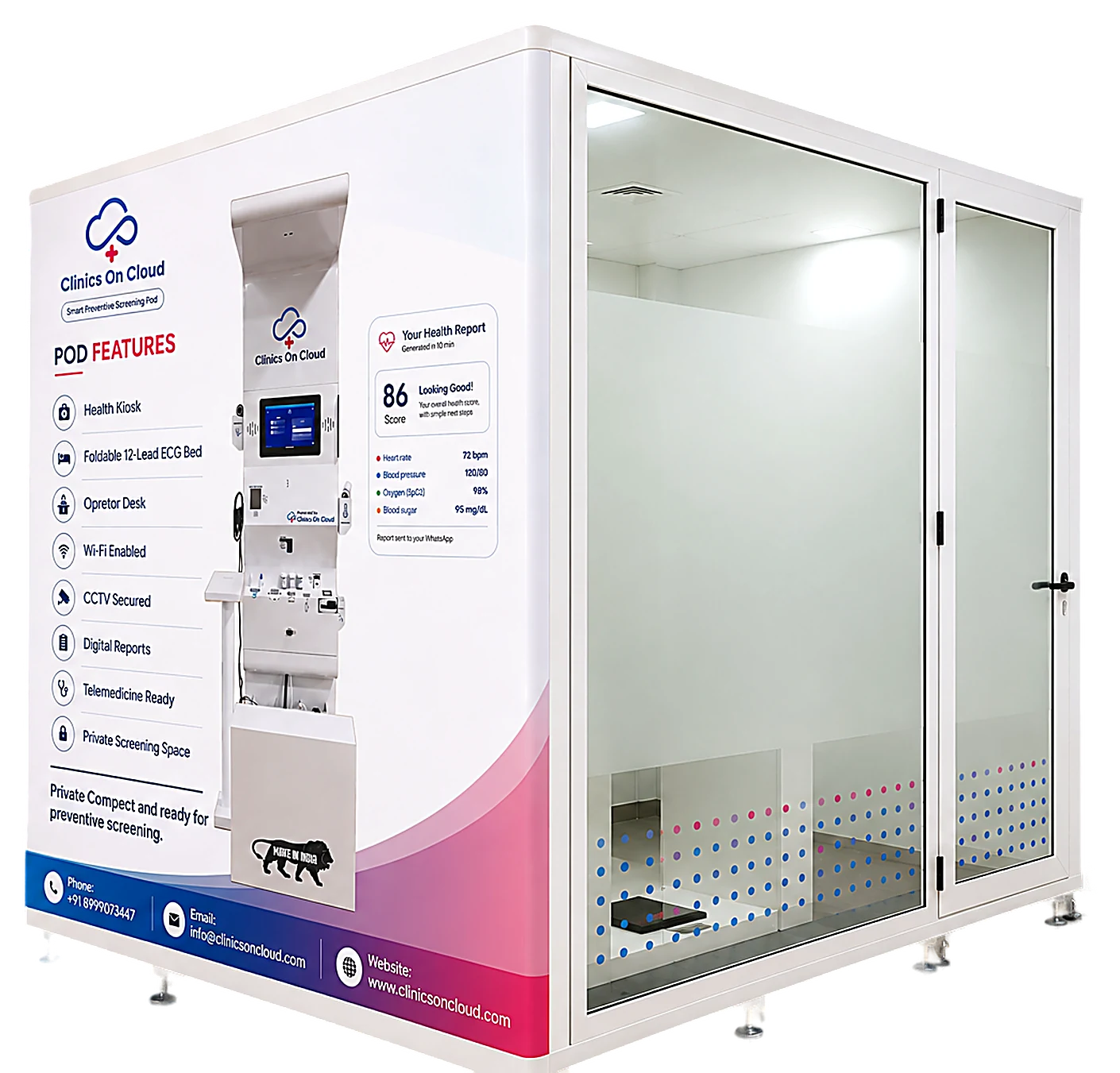
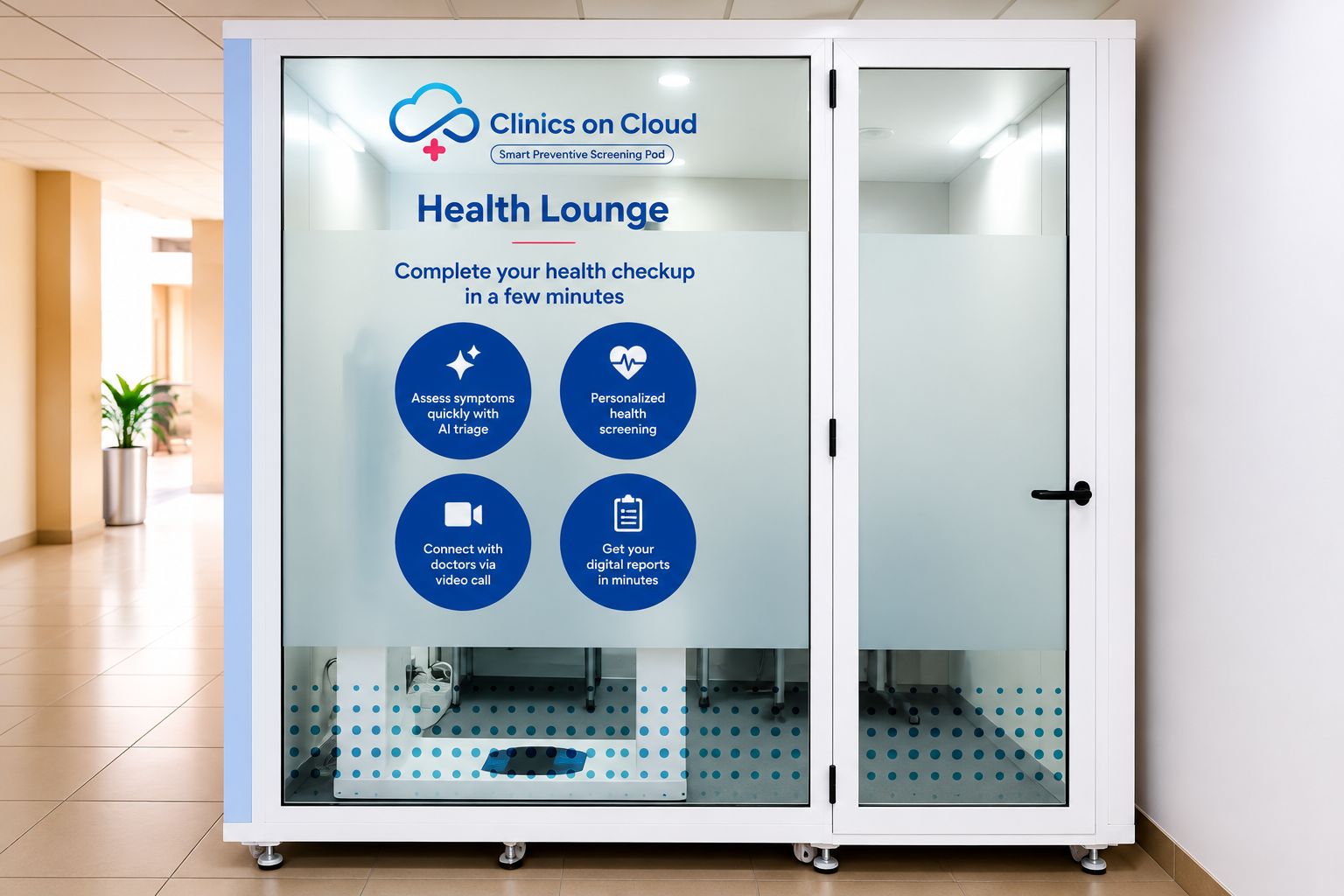
Health Lounge. A branded wellness suite: an open, designed space inside an office or community building, with seating, a checkup bay and a hospitality feel. Larger footprint, higher throughput, built for participation.
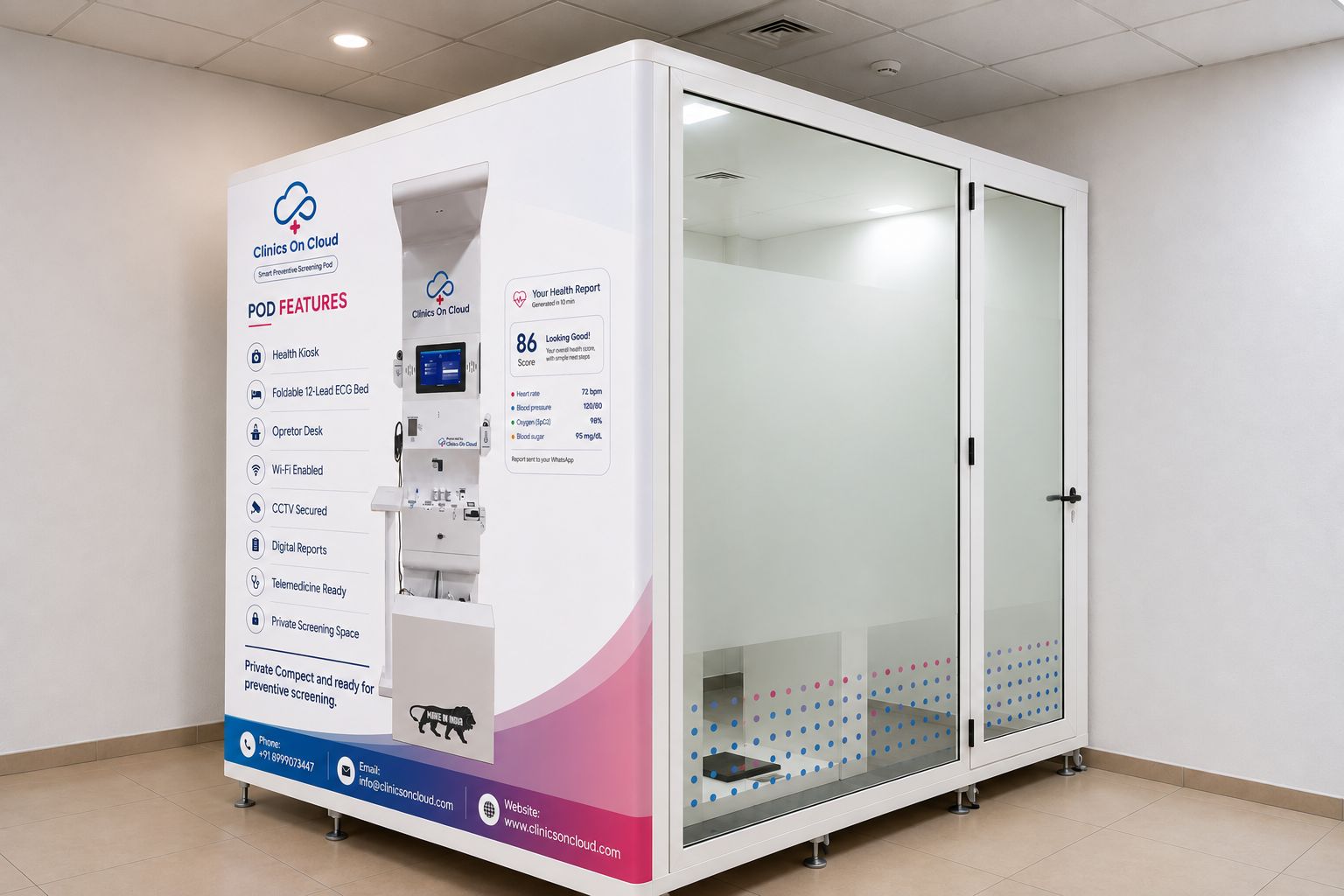
Health Pod. An enclosed, single-occupancy booth. Small footprint, acoustic and visual privacy, for settings with no private room available.
Health ATM / Health Kiosk. The open self-service screening station. Smallest footprint, lowest cost per screening, no enclosure.
Box Clinic. The portable clinic in a suitcase, carried to the population by one health worker.
The clinical payload is the same across all four: 65+ clinical parameters across 14 specialties, a full checkup in 10 minutes, colour-coded reports and a doctor on video when a result is flagged. You are choosing an enclosure and a logistics model, not a level of care.
Read the last row carefully. The open kiosk has the lowest cost per screening of any format, so any decision to buy something else should be a deliberate purchase of privacy, experience or reach, made with open eyes.
Five questions that decide the format
Does a private room already exist at the site? If yes, a lounge or an open kiosk in that room beats an enclosed pod, because you are not paying twice for the enclosure.
How sensitive is the encounter? A teleconsultation about a flagged result needs acoustic privacy. If the site cannot supply it, buy the enclosure.
What is the site’s footfall pattern? Steady footfall favours an unattended format. Bursts at shift change favour the highest-throughput format you can afford.
Who will own the unit day to day? A lounge assumes a host. A pod and a kiosk assume nobody. A Box Clinic assumes a funded operator.
Is the population fixed or dispersed? Fixed populations are served by fixed formats. Dispersed populations need a Box Clinic or a Mobile Medical Unit, and no amount of specification fixes a coverage problem.
Answer all five before you take a vendor meeting. The answers are the brief you hand the vendor, and a good one will change your mind on at least one.
Which format suits your setting?
Eight settings cover most Indian deployments. Each recommendation below assumes the questions above have been answered honestly, and each is a starting point for a site survey rather than a substitute for one.
Corporate head office
A Health Lounge is usually right, because the constraint is willingness rather than access. A designed space raises participation, and a head office has both the footprint and the reason to brand it. Reliance runs a Health Kiosk and a Health Lounge at its corporate headquarters, installed in July 2026.
Factory or plant
An open Health Kiosk on the shift-change route, specified rugged, with pulmonary function, audiometry and vision prioritised for the occupational risk profile. Where the shop floor has no private space at all and a teleconsultation matters, an enclosed pod on the floor is the alternative.
Mall or retail
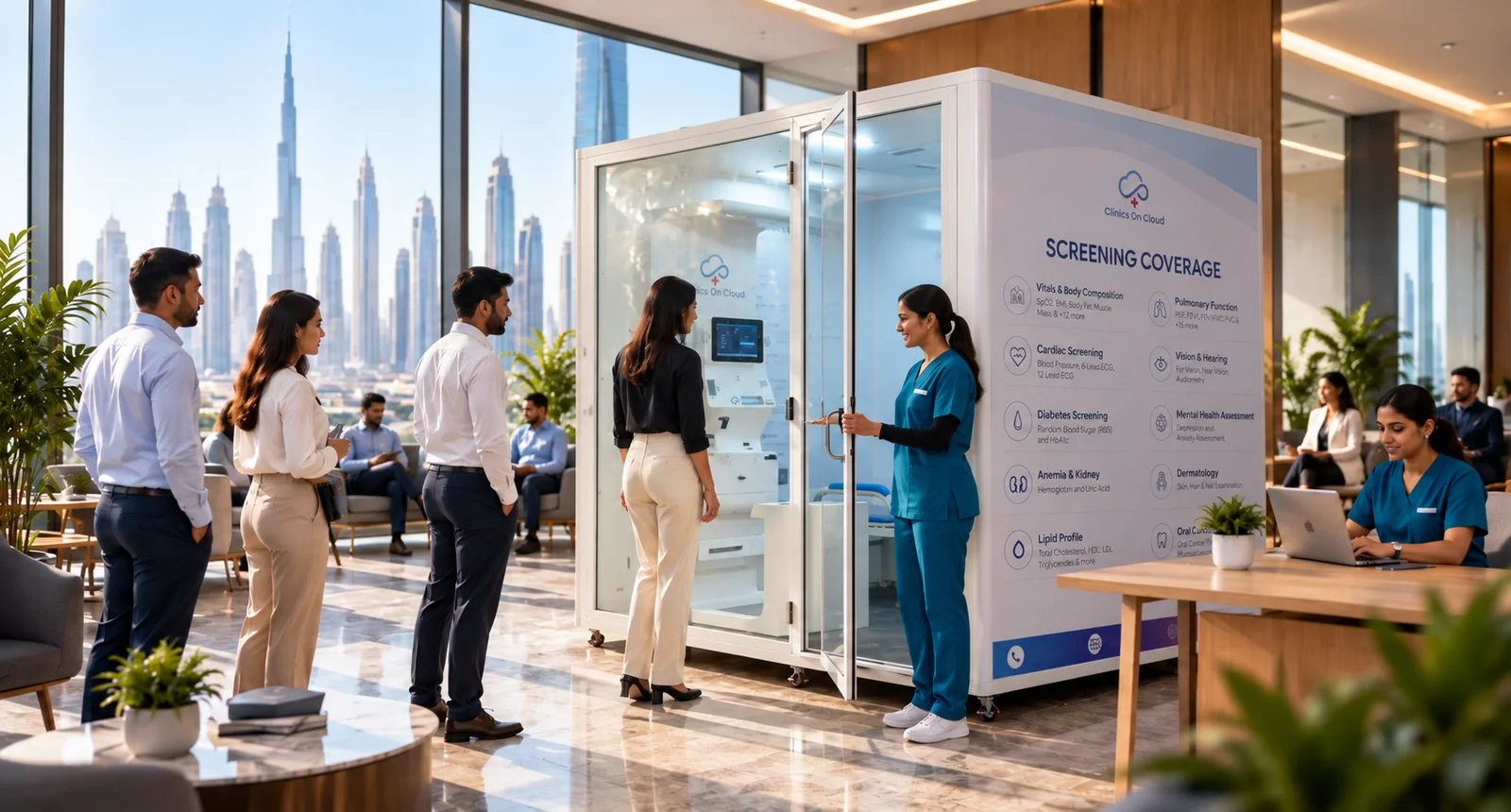
An enclosed pod. Malls have footfall and no private room, and the booth doubles as a landmark object. Specify vandal resistance, cleaning turnaround and a cashless access model, because the unit runs unattended in a public setting.
Airport or transit hub
An enclosed pod, for the same reasons as a mall plus one more: transit users are time-bound and alone, so a private ten-minute session fits the dwell time better than an open station in a concourse.
Hospital OPD
An open kiosk. The clinical environment already supplies privacy where it is needed, and the job here is throughput and triage load relief. Prioritise integration with hospital systems and ABHA linkage under the Ayushman Bharat Digital Mission.
Residential society or RWA
An open kiosk in the clubhouse or community hall where one exists, since the space is already private and residents return repeatedly. A pod suits a society with high footfall and no dedicated room, particularly where the unit sits in a lobby.
University or college campus
An open kiosk, usually two smaller units rather than one larger one, because walking distance drives participation on a campus. Prioritise vision, audiometry and the PHQ-9 and GAD-7 mental health screeners, with a clear consent flow for students.
Government building
An open kiosk with telemedicine, ABHA and eSanjeevani integration, offline capability and 3-4 days of battery backup. Service reach matters more than specification here, because a unit in a district office is only useful if an engineer can reach it.
How do you size the format to headcount?
Size on realistic screenings per year, not on the 10-minute checkup arithmetic. Theoretical throughput always overstates reality, because registration, queueing, no-shows and teleconsultation minutes all consume the day.
Work through four numbers in order:
Eligible population per site. Not total headcount; the people who can physically reach the unit.
Target screening frequency. Annual, half-yearly or quarterly. Frequency drives the number of units far more than headcount does.
Realistic sessions per working day, after allowing for turnaround. An enclosed pod’s cycle is the session plus its cleaning interval, not the session alone.
Peak, not average. A plant’s demand arrives in shift-change spikes. A campus’s arrives in the first fortnight of term.
Two rules that hold across deployments. Two smaller units usually beat one larger one wherever the population is spread across a campus, because walking distance is the real constraint on participation. And budget for the follow-up, not only the screening, since flagging a large number of people with no plan to consult them is a reputational cost rather than a health outcome.
What if your people are not in one place?
No fixed format solves a coverage problem. If your population is dispersed across villages, worksites, plantations or a district, the honest answer is a mobile format, and buying a beautiful lounge at head office will not change that.
Mobile Medical Unit
Box Clinic
Any fixed format
Brings space with it
Yes; separate consultation and examination zones
No; uses the venue
No
Reach
A route of settlements
Household and camp level, on foot if needed
One site
Setup per session
Park and open
Opens onto a table
None after installation
Team
Clinical team plus driver
One trained health worker
None to one host
Main cost driver
Fuel, staff and scheduling
The operator’s day, in every screening
Consumables and AMC
Detail on each: what a Mobile Medical Unit is and the portable Box Clinic format, with specification on Box Clinic. The common mistake is buying a vehicle without funding the route: over five years the vehicle is the cheap part, and fuel, staff and scheduling are the expensive parts.
Running more than one format across an estate
Multi-format estates are normal and usually correct, because a national employer does not have one kind of site. A lounge at head office, rugged kiosks at the plants, an enclosed pod in the public-facing lobby and a Box Clinic for dispersed field teams is a coherent estate, not an indecisive one.
What must be standardised centrally, regardless of format:
One analytics dashboard covering every site, so the group programme owner sees one view.
One parameter configuration standard, varied only where an occupational risk profile requires it.
One data and consent policy. Individual results go to the individual; sponsors and employers receive de-identified aggregate reporting only, and screening data must never inform employment decisions.
One service level framework, with response times set by city tier rather than by format.
One consumable supply route, because stockouts, not faults, are what stop most units.
Buying all formats from a single manufacturer is what makes that standardisation possible. Clinics On Cloud builds all four on a common software layer, manufactures at Chakan MIDC in Pune, and is India’s first CDSCO-licensed Health ATM and Health Kiosk manufacturer.
Common format-selection mistakes
Buying a lounge for a coverage problem. A designed suite at head office does nothing for the plant in a district town.
Buying an enclosure you do not need. If the site already offers a private room, you are paying twice for privacy.
Ignoring privacy where it matters. If people will not use the unit because colleagues can see the screen, the footprint saving costs you the entire programme.
Sizing on theoretical throughput. The 10-minute checkup is the device time, not the cycle time.
Treating the hardware as the deliverable. The deliverable is what happens after the test: the record, the consultation and the follow-up.
Choosing the format before the site survey. The building decides more of this than the brochure does.
Buying one format for a mixed estate. A national employer does not have one kind of site, so a single standard format guarantees a poor fit somewhere.
Forgetting the consent and data policy. Individual results go to the individual, and sponsors see de-identified aggregate reporting only. Settle that before the first unit is ordered, not after the first complaint.
Clinics On Cloud provides preventive health screening and is not a diagnostic laboratory. Screening results are indicative and are not a diagnosis. Always consult a qualified physician before acting on any health information.
health-loungeHealth LoungeDeep Dive
Join the conversation
Leave a comment.
Add your comment
Your email is never published. Comments appear after a quick review.
Plan an on-site employee health screening day in Dubai: goals, space, schedule, consent, follow-up and how to measure results. Includes a printable checklist.
Planning to install a health pod? Compare formats, tests, space, compliance and support so you choose the right health pod for your workplace or community.
Health lounge vs health pod: what is the difference?
A Health Lounge is a branded wellness suite: an open, designed space inside an office or community building, room-scale, with seating and a hospitality feel. A Health Pod is an enclosed single-occupancy booth with a door, small in plan, built to supply privacy where the site has none. The clinical screening inside both is the same.
Which health screening format is best in India?
No format is best in general. The right one is set by available space, the privacy the encounter demands, the throughput required, and whether the population comes to a fixed point. Clinics On Cloud supplies a Health Lounge, an enclosed pod format, the open Health ATM or Health Kiosk, and the portable Box Clinic, across 3,500+ installations.
Which format gives the lowest cost per screening?
The open Health ATM or Health Kiosk, because it runs unattended, needs no enclosure and screens every day the site is open. A pod adds cleaning turnaround, a lounge adds space and usually a host, and a portable Box Clinic embeds an operator’s day in every session. Choose anything else deliberately.
Should a corporate office buy a health lounge or a health kiosk?
Buy the kiosk if the constraint is coverage and cost per screening, and the lounge if the constraint is willingness. Many head offices run both, as at the Reliance corporate headquarters. A kiosk gets people screened; a lounge gets more of them to turn up and to take the result seriously.
Which format suits a mall or an airport?
An enclosed pod. Both settings have high footfall, no private room and no staff member beside the unit, which is exactly the case the booth is built for. Specify vandal resistance, ventilation, cleaning turnaround and a cashless access model, and read best health pod manufacturer in India before shortlisting.
How many units does a large campus need?
Size on realistic screenings per year rather than on checkup duration. Work out the eligible population per building, the target screening frequency, the realistic sessions per working day after turnaround, and the peak rather than the average. Two smaller units usually beat one larger one, because walking distance drives participation.
When is a Mobile Medical Unit better than a fixed format?
When the population is dispersed and no single site gathers it. A Mobile Medical Unit brings its own consultation and examination space along a route of settlements; a Box Clinic reaches households and camps on foot. No fixed format solves a coverage problem, however well specified. Budget the route, not just the vehicle.
How much does a health lounge or health pod cost in India?
Both are priced by configuration rather than list price, so ask for a written quotation against your site list. As bands, the open Health ATM or Health Kiosk sits at entry to mid, an enclosed pod at mid, and a Health Lounge at mid to high. Contact Clinics On Cloud on +91 8999 073 447.
Is a screening format accurate enough to be worth buying at all?
Device accuracy is 90-95% depending on the test and device, under correct usage, calibration and patient preparation. None of these formats is a diagnostic laboratory or replaces one; they screen, flag and route people to a doctor earlier than they would otherwise have gone. Most buyers keep a pathology partner for confirmatory testing.
Can we run more than one format and still report centrally?
Yes, and most multi-site organisations should. Clinics On Cloud builds all four formats on a common software layer, so one analytics dashboard covers every site. Standardise the parameter configuration, data and consent policy, service levels and consumable supply centrally, then let each site vary only by format and placement.
Get In Touch
Healthcare is a right. Not a privilege.
We started Clinics on Cloud with a simple belief - that the quality of your healthcare should not depend on your postcode. Whether you're a government, corporate, NGO or entrepreneur - we built this for you.
Call us
+91 8999 073 447
Mon - Sat · 9 AM to 6 PM IST
Write to us
sales@clinicsoncloud.com
Partnerships · Deployments · Support
Visit us online
www.clinicsoncloud.com
Products · Case Studies · News
Find us
Nighoje, Chakan MIDC
Pune, Maharashtra - 410501, India
Built for every kind of health partner.
Government Body Corporate / HR Team NGO / CSR Partner Hospital or Clinic Defence Organisation International Partner Investor / Distributor Rural Entrepreneur
 Entry · HL-39Health Lounge