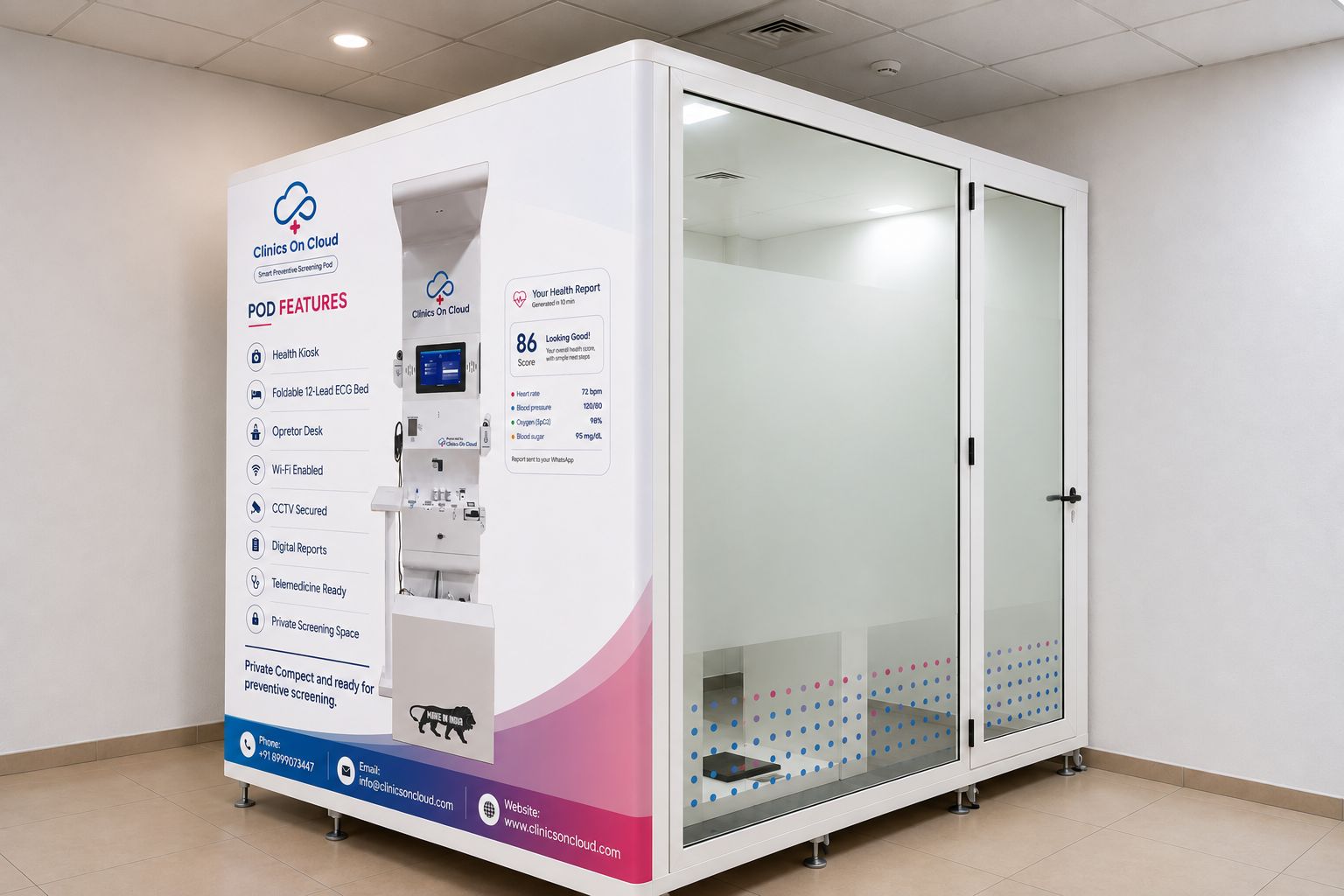
 Entry · HL-65Health Lounge
Best Health Lounge / Health Pod in India
Health lounge vs health pod: compare footprint, privacy, throughput, staffing and cost across four screening formats, then match one to each of your sites.
Read story 12 min read
Choosing a health pod manufacturer in India? Compare ventilation, privacy, durability, uptime and cost for enclosed screening booths, then get a quote.
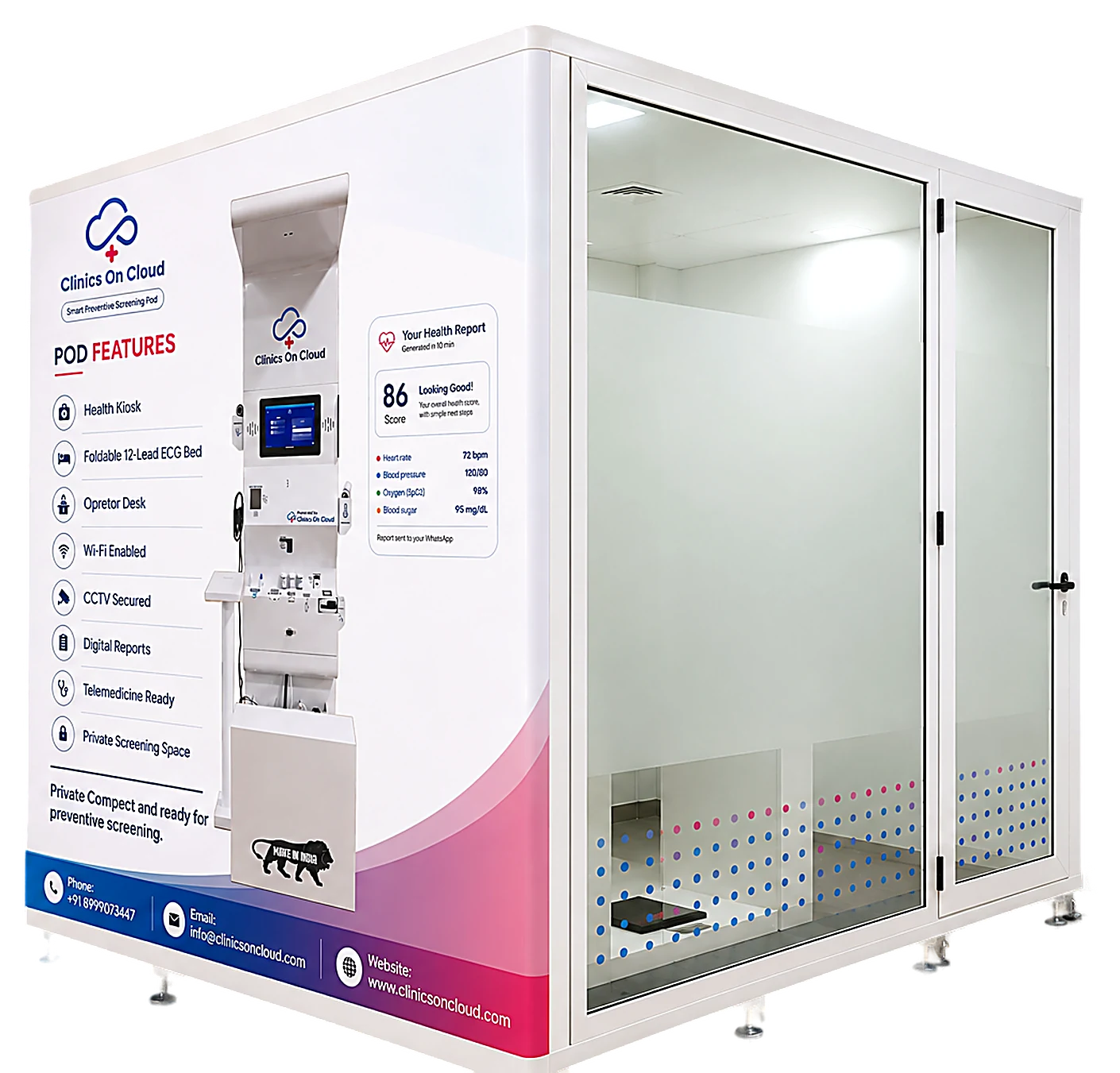
A health pod is an enclosed, single-occupancy screening booth. Clinics On Cloud builds enclosed pod-format units under CDSCO licence at Chakan MIDC, Pune, and a full checkup inside one takes 10 minutes. Buyers should judge an enclosed booth on ventilation, acoustic privacy, cleaning turnaround, vandal resistance and unattended uptime, not on parameter counts alone.
This page is about buying an enclosed booth, not defining one. For the terminology and format explainer, read what a healthcare pod or care pod actually is.
Put a door on a screening station and you inherit problems an open kiosk never has: air, sound, light, cleaning, and what happens at 9pm in a mall when nobody is watching. Those problems, not the parameter list, decide whether a pod programme survives its second year.
An enclosed pod is bought for privacy in a place that has none. That single requirement changes the specification, the site survey and the service contract.
A Health Kiosk is open, so the building supplies air, light and the acoustic environment. A Health Lounge is a designed room, so the room handles them. A pod supplies all three itself, inside a box about the size of a lift car, for someone who may be alone in it for ten minutes with the door shut.
Three consequences follow, and they are where pod procurement goes wrong:
The clinical payload is common across formats: 65+ clinical parameters across 14 specialties, colour-coded reports, and a doctor on video when a result is flagged. Specify the enclosure separately, by name, in the quotation.
Confirm the pod is the right buy before shortlisting manufacturers.
| Health Pod (enclosed booth) | Health Lounge (branded suite) | Health ATM / Kiosk (open station) | |
|---|---|---|---|
| Enclosure | Full, with a door | Designed room-scale space | Open or semi-open |
| Visual and acoustic privacy | High, engineered into the unit | High, delivered by the room | Partial; depends on placement |
| Throughput | Session plus turnaround | Moderate by design | Highest |
| Typical setting | Mall, airport, transit hub, lobby, shop floor | Corporate HQ, campus, community building | Hospital OPD, PHC, pharmacy, factory gate |
| Cleaning burden | Highest; a sealed interior between users | Managed by facilities | Lowest; wipe-down of contact surfaces |
| Cost band | Mid | Mid to high | Entry to mid |
The rule of thumb: buy the pod when the site has footfall but no private room. Where a private room exists, a lounge does more with the same money. Where privacy is not the constraint, an open kiosk screens more people per rupee. Longer version in choosing between a Health Lounge, a Health Pod and a Health ATM.
A pod occupies a small floor area but concentrates real weight into it, so the site survey question is loading, not area. A steel-shelled cabin carrying medical devices, an air-conditioning unit and a battery is heavier per square foot than anything else on that floor plate.
Ask for overall dimensions, operating weight and point loads at the feet, then put those figures to the building’s structural consultant. On an upper floor, a mezzanine or an older retail slab, that is a real check rather than a formality.
The rest of the access survey:
Yes, and ventilation is the most commonly ignored specification in an enclosed health pod. A person sitting in a sealed cabin for ten minutes with the door closed judges the whole programme on whether the air felt fresh.
Air conditioning is not ventilation. A recirculating cooler drops the temperature while moving the same air around the cabin. What you are buying is fresh-air exchange: how outside air enters, how stale air leaves, and how fast the cabin turns over.
Put six questions to every manufacturer, and take the answers in the technical datasheet rather than an email:
Clinics On Cloud builds its enclosed units with internal climate control, and the published specification describes an air-conditioned cabin. Ask for figures against your exact configuration, since they move with cabin size and device load.
Acoustic privacy is the reason a pod exists, and it is what makes the teleconsultation usable. A person will not discuss a flagged blood sugar result on video if the queue outside can hear it.
Sound travels both ways. Ask what the shell and door are built from, whether the door carries an acoustic seal, whether the glazing is laminated, and whether sound reduction has been measured. Then ask what most buyers forget: how loud is the pod’s own air conditioning inside the cabin, because a noisy fan ruins a video call as thoroughly as a thin wall.
Lighting is the second half of the same problem. A booth needs even, shadow-free light on the face for a video consultation and on the arm for a sample step, without glare on the touchscreen. Specify a neutral colour temperature, diffused sources rather than a single downlight, and a level that does not change when the door closes. Both are cheap at design stage and impossible to retrofit.
In a public setting, cleaning turnaround is a throughput number, not a housekeeping detail. Every minute of cleaning between users is a minute the pod cannot screen.
Design the protocol into the procurement:
Size the deployment on session plus turnaround, not on the 10-minute checkup alone.
A pod in a public place is street furniture with medical devices inside it, and must be specified as such. Malls, airports, transit hubs and factory floors share one risk profile: heavy use, no supervision, occasional deliberate damage.
| Risk | What to ask for |
|---|---|
| Forced entry | Steel shell, concealed fixings, tamper-resistant fasteners, lockable service panels |
| Glass damage | Laminated or toughened panels; frosted glass for privacy and impact resistance |
| Screen damage | Toughened, bonded touchscreen rated for public use |
| Misuse and occupancy | Occupancy detection, session timeout, remote door release, emergency call button |
Clinics On Cloud manufactures rugged metal enclosures with 3-4 days of battery backup and offline capability, so a unit keeps screening through a power or network interruption and synchronises later. Ask for the ingress protection rating and the spares list as annexures to the quotation.
Decide the access model before the specification, because it changes the hardware. A pod taking payment needs different components from one that opens on a badge.
Whichever you choose, confirm three things in writing: how a user is identified, whether ABHA linkage under the Ayushman Bharat Digital Mission is offered, and how the individual receives the report. Reports reach the individual by print, WhatsApp, SMS or email. Where an employer or sponsor funds the pod, that sponsor receives de-identified aggregate reporting only, never named results, and screening data must never inform employment decisions.
An unattended pod is only as good as the day you find out it has stopped working. In a staffed clinic somebody reports a fault. In a transit hub, a dead pod sits dark for a fortnight.
Specify remote monitoring as a contractual deliverable rather than a feature. The dashboard should report per unit: power state, network state, session counts, device-level faults, consumable levels, calibration due dates and occupancy anomalies. Ask whether alerts reach your team as well as the manufacturer’s service desk.
On power, ask for the connected load, whether a dedicated circuit is needed, and what happens on an outage. Clinics On Cloud units carry 3-4 days of battery backup and operate offline, syncing when connectivity returns. Screening survives an outage; the live consultation needs a working data connection, so plan connectivity around that step. Then put an uptime commitment in the AMC, with a response time measured at that site rather than at the vendor’s head office.
Clinics On Cloud, operated by SehatPro Technologies Pvt Ltd, manufactures at Nighoje, Chakan MIDC, Pune, and is India’s first CDSCO-licensed Health ATM and Health Kiosk manufacturer, with 3,500+ installations across 200+ cities and 8+ countries. Compliance covers CDSCO, ISO 13485, US FDA, CE, ISO 27001, HIPAA, GDPR and VAPT testing. Pricing varies by configuration: request a written quotation.
Cost drivers, in order of impact:
Build a five-year cost model and label it illustrative. Take capital cost, consumables per screening, AMC, cleaning, connectivity and payment charges, divide by the screenings you genuinely expect after allowing for turnaround, and treat the answer as a planning assumption, never an achieved outcome. Fuller vendor-evaluation logic sits in how to choose a Health ATM manufacturer in India.
Ask for documents against every point, not assurances.
For a site survey or a configuration quote, call +91 8999 073 447 (Mon-Sat, 9:00-18:00 IST) or email sales@clinicsoncloud.com. Buyers weighing a branded suite instead should read best health lounge manufacturer in India, and see the Health Kiosk and Health Lounge installed at Reliance corporate headquarters.
Clinics On Cloud provides preventive health screening and is not a diagnostic laboratory. Screening results are indicative and are not a diagnosis. Always consult a qualified physician before acting on any health information.
Your email is never published. Comments appear after a quick review.
Entry · HL-65Health LoungeHealth lounge vs health pod: compare footprint, privacy, throughput, staffing and cost across four screening formats, then match one to each of your sites.
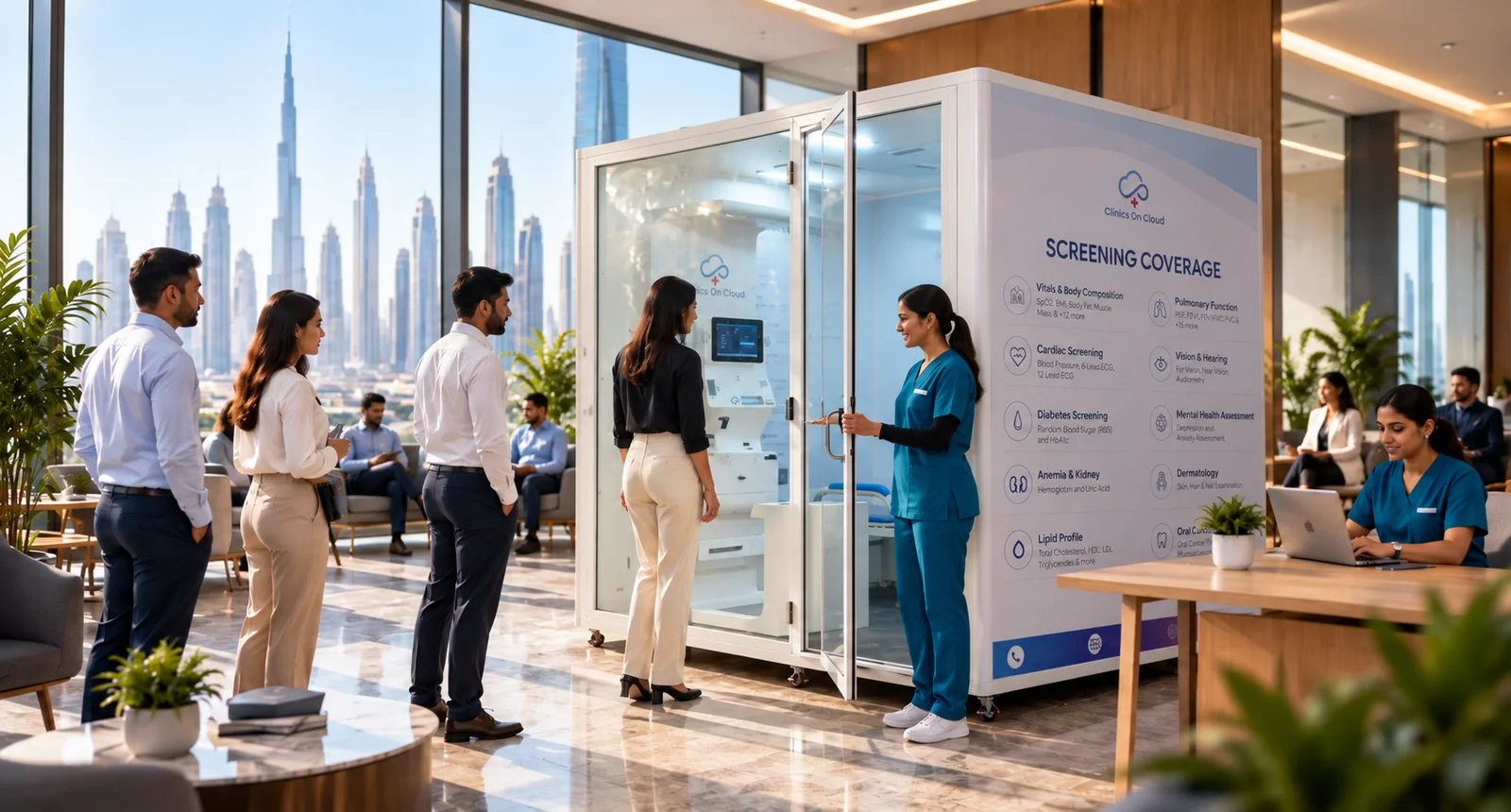 Entry · HL-39Health Lounge
Plan an on-site employee health screening day in Dubai: goals, space, schedule, consent, follow-up and how to measure results. Includes a printable checklist.
Entry · HL-35Health LoungePlanning to install a health pod? Compare formats, tests, space, compliance and support so you choose the right health pod for your workplace or community.
Judge it on enclosure engineering, not brochure photographs. Clinics On Cloud, operated by SehatPro Technologies Pvt Ltd, manufactures enclosed screening units at Nighoje, Chakan MIDC, Pune, and is India’s first CDSCO-licensed Health ATM and Health Kiosk manufacturer. It runs 3,500+ installations across 200+ cities and 8+ countries, holding CDSCO, ISO 13485, US FDA, CE and ISO 27001 credentials.
Health pod pricing varies by configuration rather than following a list price. Parameter set, enclosure engineering, ventilation and acoustic treatment, public-site hardening, payment hardware, software scope and service level all move the figure. Request a written quotation and a five-year total cost of ownership from Clinics On Cloud.
A pod is single-occupancy and small in plan, but the binding constraints are usually weight and access rather than area. Ask for overall dimensions, operating weight and point loads, then confirm floor loading with the building’s structural consultant. Check door widths, lift dimensions and turning circles on the delivery route.
Yes. Air conditioning cools recirculated air; ventilation exchanges it, and a sealed cabin occupied for ten minutes needs both. Ask for the fresh-air exchange rate as a stated figure, the filter grade and change interval, whether the fan runs continuously, and how the cabin ventilates if power fails.
That depends on the build, which is why acoustic performance belongs in the specification. Ask what shell and door are made of, whether the door carries an acoustic seal, whether sound reduction has been measured, and how loud the air conditioning is during a call. A quiet, well-lit cabin makes the teleconsultation usable.
Yes, provided it is specified as public street furniture. Ask for a steel shell with concealed fixings, laminated or toughened glazing, a public-rated touchscreen, internal cable routing, occupancy detection, session timeout and an emergency call route. Clinics On Cloud units are rugged, offline-capable and hold 3-4 days of battery backup.
Four models are common: employer or sponsor funded with badge, OTP or QR access; coupon and voucher codes from an insurer, hospital or CSR programme; cashless pay-per-session by UPI or card; and subscription screening for a defined population. Confirm payment integration, settlement and reconciliation before the build is finalised.
Lead time is driven by build and configuration rather than shipping, so get the committed date into the quotation. An annual maintenance contract should cover preventive visits, device calibration, software updates, remote monitoring and a defined response time, with a comprehensive variant covering parts. Consumables and cleaning are billed separately.
We started Clinics on Cloud with a simple belief - that the quality of your healthcare should not depend on your postcode. Whether you're a government, corporate, NGO or entrepreneur - we built this for you.
+91 8999 073 447
Mon - Sat · 9 AM to 6 PM IST
sales@clinicsoncloud.com
Partnerships · Deployments · Support
www.clinicsoncloud.com
Products · Case Studies · News
Nighoje, Chakan MIDC
Pune, Maharashtra - 410501, India