HomeBlogRole of Health Kiosks in ECG, Lipid Profile, and Blood Pressure Monitoring
Article16 December 20245 min
Role of Health Kiosks in ECG, Lipid Profile, and Blood Pressure Monitoring
In today’s fast-paced world, health kiosks are emerging as game-changers in the medical field. Offering convenience, accuracy, and accessibility, these cutting-edge devices are revolutionizing preventive healthcare. They provide quick diagnostic tests for critical health parameters such as 6 Lead ECG / 12 Lead ECG, Lipid Profile (including TC, TG, HDL, LDL, and TC/HDL Ratio), and Blood Pressure. T
CCClinics On Cloud TeamPublished from Pune, India
Health ATM
“
A cardiac screening programme uses health kiosks to screen a whole population for ECG, blood pressure and lipid risk, then routes flagged individuals into clinical follow-up. Clinics On Cloud operates 3,500+ installations across 200+ cities, has screened 12M+ patients, and has identified 2 lakh+ abnormalities for early intervention.
What a cardiac screening programme actually is
A cardiac screening programme is not a device purchase. It is a workflow with four parts: reach a population, take the measurements, route flagged individuals into care, and prove the routing happened. Most organisational screening fails at part three. A camp runs, reports are handed out, and nobody knows who acted on them. The measurement was never the hard part.
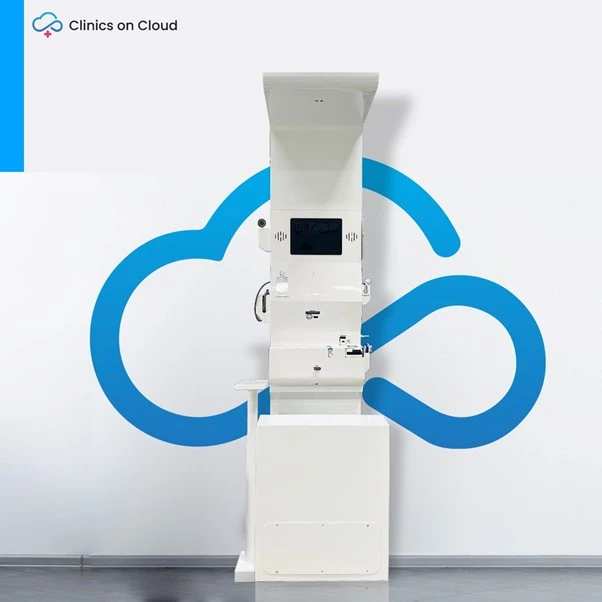
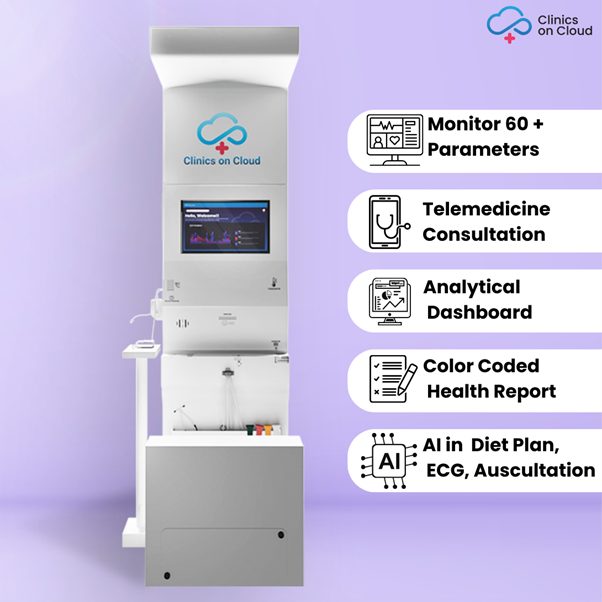
The Clinics On Cloud Health ATM screens 65+ clinical parameters across 14 specialties in a 10-minute checkup, 9 of them cardiac. This page covers the programme around that device; for what each test measures clinically, read what an ECG, blood pressure reading and lipid profile each measure. Clinics On Cloud is India’s first CDSCO-licensed Health ATM and Health Kiosk manufacturer, operating from Nighoje, Chakan MIDC, Pune, under SehatPro Technologies Pvt Ltd.
The four deployment models
Model
Buyer
Siting
Cadence
Product fit
The binding constraint
Corporate wellness
HR, benefits lead
Office lobby, cafeteria approach
Always-on, self-serve
Health Kiosk, Health Lounge
Participation, not capacity
Factory and plant workforce
Occupational health, EHS, plant head
Plant gate, shift-change corridor, canteen
Always-on, plus periodic drives
Health Kiosk
Shift timing and queue at gate
CSR and community camps
CSR head, foundation, implementing partner
Village centre, school, panchayat office
Campaign cycles
Box Clinic, Mobile Medical Unit
Follow-up after the camp leaves
Hospital OPD triage
Hospital administrator, medical superintendent
OPD waiting area, registration desk
Continuous during OPD hours
Health Kiosk
Integration with the OPD queue
Each model breaks in a different place. Corporate wellness has no capacity problem and a severe participation problem: employees will not walk to a screening, so the kiosk must sit in the path they already take. Factory workforces have the opposite problem, because at a gate where a full shift crosses at once the queue is the constraint; enable a short package for walk-ins and reserve the full session for scheduled slots.
CSR camps have a continuity problem instead. The Box Clinic arrives, screens a village and leaves, and without a named local follow-up partner the flags go nowhere. Clinics On Cloud has run this pattern for Indian Army, BSF, NHM Uttar Pradesh, which deployed 200 Health ATMs, and Government of West Bengal employee screening.
Hospital OPD triage has the clearest immediate return, because patients are already waiting. A kiosk in the waiting area captures vitals, blood pressure and an ECG trace before the consultation, so the physician opens with data. OPD installations include AIIMS Rishikesh and Mathura District Hospital; corporate deployments include Reliance, Tata Power, Godrej, Bajaj Allianz, Hewlett Packard, Konica Minolta, IDBI, Medi Assist and ALMAS Hospital.
Where to site a kiosk, and why it decides everything
Siting is the largest single determinant of a programme’s output, and it is usually decided by whoever has spare floor space. Four rules, in order of importance.
Put it in an existing path, not a destination. The cafeteria approach, the gate corridor, the OPD waiting area, the lift lobby. People screen when screening costs no detour.
Give it visual privacy without hiding it. A station in full view of a manager’s desk kills uptake; so does a locked room nobody enters. A screened alcove off a busy corridor works.
Solve for the second visit, not the first. The first screening is driven by novelty, the second by wanting to see whether a number moved.
Check power, network and footfall before the enclosure. The Health ATM is offline-capable with 3–4 days of battery backup, which removes most of the infrastructure objection.
For multi-site organisations, sequencing matters more than siting. Deploy at two contrasting sites, measure for a quarter, then roll out with a tested pattern.
Programme metrics: what to measure and how
Screening programmes are usually reported as a count of tests performed, which is close to meaningless. These are the metrics that tell you whether the programme is working.
Metric
How to calculate it
Why it matters
Participation rate
Unique individuals screened ÷ eligible population
The ceiling on everything else. A programme reaching 15% of a workforce cannot deliver population-level value.
Repeat rate
Individuals with 2+ screenings ÷ individuals screened
Distinguishes a screening programme from a one-off event. Trends need repeats.
Coverage of the target cohort
Individuals screened in the high-risk cohort ÷ that cohort
Programmes often over-reach the already-health-conscious and miss the group that needs it.
Flag rate
Screenings with one or more parameters outside range ÷ screenings
Your programme’s yield. Compare across sites to find where risk concentrates.
Teleconsultation uptake
Flagged individuals who took the on-kiosk consultation ÷ flagged individuals
The first point where a programme leaks.
Referral completion
Flagged individuals with a confirmed clinical follow-up ÷ flagged individuals
The only metric that represents a health outcome rather than an activity.
Time to follow-up
Median days from flag to confirmed clinical contact
Short is the whole point of screening at the point of presence.
Throughput at peak
Screenings completed ÷ peak hour
Determines whether the queue, not the population, is your constraint.
The number your CFO will ask for. Amortise honestly.
Cost per abnormality identified
Total programme cost ÷ flagged individuals routed to follow-up
The number that actually justifies the programme.
Set your own baselines from your first quarter rather than importing benchmarks, because flag rates vary with the age and occupational profile of the population. Report referral completion to leadership from month one, because a programme measured on tests performed will optimise for tests performed.
A 10-minute full checkup sets a theoretical ceiling of six full sessions per kiosk-hour; real throughput is lower once you allow for arrival gaps and package mix. The Clinics On Cloud centralised multi-location analytics dashboard reports these metrics across sites, which is what makes multi-plant and multi-district programmes governable rather than anecdotal.
Who should be screened in an organisational programme
Universal offer, prioritised outreach. Open the kiosk to everyone, then actively pursue the highest-yield groups.
Everyone over 30 in the eligible population, the default cohort for workplace non-communicable disease screening, aligned with National Health Mission NCD priorities.
The full shop-floor and shift-working population, at any age. Rotating shifts and physical exposure change the risk profile.
Anyone with a family history of heart disease, stroke, hypertension or high cholesterol, and tobacco users and smokers.
Field staff, drivers and logistics workers, often the least covered group in a corporate health benefit and frequently the highest risk.
Anyone previously flagged and not yet followed up. Your highest-priority outreach list, and the one most programmes never build.
Exclusions and routing. Anyone with active chest pain, breathlessness, palpitations with dizziness or fainting goes to emergency care immediately. Employees with implanted cardiac devices should follow their clinician’s guidance. Do not make participation a condition of employment or tie it to performance review or insurance eligibility; coerced screening produces attendance and destroys trust.
The referral pathway: what happens after a flag
Design this before you order the hardware. It produces the value, and it is the part most commonly left undefined.
Flag at the machine. A colour-coded report prints instantly and is sent by SMS, email and WhatsApp.
Immediate teleconsultation. The kiosk offers a live doctor consultation on the spot, far more effective than asking the person to book one later.
Named referral destination. Every flag needs somewhere to go: occupational health, a panel hospital, the empanelled diagnostic partner or the district health facility. Name it before launch.
Confirmatory testing. Flags require confirmation by accredited laboratory or clinical assessment. Budget for the volume your flag rate generates; programmes forget this and the pathway stalls on cost.
Follow-up loop and reporting. A defined contact at a defined interval to confirm the person reached care, plus site and cohort dashboards, with individual reports going only to the individual.
For public-health programmes, teleconsultation can route through eSanjeevani and records can link to an ABHA number under the Ayushman Bharat Digital Mission.
What programme results indicate, and what they do not
At the individual level, a Clinics On Cloud report is colour-coded into three bands: within standard reference ranges, borderline, and outside range. The band is a routing instruction, not a conclusion. Reference ranges and cardiovascular risk thresholds follow standard clinical guidance from bodies including WHO and ICMR, vary with age, sex, pregnancy, medication and existing conditions, and are not set by Clinics On Cloud. Every individual should take their report to a qualified physician for interpretation.
At the programme level, three cautions apply.
A flag rate is not a prevalence figure. Your screened population is self-selected and your instruments are screening grade, so never publish a flag rate as a prevalence statistic about your workforce.
A falling flag rate is not proof of improvement. It can equally mean the people with problems stopped participating. Read it alongside participation and repeat rates.
Screening does not treat. The programme identifies and routes; outcomes come from the care people receive afterwards, which is why referral completion is the metric that matters.
Device accuracy is 90–95%, depending on the specific test and device, under correct usage, calibration and patient preparation. That is screening grade and appropriate for population screening; it does not replace accredited laboratory pathology or clinical assessment.
Consent, access and data governance
Screening employees creates obligations. Settle four things in writing before the first session.
Consent must be explicit, informed, revocable and separate from the employment contract.
Access rules. Individuals see their own reports; the organisation sees aggregate dashboards; line managers see nothing individual. Say so in writing, because the belief that a manager can see results is the most common cause of low participation.
Security and portability. Clinics On Cloud operates under ISO 27001, is HIPAA and GDPR compliant, and the platform is VAPT tested. Records link to an ABHA number so a history follows the individual. Ask any vendor for its ISO 27001 scope and data residency position in writing.
Regulatory. Confirm CDSCO licensing in India; Clinics On Cloud also holds ISO 13485, US FDA and CE.
Talk to the team
If you are designing a screening programme across plants, campuses, districts or OPDs, talk to our team about siting, cadence, referral workflow and dashboard design. Call +91 8999 073 447, Monday to Saturday, 9:00 to 18:00 IST, or email sales@clinicsoncloud.com.
Clinics On Cloud provides preventive health screening and is not a diagnostic laboratory. Screening results are indicative and are not a diagnosis. Always consult a qualified physician before acting on any health information.
Health kiosks are transforming the healthcare industry by providing convenient, accessible, and affordable healthcare services. These self-service machines offer a
Health Kiosk Manufacturers: Revolutionizing Healthcare Access and Affordability In today’s digital world, health kiosk manufacturers are changing how people access
How do you run a cardiac screening programme at scale?
Define the eligible population, site the kiosk in a path people already walk, enable a short cardiac and vitals package for walk-ins, and build a named referral pathway before launch. Measure participation, flag rate and referral completion rather than tests performed, using on-kiosk teleconsultation and a centralised analytics dashboard.
How many people can one health kiosk screen?
A full 65+ parameter checkup takes 10 minutes on the Clinics On Cloud Health ATM, a theoretical ceiling of six full sessions per hour per unit. Real throughput is lower because of arrival gaps and package mix, and most programmes run shorter packages at peak. Size capacity from your observed peak hour.
How do you increase participation in a workplace health screening?
Siting does most of the work. Place the kiosk in an existing path such as the cafeteria approach or the shift-change corridor, give it visual privacy, and state in writing that managers cannot see individual results. Offer the non-invasive general health block as the entry point; it needs no blood sample and completes fastest.
What happens after a screening flags an abnormal result?
The Clinics On Cloud kiosk offers a live doctor teleconsultation at the machine immediately, and a colour-coded report is printed and sent by SMS, email and WhatsApp. The programme then routes the person to a named referral destination for confirmatory testing. Screening flags are indicative and require confirmation by a qualified physician.
How much does a cardiac screening programme cost to run?
Indicative pricing for a Clinics On Cloud Health ATM starts from ₹6,00,000, with consumables and annual maintenance quoted separately. Budget three lines most programmes forget: confirmatory testing generated by your flag rate, staffing for follow-up, and the communications that drive participation.
Can a health kiosk triage patients in a hospital OPD?
Yes, and it is one of the highest-return deployments. A kiosk in the OPD waiting area captures vitals, blood pressure and an ECG trace before the consultation, so the physician opens with data instead of collecting it. Clinics On Cloud OPD installations include AIIMS Rishikesh and Mathura District Hospital.
Will employees trust a workplace screening programme with their health data?
Trust depends on governance, not technology. Individuals receive their own reports; the organisation receives aggregate dashboards only, with no individual visibility for line managers. Clinics On Cloud operates under ISO 27001, is HIPAA and GDPR compliant, and its platform is VAPT tested. State the access rules in writing before launch.
Can a screening programme run where there is no reliable power or internet?
Yes. The Clinics On Cloud Health ATM is offline-capable with 3–4 days of battery backup, and records sync when connectivity returns. For sites with no infrastructure, the Box Clinic covers camps and the Mobile Medical Unit rotates screening across villages and worksites.
Get In Touch
Healthcare is a right. Not a privilege.
We started Clinics on Cloud with a simple belief - that the quality of your healthcare should not depend on your postcode. Whether you're a government, corporate, NGO or entrepreneur - we built this for you.
Call us
+91 8999 073 447
Mon - Sat · 9 AM to 6 PM IST
Write to us
sales@clinicsoncloud.com
Partnerships · Deployments · Support
Visit us online
www.clinicsoncloud.com
Products · Case Studies · News
Find us
Nighoje, Chakan MIDC
Pune, Maharashtra - 410501, India
Built for every kind of health partner.
Government Body Corporate / HR Team NGO / CSR Partner Hospital or Clinic Defence Organisation International Partner Investor / Distributor Rural Entrepreneur
 Entry · HA-90Health ATM