Ear Health: Audiometry and Otoscope Features in Clinics On Cloud
Ear Health: Audiometry and Otoscope Features in Clinics On Cloud Ear health is a vital yet often overlooked aspect of
Read story 3 min
Dermatology Assessments Using Clinics On Cloud Skin, Hair, Nail Visualization
A skin analysis machine on a Clinics On Cloud kiosk is an imaging device that captures high-resolution photographs of skin, hair and nails so a qualified clinician can review them during a teleconsultation. It does not detect, diagnose or rule out skin cancer or any dermatological disease. Imaging sits within 65+ clinical parameters across 14 specialties.
Read this section before any other, because the boundary here is not a formality.
A Clinics On Cloud kiosk captures high-resolution images of skin, hair and nails. Those images are stored in the person’s digital health record and made available to a qualified clinician, usually through an integrated teleconsultation. That is the entire function.
The device does not diagnose. It does not detect skin cancer. It does not rule out skin cancer. It does not identify melanoma, does not grade a mole, does not name a rash, and does not decide whether any skin finding is harmless. No screening image on any kiosk can do those things, and any supplier who says otherwise is describing something a regulator has not agreed to.
Dermatological diagnosis requires a qualified dermatologist, in-person examination, dermoscopy where indicated, and in many cases a biopsy with histopathology. Clinics On Cloud is not a diagnostic laboratory and does not replace a dermatologist. Clinics On Cloud is India’s first CDSCO-licensed Health ATM and Health Kiosk manufacturer, based at Nighoje, Chakan MIDC, Pune, and its dermatology module is an imaging and referral tool, not an assessment engine.
If you have a mole, lesion, sore, patch or nail change that is new, changing, bleeding, non-healing or worrying you, see a qualified physician or dermatologist. Do not wait for a screening camp, and do not use any image-based tool, on a kiosk or on a phone, to reassure yourself.
Clinics On Cloud lists three dermatology parameters: skin visualisation, hair visualisation and nail visualisation. Each is a capture, not a verdict.
Skin imaging takes close-up, well-lit photographs of nominated skin areas, recording texture, surface appearance and pigmentation at a resolution far better than a phone snapshot in a village hall.
Hair and scalp imaging photographs the scalp surface and hair at close range, as they appear on the day of capture.
Nail imaging photographs the fingernails and, where relevant, the toenails, showing colour, shape and surface appearance.
The value is the same in every case. A clinician who cannot be physically present gets a clear, dated picture instead of a verbal description from someone who is not medically trained.
| Parameter | What is captured | How it is captured | What a clinician can use it for | What it is not |
|---|---|---|---|---|
| Skin visualisation | High-resolution images of nominated skin areas | Digital imaging module with controlled lighting, guided by on-screen prompts | Deciding whether an in-person dermatology consultation is needed; comparing the same area over time | Not a diagnosis, not a lesion assessment, not a cancer check |
| Hair and scalp visualisation | Close-range images of scalp surface and hair | Same imaging module at scalp working distance | Discussing a hair or scalp complaint during a teleconsultation with a visual reference | Not a measurement of hair loss and not a trichological diagnosis |
| Nail visualisation | Images of nail plates and surrounding skin | Same imaging module at nail working distance | Providing a visual reference for a nail complaint raised in consultation | Not a fungal test, not a systemic disease indicator |
| Longitudinal image record | Dated image sets stored per person | Digital health record with longitudinal tracking | Comparing an area across screening rounds under clinician direction | Not automated change detection |
Clinics On Cloud states device accuracy of 90 to 95 percent depending on the specific test and device, under correct usage, calibration and patient preparation. For imaging, accuracy refers to capture quality, lighting and focus, not to any interpretation of what the image shows, because the device performs none.
The session is quick, non-invasive and involves no sample, no needle and no radiation. It also involves no automated conclusion.
A dermatology consultation is one of the harder appointments to get in much of India, especially outside the metros, and much of what reaches a dermatologist’s OPD could have been prioritised remotely if there were a good picture to look at.
Clinics On Cloud connects the imaging session directly to a live doctor consultation. The clinician sees the images alongside the rest of the checkup, which is often relevant, since the same session carries vitals, blood sugar, lipid, urine and other parameters described in clinical parameters and tests offered by a health kiosk.
The clinician then advises the person directly, asks for better images, or refers them for in-person dermatology assessment. Every clinical decision in that chain is made by a person with a medical qualification. The kiosk carries the picture and the referral, nothing more. The same architecture supports audiometry and otoscope ear screening, where a stored image of the ear canal serves the same purpose.
Screening imaging is most useful where access to a dermatologist is the constraint, or where a population is exposed to something specific.
Two groups should skip screening and go directly to a doctor: anyone with a new, changing, non-healing, bleeding or painful skin lesion, and anyone with a rapidly spreading rash, fever with a rash, or a skin problem affecting the eyes, mouth or genitals. Those need clinical attention now, not a queue at a camp.
An image is not a result. This section exists because people expect a number and there is none, and that expectation is exactly what leads to misuse.
A captured image indicates only what the skin, scalp or nail looked like on the day of capture, at that magnification, under that lighting. It carries no verdict. Nothing about a stored image means a finding is benign, and nothing about it means a finding is serious.
A clinician’s advice following a teleconsultation is the meaningful output of the session. That advice belongs to that clinician and applies to that person. Follow it, and ask questions if any part is unclear.
The absence of a flagged finding indicates nothing about the presence or absence of disease. Imaging covers only the areas photographed, at one moment in time, and skin conditions can be invisible at the surface, appear between screenings or sit on parts of the body that were never imaged.
Do not apply any cream, ointment, oil, medication or home remedy on the basis of a screening image. Do not stop treatment prescribed by a doctor because an image looks better. Treatment decisions require a qualified physician who has examined you.
Skin, hair and scalp images are personal health data, and images of a person’s body are among the most sensitive categories of it. Clinics On Cloud operates an ISO 27001 certified, HIPAA compliant and GDPR compliant platform with VAPT testing, and images are stored in the individual’s digital health record rather than in a shared folder.
For any employer, school or CSR programme, three rules should be written down before the first screening:
Put those three in the contract, not in an email.
| Setting | Why imaging fits | Recommended product | Screened alongside |
|---|---|---|---|
| Rural camps and CSR programmes | No local dermatologist; teleconsultation closes the gap | Box Clinic, offline-capable with 3 to 4 days of battery backup | Full 65+ parameter checkup |
| Manufacturing with chemical or wet-work exposure | Occupational skin complaints are common and under-reported | Clinics On Cloud Health Kiosk at the plant gate | Audiometry, spirometry, vitals |
| Corporate offices | Employees raise hair and skin concerns they have not taken to a doctor | Health Lounge | Body composition, lipid profile |
| Hospital and clinic OPD | Visual documentation and referral prioritisation before the dermatology queue | Health Kiosk in the outpatient area | Full checkup with telemedicine |
| School health programmes | Common skin and scalp complaints are widespread and easily missed | Box Clinic, with guardian consent | Vision, hearing, growth parameters |
| Government and public health drives | Reach at scale into underserved districts | Mobile Medical Unit | Rapid tests, vitals, diabetes screening |
For camp settings where skin findings and infection screening overlap, read rapid infectious disease tests available at the kiosk and far vision, near vision and colour blindness screening.
To scope dermatology imaging for a camp, plant, school or hospital OPD, call +91 8999 073 447, Monday to Saturday, 9:00 to 18:00 IST, or email sales@clinicsoncloud.com. Bring the clinician or teledermatology partner who will review the images, because imaging without a reviewing clinician has no clinical value at all.
Clinics On Cloud provides preventive health screening and is not a diagnostic laboratory. Screening results are indicative and are not a diagnosis. Always consult a qualified physician before acting on any health information.
Your email is never published. Comments appear after a quick review.
Ear Health: Audiometry and Otoscope Features in Clinics On Cloud Ear health is a vital yet often overlooked aspect of
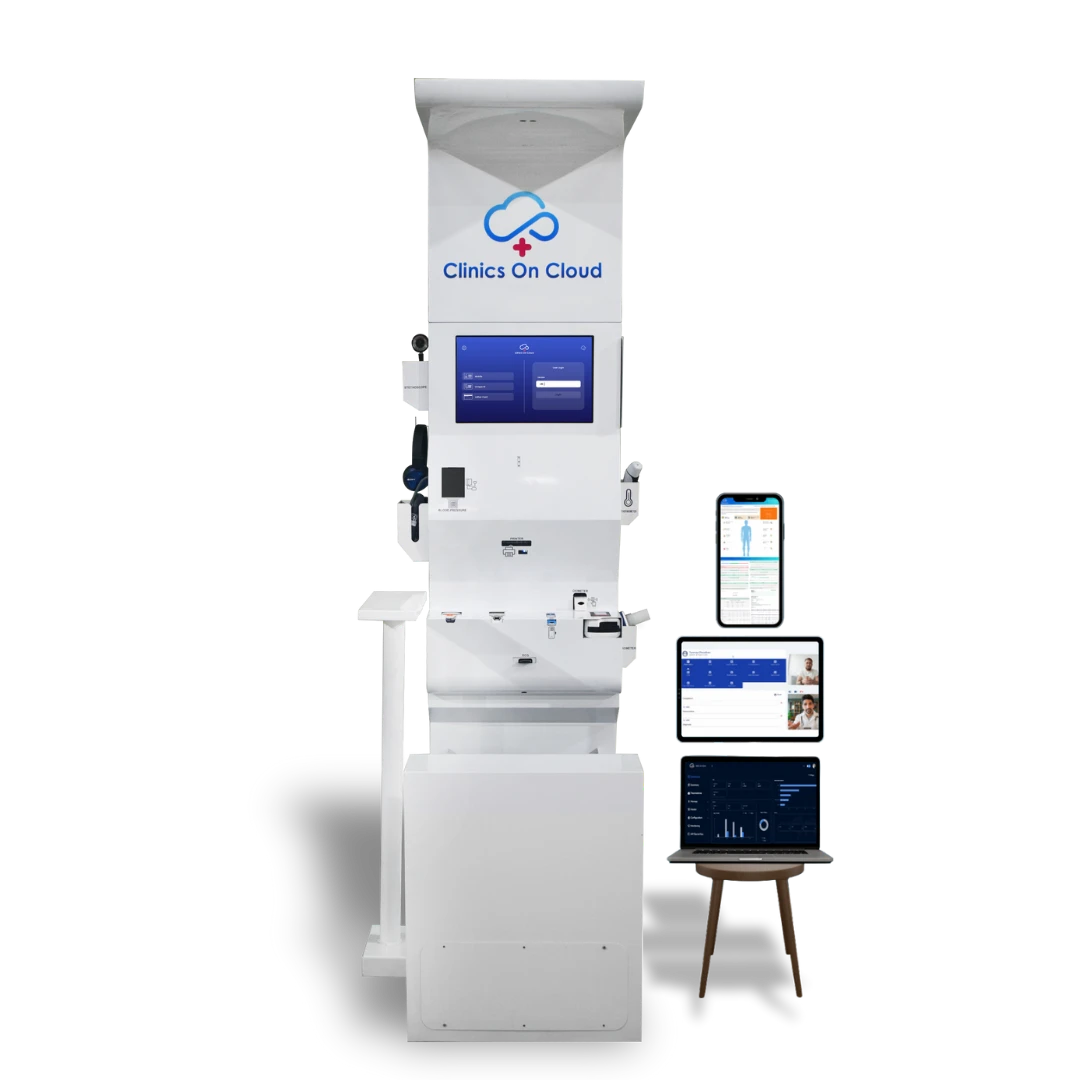 Entry · HA-95Health ATM
Health Kiosk का मतलब (सरल हिंदी) Health Kiosk एक डिजिटल मशीन/स्टेशन है जहाँ कुछ मिनटों में बेसिक हेल्थ चेकअप और
Clinical Parameters and Tests Offered by Health Kiosk In the era of preventive health, early detection and comprehensive screening are
On a Clinics On Cloud kiosk, a skin analysis machine is an imaging module that captures high-resolution photographs of skin, hair and nails and stores them in a person’s health record for review by a qualified clinician. It captures images. It does not analyse them for disease, and it does not produce a dermatological assessment of any kind.
No. Clinics On Cloud kiosks do not detect, diagnose or rule out skin cancer or any other dermatological disease. Skin cancer is diagnosed by a qualified dermatologist through clinical examination, dermoscopy where indicated and biopsy with histopathology. Any new, changing, bleeding or non-healing skin lesion should be shown to a doctor promptly, not photographed at a kiosk.
No. The kiosk captures images and connects you to a clinician by teleconsultation, which is useful where a dermatologist is far away. A dermatologist examines the skin in person, can use dermoscopy, can take a biopsy and can prescribe treatment. Screening imaging identifies who should reach that dermatologist; it does not substitute for one.
It shows high-resolution images of the scalp surface and hair as they appear on the day of capture, which gives a clinician a visual reference during a consultation about a hair or scalp complaint. It is not a measurement of hair loss, not a trichological assessment and not a basis for buying any hair product or starting any treatment.
No. The kiosk produces no diagnosis, no condition name and no treatment recommendation. What you receive is an image record and, where you choose it, a consultation with a qualified clinician who reviews the images and advises you directly. Any advice you act on should come from that clinician, not from the screen.
Images are stored in your digital health record on an ISO 27001 certified, HIPAA compliant and GDPR compliant platform that is VAPT tested, and are made available to the clinician consulting with you. For workplace or school programmes, insist in writing that individual images go only to the individual and the clinician, while the sponsoring organisation receives aggregate, de-identified reporting.
Pricing varies by configuration, since dermatology imaging is normally specified as one module within a wider screening build rather than bought alone. Indicative Health ATM pricing starts from ₹6,00,000. Share your setting, expected volume and teleconsultation requirement with the Clinics On Cloud team at +91 8999 073 447 for a configured quote.
Clinics On Cloud, the brand of SehatPro Technologies Pvt Ltd, manufactures screening kiosks at Nighoje, Chakan MIDC, Pune and is India’s first CDSCO-licensed Health ATM and Health Kiosk manufacturer. The platform carries CDSCO, ISO 13485, US FDA, CE, ISO 27001, HIPAA and GDPR credentials, with 3,500+ installations across 200+ cities and 8+ countries.
We started Clinics on Cloud with a simple belief - that the quality of your healthcare should not depend on your postcode. Whether you're a government, corporate, NGO or entrepreneur - we built this for you.
+91 8999 073 447
Mon - Sat · 9 AM to 6 PM IST
sales@clinicsoncloud.com
Partnerships · Deployments · Support
www.clinicsoncloud.com
Products · Case Studies · News
Nighoje, Chakan MIDC
Pune, Maharashtra - 410501, India