Health KIOSK in Uttarakhand
Health ATM in Uttarakhand | Clinics On Cloud Smart Health Kiosk for Preventive Healthcare Why Preventive Healthcare Is Critical in
Read story 4 min
Punjab is one of India’s most agriculturally advanced and economically active states, yet it faces a growing preventive healthcare challenge. Urban centres like Ludhiana, Amritsar, Jalandhar, Patiala, Bathinda, and Mohali have hospitals and diagnostics, but a large rural population depends heavily on PHCs and district facilities.
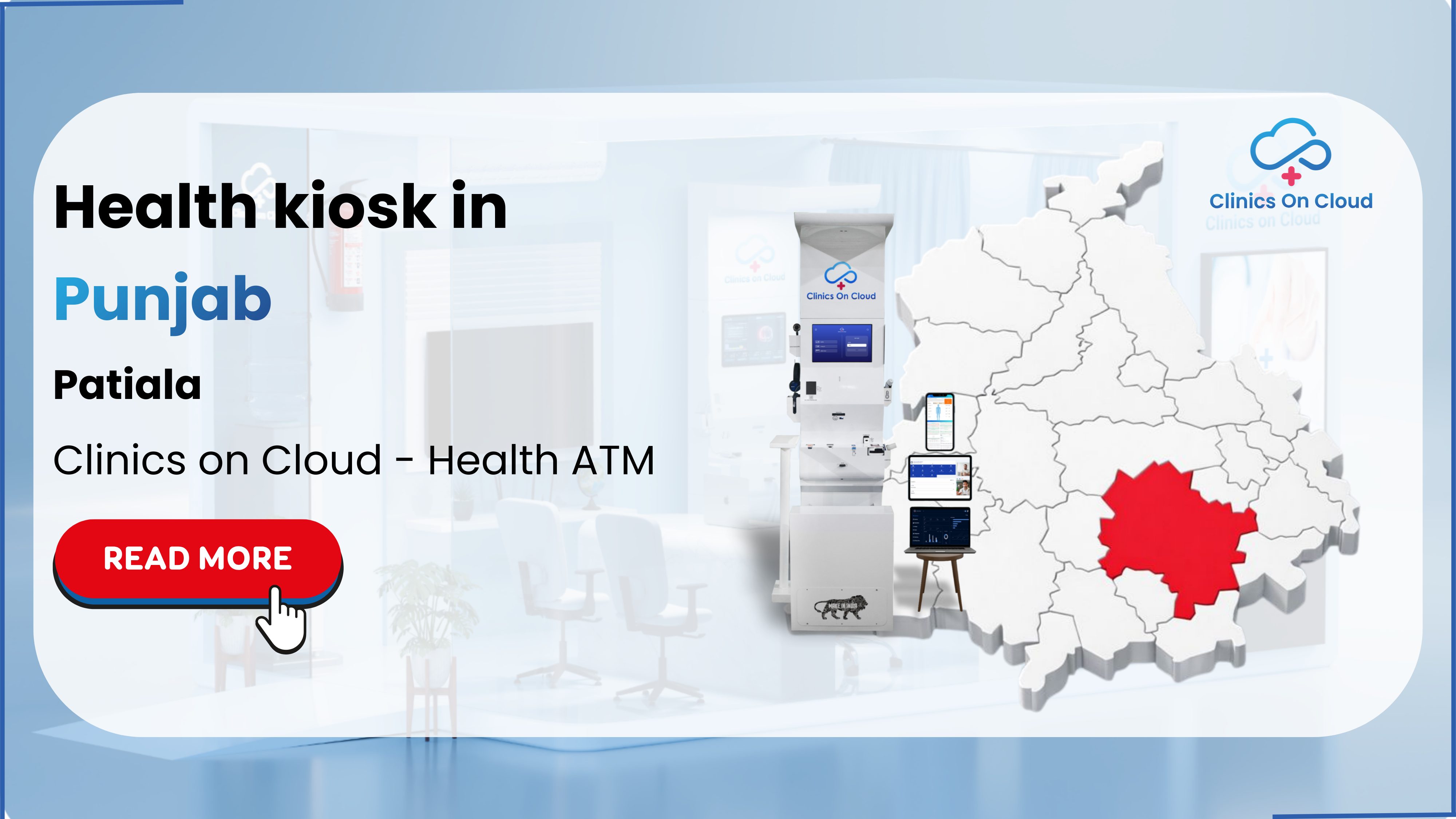
A Health ATM is a self-service screening station that captures 65+ clinical parameters across 14 specialties and connects a flagged user to a doctor on video. In Punjab, Clinics On Cloud kiosks are bought by five sectors: agriculture and the mandi economy, the Ludhiana and Doaba manufacturing clusters, heavy metal processing, charitable trusts, and campus or corporate wellness.
Punjab is compact and well connected by road, so distance is rarely the binding constraint it is in a hill or desert state. The binding constraint here is occupational. Who a person works for decides whether they are ever screened, how often, and whether anyone follows up.
A knitwear machine operator, a harvester crew, a rerolling mill worker and a college student have nothing in common except that all four are easier to reach at work than at a diagnostic centre. So a health kiosk in Punjab should be specified by sector. The hardware is the same. What changes is siting, screening cadence, parameter weighting and who owns the follow-up.
Punjab’s wheat and paddy cycle produces two intense procurement windows a year, and during those windows the grain markets at Khanna, Rajpura, Jagraon, Moga, Barnala, Sangrur and Mansa concentrate farmers, arhtiya staff, labourers and truck crews in one enclosed compound for days at a time.
That concentration is the opportunity. A screening station inside a mandi yard reaches a farming population that will not take a separate day to visit a hospital, and reaches them during a wait they have already committed to. The same logic applies to co-operative society buildings, milk collection centres and agri-input dealerships across Malwa.
Buyers here weight the configuration towards general health, cardiac and pulmonary parameters, the last covering PEF, FVC, FEV and the FEV1/FVC ratio. Where the site is a village rather than a market yard, the format is the portable Box Clinic, run as a camp and synced afterwards.
Ludhiana’s hosiery and knitwear units, bicycle and bicycle-parts makers, auto components workshops and fastener plants employ a workforce that is partly local and heavily supplemented by migrant labour from Bihar and Uttar Pradesh. Jalandhar adds sports goods, hand tools, leather and rubber. Kapurthala, Phagwara and Hoshiarpur carry engineering and light fabrication.
Two things make this cluster a strong fit. Workers are already inside a compound for a full shift, so a 10-minute screening costs a tea break rather than a day’s wage. And the workforce rotates between units, so no health record accumulates anywhere. A kiosk screening produces a digital report by print, SMS, email or WhatsApp, and it can be linked to an ABHA number under the Ayushman Bharat Digital Mission so the record stays with the worker after they move.
For a plant of several hundred workers the pattern is one fixed kiosk near the gate or canteen, an annual full-coverage cycle, and a repeat screening for anyone flagged. The parameter list sits on the clinical parameters and tests offered by a health kiosk page.
The steel rerolling belt around Mandi Gobindgarh, the foundry cluster at Batala, the forging units near Ludhiana and the process industry around Bathinda work in a harder environment. Heat, noise and particulate load are higher, shifts longer, and the workforce skews towards contract labour. Screening interest concentrates on pulmonary function, hearing, cardiac parameters and general health including body composition. Audiometry and otoscope ear visualisation sit in the kiosk’s hearing and ENT group, which matters in a rolling mill where ambient noise is a standing concern.
Be clear about scope when you brief a safety committee. Clinics On Cloud screens and flags. It is not a diagnostic laboratory, it does not diagnose or treat, and it does not replace any statutory occupational health examination your unit must conduct. Device accuracy is 90 to 95 percent depending on the test and device, under correct usage, calibration and patient preparation.
Punjab has an unusually strong charitable healthcare tradition. Trust-run hospitals, gurdwara-attached dispensaries, village welfare societies and NRI-funded projects across the Doaba districts of Jalandhar, Kapurthala, Hoshiarpur and Shaheed Bhagat Singh Nagar fund a large share of free and subsidised care outside the government system.
For a donor sitting in Vancouver, Birmingham or Milan, a health kiosk is a legible thing to fund. It is a single capital item, it sits in a named village, and it produces countable output. The centralised multi-location analytics dashboard means a trust reports screenings completed, flag rate and referral follow-through per site rather than reporting spend.
The realistic model is a kiosk at the dispensary plus a periodic circuit to surrounding villages using a Mobile Medical Unit. Decide the referral route first. A flagged result with nowhere to go generates anxiety and nothing else, which is why integrated teleconsultation matters: the user speaks to a doctor while still at the machine.
Mohali and the Chandigarh periphery carry IT offices, pharmaceutical units and shared services centres, and Patiala, Amritsar, Ludhiana and Bathinda carry large universities and technical institutes. These are the easiest sites to run: stable power and connectivity, a fixed countable population, and an HR wellness budget that already exists. The Health Lounge format suits a corporate lobby where screening should feel like a benefit rather than an inspection.
| Sector | Punjab locations | Who buys | Format that fits | Parameters weighted |
|---|---|---|---|---|
| Agriculture and mandis | Khanna, Rajpura, Jagraon, Moga, Barnala, Sangrur, Mansa | Market committee, co-operative, agri CSR | Kiosk in mandi yard; Box Clinic for villages | General health, cardiac, pulmonary |
| Light manufacturing | Ludhiana, Jalandhar, Phagwara, Kapurthala, Hoshiarpur | Plant HR, EHS head | Fixed kiosk at gate or canteen | General health, cardiac, vision, diabetes |
| Heavy metal processing | Mandi Gobindgarh, Batala, Bathinda | Safety committee, contractor | Fixed kiosk plus repeat cycle | Pulmonary, hearing and ENT, cardiac |
| Trust and diaspora CSR | Doaba villages, Kapurthala, Hoshiarpur, SBS Nagar | Trust board, NRI donor, gurdwara committee | Kiosk at dispensary plus MMU circuit | Broad, all 14 specialties |
| Campus and corporate | Mohali, Patiala, Amritsar, Ludhiana | HR, university administration | Kiosk or Health Lounge in lobby | General health, mental health, vision |
| Border and rural Majha | Tarn Taran, Gurdaspur, Ferozepur, Fazilka | District programme, NGO | Box Clinic camps, periodic kiosk | Broad screening |
A screening only counts if the user finishes it unaided. In Punjab that means Punjabi, spoken aloud rather than only printed in Gurmukhi on a screen.
The Clinics On Cloud kiosk runs a multilingual touchscreen with audio-visual guidance, so the same hardware handles Punjabi for local users, Hindi for the migrant workforce in the Ludhiana and Jalandhar clusters, and English for corporate Mohali. Voice guidance is why an older farmer at a mandi completes a session with nobody standing over him. Reports go out by print, SMS, email or WhatsApp, which matters when the household member who reads the report is not the person screened.
Indicative Health ATM pricing starts from ₹6,00,000, with the quotation driven by configuration, monthly screening volume and consumables. A rerolling mill configuration weighted towards pulmonary and hearing parameters is priced differently from a campus or trust configuration. A prepared site in Ludhiana, Jalandhar, Amritsar, Patiala or Mohali is surveyed, delivered, commissioned and handed over within days, and orientation takes under a day because no skilled operator is required.
The AMC should cover preventive visits, calibration, sensor checks, consumables and spares, with the response window fixed in writing. Clinics On Cloud manufactures at Nighoje, Chakan MIDC, Pune, and is India’s first CDSCO-licensed Health ATM and Health Kiosk manufacturer, with ISO 13485 and ISO 27001 certification. Multi-state buyers often compare this page with health kiosk deployment across Uttarakhand and health kiosk buyers in Delhi NCR, since Punjab corporate procurement often runs through an NCR office. Product detail sits on the Health Kiosk page, and buyers comparing suppliers should read the guide to the best Health ATM in India.
Clinics On Cloud provides preventive health screening and is not a diagnostic laboratory. Screening results are indicative and are not a diagnosis. Always consult a qualified physician before acting on any health information.
Your email is never published. Comments appear after a quick review.
Health ATM in Uttarakhand | Clinics On Cloud Smart Health Kiosk for Preventive Healthcare Why Preventive Healthcare Is Critical in
 Entry · HA-30Health ATM
Health ATM in Jammu & Kashmir | Clinics On Cloud Smart Health Kiosk for Preventive Healthcare Introduction: Jammu & Kashmir’s
Health ATM in Ladakh | Clinics On Cloud Smart Health Kiosk for Preventive Healthcare Introduction: Ladakh’s Healthcare Landscape Ladakh, one
Indicative pricing for a health ATM starts from ₹6,00,000, with the final figure set by configuration, screening volume and consumables. A Ludhiana plant weighting pulmonary and hearing parameters is quoted differently from a Mohali corporate lobby. Rental and CSR-funded structures are available. Send your site list for a configured quotation.
Yes. Clinics On Cloud supplies, installs and services Health ATMs across Punjab from its manufacturing base at Nighoje, Chakan MIDC, Pune, covering site survey, commissioning, calibration, consumables and spares. Buyers can inspect the production line before ordering.
Yes. The touchscreen and audio guidance are multilingual, so a session runs in Punjabi with spoken prompts, and Hindi or English can be enabled on the same unit for migrant workers or corporate users. Spoken guidance is what lets a user with limited reading comfort finish a screening unaided.
Yes, given a covered, dust-protected position and a power point. Offline operation and 3 to 4 days of battery backup cover interruptions, and data syncs when connectivity returns. Procurement season is the highest-yield window, so install ahead of it rather than during it.
Treat it as a single capital item with a named site and a reporting line. The centralised dashboard lets the trust report screenings completed, flag rate and referral follow-through rather than expenditure. Most trusts start with one village site for 90 days before adding more.
Treat it as a screening output, not a diagnosis. It is designed to raise awareness and prompt appropriate medical follow-up, and Clinics On Cloud is not a diagnostic laboratory. Integrated teleconsultation lets a flagged user speak to a doctor immediately, which is what turns a printed result into a clinical next step.
We started Clinics on Cloud with a simple belief - that the quality of your healthcare should not depend on your postcode. Whether you're a government, corporate, NGO or entrepreneur - we built this for you.
+91 8999 073 447
Mon - Sat · 9 AM to 6 PM IST
sales@clinicsoncloud.com
Partnerships · Deployments · Support
www.clinicsoncloud.com
Products · Case Studies · News
Nighoje, Chakan MIDC
Pune, Maharashtra - 410501, India