Health kiosk in Ladakh
Health ATM in Ladakh | Clinics On Cloud Smart Health Kiosk for Preventive Healthcare Introduction: Ladakh’s Healthcare Landscape Ladakh, one
Read story 4 min
Health ATM in Jammu & Kashmir | Clinics On Cloud Smart Health Kiosk for Preventive Healthcare
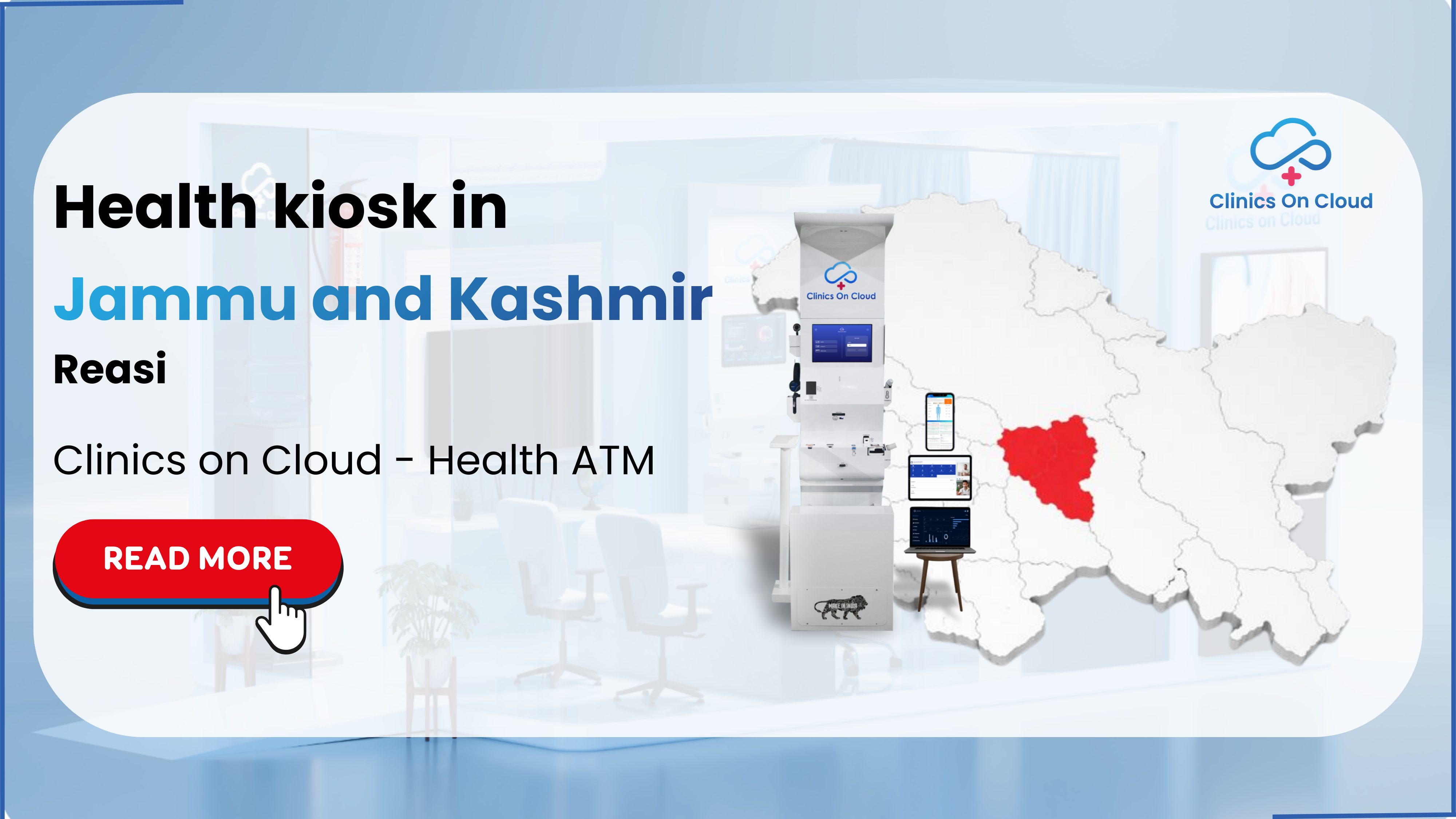
A Health ATM is a self-service screening station that records 65+ clinical parameters across 14 specialties in a 10-minute checkup, completes screenings offline, and holds 3 to 4 days of battery backup. Clinics On Cloud is India’s first CDSCO-licensed Health ATM and Health Kiosk manufacturer, with 3,500+ installations across India and abroad.
Most multi-site health kiosk programmes are planned around population and footfall. In Jammu and Kashmir the binding constraint is access over time: which sites are reachable in January, which routes close, and what a unit has to do on its own when nobody can get to it.
That produces a different planning order. Zone first, choose sites against seasonal access second, and only then discuss configuration. A programme designed the other way round places its most capable units where they are easiest to install rather than where they are hardest to replace.
Two hardware properties do more work here than anywhere else in India. The Clinics On Cloud kiosk completes a screening offline and synchronises when connectivity returns, and it holds 3 to 4 days of battery backup. Both exist so a site keeps functioning when the road, the network or the power supply does not.
Jammu and Kashmir is not one terrain. Five zones behave differently enough to need separate site rules, configurations and service assumptions.
| Zone | Representative districts | Access reality | Programme implication |
|---|---|---|---|
| Jammu plains and foothills | Jammu, Samba, Kathua, Udhampur | Year-round road access, industrial estates nearby | Standard installation; corporate and institutional sites |
| Pir Panjal belt | Rajouri, Poonch | Mughal Road closes seasonally; Poonch depends on the tunnel route | Permanent placement essential; avoid camp dependence |
| Chenab valley | Doda, Kishtwar, Ramban | Steep valley roads, slide-prone, long approach times | District anchors plus outreach; assume delayed service visits |
| Kashmir valley floor | Srinagar, Anantnag, Baramulla, Pulwama, Budgam, Kulgam, Shopian, Ganderbal, Bandipora | Dense, well connected, high institutional footfall | Highest throughput sites; horticulture and campus populations |
| High valleys and border belt | Gurez, Karnah and Tangdhar in Kupwara, Machil, upper Kishtwar | Passes close in winter; extended isolation | Offline and battery capability are the entire argument |
Write the zone against every site in the procurement list. If a site’s zone is not stated, the rollout plan is not finished.
The question at each candidate site is not how many people live nearby. It is what that site is expected to do in the third week of January.
For the Jammu plains and the valley floor, ordinary footfall logic applies: district and sub-district hospitals, government office complexes, university and college campuses, industrial estates around Bari Brahmana and Kathua, and transport nodes. These sites are chosen for volume.
For the Pir Panjal belt, the Chenab valley and the high valleys, sites are chosen for isolation. A Health Kiosk at a facility in Gurez, Tangdhar, Kishtwar or an upper Poonch block is worth more per unit than one in Srinagar, because during the closed months it is the only broad screening capability in that catchment.
Pilgrimage and tourism add a third site type with its own calendar. Katra receives sustained Vaishno Devi footfall, the Amarnath Yatra concentrates very large numbers along the Pahalgam and Baltal routes in a short summer window, and Gulmarg, Pahalgam and Sonamarg carry seasonal visitor volume. These sites are chosen for peaks, and a 10-minute checkup fits a queue.
Configuration should follow the zone and the population, not a single standard specification repeated across the programme.
Valley floor and Jammu plains sites serving offices, campuses and hospitals usually lead with general health, cardiac including 6-lead and 12-lead ECG, diabetes, vision and the mental health instruments. Industrial estate sites near Jammu, Samba and Kathua, and the cement activity around Khrew, add pulmonary function testing where dust exposure is part of the work.
Horticulture districts such as Sopore, Shopian and Pulwama and the saffron belt around Pampore involve seasonal labour that arrives, works and leaves. There the priority is that everything completes in one visit: screening, colour-coded report by print, SMS, email or WhatsApp, and an ABHA-linked record under the Ayushman Bharat Digital Mission that travels with the person.
High valley and border-belt sites should carry the broadest configuration the budget allows, because they are where a second opinion is hardest to obtain. The full parameter list is in the guide to the clinical parameters and tests offered by a health kiosk.
Staffing assumptions are where multi-site programmes fail. A plan that quietly depends on a dedicated attendant at every location will not survive its first winter.
The Clinics On Cloud kiosk is voice-guided and multilingual and requires no skilled operator, which is what makes unattended placement realistic. The honest staffing model has three roles: a site custodian, an existing staff member who unlocks the area, keeps consumables stocked and reports faults, neither a technician nor full time; a zone coordinator who tracks uptime, consumable levels and screening numbers across sites and escalates; and the teleconsultation panel, doctors reached through the unit rather than posted at it.
Orientation for a site custodian takes under a day. Budget for custodian turnover instead of pretending it will not happen.
Every site should pass a short readiness check before the season closes, and the check should be scheduled, not improvised.
Confirm that consumables are stocked to cover the full expected isolation period rather than a normal replenishment cycle. Confirm that the site’s power arrangement is intact, since the 3 to 4 day battery backup carries interruptions rather than replacing a supply. Confirm that offline data has synchronised, so nothing waits on a connection that may not return for weeks.
For a Mughal Road, Chenab valley or high valley site, treat the last pre-winter service visit as the most important in the AMC calendar: it determines whether the unit is productive through the closed months or becomes a stranded asset. Plan installations around the same calendar, because commissioning a unit into a high valley in late autumn wastes a procurement cycle.
A screening programme is only as good as what happens after a flagged result, and here the journey to a referral hospital is the same difficult journey twice. Integrated telemedicine on the unit removes one of those journeys by connecting the user to a live doctor consultation when a reading is flagged. It should be configured and tested at commissioning rather than enabled later.
Decide in advance where confirmed cases go, which institution accepts them, and who tracks whether the person arrived. For defence and paramilitary installations, Clinics On Cloud’s named deployments include the Indian Army, the Indian Navy and BSF, which is the reference set such buyers ask to see.
Then measure. A Jammu and Kashmir programme cannot be judged on a single quarter, because a quarter shows you one season. Report four figures per site monthly and review them across a full year: screenings completed, coverage as a percentage of the intended population, abnormality flag rate compared across zones, and teleconsultation completion on flagged results. Across the Clinics On Cloud network, 12M+ patients have been screened and 2 lakh+ abnormalities identified for early intervention, in 200+ cities including last-mile locations. Expect valley floor and high valley sites to produce very different profiles on all four. That divergence is the programme working, not a fault.
Kashmiri, Dogri and Urdu, with voice guidance rather than text alone, and Hindi and English enabled alongside them.
The union territory then layers on more. Gojri is spoken by Gujjar and Bakarwal communities across the Pir Panjal belt and the highland pastures, Pahari across Rajouri, Poonch and parts of Baramulla and Kupwara, Punjabi across parts of the Jammu plains, Kishtwari, Bhaderwahi and Siraji through the Chenab valley, and Shina in Gurez.
The Gujjar and Bakarwal population is a distinctive screening group because it is transhumant, moving with livestock between winter settlements and summer pastures. A fixed kiosk will not follow that movement, but a portable Box Clinic or a Mobile Medical Unit on a seasonal circuit can, and an ABHA-linked record makes the two halves of the year one health history.
Indicative Health ATM pricing starts from ₹6,00,000, with the final quotation depending on which of the 14 specialties you configure, monthly screening volume and consumable mix. Rental and CSR-funded structures are available where capital budgets are fixed.
Units are manufactured at the Clinics On Cloud facility at Nighoje, Chakan MIDC, Pune. Commissioning and handover at a prepared site take days once the unit arrives; the variables are transit and, for higher sites, the season, so plan so high valley installations land well before passes close.
Annual maintenance covers calibration, preventive visits, sensor checks and spares. For Poonch, Kupwara, Kishtwar and Gurez, negotiate consumable stocking levels and remote diagnostic support alongside the response window, because a written response time cannot open a closed road.
Buyers comparing manufacturers should read the guide to the best Health ATM in India. For comparable terrain and distance programmes, see health kiosk deployment in Mizoram and health kiosk deployment in Rajasthan.
Clinics On Cloud provides preventive health screening and is not a diagnostic laboratory. Screening results are indicative and are not a diagnosis. Always consult a qualified physician before acting on any health information.
Your email is never published. Comments appear after a quick review.
Health ATM in Ladakh | Clinics On Cloud Smart Health Kiosk for Preventive Healthcare Introduction: Ladakh’s Healthcare Landscape Ladakh, one
 Entry · HA-59Health ATM
Health ATM in Chhattisgarh | Clinics On Cloud Smart Health Kiosk for Preventive Healthcare Introduction: Chhattisgarh’s Healthcare Landscape Chhattisgarh, with
Health ATM in Mizoram | Clinics On Cloud Smart Health Kiosk for Preventive Healthcare Introduction: Mizoram’s Healthcare Landscape Mizoram, a
Zone first, choose sites against the winter road map second, configure third. Group sites into the Jammu plains, the Pir Panjal belt, the Chenab valley, the Kashmir valley floor and the high valley and border belt, because each has different access, staffing and service assumptions.
District and sub-district hospitals, government office complexes, university and college campuses, industrial estates around Bari Brahmana and Kathua, block-level facilities in Poonch, Rajouri, Doda and Kishtwar, isolated facilities in Gurez and Tangdhar, and pilgrimage sites such as Katra and the Yatra routes.
Yes. The Clinics On Cloud kiosk is offline-capable, so a screening completes and stores locally and synchronises when connectivity returns. That is why isolated sites in Gurez, Karnah, Tangdhar, Machil and the upper Chenab valley are viable placements rather than problem locations.
3 to 4 days. The backup carries a site through power interruptions rather than replacing a supply, which is why the winter readiness check should confirm the site’s power arrangement before the season closes.
Indicative pricing starts from ₹6,00,000. Configuration drives the final figure: a Srinagar or Jammu institutional unit, an industrial estate unit with pulmonary function testing, and a broad-configuration high valley unit differ in sensor set and consumables. Rental and CSR-funded models are available. Send your zoned site list for a quotation.
Yes. Clinics On Cloud supplies, installs and services Health ATMs across India, manufacturing at Nighoje, Chakan MIDC, Pune. Coverage includes delivery, commissioning, calibration, consumables and spares, and buyers can inspect the facility before placing an order.
Yes. Annual maintenance covers preventive visits, calibration, consumable supply and spares. For seasonally isolated districts, agree consumable stocking levels, a pre-winter service visit and remote diagnostic support in the contract, because those provisions matter more than a headline response time once a route closes.
Yes. The touchscreen and audio guidance are multilingual, so screenings complete in Kashmiri, Dogri, Urdu, Hindi or English, and further languages can be enabled where Gojri, Pahari, Punjabi, Kishtwari or Shina are spoken. Voice guidance means limited literacy does not prevent completion.
A Health Kiosk screens and flags; it does not diagnose, and Clinics On Cloud is not a diagnostic laboratory. Device accuracy is 90 to 95 percent depending on the test and device, under correct usage, calibration and patient preparation. Reports prompt appropriate follow-up with a qualified physician.
We started Clinics on Cloud with a simple belief - that the quality of your healthcare should not depend on your postcode. Whether you're a government, corporate, NGO or entrepreneur - we built this for you.
+91 8999 073 447
Mon - Sat · 9 AM to 6 PM IST
sales@clinicsoncloud.com
Partnerships · Deployments · Support
www.clinicsoncloud.com
Products · Case Studies · News
Nighoje, Chakan MIDC
Pune, Maharashtra - 410501, India