
For millions of people in villages, work sites, schools, and camps, the biggest barrier to good healthcare isn’t the quality of treatment available it’s simply reaching it. A clinic that’s an hour away by bus, a day’s lost wages, a referral chain that eats up a week: these are the real obstacles standing between people and basic care.
Clinics On Cloud’s Mobile Medical Unit flips that equation. Instead of asking people to travel to a clinic, the clinic travels to them. It is fully-equipped, air-conditioned facility on wheels proof that healthcare on wheels isn’t a slogan, it’s an engineering reality.
A Clinic Engineered Into a Single Vehicle
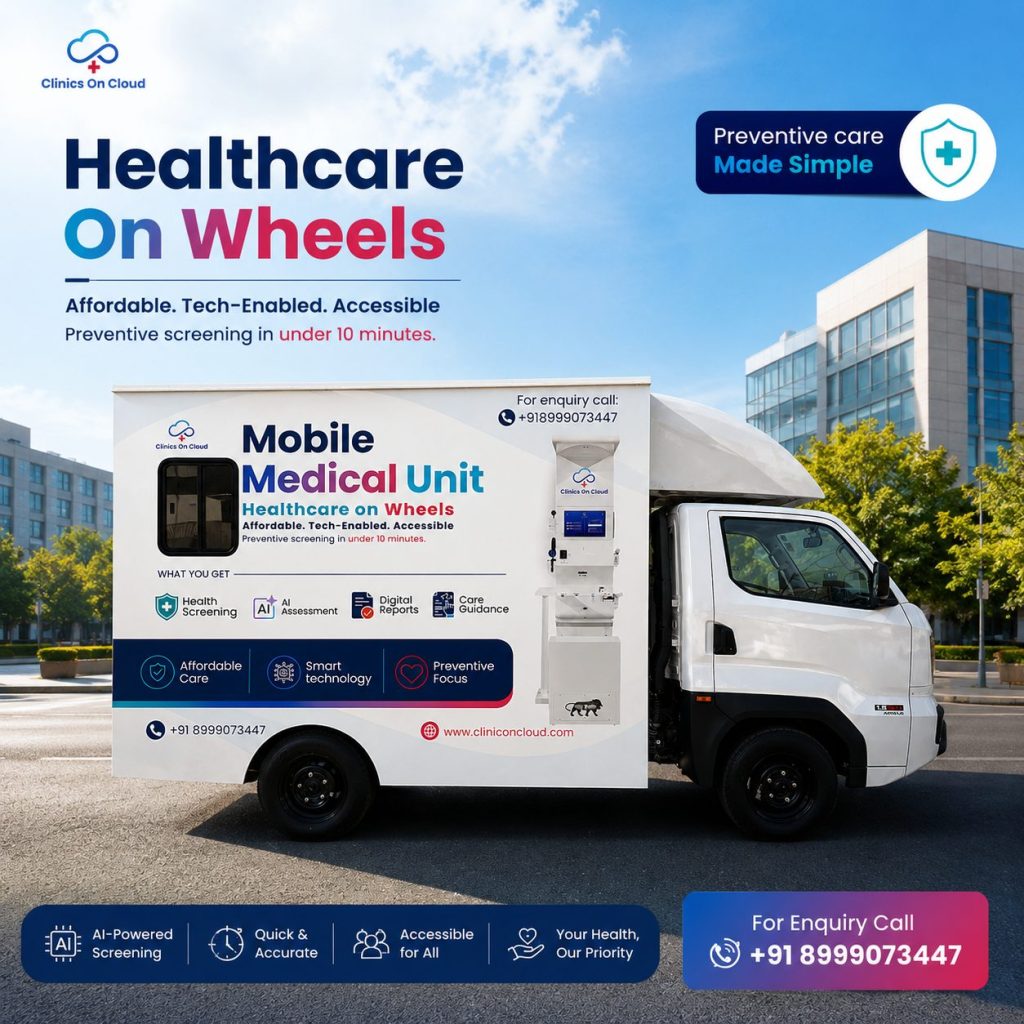
Everything a basic health check needs- diagnostics, an examination bay, a teleconsultation setup, and enough power to run all day off the grid is packed into one compact vehicle. There’s no support truck trailing behind, no generator van, no separate diagnostic tent. It’s one vehicle, doing the work of an entire outpatient department.
Built to Last in the Field
The mobile medical unit’s shell is galvanised steel over a 40×40 mm MS tubular frame, finished with 1 mm panels and minimal joints to keep water and rust out over years of use on rough routes. Inside, solid white PU FRP panelling keeps the cabin hygienic and easy to wipe down, while a 12 mm ply base topped with 1.3 mm anti-skid vinyl flooring keeps footing safe even in wet conditions. A 25 mm layer of Heatlon insulation between the panels helps the interior stay cool and stable regardless of what’s happening outside.
The cabin is thoughtfully divided by curtains into two private compartments, so screening and examination can happen with dignity, not in the open. An 8×6 ft retractable awning extends outside the vehicle to create shaded waiting space for the next patient in line- a small detail that makes a real difference on a hot day.
The Health ATM: Diagnostics Without the Wait
At the heart of the unit sits what the team calls a Health ATM– an automated diagnostic station where a patient simply steps up, holds the sensors, and lets the machine do the work. In minutes, it captures:
– Body composition — floor scale readings, BMI, and fat analysis
– Vitals and ECG— blood pressure, SpO₂, pulse, and temperature
– Point-of-care tests— rapid on-board screening
– Cloud records — every reading digitised and instantly shareable
There’s no lab to send samples to and no waiting room shuffle. The data is captured, screened, and synced straight to the cloud, ready for a doctor to review- whether that doctor is standing right there or connecting in over teleconsultation from miles away.
Power That Doesn’t Depend on the Grid
A mobile clinic is only as useful as its ability to run without outside help, and this is where the Mobile Medical Unit is built for genuine independence. It carries three layers of power:
1. Primary power — a 3 kVA Honda EU30is petrol generator, a quiet inverter genset mounted right under the work table
2. Backup power— an 1100 VA pure sine-wave inverter paired with a 100 Ah Exide battery, for silent operation when the generator isn’t running
3. Shore power— an industrial mains inlet with a 10-metre cable that can charge the unit from any 230 V point
Distribution runs through modular, MCB-protected 230 V boards, while six 12V LED tube lights and two 12V DC Remi fans keep the cabin lit and ventilated. Add in a proper automotive evaporator and split AC unit for true climate control, and the result is a clinic that can run a full day in the field- no matter how far it is from the nearest power line.
Inside the Examination Bay
Beyond diagnostics, the unit is fitted out as a real clinical space. A foldable examination table with an MS-tubular frame and 3-inch cushion tucks away when not in use, and a doctor’s workstation a ply work table with two drawers and a chair gives the visiting or remote clinician everything they need to consult properly. A sliding glass window and FRP hat-rack storage round out the practical touches that make the space function like a small clinic rather than a converted van.
The Care Pathway: What a Visit Actually Looks Like
The whole experience is designed around a simple four-step rhythm:
1. Walk in — The vehicle parks, the awning extends, and the side door opens into a private room within minutes.
2. Screen — At the Health ATM, vitals, weight, body composition, and core diagnostics are captured and digitised.
3. Examine & consult — Behind the curtain, the patient is examined and connected to a doctor by teleconsultation.
4. Report & move on— Reports are generated on the spot, and the clinic packs up to drive to the next community.
A side door with internal steps gives patients easy, dignified entry, while a separate access door serves the AC unit-small design choices that add up to a smoother experience for everyone using the unit.
Why It Matters: The Case for Healthcare on Wheels
The idea of mobile medical unit (healthcare on wheels) solves problems that fixed clinics simply can’t:
– Care that travels. One vehicle can serve villages, work sites, schools, and camps on a single route through the week, instead of asking every community to have its own health infrastructure.
– Catching problems early. Routine screening for things like hypertension and diabetes surfaces conditions before they become emergencies- the kind of preventive care that’s often skipped simply because it’s inconvenient to access.
– A lower cost of care. No travel, no lost wages, no long referral chain for a basic check. Care happens where people already are.
– Data that builds over time. Every visit feeds into digital records, slowly building a real, cumulative picture of a community’s health- insight that’s impossible to gather when care is sporadic and undocumented.
One Vehicle. A Whole Clinic. Anywhere.
The Mobile Medical Unit is a durable, self-powered, air-conditioned clinic- combining Health ATM diagnostics, a proper examination and teleconsultation bay, an all-weather galvanised body, and three layers of independent power. It’s a compact answer to a large problem: bringing primary healthcare to places it has never comfortably reached before.
That’s the promise behind healthcare on wheels- not a stopgap, but a genuinely engineered, self-sufficient way of meeting people where they are.