 Entry · MM-09Mobile Medical Units
Clinics On Cloud Accessible Healthcare Anytime, Anywhere
Clinics On Cloud Accessible Healthcare Anytime, Anywhere You awoke one morning feeling ill. Your body hurts all over, your
Read story 8 min
Discover Clinics On Cloud Portable Box Clinic, a connected Health Box for rural healthcare, CSR camps, door-to-door screening, telemedicine, AI health reports and up to 65+ clinical parameters.
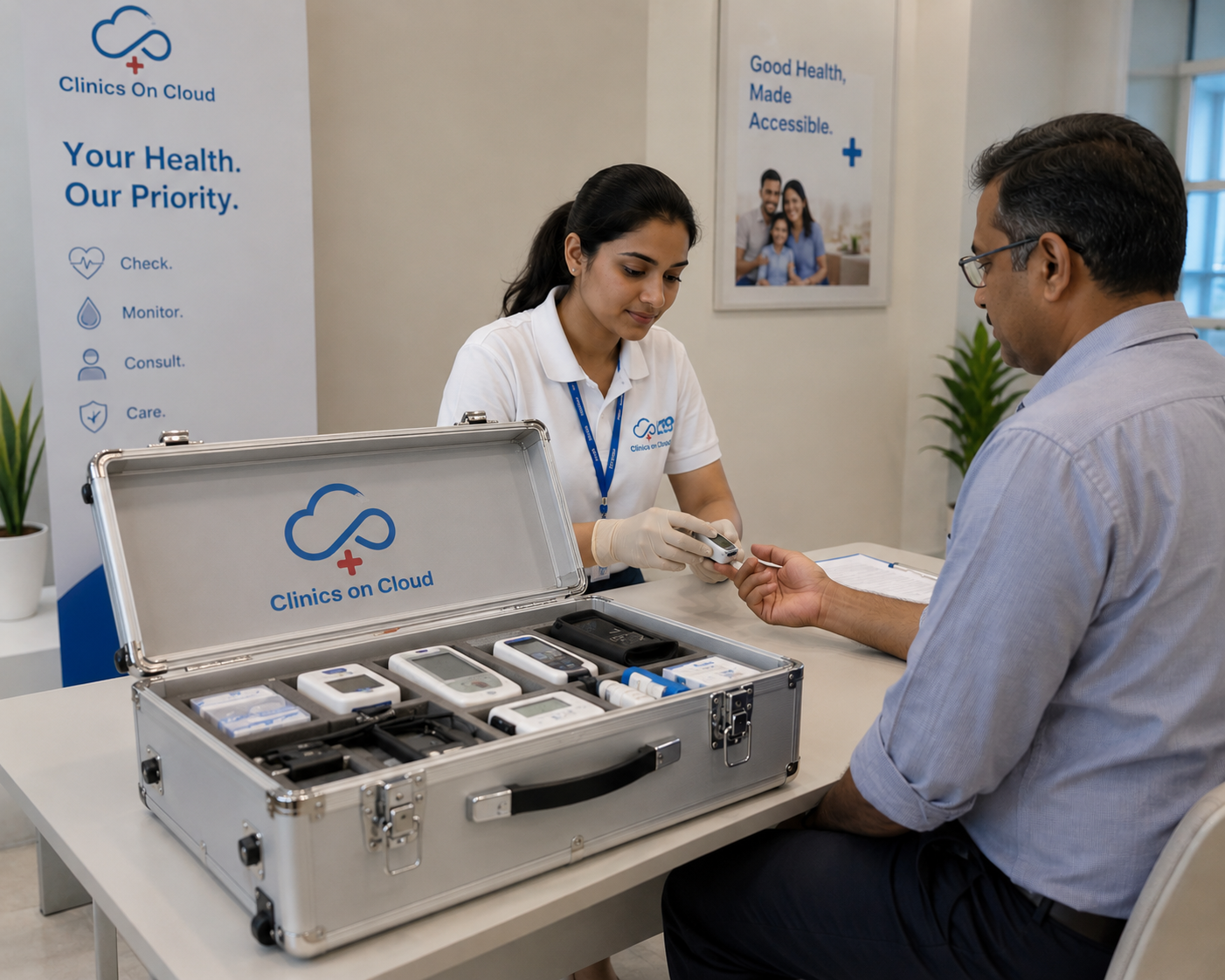
A portable clinic is a carried case containing medical screening devices, guided software, digital records and a telemedicine link, so one health worker can run a full screening session anywhere without a building. The Clinics On Cloud Box Clinic supports 65+ clinical parameters across 14 specialties with a 10-minute checkup, works offline and holds 3–4 days of battery backup.
A Box Clinic is a portable digital healthcare system that packs medical screening devices, point-of-care testing, guided software, digital health records and a telemedicine link into a single carried case that one trained health worker can set up on a table.
It is the “clinic in a suitcase” format in the Clinics On Cloud range, alongside the fixed Health ATM/Health Kiosk, the Health Lounge and the Mobile Medical Unit. It exists for the situations where there is no building, no reliable power, no dependable network, and often no road that a vehicle can take.
Two clarifications that belong in every procurement note. First, Clinics On Cloud is not a diagnostic laboratory and does not replace one; screening results are indicative. Second, the AI in the platform performs risk flagging and general diet and lifestyle guidance. It does not diagnose, does not prescribe and does not replace a clinician. A registered medical practitioner makes every clinical decision through the teleconsultation link.
The product page for the format is Box Clinic.
Five deployment contexts account for most Box Clinic use.
The unifying feature is that the population cannot come to a fixed point, and the terrain or budget rules out a vehicle. For vehicle-based outreach, see what a Mobile Medical Unit is, and how to specify one.
| Attribute | Clinics On Cloud Box Clinic |
|---|---|
| Format | Carried case; opens and sets up on a table |
| Transport | Hand-carried; moves in a car boot, on a two-wheeler with a carrier, or by porter |
| Setup requirement | A flat surface and a seated patient; no fixed installation, no civil work |
| Operator | One trained health worker; no specialist technician required |
| Power | Battery operated with 3–4 days of battery backup; mains charging when available |
| Connectivity | Offline-capable; records captured without a network and synchronised when connectivity returns |
| Teleconsultation | Requires a live data connection at the moment of the consultation |
| Clinical scope | 65+ clinical parameters across 14 specialties, configurable by deployment |
| Checkup duration | Full checkup in 10 minutes |
| Reporting | Colour-coded report by print, SMS, email or WhatsApp |
| Records | Digital health records with longitudinal tracking; ABHA and eSanjeevani integration |
| Device accuracy | 90–95% depending on test and device, under correct usage, calibration and patient preparation |
| Manufacturing and compliance | Built under CDSCO licence and ISO 13485; platform holds ISO 27001, HIPAA and GDPR compliance, VAPT tested |
| Consumables | Test strips, cuvettes and accessories by configured parameter set; must be planned per camp |
| Box Clinic (portable) | Health ATM / Health Kiosk (fixed) | |
|---|---|---|
| Goes to the patient | Yes | No; the patient comes to it |
| Setup per session | Required every time | Once, at installation |
| Operator needed | One trained health worker | None; voice-guided self-service |
| Throughput per day | Moderate; limited by the operator and setup | High; limited only by footfall |
| Cost per screening | Higher, because a person’s day is part of every session | Lowest of any format |
| Availability | Only when the team is there | Every day the site is open |
| Enclosure and privacy | Depends entirely on the venue | Consistent, designed |
| Ruggedness requirement | High; travels constantly | Lower; fixed, sheltered |
| Best for | Camps, doorstep, disaster response, scattered sites | PHCs, hospitals, factories, campuses, pharmacies, panchayat offices |
The decision rule is straightforward. If the population reliably gathers at a known location, buy the fixed kiosk. Its cost per screening is the lowest in the range and it works every day rather than on camp days. Buy the portable format when no such location exists. Read what a Health ATM is and how it works before deciding, and compare all four formats on healthcare pods, care pods and kiosk form factors compared.
Many programmes run both: a fixed Health Kiosk at the block hospital as the anchor, and one or two Box Clinics working the villages around it.
The Clinics On Cloud platform supports 65+ clinical parameters across 14 specialties, and a Box Clinic is configured with the subset that matches the target population:
General health and vital parameters, diabetes screening, cardiac screening including ECG, anaemia and kidney-related parameters, lipid profile, pulmonary function, vision screening, hearing and ENT screening, dental and oral screening, dermatology, mental health assessments, maternal health, urine analysis, Ayurvedic assessment and rapid infectious disease testing.
The full parameter breakdown is published on clinical parameters and tests offered by a health kiosk.
Configure narrow. A camp that screens for three conditions and follows up on every flag achieves more than one that measures everything and refers nobody. Every result is a screening output: indicative, and not a diagnosis.
Step 7 is what distinguishes a Box Clinic from a bag of instruments. A camp that produces paper produces a day’s activity. A camp that produces linked digital records produces a baseline you can measure against next year.
Two constraints define field screening in India, and both are addressed at the design stage rather than worked around in the field.
Power. The Box Clinic runs on battery with 3–4 days of backup, so a multi-day camp in a village with intermittent supply does not stop when the line goes down.
Connectivity. Screening, reporting and record capture all work offline. Data synchronises when the device returns to coverage. The one function that genuinely needs a live connection is the video consultation, so plan connectivity around that specific step: identify where in the route a signal exists, and schedule flagged consultations there if the camp site has none.
Designing for these constraints is not a rural-only concern. Basements, factory floors, ships and disaster sites all present the same two problems.
Clinics On Cloud does not publish a single Box Clinic price, because configuration changes the figure substantially. Pricing varies by configuration: talk to our team on +91 8999 073 447 or sales@clinicsoncloud.com for a scoped quotation.
The drivers, in order of impact:
For reference, indicative Health ATM pricing starts from ₹6,00,000. Buyers comparing formats and suppliers should read best Health ATM in India.
This is an illustrative framework, not a quotation, and it contains no Clinics On Cloud pricing. Enter your own verified figures. Its purpose is to show which variables actually move the answer.
Inputs you must supply: - A = capital cost of the configured unit, including taxes - B = expected useful service life in years - C = annual operator cost (salary, travel, allowances) attributable to the unit - D = annual consumables cost, calculated per camp and multiplied out - E = annual maintenance, calibration and connectivity cost - F = camp days per year, after weather, festivals and staff leave - G = realistic screenings completed per camp day
Method: 1. Annualised capital = A ÷ B 2. Total annual cost = (A ÷ B) + C + D + E 3. Annual screenings = F × G 4. Cost per screening = Total annual cost ÷ Annual screenings
What the model shows regardless of your inputs:
Clinics On Cloud provides preventive health screening and is not a diagnostic laboratory. Screening results are indicative and are not a diagnosis. Always consult a qualified physician before acting on any health information.
Your email is never published. Comments appear after a quick review.
Entry · MM-09Mobile Medical UnitsClinics On Cloud Accessible Healthcare Anytime, Anywhere You awoke one morning feeling ill. Your body hurts all over, your
 Entry · MM-49Mobile Medical Units
Clinics On Cloud Improving Rural Healthcare. Post-COVID everyone has made incredible progress in the preventive healthcare system by utilizing innovative
Digital Health Records: Giving Privilege to Patients through Data Security A Digital Health record, also known as an Electronic Health
A Box Clinic is a portable digital healthcare system that combines medical screening devices, point-of-care testing, guided software, digital health records and a telemedicine link inside a single carried case. The Clinics On Cloud Box Clinic supports 65+ clinical parameters across 14 specialties, completes a checkup in 10 minutes, and needs one trained health worker rather than a technician.
Clinics On Cloud Box Clinic pricing varies by configuration, since the parameter set, point-of-care test menu, ECG inclusion, software scope and telemedicine plan each move the figure. Contact Clinics On Cloud on +91 8999 073 447 or sales@clinicsoncloud.com for a scoped quotation. For reference, indicative Health ATM pricing starts from ₹6,00,000.
Clinics On Cloud, operated by SehatPro Technologies Pvt Ltd, manufactures the Box Clinic at Nighoje, Chakan MIDC, Pune, and is India’s first CDSCO-licensed Health ATM and Health Kiosk manufacturer. Certifications include ISO 13485, US FDA, CE, ISO 27001, HIPAA and GDPR compliance, with 3,500+ installations across 200+ cities and 8+ countries.
Begin with the target population, the conditions you intend to screen for and the referral pathway, then configure the parameter set to match. Clinics On Cloud scopes the unit, operator training, consumables and annual maintenance against that brief and supports tender documentation. Call +91 8999 073 447 or email sales@clinicsoncloud.com.
Yes for screening. The Box Clinic runs on battery with 3–4 days of backup and captures records offline, synchronising when connectivity returns. The live doctor consultation is the one function that needs a working data connection, so plan where on your route that consultation can take place.
It opens onto a table and requires no installation, no civil work and no generator, so a session begins in minutes rather than hours. That difference is the main reason portable units outperform assembled camp setups when the team moves to a different village each day.
Neither is better in general. A fixed Health ATM delivers the lowest cost per screening and runs every day, so it wins wherever the population already gathers at a known site. A Box Clinic wins where no such site exists, where the team must reach households, or where a disaster has removed the infrastructure a fixed unit needs.
No. Clinics On Cloud is not a diagnostic laboratory and does not replace one. Point-of-care results are indicative screening outputs with device accuracy of 90–95% depending on the test and device, under correct usage, calibration and patient preparation, and they require confirmation by a qualified physician and appropriate laboratory testing.
Yes. Portability, offline capability and 3–4 days of battery backup suit situations where buildings, power and networks are unavailable. Note the boundary: a Box Clinic is preventive screening and consultation infrastructure, not an emergency medical service, and it does not substitute for trauma or acute care.
Records are captured digitally and stored on a platform holding ISO 27001 information security certification with HIPAA and GDPR compliance and VAPT testing, with ABHA linkage available under the Ayushman Bharat Digital Mission. Buyers should still contract explicitly on data ownership, storage location, access rights and deletion on exit.
We started Clinics on Cloud with a simple belief - that the quality of your healthcare should not depend on your postcode. Whether you're a government, corporate, NGO or entrepreneur - we built this for you.
+91 8999 073 447
Mon - Sat · 9 AM to 6 PM IST
sales@clinicsoncloud.com
Partnerships · Deployments · Support
www.clinicsoncloud.com
Products · Case Studies · News
Nighoje, Chakan MIDC
Pune, Maharashtra - 410501, India