 Entry · PC-52Preventive Care
420 Million NCD Screenings Later: How India Can Close the Follow-up Gap at Ayushman Arogya Mandirs
India has done 420M+ hypertension and diabetes screenings at Ayushman Arogya Mandirs. Here’s why follow-up is the next frontier, and how technology helps.

Quick answer: India has run one of the world’s largest non-communicable disease (NCD) screening programmes. Ayushman Arogya Mandirs (AAMs) have completed more than 420 million screenings for hypertension and diabetes, 360 million for oral cancer, 170 million for breast cancer and 90 million for cervical cancer, through about 1.86 lakh AAMs (Union Health Minister J P Nadda, 30 Sept 2026). The next challenge is not screening more people. It is making sure that everyone flagged is confirmed, treated and followed up, and that needs connected, data-driven primary care infrastructure.
Key takeaways
- Scale achieved: 420M+ hypertension and diabetes screenings; population-based screening for everyone aged 30+.
- Burden remains large: ICMR-INDIAB estimates 315 million Indians with hypertension and 101 million with diabetes (Lancet Diabetes & Endocrinology, 2023).
- Control is the weak link: fewer than 7% of people with self-reported diabetes achieve combined blood sugar, blood pressure and cholesterol control (NMJI, 2023).
- States are innovating on follow-up: Karnataka’s Gruha Arogya Yojana pairs door-to-door screening with monthly AAM follow-up camps and ABHA linkage (Deccan Herald).
- Technology can close the loop: digital screening points, ABHA-linked records and follow-up dashboards make continuity measurable.
How NCD screening works at Ayushman Arogya Mandirs
Under the National Programme for Prevention and Control of NCDs (NP-NCD), screening follows a defined pathway (NHSRC):
- Community enumeration and risk assessment: ASHAs list the population and fill in the Community-Based Assessment Checklist (CBAC).
- Screening at the Sub-Health Centre AAM: the Community Health Officer screens for hypertension, diabetes and common cancers.
- Confirmation and treatment start at the PHC: a medical officer confirms the diagnosis and starts treatment.
- Follow-up back at the AAM: medicines are dispensed, readings are monitored and adherence is supported close to home.
- Referral upward for complications or specialist work-up.
Screening data is uploaded to the NP-NCD portal (BioSpectrum).
Where the pathway leaks
| Stage | Typical leak | Why it happens |
|---|---|---|
| Screening → confirmation | People flagged at the AAM never reach the PHC | Distance, lost wages, no reminder |
| Confirmation → treatment | Diagnosis made, treatment not started or quickly stopped | Few symptoms, low perceived risk |
| Treatment → control | Readings stay uncontrolled | No regular measurement, no titration |
| Data | Records split across paper, portals and apps | Limited interoperability at the point of care |
| Hard-to-reach groups | Working-age men, migrants and shift workers are missed | Clinic hours clash with working hours |
Five ways to close the follow-up gap
1. Measure at every touchpoint, not only at screening
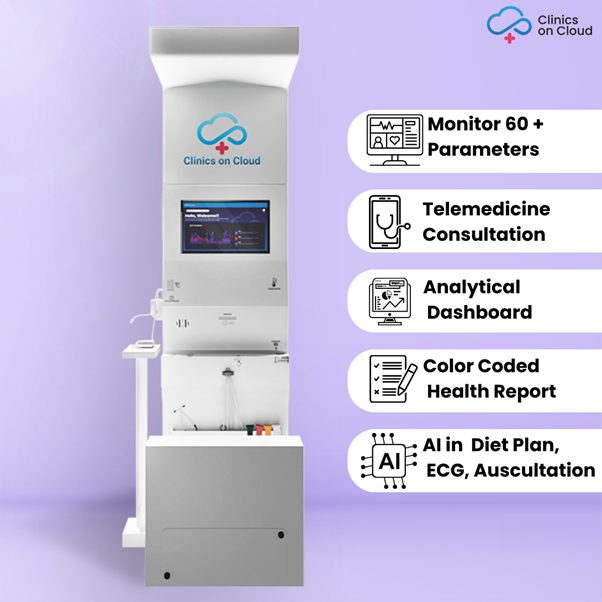
Follow-up depends on repeated readings. Health ATMs and smart kiosks at AAMs, PHCs, panchayat offices or workplaces let people re-check their blood pressure and glucose without a clinic appointment. Each reading adds to their record.
2. Link every result to ABHA
India now has 95.99 crore ABHA IDs (Lok Sabha reply, 31 Jul 2026). When screening devices write results straight to ABHA-linked records, the medical officer at the PHC sees the same history the CHO recorded.
3. Turn data into a follow-up worklist
A screening dashboard should answer one question each morning: who is overdue? Flag anyone with a high reading who has no confirmatory visit within a set window, and route the list to the ASHA or CHO.
4. Bring follow-up to where people work
The hardest group to follow up, working-age adults, can be reached at factories, construction sites and markets through mobile medical units and workplace kiosks. This fits with the push for annual employee health check-ups under India’s new labour codes.
5. Use teleconsultation to shorten the path to confirmation
An assisted teleconsultation at the point of screening can turn a “come to the PHC next week” into a same-day medical opinion and prescription where protocols allow.
What good looks like: metrics for programme managers
| Metric | What it tells you |
|---|---|
| % of the eligible population screened | Coverage |
| % of screen-positives confirmed within 30 days | Referral completion |
| % of confirmed cases on treatment | Treatment start |
| % of patients on treatment with a reading in the last 90 days | Follow-up continuity |
| % of patients at target BP or glucose | Control, the outcome that matters |
How Clinics On Cloud supports state NCD programmes
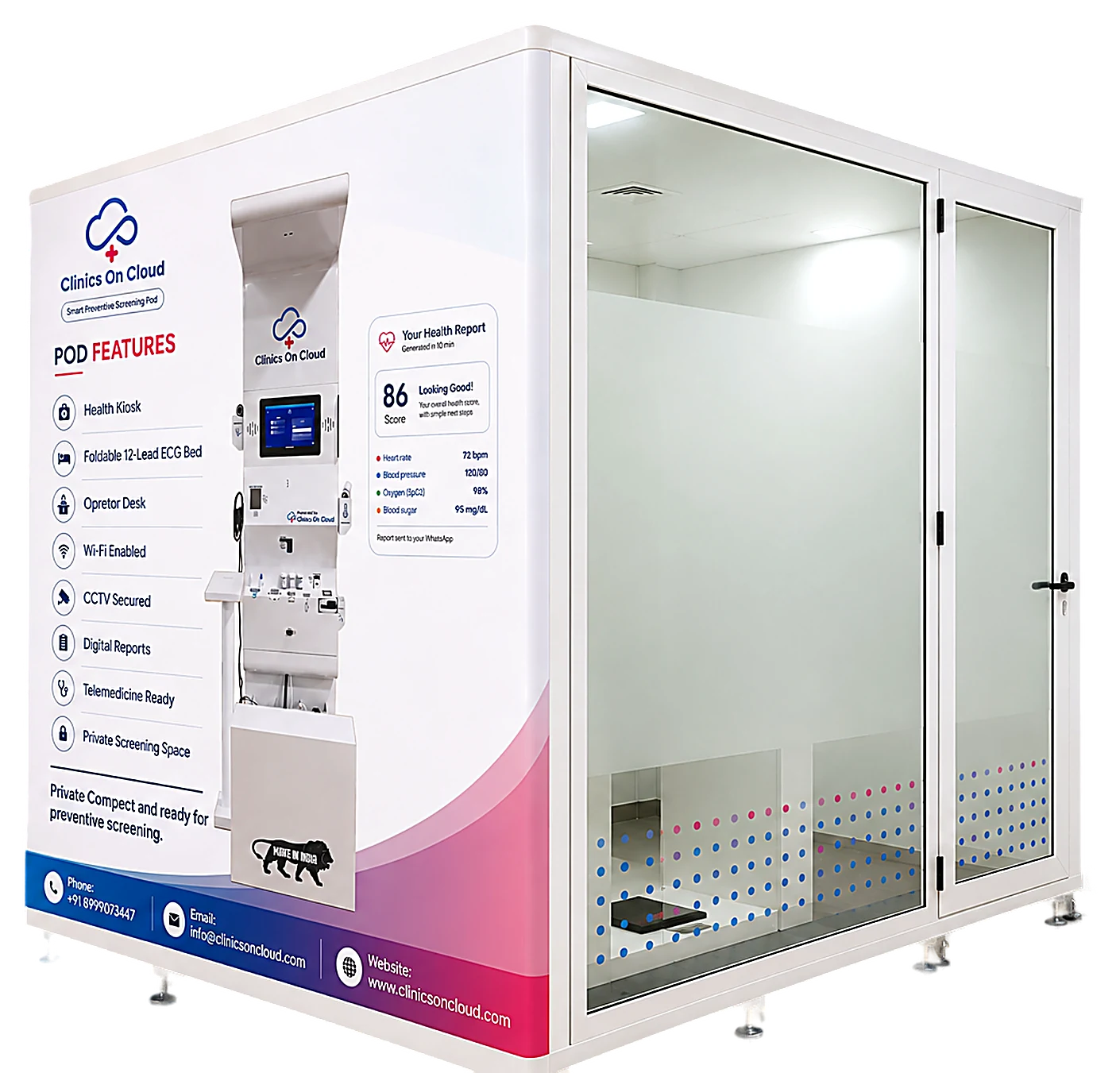
Clinics On Cloud provides connected screening infrastructure for public health systems: Health ATMs, Health Pods, Box Clinics and Mobile Medical Units. They offer point-of-care screening, teleconsultation, and digital records designed to integrate with national digital health systems. Talk to our public health team about piloting a follow-up-focused model in your district.
Sources
- Daily Excelsior — 420 million screened for hypertension, diabetes under central scheme (30 Sept 2026)
- Anjana RM et al. ICMR-INDIAB-17, Lancet Diabetes Endocrinol 2023
- Mohan V et al. Lessons learnt from the ICMR–INDIAB study, NMJI 2023
- NHSRC — Assuring NCD services through Ayushman Arogya Mandir
- MoHFW — Intensified Special NCD Screening Drive
- Deccan Herald — Gruha Arogya Yojana, Mysuru
- Kashmir Life — 95.99 crore ABHA IDs (Lok Sabha reply)