Health KIOSK in Mizoram
Health ATM in Mizoram | Clinics On Cloud Smart Health Kiosk for Preventive Healthcare Introduction: Mizoram’s Healthcare Landscape Mizoram, a
Read story 3 min
Chhattisgarh, with a population of around 3 crore, has a unique mix of urban regions such as Raipur, Bilaspur, Durg, Bhilai, Raigarh, Korba, and vast tribal areas across Bastar and Surguja divisions. Despite several government programs and a growing healthcare network, the state continues to face challenges in diagnostics accessibility, preventive screening, tribal health, and rural connectivity.
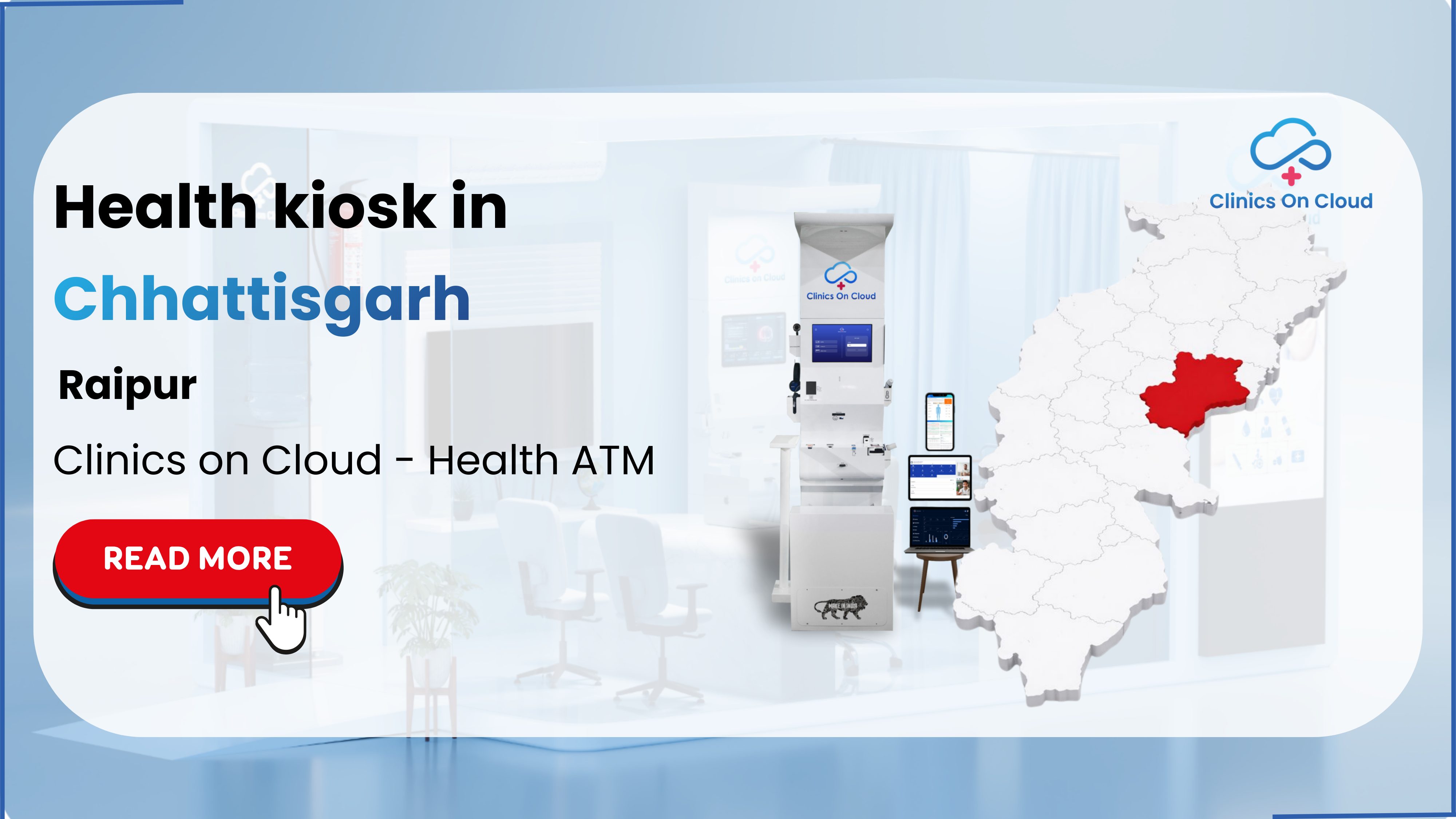
A Health ATM is a self-service screening station that records 65+ clinical parameters across 14 specialties in a 10-minute checkup, prints or messages a colour-coded report, and connects the user to a doctor on video when a reading is flagged. Clinics On Cloud supplies health kiosks across Chhattisgarh and is India’s first CDSCO-licensed Health ATM and Health Kiosk manufacturer.
Chhattisgarh sells a health kiosk on a different argument from most Indian states. It carries an unusually high concentration of extractive and heavy industry, so the first buyer is almost always an occupational health, HR or CSR function attached to a plant or a mine, not a hospital or a retail site. A workforce exposed to dust, heat and noise needs a repeatable screening interval and a record that follows a worker between contractors, rather than a camp report filed in a site register.
The table maps the state’s main sectors to the screening emphasis each asks for. It is a configuration guide, not a clinical protocol; final parameter selection should be set with your medical officer.
| Sector | Where in Chhattisgarh | Working condition driving screening | Parameter emphasis buyers ask for |
|---|---|---|---|
| Coal mining and thermal power | Korba, Hasdeo belt, Raigarh, Surguja | Dust, heat, shift work, contractor churn | Pulmonary function, cardiac, general health |
| Integrated steel and sponge iron | Bhilai, Durg, Raipur, Raigarh, Nagarnar | Heat load, particulates, long shifts | Cardiac, pulmonary function, diabetes |
| Iron ore mining | Bailadila range, Dantewada, Kirandul, Bacheli | Remote sites, altitude and terrain, dust | General health, pulmonary function, vision |
| Aluminium and captive power | Korba, Janjgir-Champa | Heat, continuous process operations | Cardiac, general health, hearing |
| Rice milling and agri trade | Raipur, Dhamtari, Mahasamund, Bemetara | Seasonal labour, husk dust, mandi crowds | General health, pulmonary function, anaemia |
| Railways, government, education | Bilaspur, Raipur, Naya Raipur, Jagdalpur | Large fixed staff and student populations | General health, cardiac, vision, mental health |
| CSR and community outreach | Bastar, Surguja, Jashpur, Kanker | Distance, forest terrain, dispersed villages | General health, anaemia, diabetes, vision |
Korba is the densest industrial screening opportunity in the state, combining opencast and underground coal mining with a cluster of thermal power stations and a large permanent and contractor workforce. The Hasdeo belt extends the pattern northward, and Raigarh adds coal alongside steel and power.
The brief in a coal and power environment is consistent: pulmonary function testing, cardiac parameters and general health, repeated at a defined interval, with results held against a worker identity rather than a shift roster. Pulmonary function on the Clinics On Cloud kiosk covers PEF, FVC, FEV and the FEV1/FVC ratio, the set occupational health teams ask about first.
Placement matters as much as configuration. A kiosk at a gate, colony dispensary or canteen captures people inside a shift break; one in an administration block does not. Battery backup of 3 to 4 days keeps a unit running through the supply interruptions remote mine sites treat as routine.
The Durg-Bhilai axis is the state’s manufacturing anchor, with the surrounding Raipur belt carrying a very large number of sponge iron, re-rolling and induction furnace units. Raigarh adds a further steel and power concentration, and Nagarnar in Bastar extends the industry south.
Large integrated plants usually run an occupational health centre already, so their interest is throughput: handling routine periodic checks without occupying clinical staff. Small and mid-sized units are the opposite case, employing hundreds of people with no medical officer and no way to justify a screening room. For them, a shared kiosk hosted at an industrial association office serves several employers at once, which is the difference between a small foundry running structured screening and running none. Heat exposure makes cardiac and general health parameters the starting configuration, with pulmonary function added where particulate load is high.
The Bailadila deposits around Kirandul and Bacheli in Dantewada district present the most demanding logistics of any industrial site in the state: a forested range, long road access, and a dispersed, largely tribal surrounding population. Offline capability is therefore mandatory, and the kiosk completes a screening without a live connection and synchronises later. Township sites suit a fixed unit; villages beyond are better served by the portable Box Clinic.
Korba’s aluminium smelting and the power and aluminium activity through Janjgir-Champa create a different problem: continuous-process workplaces with rotating shifts in high ambient heat and noise. Screening has to be available across all shifts, including nights, which is what a self-service kiosk with voice guidance and no operator requirement delivers. A staffed camp cannot cover a night shift; a kiosk in a canteen can.
Audiometry and otoscope ear visualisation are part of the Clinics On Cloud parameter set, and hearing screening is a recurring request here. Results feed a centralised dashboard, so a company running several units sees the whole workforce in one view.
The Mahanadi plain through Raipur, Dhamtari, Mahasamund, Bemetara and Baloda Bazar is a paddy and rice milling economy with a heavy seasonal labour cycle and busy mandi towns.
Rice milling brings husk and grain dust, and mill labour is often seasonal, so a follow-up appointment weeks later rarely happens. The value of a kiosk here is that the cycle completes in one visit: screening, colour-coded report on WhatsApp or SMS, and a teleconsultation triggered when a reading is flagged. Mandi towns and cooperative buildings work as public screening points because they concentrate footfall on fixed days, reaching a farming population that will not otherwise present for a routine check.
Bilaspur hosts the South East Central Railway zone with a substantial railway workforce, colonies and institutional buildings, while Raipur and Naya Raipur concentrate state government offices.
These buyers behave like the corporate segment rather than the industrial one. The specification is coverage of a defined staff population within a screening window, per-person reports, ABHA linkage under the Ayushman Bharat Digital Mission, and a coverage figure reportable at the end. Clinics On Cloud public-sector deployments elsewhere include NHM Uttar Pradesh, UP Vidhan Sabha and the Government of West Bengal. Education is the adjacent case: Raipur, Bilaspur, Durg and Jagdalpur carry colleges and hostels where the PHQ-9 and GAD-7 mental health instruments are often the reason a campus enquires at all.
Bastar and Surguja divisions are where a fixed kiosk alone will not achieve coverage. Both are forested, hilly and dispersed, with settlements far from any facility that can run a blood test and roads that deteriorate through the monsoon.
The realistic model has two layers. A fixed Health Kiosk sits where people already go: a block headquarters, a district institution, a large school, a weekly market building. Around it, outreach carries the screening outward, which is the Mobile Medical Unit and Box Clinic case. Measure this layer on completed teleconsultations rather than footfall, because where the nearest doctor is far away the screening only helps if the flagged result reaches a clinician the same day.
Hindi and Chhattisgarhi first, with voice guidance rather than text alone, because that decision determines whether a mill worker or a farm labourer completes a screening unassisted.
The south and north then diverge. Halbi, Gondi and Bhatri are widely spoken across Bastar, Kanker, Kondagaon, Dantewada and Sukma, while Surgujia, Sadri and Kurukh are used across Surguja, Jashpur and Balrampur. Odia is common along the eastern border, and industrial townships in Korba, Bhilai and Raigarh carry Bengali, Odia and Telugu among migrant workers. The Clinics On Cloud kiosk uses a multilingual touchscreen with audio-visual guidance, so one platform serves the whole state.
Indicative Health ATM pricing starts from ₹6,00,000, with the final quotation depending on which of the 14 specialties you configure, monthly screening volume and consumable mix. Annual maintenance covers calibration, preventive visits, sensor checks and spares; for mine and forest-district sites, fix the on-site response window before signing, because that number decides effective uptime.
A plant pilot that produces a usable decision: choose two contrasting sites, for example one Bhilai or Raipur plant and one Korba or Bailadila site; set a monthly screening target as a percentage of headcount; run 90 days across all shifts; then compare throughput, abnormality flag rate and teleconsultation completion before fixing the wider configuration.
Across the Clinics On Cloud network, 12M+ patients have been screened and 2 lakh+ abnormalities identified for early intervention, with 3,500+ installations in service. Buyers comparing manufacturers should read the guide to the best Health ATM in India, and medical officers should review the clinical parameters and tests offered by a health kiosk. For comparable markets, see health kiosk deployment in Jharkhand and health kiosk deployment in Madhya Pradesh.
Clinics On Cloud provides preventive health screening and is not a diagnostic laboratory. Screening results are indicative and are not a diagnosis. Always consult a qualified physician before acting on any health information.
Your email is never published. Comments appear after a quick review.
Health ATM in Mizoram | Clinics On Cloud Smart Health Kiosk for Preventive Healthcare Introduction: Mizoram’s Healthcare Landscape Mizoram, a
Health ATM in West Bengal | Clinics On Cloud Smart Health Kiosk for Preventive Healthcare West Bengal’s Healthcare Landscape West
Rajasthan’s Healthcare Landscape Rajasthan is India’s largest state by area, with vast desert regions, tribal belts, remote villages, and challenging
Coal mining and thermal power around Korba and Raigarh, steel and sponge iron around Bhilai, Durg and Raipur, iron ore mining on the Bailadila range, aluminium and captive power in Janjgir-Champa, rice milling across the Mahanadi plain, railways and government offices in Bilaspur and Raipur, plus campuses and CSR programmes in Bastar and Surguja.
Any site with daily footfall and a power point: plant gates, mine colony dispensaries, canteens, railway and government buildings, district hospitals, colleges and hostels, mandi and cooperative buildings, block headquarters, and community centres in the forest districts.
Indicative pricing starts from ₹6,00,000. Configuration drives the final figure: a Korba or Raigarh unit with pulmonary function and hearing screening differs from a Raipur office unit or a rural outreach unit. Rental and CSR-funded models are available. Send your site list and monthly volume target for a quotation.
Yes. Clinics On Cloud supplies, installs and services Health ATMs across Chhattisgarh, manufacturing at Nighoje, Chakan MIDC, Pune. Buyers are covered for commissioning, calibration, consumables and spares, and can inspect the facility before placing an order.
A prepared site is surveyed, delivered, commissioned and handed over within days. Mine and forest-district sites take longer only where road access or power provisioning is the constraint. Staff orientation takes under a day, because no skilled operator is required.
Yes. Annual maintenance covers preventive visits, calibration, consumable supply and spares statewide, including Bastar and Surguja divisions. For remote sites, write the on-site response window into the contract, because that commitment determines uptime far more than the purchase price.
Yes. The touchscreen and audio guidance are multilingual, so a screening completes in Hindi or Chhattisgarhi, and further languages can be enabled where Halbi, Gondi, Bhatri, Surgujia, Kurukh or Odia are spoken. Voice guidance means limited literacy does not block a screening.
Yes. The kiosk is offline-capable, so a screening completes and stores without a live connection and synchronises when connectivity returns. Battery backup of 3 to 4 days covers power interruptions, which is why the unit suits Bailadila, Hasdeo and remote colony sites.
A Health Kiosk screens and flags; it does not diagnose, and Clinics On Cloud is not a diagnostic laboratory. Device accuracy is 90 to 95 percent depending on the test and device, under correct usage, calibration and patient preparation. Statutory records remain your medical officer’s responsibility.
We started Clinics on Cloud with a simple belief - that the quality of your healthcare should not depend on your postcode. Whether you're a government, corporate, NGO or entrepreneur - we built this for you.
+91 8999 073 447
Mon - Sat · 9 AM to 6 PM IST
sales@clinicsoncloud.com
Partnerships · Deployments · Support
www.clinicsoncloud.com
Products · Case Studies · News
Nighoje, Chakan MIDC
Pune, Maharashtra - 410501, India